

If you have practiced even a handful of System Design interview questions, you have likely heard the CAP theorem mentioned at some point. It often appears when discussing databases, distributed storage systems, microservices, and large-scale architectures. Yet many candidates struggle not because the theorem is complicated, but because they treat it as a memorization exercise instead of a decision-making framework.
In System Design interviews, the CAP theorem is not about reciting definitions. Interviewers want to see whether you understand how distributed systems behave under failure and how engineers choose trade-offs based on product requirements. The CAP theorem gives a structured way to reason about those trade-offs.
This article explains the CAP theorem in distributed systems from an interview preparation perspective. You will learn what the theorem actually means, why it matters, how it applies to real systems, and how to discuss it confidently during interviews without sounding theoretical or rigid.
What Is The CAP Theorem?
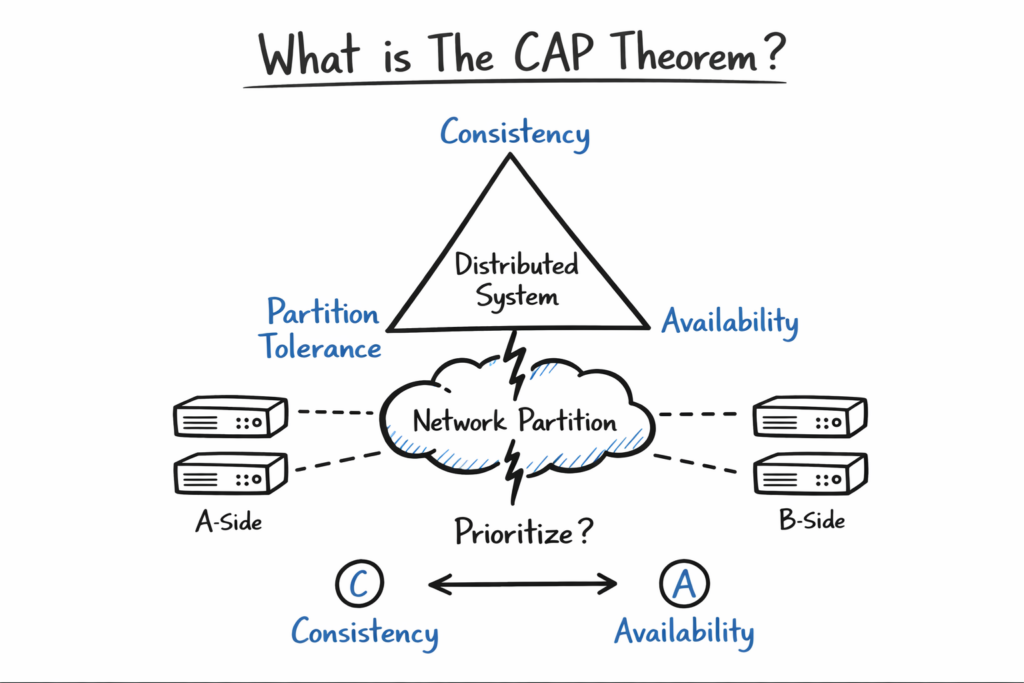
The CAP theorem states that in a distributed system, it is impossible to simultaneously guarantee consistency, availability, and partition tolerance. When a network partition occurs, the system must choose between consistency and availability.
This definition often confuses candidates because it sounds absolute and academic. In practice, the CAP theorem describes constraints, not system categories. Every distributed system must tolerate network partitions because partitions are unavoidable. Once a partition occurs, designers must decide whether the system prioritizes consistency or availability for that specific scenario.
In interviews, you should think of CAP as a lens for reasoning about system behavior under failure rather than a rule that forces systems into rigid boxes.
Understanding The Three Properties Of CAP
To apply the CAP theorem correctly, you must clearly understand what each property means in a distributed environment.
Consistency In Distributed Systems
Consistency means that all clients see the same data at the same time. After a successful write, every subsequent read should return the updated value, regardless of which node processes the request.
In System Design interviews, consistency is often discussed in the context of correctness. For example, account balances, inventory counts, and financial transactions usually require strong consistency because stale data can lead to incorrect outcomes.
Availability In Distributed Systems
Availability means that every request receives a response, even if the response does not contain the most recent data. The system should remain responsive as long as it is operational.
High availability is critical for user-facing systems such as social networks, content feeds, and search platforms. In these cases, serving slightly outdated data is often preferable to returning an error or timing out.
Partition Tolerance In Distributed Systems
Partition tolerance means that the system continues operating despite network failures that split nodes into isolated groups. Messages between partitions may be delayed or dropped entirely.
Partition tolerance is not optional in real-world distributed systems. Networks fail unpredictably, and systems must be designed with this reality in mind. Because partition tolerance is mandatory, the real trade-off in CAP occurs between consistency and availability.
Why Network Partitions Change Everything
Many candidates misunderstand the CAP theorem because they assume partitions are rare. In practice, partitions occur more often than expected due to network congestion, hardware issues, or cloud infrastructure failures.
When a partition happens, nodes cannot communicate reliably. At that point, the system must choose whether to reject requests to preserve consistency or serve requests with potentially stale data to preserve availability.
This is the moment where CAP decisions matter most, and this is exactly what interviewers want you to reason about.
The CAP Trade-Off In Practical Terms
Rather than labeling systems as CA, CP, or AP in isolation, it is more useful to discuss how systems behave during partitions.
| System Behavior During Partition | Resulting Trade-Off |
|---|---|
| Rejects requests to avoid stale data | Favors consistency |
| Serves requests despite stale data | Favors availability |
| Pauses some operations selectively | Hybrid approach |
In interviews, explaining this behavior-based view demonstrates a deeper understanding than simply categorizing systems.
CP Systems: Prioritizing Consistency Over Availability
CP systems choose consistency when a partition occurs. If a node cannot confirm that it has the latest data, it will reject requests rather than risk serving incorrect information.
When CP Systems Make Sense
CP systems are commonly used in scenarios where correctness is more important than uptime. Examples include financial systems, distributed locking services, and metadata stores.
In interviews, you might describe how a system temporarily becomes unavailable during a partition to ensure data correctness. This shows that you understand the real-world consequences of prioritizing consistency.
Interview Example: Distributed Lock Service
If asked to design a distributed lock service, you can explain that serving an incorrect lock state would be disastrous. Therefore, the system favors consistency and may reject lock requests during partitions.
AP Systems: Prioritizing Availability Over Consistency
AP systems choose availability during partitions. They continue serving requests even if the data may be slightly outdated. Over time, the system resolves inconsistencies and converges to a consistent state.
When AP Systems Make Sense
AP systems are well-suited for user-facing applications where uptime matters more than immediate consistency. Social feeds, messaging systems, and recommendation engines often follow this model.
Eventual Consistency As A Design Choice
Eventual consistency is a common strategy in AP systems. It guarantees that all replicas will eventually converge, even if they temporarily diverge during failures.
| Property | Behavior In AP Systems |
|---|---|
| Read Responses | Always available |
| Write Handling | Accepted during partitions |
| Data State | Temporarily inconsistent |
| Long-Term Outcome | Eventual convergence |
Explaining eventual consistency clearly during interviews helps interviewers see that you understand both the benefits and limitations of AP systems.
CA Systems And Why They Are Rare
CA systems provide consistency and availability, but do not tolerate partitions. These systems assume a reliable network and often operate within a single data center.
In theory, CA systems are simple and attractive. In practice, they are rare because network partitions are unavoidable in distributed environments. Most interview discussions focus on CP and AP trade-offs because partition tolerance is assumed.
If CA systems come up in interviews, it is usually to test whether you understand their limitations rather than to encourage their use.
CAP Theorem And Modern Distributed Databases
Many System Design interviews involve choosing or designing a database. Understanding how databases align with CAP trade-offs is essential.
| Database Type | CAP Preference |
|---|---|
| Relational Databases With Replication | Consistency-focused |
| Distributed Key-Value Stores | Availability-focused |
| Distributed Consensus Systems | Strong consistency |
| NoSQL Databases | Tunable trade-offs |
Modern systems often allow tuning consistency and availability based on use case. Explaining this flexibility shows maturity and real-world awareness.
Misconceptions About The CAP Theorem
A common mistake is assuming that systems permanently choose only two properties. In reality, CAP trade-offs are contextual and dynamic.
Systems may behave differently for reads versus writes or under normal operation versus failure scenarios. Interviewers appreciate candidates who acknowledge this nuance rather than oversimplifying the theorem.
Another misconception is believing that CAP is outdated. While newer theories like PACELC extend CAP, the core idea remains foundational for distributed System Design.
How Interviewers Expect You To Discuss CAP Theorem
Interviewers are not testing theoretical knowledge alone. They want to see how CAP influences your design decisions.
Strong answers usually include acknowledging that partitions are inevitable, explaining which property is prioritized during failures, and justifying that choice based on business requirements.
Avoid stating preferences without explanation. Instead, tie CAP decisions directly to user impact, system goals, and failure scenarios.
Applying CAP Theorem To Common System Design Questions
Understanding how CAP applies to typical interview problems makes it easier to respond naturally.
| Design Problem | Likely CAP Focus |
|---|---|
| Payment Processing System | Consistency |
| Chat Application | Availability |
| Distributed Cache | Availability |
| Configuration Management | Consistency |
Mentioning CAP implicitly through behavior and trade-offs is often more effective than explicitly naming it.
CAP Theorem And Real-World Engineering Trade-Offs
In real systems, engineers rarely choose absolute consistency or availability. Instead, they use techniques like quorum reads, write acknowledgments, and fallback strategies to balance trade-offs.
Discussing these mechanisms during interviews demonstrates that you understand CAP as a practical constraint rather than a theoretical limit.
How to answer CAP theorem interview questions
Interviewers rarely ask you to define the CAP theorem in isolation. Instead, they want to understand how you apply it when designing distributed systems. A strong answer connects the theorem to business requirements, failure scenarios, and architectural decisions rather than focusing on textbook definitions.
Start with the system requirements
Begin by understanding what the system is trying to achieve. Identifying whether correctness or continuous availability is more important provides the context for your CAP discussion.
Explain the partition scenario
Mention that network partitions are inevitable in distributed systems. Explain that CAP trade-offs only become relevant when communication between nodes is disrupted.
Justify your design choice
Clearly explain whether your design prioritizes consistency or availability during a partition, and connect that decision to user expectations and business goals.
Use a practical example
Reinforce your explanation with a familiar example, such as a payment system favoring consistency or a social media feed prioritizing availability.
Common mistakes candidates make when explaining CAP theorem
Many candidates understand the CAP theorem conceptually but struggle to explain it effectively during interviews. Avoiding a few common mistakes can make your answers more accurate, practical, and convincing.
Treating CAP as a memorization exercise
Simply reciting the definition without applying it to a real system shows theoretical knowledge but not engineering reasoning.
Ignoring partition tolerance
Some candidates discuss consistency and availability without acknowledging that partition tolerance is unavoidable in distributed systems.
Thinking systems are permanently CP or AP
Most modern systems make different trade-offs depending on the failure scenario, workload, or operation being performed.
Forgetting the business context
CAP decisions should always be tied to user impact and product requirements. Explaining why a trade-off makes sense is just as important as identifying it.
Real-world skills you’ll build by understanding CAP theorem
The CAP theorem is more than an interview topic. Learning how distributed systems behave during failures helps you make stronger architectural decisions throughout your software engineering career.
Better database selection
Understanding CAP helps you choose storage technologies that align with application requirements rather than selecting databases based solely on popularity.
Stronger architectural reasoning
Evaluating consistency and availability trade-offs improves your ability to justify technical decisions during design discussions and architecture reviews.
Improved failure analysis
Thinking through network partitions and system behavior prepares you to design applications that remain reliable under real-world conditions.
More confident technical communication
Explaining distributed systems concepts clearly makes it easier to collaborate with engineers, architects, and stakeholders on complex software projects.
Conclusion
The CAP theorem in distributed systems is not about memorization or classification. It is a way to reason about failure, trade-offs, and system behavior under stress.
For System Design interviews, mastering CAP means being able to explain why a system behaves the way it does when things go wrong. When you can articulate how consistency, availability, and partition tolerance influence your design choices, you demonstrate the mindset of a distributed systems engineer.
As you continue preparing, practice applying CAP to real-world systems you use every day. Over time, these trade-offs will feel intuitive, and your System Design answers will become clearer, more confident, and more compelling.