
















Ace Your System Design Interview — Save up to 50% or more on Educative.io Today! Claim Discount
Arrow

System Design Interview coming up?

Its free
System Design Interview
Fahim Avatar

Hi I’m Fahim

As a software engineer at Meta and Microsoft, I helped develop cloud-scale distributed systems, including Azure and Facebook storage.

In my 20+ years in tech, I have also personally led hundreds of System Design Interviews.

These are the resources I wish I could have given to candidates to guide them through the interview process.

The best part — it’s all 100% free.

I hope you find this handbook useful. Good luck with your interviews!

explore
Explore

The System Design Handbook

Dont worry its free
System Design Handbook

Why are System Design Interviews such a big deal?

This might be controversial, but here it goes: System Design Interviews aren’t just a hoop to jump through.

They actually really matter. Here’s why

Down curve arrow
Right curve arrow
Box Outline

System Design Interviews test your real-world problem-solving skills.

Message Icon
Ability to reason through trade-off
Box Outline

Your ability to reason through trade-offs is a huge predictor of on-the-job success.

Arrow Down
Box Outline
Box Outline

There’s a reason why every top company today (especially FAANG) has a System Design loop of some kind. Trust me, it pays to be prepared.

Arrow Down
Box Outline

Because they are so open-ended, SDI loops can be tricky for even the best software engineers.

Right Arrow
SDI Loop
There a way through
Box Outline

But luckily there’s a way through.

Learn what interviewers are actually looking for

Get the offer

Demonstrate hireable skills and navigate your interview loops with confidence.

Avoid getting down-leveled

Maximize your comp package by getting hired at a higher starting level and salary.

Set yourself up for success

Learn System Design skills that will serve you for the rest of your career.

Hey.

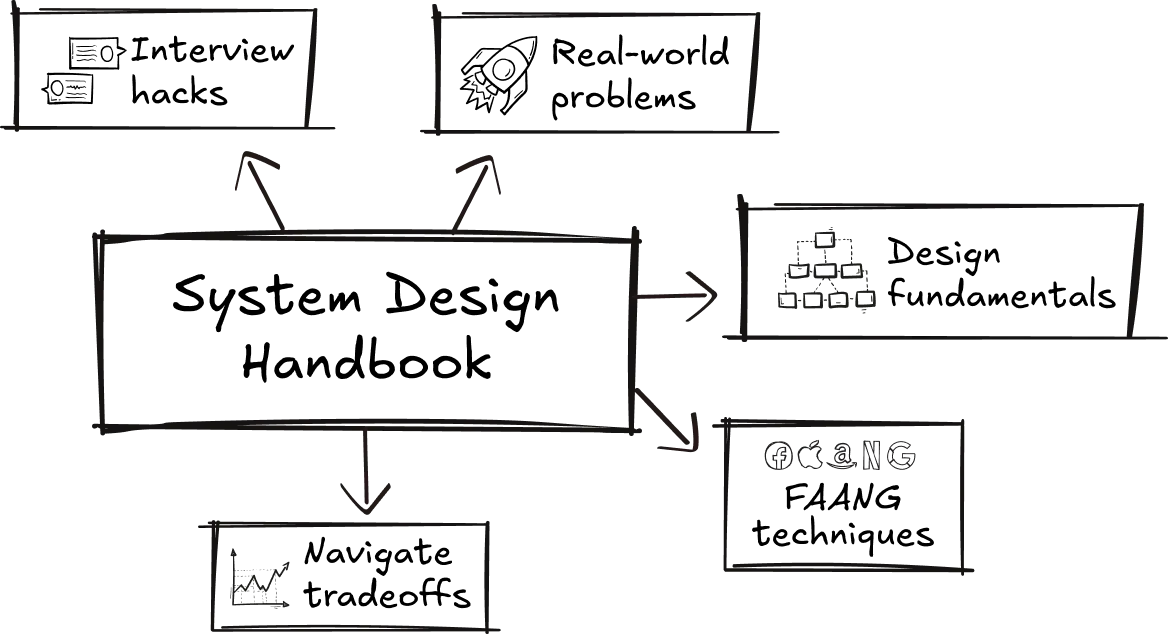
Here’s a free System Design Handbook that you might find useful.

Explore icon
System Design Building Blocks

More free System Design Interview guides

System Design: The Complete Guide 2026

If you’ve ever wondered how platforms like Netflix stream to millions without crashing, or how WhatsApp handles billions of messages every day, the answer lies in System Design. It’s the...
Read the guide
rectangle-iconrectangle-iconrectangle-iconrectangle-icon

The Complete System Design Interview Guide (2026 Edition)

System Design engineering as a discipline has flourished in the past two decades, and I’ve had the privilege of witnessing its explosion firsthand. Designing large-scale, distributed systems was considered a...
Read the guide
rectangle-iconrectangle-iconrectangle-iconrectangle-icon

System Design Interview Questions: Top 40 for 2026 (FAANG Prep)

Imagine you’ve aced the coding rounds and impressed the interviewers with your algorithms, and now you’re facing the make-or-break moment of your tech interview—the System Design round. Your task? Design...
Read the guide
rectangle-iconrectangle-iconrectangle-iconrectangle-icon

Meta System Design Interview: A step-by-step Guide

Meta engineers don’t just write code—they build the infrastructure that powers billions of daily interactions across Facebook, Instagram, WhatsApp, and Messenger. Acing the System Design interview is non-negotiable if you...
Read the guide
rectangle-iconrectangle-iconrectangle-iconrectangle-icon

Generative AI System Design Interview: A step-by-step Guide

If you’re interviewing for a role involving LLM-backed systems at companies like OpenAI, Meta, Google DeepMind, Anthropic, or even newer SaaS startups building with AI primitives, your generative AI System...
Read the guide
rectangle-iconrectangle-iconrectangle-iconrectangle-icon

OpenAI System Design Interview: A step-by-step Guide

If you’re preparing for an OpenAI System Design interview, you’re designing AI infrastructure at the edge of production and research, along with a high-traffic backend.  Unlike traditional FAANG interviews, where...
Read the guide
rectangle-iconrectangle-iconrectangle-iconrectangle-icon

Why it’s important to learn System Design

Learning System Design is essential for any engineer who wants to build scalable, reliable, and efficient software systems. It’s the discipline that ensures your product can handle millions of users, recover from failures, and evolve gracefully as new features are added. Without solid architecture, even the best ideas can collapse under real-world load.

System design goes beyond interviews or theory—it’s at the core of modern engineering. Companies like Netflix, Google, and Uber rely on distributed systems that balance performance, availability, and cost at a massive scale. Engineers who understand caching, load balancing, database sharding, and fault tolerance contribute directly to the backbone of these platforms.

The System Design Handbook helps you learn these principles step by step through examples and case studies. Mastering them means you’ll be equipped to build systems that are both reliable today and adaptable tomorrow.

The fundamentals of System Design

At its core, System Design defines how different parts of a system interact to solve problems. It addresses System Design questions like:

  • How will data be stored and retrieved?
  • How will the system perform under high traffic?
  • What happens if part of the system fails?

System design is often divided into two layers:

  • High-level design focuses on the overall architecture—how APIs, databases, and services communicate.
  • Low-level design handles internal logic, such as data models and class structures.

Every system should aim for four outcomes:

  • Scalability: The system grows smoothly with demand.
  • Reliability: It continues functioning even during failures.
  • Maintainability: Code and architecture are modular and easy to update.
  • Efficiency: Resources like CPU, memory, and bandwidth are used wisely.

To achieve these goals, engineers rely on several foundational pillars.

Performance & scalability

Systems must withstand both regular and peak traffic. Techniques such as caching, load balancing, and database sharding help distribute workloads and prevent crashes—crucial for platforms like e-commerce stores during holiday rushes.

Reliability & fault tolerance

Hardware and networks fail, but systems should recover automatically. Redundancy, replication, and failover mechanisms keep apps like ride-sharing platforms running smoothly even during partial outages.

Data management

Choosing the right database (SQL vs. NoSQL) and managing data partitions or indexes are central to performance. Streaming platforms such as Spotify depend on optimized data pipelines to serve millions of users in real time.

Security & privacy

From encryption to authentication, protecting user data is a non-negotiable part of System Design. Applications in healthcare or finance must ensure confidentiality while maintaining accessibility for authorized users.

How to start learning System Design

System design can seem overwhelming because it bridges multiple domains, including databases, networking, and distributed systems, but a structured roadmap helps you learn effectively:

  1. Start with the basics: Strengthen your understanding of databases, networking, and operating systems.
  2. Learn scalability patterns: Study caching, replication, and load balancing to see how real systems scale.
  3. Analyze real-world systems: Examine architectures like YouTube or Uber to understand practical trade-offs.
  4. Build small projects: Design simple systems (like a URL shortener or chat app) to apply what you learn.
  5. Use a framework: Break designs into high-level and low-level components, evaluate trade-offs, and iterate.

Start Learning System Design Today

System design is one of the most valuable skills you can develop as a software engineer. It empowers you to build systems that don’t just work, but scale reliably to millions of users. This handbook is here to guide you with fundamentals, case studies, and practical resources—everything you need to succeed.

Ready to begin your journey? Explore our learning path, dive into real-world examples, and start building your own projects. Bookmark this page, share it with peers, and check back often as we continue to expand our content.

Start learning System Design | Explore System Design Guides

Frequently Asked Questions

What is System Design?

System Design is the process of planning and structuring the components of a software system to handle real-world requirements, such as scalability, performance, reliability, and maintainability. It involves selecting the optimal architecture, storage systems, communication patterns, and trade-offs to develop applications that serve millions of users. In simple terms, System Design teaches you how to turn an idea into a scalable, production-ready solution.

System Design feels difficult at first because it’s broad and open-ended. There is no single “correct” answer, and you often need to combine architecture knowledge, engineering intuition, and trade-off analysis. However, with a structured learning plan that starts from fundamentals such as caching, databases, load balancing, queues, and APIs, it becomes completely manageable. With consistent practice, the concepts become intuitive rather than overwhelming.

Start with the core building blocks: client–server architecture, databases, caching, load balancing, replication, messaging systems, sharding, and observability. Then study real system case studies (like designing Instagram, YouTube, or WhatsApp) to understand how these components work together. Follow a structured roadmap, take high-quality courses, and practice designing systems from scratch. Most importantly, learn to explain why you choose one approach over another.

Practice by picking real-world problems, like designing a chat app, URL shortener, or news feed, and walking through them end-to-end. Focus on requirements, constraints, estimations, high-level design, API design, storage choices, scaling strategies, and trade-offs. You can also join mock interviews, reverse-engineer well-known architectures, or follow guided practice problems. Consistency matters more than perfection; one problem per week builds strong intuition fast.

No, System Design does not require coding during interviews or learning. However, you do need a solid understanding of software engineering fundamentals, including data structures, networking, APIs, databases, and how systems behave in production environments. Coding helps you understand how components actually work, but you don’t need to write code to learn System Design effectively.

Most beginners start feeling confident after 6–12 weeks of consistent study. It depends on your background: if you already understand backend concepts, you’ll ramp up faster. If you’re completely new, allow enough time to build comfort with scalability, trade-offs, and real-world patterns. The key is structured learning + regular practice.

One month is enough for a foundational understanding, but not mastery. In 4 weeks, you can learn the fundamentals, explore 6–8 common interview patterns, and complete several practice problems. It’s ideal for getting interview-ready if you stay consistent. However, deep intuition about distributed systems usually develops over a few months of practice.

Yes. Even though freshers aren’t expected to master large-scale architecture, understanding System Design fundamentals sets you apart. It helps you:

  • design cleaner APIs
  • understand backend logic
  • work effectively with senior engineers
  • grow faster into backend or full-stack roles

Many companies (including FAANG) now include light System Design rounds for new grads, so early exposure gives a strong advantage.

Look for courses that teach both fundamentals and real-world system walkthroughs. A good course should cover databases, caching, load balancing, queues, replication, sharding, CAP theorem, consistency models, and hands-on design exercises, like Grokking the System Design Interview. SystemDesignHandbook.com also provides structured learning paths, case studies, solved interview problems, and frameworks to help learners build confidence from beginner to advanced levels.

Get upto 68% off lifetime System Design learning with Educative

Preparing for System Design interviews or building a stronger architecture foundation? Unlock a lifetime discount with in-depth resources focused entirely on modern system design.

System Design interviews

Scalable architecture patterns

Distributed systems fundamentals

Real-world case studies

System Design Handbook Logo