
Every millisecond counts when millions of users simultaneously request data from your application. A single database query that takes 50 milliseconds might seem trivial in isolation. Multiply that by ten million concurrent requests, and you’ve created a bottleneck that brings your entire system to its knees. This is precisely why distributed caching has become the backbone of every high-performance system, from Twitter’s timeline rendering to Google’s autocomplete suggestions that respond before you finish typing.
The challenge isn’t just about speed. It’s about designing a system that maintains consistency across dozens of cache nodes, recovers gracefully when servers fail, and scales horizontally without reshuffling your entire dataset. In System Design interviews, this problem separates candidates who understand theoretical concepts from those who can architect production-grade systems. By the end of this guide, you’ll understand not just the components of a distributed cache but the engineering trade-offs that determine whether your cache serves as a performance multiplier or becomes another point of failure.
The following diagram illustrates where a distributed cache fits within a typical application architecture. It sits between clients and persistent storage to intercept and accelerate data access.

Understanding what a distributed cache system does
A distributed cache system temporarily stores frequently accessed data across multiple servers to reduce latency and offload read requests from databases or APIs. Instead of fetching data from slow or remote data stores, applications retrieve it from a nearby cache node. This significantly improves response time and scalability. The key distinction from a simple in-memory cache is distribution. Data is partitioned across multiple nodes, allowing the system to handle far more data and traffic than any single machine could manage.
Consider large-scale applications like Twitter timelines, Netflix recommendations, or Google’s autocomplete. When a user types a search query, the system must respond to every keystroke in under 100 milliseconds. Achieving this speed would be impossible without a caching layer that serves suggestions from memory instead of querying the database for each character entered. The cache transforms an O(n) database scan into an O(1) memory lookup, often reducing response times from hundreds of milliseconds to single-digit milliseconds. Understanding these patterns will help you approach your System Design interview questions with the depth interviewers expect.
Before diving into architecture decisions, you need to understand the fundamental problem a distributed cache solves and how to frame requirements clearly for an interviewer or stakeholder.
The problem statement and requirements
A typical interview prompt might ask you to design a distributed cache system that stores and retrieves key-value pairs across multiple nodes, emphasizing scalability, fault tolerance, and reasonable consistency. Before jumping into architecture, you should clarify requirements with your interviewer. These constraints fundamentally shape your design decisions.
Functional requirements define what the system must do. Your cache needs to store key-value pairs in memory for quick retrieval, supporting basic operations like GET, SET, and DELETE. It must handle cache expiration through TTL (time-to-live) mechanisms and implement eviction policies when memory fills up. For fault tolerance, the system should replicate data across nodes so that no single failure causes data loss. These requirements form the contract your system makes with its clients.
Non-functional requirements define how well the system performs these functions. High availability means the cache should remain operational even during partial failures, targeting 99.99% uptime. Low latency requires sub-millisecond response times for cache hits, typically targeting p99 latency under 5ms. Horizontal scalability means adding nodes should linearly increase capacity, both in terms of storage and throughput. Consistency requirements vary by use case. Some applications tolerate eventual consistency for better performance, while others require read-after-write consistency to prevent stale data from causing bugs.
With requirements established, let’s examine why caching occupies such a critical position in system architecture and the fundamental mechanics that make it work.
Why caching matters and how it works
Caching solves one of the most common bottlenecks in distributed systems. Slow access to persistent storage creates latency problems at scale. Databases excel at durability and complex queries, but even the fastest SSDs introduce latency measured in milliseconds. Memory access operates in nanoseconds, roughly 100,000 times faster. A distributed cache leverages this speed differential by keeping frequently accessed data in memory, serving as a high-speed layer in front of your database.
The basic flow follows a simple pattern. Client → Cache → Database. When a request arrives, the application first checks the cache using a key. If the data exists in cache (a “cache hit”), it’s returned immediately without touching the database. If the data doesn’t exist (a “cache miss”), the application fetches it from the database, stores it in the cache for future requests, and returns it to the client. This pattern is known as cache-aside or lazy loading. It is the most common caching strategy because it’s simple to implement and naturally adapts to access patterns.
Core caching concepts you must understand
Cache hit ratio measures your cache’s effectiveness. It represents the percentage of requests served from cache versus total requests. A 95% hit ratio means only 5% of requests reach your database, effectively reducing database load by 20x. This metric directly correlates with system performance. Even small improvements in hit ratio can dramatically reduce latency percentiles and infrastructure costs.
Eviction policies determine which data gets removed when the cache reaches memory capacity. LRU (Least Recently Used) removes items that haven’t been accessed recently. It works well for most workloads where recent access predicts future access. LFU (Least Frequently Used) tracks access counts and removes items accessed least often. It is better suited for workloads with stable hot sets. FIFO (First In, First Out) simply removes the oldest items, offering predictable behavior but ignoring access patterns entirely. Production systems often use segmented LRU or approximate LFU (like Redis’s LFU implementation) to balance accuracy with computational overhead.
TTL (Time To Live) assigns an expiration time to each cache entry, after which it becomes invalid regardless of access patterns. TTL prevents indefinitely stale data and provides a safety net when explicit invalidation fails. Setting appropriate TTL values requires balancing freshness against hit ratio. Shorter TTLs ensure fresher data but reduce cache effectiveness. Longer TTLs improve performance but risk serving outdated information.
Understanding these fundamentals prepares you for the architectural decisions that differentiate a toy cache from a production system. Let’s examine the write policies that determine how data flows between your cache and database.
Write policies and data synchronization
How your cache handles writes determines both performance characteristics and consistency guarantees. Each write policy makes different trade-offs. Choosing the right one depends on your application’s specific requirements.
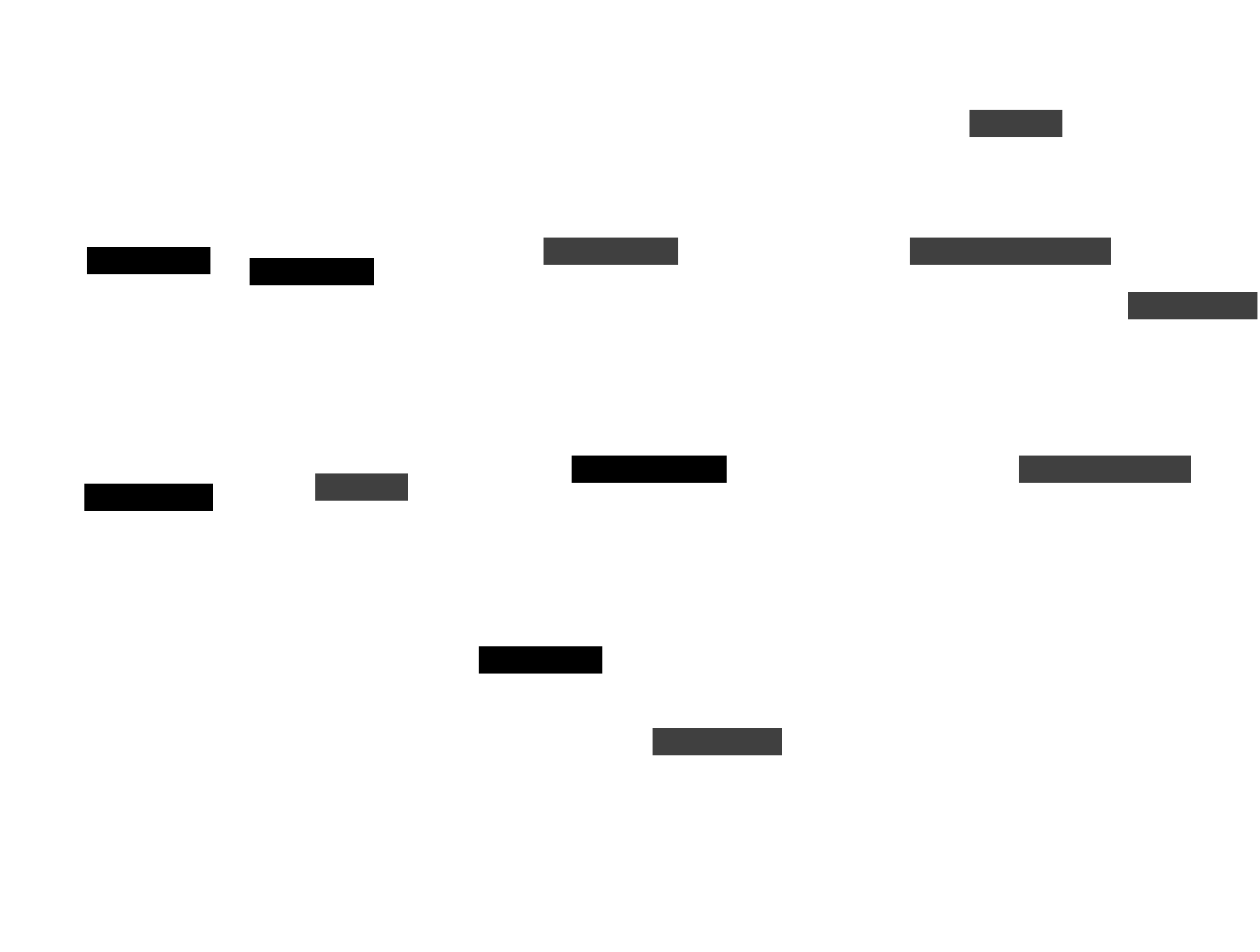
Write-through writes data to both the cache and database synchronously before acknowledging the write to the client. This approach guarantees consistency. The cache always reflects what’s in the database. However, it adds latency to every write operation since both systems must complete before responding. Write-through works well for applications where consistency matters more than write latency, such as financial transactions or inventory management.
Write-back (write-behind) writes data to the cache immediately and acknowledges the client, then asynchronously persists to the database later. This dramatically improves write latency since clients don’t wait for database operations. It also enables write coalescing where multiple updates to the same key result in a single database write. However, write-back introduces a consistency window where the cache and database differ. Data loss becomes possible if the cache node fails before persistence completes. Systems requiring high write throughput, like analytics event collectors, often accept these trade-offs.
Write-around bypasses the cache entirely, writing directly to the database. The cache only populates through read operations. This prevents the cache from filling with data that might never be read again. This policy suits write-heavy workloads where most written data is never subsequently accessed, avoiding cache pollution at the cost of guaranteed cache misses on first reads.
The following diagram compares how data flows through each write policy, highlighting the synchronous versus asynchronous nature of database updates.
| Write policy | Write latency | Consistency | Data loss risk | Best for |
|---|---|---|---|---|
| Write-through | High | Strong | None | Financial systems, inventory |
| Write-back | Low | Eventual | Possible | Analytics, social feeds |
| Write-around | Medium | Strong | None | Write-heavy, rarely-read data |
Historical note: Write-back caching originated in CPU cache design, where the performance benefits of avoiding memory bus traffic outweighed the complexity of maintaining coherence. Distributed systems adopted the same principle for database writes.
With caching fundamentals covered, let’s explore the architecture that transforms a single-node cache into a distributed system capable of handling internet-scale traffic.
High-level architecture and core components
A distributed cache system consists of several interconnected components, each serving a specific purpose in the overall architecture. Understanding these components helps you articulate design decisions clearly in interviews and identify potential failure points in production systems.
Cache servers form the data plane. They hold cached data in memory and serve client requests. Each server manages a portion of the total keyspace, determined by the partitioning scheme. Popular implementations like Redis and Memcached optimize for different use cases. Redis offers data structures, persistence, and replication built-in. Memcached focuses on simplicity and raw performance for pure key-value workloads.
Client libraries implement the routing logic that connects applications to the correct cache node. A well-designed client library handles consistent hashing to determine which node holds a given key. It maintains connection pools for efficiency, implements retry logic for transient failures, and potentially caches cluster topology locally to avoid metadata lookups on every request. The choice between “smart clients” that understand cluster topology and “thin clients” that rely on proxies affects both performance and operational complexity.
Metadata store maintains cluster state including node membership, partition assignments, and configuration. Distributed coordination systems like etcd or ZooKeeper provide strong consistency guarantees for this critical metadata. This ensures all clients agree on cluster topology even during node additions or failures. Some systems embed this functionality directly (like Redis Cluster’s gossip protocol), trading consistency guarantees for reduced operational dependencies.
Replication manager coordinates data redundancy across nodes. It ensures that each piece of data exists on multiple servers for fault tolerance. This component handles leader election when primary nodes fail, manages replication lag monitoring, and orchestrates failover procedures. The replication topology (whether leader-follower, multi-leader, or leaderless) fundamentally shapes consistency and availability characteristics.
Monitoring and eviction manager tracks cache utilization, enforces eviction policies, and exposes metrics for operational visibility. This component ensures memory usage stays within bounds, identifies hot keys causing load imbalance, and provides the observability necessary to diagnose production issues.
Now that you understand the components, let’s examine how data gets distributed across cache nodes. The partitioning strategy makes horizontal scaling possible.
Data partitioning with consistent hashing
To scale horizontally, data must be distributed across multiple nodes. The simplest approach uses modular hashing. You compute node = hash(key) % N where N is the number of nodes. This works until you add or remove a node. Suddenly most keys map to different nodes, causing a cascade of cache misses and potentially overwhelming your database. For a 100-node cluster, adding one node remaps approximately 99% of keys.
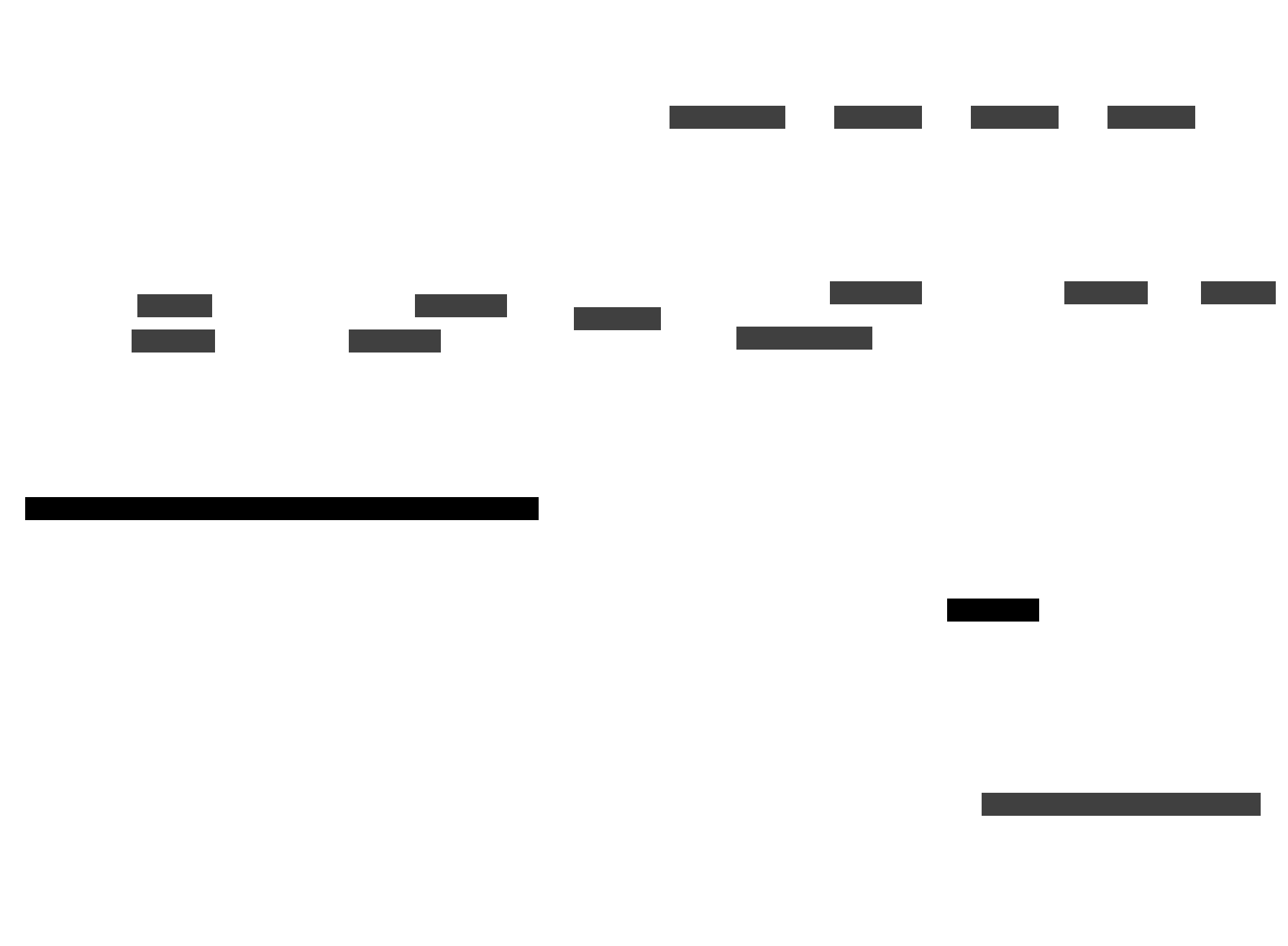
Consistent hashing solves this problem elegantly. Imagine arranging all possible hash values on a circular ring from 0 to 2^32-1. Each cache node is assigned a position on this ring based on hashing its identifier. To find which node stores a given key, you hash the key, locate that position on the ring, and walk clockwise until you encounter a node. When nodes join or leave, only keys in the affected range need remapping. This is typically just 1/N of the total keyspace.
Virtual nodes improve on basic consistent hashing by assigning each physical node multiple positions on the ring. Instead of one hash position per server, a node might occupy 150-200 virtual positions. This creates more uniform key distribution, avoiding hot spots when physical nodes happen to cluster on the ring. It also enables weighted distribution where more powerful servers can handle proportionally more data by having more virtual nodes.
The following diagram shows how consistent hashing distributes keys across nodes. It demonstrates the minimal disruption when adding a new node to the cluster.
Partitioning distributes data for scalability. But what happens when a node fails? Replication ensures your cache survives hardware failures without data loss.
Replication for fault tolerance
Distributing data across nodes improves scalability but introduces a new problem. If any single node fails, the data it holds becomes unavailable. Replication addresses this by maintaining copies of each cache entry on multiple nodes. This ensures that failures don’t cause data loss or service disruption.
Primary-replica replication is the most common approach. Each partition has one primary node that handles all writes and one or more replica nodes that maintain copies of the data. Writes flow to the primary, which replicates changes to replicas either synchronously (blocking until replicas acknowledge) or asynchronously (acknowledging immediately and replicating in the background). Synchronous replication guarantees no data loss but increases write latency. Asynchronous replication offers better performance but risks losing recent writes if the primary fails before replication completes.
When a primary node fails, the system must promote a replica to become the new primary. This process is called failover. Automatic failover requires consensus among remaining nodes to elect a new leader, typically coordinated through the metadata store. The failover process must handle edge cases carefully. What happens to writes that reached the old primary but weren’t replicated? How do clients discover the new primary? How do you prevent “split-brain” scenarios where two nodes both think they’re primary?
Replication factor determines how many copies of each entry exist. A replication factor of 3 means each key exists on three nodes, tolerating up to two simultaneous failures. Higher replication factors improve durability and read availability (since reads can go to any replica) but increase storage costs and write amplification. Most production systems use a replication factor between 2 and 3, balancing durability against resource consumption.
Replication introduces complexity around consistency. How do you ensure clients see the same data regardless of which replica they query? Let’s examine the consistency challenges inherent in distributed caching.
Handling consistency in distributed caches
Distributed caching forces you to confront the CAP theorem. In the presence of network partitions, you must choose between consistency (all nodes see the same data) and availability (all requests receive a response). Most caching systems prioritize availability, accepting that stale data is better than no data. However, the degree of inconsistency tolerance varies by application.
Read-after-write consistency guarantees that after updating a key, subsequent reads return the new value. This sounds obvious but becomes challenging in distributed systems. If a client writes to the primary and immediately reads from a replica that hasn’t received the update yet, they’ll see stale data. Solutions include routing reads to the primary (reducing read scalability), waiting for replication before acknowledging writes (increasing latency), or using version vectors to detect and handle stale reads.
Eventual consistency relaxes these guarantees. It accepts that replicas will converge over time but might serve different values during the convergence window. This model works well for many caching use cases where slight staleness is acceptable. A user seeing an old profile photo for a few seconds rarely causes problems. The key is understanding your application’s consistency requirements and designing accordingly.
Consistency through invalidation offers another approach. Instead of trying to keep replicas synchronized, you immediately invalidate cache entries when the underlying data changes. This guarantees that cached data is never staler than the TTL, at the cost of increased cache misses after updates. Combined with change data capture (CDC), where database changes automatically trigger cache invalidations through message queues, this pattern provides strong consistency guarantees without complex distributed consensus.
Speaking of invalidation, let’s explore the strategies for keeping cache data fresh. This is one of the hardest problems in distributed systems.
Cache invalidation strategies
Phil Karlton famously said there are only two hard things in computer science. Cache invalidation and naming things. The difficulty stems from distributed systems’ fundamental challenge. You need to coordinate state changes across multiple independent processes. When data changes in your database, how do you ensure all cache nodes stop serving the old value?
Time-based invalidation (TTL) is the simplest approach. Every cache entry expires after a configured duration regardless of whether the underlying data changed. TTL provides a consistency bound (data is never more than TTL seconds stale) and serves as a safety net for other invalidation mechanisms. The trade-off is between freshness and hit ratio. Shorter TTLs ensure fresher data but increase database load as entries expire more frequently.
Event-based invalidation actively removes cache entries when related data changes. When you update a user’s profile in the database, you also delete or update the corresponding cache entry. This provides immediate consistency but requires discipline. Every write path must include cache invalidation, and bugs in this logic cause subtle, hard-to-diagnose staleness issues. Event-driven architectures using message queues (Kafka, RabbitMQ) can decouple invalidation from write paths, improving reliability.
Version-based invalidation attaches version numbers to cache keys, allowing old and new versions to coexist during transitions. Instead of caching under key user_profile_123, you use user_profile_123_v42. When data changes, you increment the version and start using the new key. Old versions naturally expire through TTL while new requests use updated data. This pattern eliminates race conditions where invalidation and population occur simultaneously but increases storage requirements and complicates cache warming.
The following diagram illustrates these three invalidation strategies and when each approach is most appropriate.

Even with perfect invalidation, you’ll face memory constraints. Let’s examine how eviction policies determine which data stays in cache when memory fills up.
Eviction policies and memory management
Memory is finite, and your cache will inevitably fill up. Eviction policies determine which entries to remove when space is needed for new data. The goal is maximizing cache hit ratio by keeping the data most likely to be requested while discarding data unlikely to be accessed again.
LRU (Least Recently Used) evicts entries that haven’t been accessed for the longest time, based on the assumption that recent access predicts future access. Most workloads exhibit temporal locality. Data accessed recently tends to be accessed again soon. This makes LRU effective across many use cases. Implementation typically uses a doubly-linked list combined with a hash map. The list maintains access order while the map provides O(1) key lookups. Each access moves the entry to the list’s head. Eviction removes from the tail.
LFU (Least Frequently Used) tracks access counts and evicts entries accessed the fewest times. LFU performs better than LRU for workloads with stable popularity distributions. If certain items are consistently popular, LFU keeps them even if they haven’t been accessed in the last few milliseconds. However, LFU struggles with shifting popularity. An item that was popular yesterday but isn’t today remains cached because of its accumulated count. Time-decayed LFU variants address this by reducing counts over time.
Production systems often use segmented LRU or approximate algorithms that balance accuracy with computational overhead. Redis’s LFU implementation uses a probabilistic counter that requires only 8 bits per key while approximating access frequency reasonably well. This matters when you’re managing billions of keys. Even one byte of overhead per key translates to gigabytes of additional memory.
| Policy | Strengths | Weaknesses | Best for |
|---|---|---|---|
| LRU | Simple, adapts to changing patterns | Scan pollution, ignores frequency | General purpose workloads |
| LFU | Keeps popular items | Slow to adapt, metadata overhead | Stable popularity distributions |
| Random | Zero overhead, no pathological cases | Suboptimal hit ratio | When simplicity trumps optimization |
Beyond eviction, production caches face a critical challenge. Hot keys receive disproportionate traffic and can overwhelm individual nodes.
Hot key mitigation and multi-tier caching
Consistent hashing distributes keys evenly across nodes, but it can’t account for uneven access patterns. When a celebrity tweets or a product goes viral, the cache node holding that key receives orders of magnitude more traffic than its peers. This hot key problem can overwhelm individual nodes while leaving others underutilized. It effectively bottlenecks your entire cache on a single server.
Hot key detection is the first step toward mitigation. Track access counts per key at the cache node level, identifying keys that exceed a threshold (like 1% of total node traffic). Real-time detection allows dynamic response. Once you identify a hot key, you can take action before it causes an outage. Some systems use sampling to reduce detection overhead, tracking a random subset of accesses and extrapolating hot keys from that sample.
Hot key replication distributes load by caching hot keys on multiple nodes rather than just one. When a key is identified as hot, the system replicates it to additional nodes and routes requests across all replicas. This requires careful coordination to maintain consistency. Writes must update all replicas, and invalidation must reach every copy. The replication can be automatic (the system promotes keys based on access patterns) or manual (operators configure known hot keys in advance).
Local caching (L1 cache) adds another layer closer to the application, caching hot data in application process memory. This multi-tier caching architecture uses a small, fast local cache as the first lookup, falling back to the distributed cache on local misses. Local caches dramatically reduce network round trips for the hottest data. Since each application instance has its own local cache, hot keys are automatically distributed across all instances. The trade-off is increased memory consumption per instance and additional complexity around invalidation across tiers.
Cache warming complements these strategies by proactively populating caches before traffic arrives. When deploying new cache nodes or after cache failures, warming prevents the thundering herd of cache misses that would otherwise hit your database. Warming can use recorded access logs to replay historical patterns or predictive models that anticipate which data will be needed based on time of day or upcoming events.

With caching strategies covered, let’s examine the operational aspects that determine whether your cache thrives or fails in production.
Fault tolerance, recovery, and high availability
Hardware fails. Networks partition. Processes crash. A production-grade distributed cache must handle these realities gracefully, maintaining service availability even when individual components fail. Designing for failure isn’t pessimism. It’s engineering discipline.
Replication provides the foundation for fault tolerance, as discussed earlier. With a replication factor of 3, your cache tolerates two simultaneous node failures per partition without data loss. But replication alone isn’t enough. You need mechanisms to detect failures and respond automatically. Health checks continuously verify node responsiveness. Failure detectors must balance speed (detecting failures quickly) against accuracy (avoiding false positives that cause unnecessary failovers).
Automatic failover promotes replicas to primary status when the current primary becomes unavailable. This requires consensus among surviving nodes to prevent split-brain scenarios where multiple nodes think they’re primary. Coordination services like ZooKeeper or etcd provide the distributed locking and leader election primitives needed for safe failover. The failover process must also handle client routing. Clients need to discover the new primary and redirect their requests, either through cluster topology refresh or proxy-based routing.
Persistent snapshotting extends fault tolerance beyond node failures to cluster-wide disasters. Periodically writing cache state to durable storage (disk, S3, or other blob stores) enables recovery even after total cluster loss. Redis implements this through RDB snapshots and AOF logging, allowing you to trade recovery point objectives against I/O overhead. For truly critical data, synchronous persistence ensures no committed data is lost, though at significant performance cost.
Multi-region deployment provides disaster recovery when entire data centers fail. Running cache clusters in multiple geographic regions, with asynchronous cross-region replication, ensures that regional outages don’t cause global service disruption. This architecture introduces significant complexity around consistency (cross-region latency makes synchronous replication impractical) and routing (how do clients discover which region to query?). However, it provides the highest level of availability for mission-critical systems.
Understanding failure modes is essential, but so is observing your system’s behavior in production. Let’s explore the monitoring and metrics that make distributed caches operable.
Monitoring, observability, and operational excellence
A production-grade distributed cache must be observable. Without visibility into cache behavior, you’re operating without the information needed to diagnose performance issues, capacity plan effectively, or detect problems before they cause outages. Monitoring transforms caching from an opaque system into an engineered system you can understand and optimize.
Cache hit ratio is your primary effectiveness metric. Calculate it as hits/(hits + misses) and track it over time. A declining hit ratio might indicate changed access patterns, inappropriate TTLs, or insufficient cache capacity. Alert when hit ratio drops below your baseline (typically 90%+ for well-tuned caches) to catch problems early. Segment hit ratio by key prefix or data type to identify which categories of data are underperforming.
Latency percentiles reveal performance characteristics that averages obscure. Track p50 (median), p95, p99, and p99.9 latencies separately for cache hits and misses. Cache hits should show consistent sub-millisecond latency. High variance suggests network issues or node overload. Cache miss latency depends on your database, but sudden increases might indicate database problems or connection pool exhaustion. Set alerts on percentile thresholds rather than averages to catch tail latency issues.
Memory utilization tracks how close you are to capacity limits. Monitor both absolute memory usage and eviction rate. High eviction rates indicate your cache is too small for your working set. Track memory by key type if your cache supports namespaces, identifying which data categories consume the most resources. Plan capacity expansions proactively. When memory utilization consistently exceeds 80%, start planning for additional nodes.
Replication lag measures the delay between writes reaching the primary and propagating to replicas. In asynchronous replication setups, some lag is expected, but excessive lag indicates problems. These could include network congestion, replica overload, or primary write rates exceeding replication capacity. Track lag in both time (seconds behind) and operations (writes pending). Alert when either exceeds your consistency SLO.
Use infrastructure like Prometheus for metrics collection, Grafana for visualization, and PagerDuty or similar tools for alerting. Build dashboards that surface key metrics at a glance. These should include overall health, per-node breakdown, and trend analysis. Instrument your client libraries to emit metrics from the application perspective, complementing server-side measurements.
Before we move to security considerations, let’s examine a concrete example that ties these concepts together.
Real-world example: distributed cache for e-commerce
Abstract concepts become clearer through concrete application. Let’s design a distributed cache for an e-commerce platform handling 100,000 concurrent users, 1 million products, and peak traffic of 50,000 requests per second.
Step 1: Identify cacheable data. Product details (name, description, images, price) change infrequently and are accessed on every page view. These are ideal for caching with 1-hour TTL. Inventory counts change frequently during sales but benefit from short-lived caching (30-second TTL) to reduce database load. User session data requires low-latency access and moderate consistency, suitable for caching with 30-minute TTL aligned with session timeout. Shopping cart contents are user-specific and change with every interaction, benefiting from write-through caching to maintain consistency.
Step 2: Choose caching strategies. Product details use read-through caching. The application always queries the cache, which transparently fetches from the database on misses. This simplifies application code and ensures the cache stays populated. Inventory updates use write-behind caching. Writes go to cache immediately, with batched database updates every few seconds. This handles burst traffic during flash sales without overwhelming the database. Session data uses write-through to ensure consistency. Losing a session due to cache failure would force user re-authentication.
Step 3: Design the cluster. With 1 million products averaging 10KB each, you need approximately 10GB for product data. Add session data (100,000 users × 5KB = 500MB) and inventory cache (1 million items × 100 bytes = 100MB). Accounting for overhead and growth, provision 6 cache nodes with 4GB each, using consistent hashing to distribute data. Set replication factor to 2 for fault tolerance while controlling costs.
Step 4: Handle invalidation. Connect to the inventory management system via CDC. When inventory changes in the database, automatically invalidate the corresponding cache entry. For product updates, use version-based keys (product_123_v15) allowing atomic updates without race conditions. Implement a message queue (Kafka) to distribute invalidation events to all cache nodes reliably.
Step 5: Plan for failure. Deploy cache nodes across three availability zones to survive zone failures. Configure automatic failover with a 10-second detection threshold. This is aggressive enough to minimize downtime but conservative enough to avoid false positives. Implement circuit breakers in the application. If cache latency exceeds 100ms, bypass the cache and query the database directly. This prevents cache problems from causing application outages.
This end-to-end design demonstrates how caching concepts combine in production systems. Similar patterns apply to other System Design problems where latency and scalability matter.
Security and access control
When data resides in memory across multiple network-accessible nodes, securing it becomes crucial. Cache security often receives less attention than database security, but cached data deserves equivalent protection. It’s often the same sensitive information, just stored differently.
Encryption in transit protects data as it moves between clients and cache nodes. Enable TLS for all cache connections, preventing network observers from reading or modifying cached data. This adds some latency (TLS handshake and encryption overhead), but modern CPUs with AES-NI instructions minimize the performance impact. For internal networks where you trust the infrastructure, you might accept unencrypted connections for performance. However, external-facing caches absolutely require TLS.
Authentication ensures only authorized clients access the cache. Redis supports password authentication and ACLs (access control lists) that restrict which commands specific users can execute. In cloud environments, leverage IAM integration to tie cache access to your existing identity infrastructure. Never expose cache ports directly to the internet. Even with authentication, reducing attack surface is essential.
Network isolation provides defense in depth. Deploy cache nodes in private subnets accessible only from application servers, using security groups or network policies to restrict traffic. Consider service mesh architectures where mTLS (mutual TLS) authenticates both clients and servers, preventing impersonation attacks.
Rate limiting prevents cache abuse from overwhelming your system. Limit requests per client, per key, and globally to contain the blast radius of misbehaving clients or DDoS attacks. Implement rate limits at both the proxy layer (if using one) and within application code.
With all components covered, let’s synthesize the key trade-offs you’ll navigate when designing distributed cache systems.
Challenges and trade-offs
Every distributed cache design involves navigating trade-offs. Understanding these tensions helps you make informed decisions and articulate your reasoning clearly in interviews.
Consistency versus availability is the fundamental tension from the CAP theorem. Synchronous replication provides strong consistency but increases latency and reduces availability during partitions. Asynchronous replication improves performance and availability but accepts temporary inconsistency. Most caching use cases favor availability. Serving slightly stale data is usually better than serving nothing. However, financial or inventory systems might require stronger guarantees.
Performance versus durability appears when choosing persistence options. Pure in-memory caching offers the best performance but loses all data on restart. Disk-backed persistence (like Redis AOF) provides durability but adds write latency. Hybrid approaches with asynchronous persistence balance these concerns, accepting that recent writes might be lost during failures. Your choice depends on whether cache data can be reconstructed from the source of truth and how expensive reconstruction would be.
Freshness versus hit ratio emerges in TTL configuration. Shorter TTLs ensure data freshness but increase cache misses, pushing more load to your database. Longer TTLs improve hit ratio but risk serving stale data. The optimal balance depends on data volatility and staleness tolerance. Rapidly changing data needs shorter TTLs, while stable reference data can use longer ones.
Complexity versus capability influences your architecture choices. A simple single-node cache is easy to operate but limited in capacity and fault tolerance. A fully distributed cache with automatic sharding, replication, and failover handles any scale but requires significant operational expertise. Start with the simplest solution that meets your requirements and add complexity only when needed.
Conclusion
Designing a distributed cache system requires balancing competing concerns across multiple dimensions. You must weigh consistency against availability, performance against durability, and simplicity against capability. The most important insight isn’t any single technique but rather understanding how these components interact and affect each other. Consistent hashing enables horizontal scaling while minimizing data movement during topology changes. Replication provides fault tolerance but introduces consistency challenges that require careful handling through write policies and invalidation strategies. Hot key mitigation and multi-tier caching address real-world access patterns that naive designs ignore.
The future of distributed caching points toward greater automation and intelligence. Machine learning models already optimize eviction policies by predicting access patterns more accurately than simple LRU or LFU heuristics. Serverless cache offerings abstract away operational complexity, letting developers focus on access patterns rather than cluster management. Edge caching pushes data closer to users, reducing latency for globally distributed applications. As these technologies mature, the fundamental principles remain constant. Understand your access patterns, design for failure, and measure everything.
Whether you’re preparing for a System Design interview or architecting production infrastructure, distributed caching skills will serve you well. These patterns appear not just in dedicated caching systems but throughout distributed computing. They show up in CDNs, database buffer pools, API gateways, and anywhere else that latency and scale matter. Master these concepts, and you’ll have a foundation for designing high-performance systems across domains.