
System Design exercises are deliberately open-ended problems used to simulate how real System Design interviews unfold. They are not questions with a single correct answer, and they are not meant to be “solved” in the traditional sense. Instead, they exist to train your ability to reason, communicate, and adapt while designing systems under uncertainty.
In interviews, System Design questions often sound deceptively simple. What makes them challenging is not the complexity of the system, but the lack of explicit constraints. System Design exercises help you become comfortable operating in that ambiguity.
Why exercises matter more than passive learning
Reading about System Design concepts builds familiarity, but it does not build fluency. Exercises force you to make decisions, justify trade-offs, and explain your thinking out loud. This is exactly what interviews demand.
Candidates who rely only on reading often freeze when asked follow-up questions. Candidates who practice exercises regularly learn how to recover, adjust, and continue reasoning even when unsure.
What exercises actually train
System Design exercises train multiple skills at once. They strengthen your ability to structure answers, manage time, identify bottlenecks, and communicate clearly. Just as importantly, they train you to recognize patterns across different problems, so new questions feel familiar rather than intimidating.
Interviewers can tell very quickly whether a candidate has practiced real exercises. The difference shows up in pacing, clarity, and confidence.
How interviewers use System Design exercises to evaluate candidates
Interviewers use System Design exercises as a lens into how you think as an engineer. They are not testing whether you know a specific architecture or have seen a similar problem before. They are testing how you approach an unfamiliar problem with incomplete information.
The exercise gives interviewers multiple opportunities to probe your reasoning. They can change requirements, introduce failures, or push scale assumptions to see how you adapt.
What interviewers observe during an exercise
Interviewers pay close attention to how you structure your approach. They notice whether you clarify requirements before designing, whether you start with a high-level view, and whether you explain trade-offs clearly.
They also observe how you respond to interruptions and follow-up questions. Adjusting your design gracefully is often a stronger signal than getting everything “right” on the first pass.
| Interview behavior | What interviewers infer |
| Clarifies scope early | Comfort with ambiguity |
| Explains trade-offs | Conceptual understanding |
| Adapts to new constraints | Engineering maturity |
| Communicates simply | True comprehension |
These signals often matter more than the final architecture.
Why the final design matters less than the process
Two candidates can produce very different designs, and both perform well if their reasoning is sound. Interviewers care far more about the journey than the destination.
A candidate who builds a simple design and explains its limitations clearly is often rated higher than one who proposes a complex system without justification.
How to approach any System Design exercise systematically
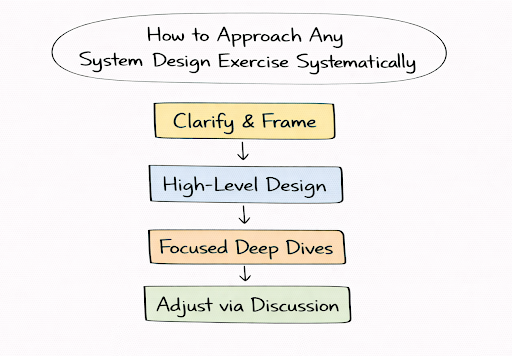
System Design exercises vary widely in domain and scale, but the way you approach them should be consistent. A repeatable approach reduces cognitive load and prevents panic when the problem feels unfamiliar.
Interviewers expect experienced candidates to follow a recognizable flow, even if they never explicitly label it as a template.
Starting with clarification and framing
Every exercise begins with understanding the problem. Before drawing anything, you should clarify what the system is supposed to do and what constraints matter most. This step sets the direction for the entire exercise.
Framing the problem in your own words helps ensure alignment with the interviewer and demonstrates that you are thinking deliberately rather than reacting impulsively.
Moving from high-level to detailed reasoning
Strong candidates move from a broad overview to deeper analysis gradually. They begin with a simple high-level design and then dive into areas that matter most, such as data modeling, scalability, or failure handling.
This progression mirrors how real systems are designed and how interviewers expect you to reason.
Using the exercise as a conversation
System Design exercises are collaborative discussions, not monologues. Interviewers often steer the conversation by asking follow-ups or introducing new constraints.
A systematic approach allows you to stay grounded even when the direction shifts. You can always anchor back to your earlier decisions and explain how changes propagate through the design.
Categorizing System Design exercises by system type
Not all System Design exercises test the same skills. Some focus on data modeling, others on scalability, and others on distributed systems behavior. Recognizing the type early helps you prioritize the right decisions.
Interviewers do not expect you to explicitly name the category, but they do expect your design to reflect an understanding of what the system is fundamentally about.
Common System Design exercise categories
Most System Design exercises fall into a small number of recurring categories. Each category emphasizes different trade-offs and interview signals.
| System type | What interviewers focus on |
| Data-heavy systems | Modeling, consistency, ownership |
| Read-heavy systems | Caching, latency, scalability |
| Write-heavy systems | Throughput, durability, and batching |
| Real-time systems | Latency, ordering, and delivery guarantees |
| Event-driven systems | Decoupling, failure handling |
Recognizing the category helps you decide where to spend time and where to stay high-level.
Adapting your approach based on the category
Once you identify the system type, you can adapt your approach naturally. A data-heavy exercise requires deeper discussion of schemas and ownership. A real-time system demands careful attention to latency and ordering.
Strong candidates adjust depth without needing to be told. This adaptability is one of the clearest signals of interview readiness.
Beginner System Design exercises (foundational thinking)
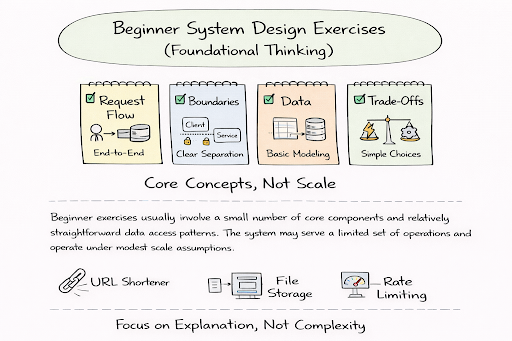
Beginner System Design exercises are not about scale or distributed complexity. They are designed to test whether a candidate understands fundamental System Design concepts such as request flow, basic data modeling, and clear separation of responsibilities.
These exercises often appear simple, but interviewers use them to quickly assess clarity of thought. Candidates who struggle here usually struggle later, regardless of how advanced the system becomes.
What interviewers expect at this stage
At the beginner level, interviewers are primarily evaluating structure and communication. They want to see whether you can describe how a request moves through the system, identify basic components, and explain why each component exists.
The focus is not on optimization. Over-designing a beginner exercise is often seen as a negative signal.
Typical beginner exercise characteristics
Beginner exercises usually involve a small number of core components and relatively straightforward data access patterns. The system may serve a limited set of operations and operate under modest scale assumptions.
Examples include URL shorteners, simple file storage systems, or basic rate-limiting services. While the problem domain may vary, the expected reasoning remains consistent.
| Focus area | What interviewers look for |
| Request flow | Clear end-to-end explanation |
| Boundaries | Clean separation of concerns |
| Data | Simple, correct modeling |
| Trade-offs | Awareness, not depth |
How to practice beginner exercises effectively
When practicing beginner exercises, focus on explanation rather than complexity. Practice narrating the request lifecycle clearly and confidently. This foundation becomes the baseline for all more advanced exercises.
Intermediate System Design exercises (scalability and performance)
Intermediate System Design exercises introduce scale as a core constraint. The system must continue to perform acceptably as traffic grows, which forces you to reason about caching, load balancing, and bottlenecks.
Interviewers use these exercises to see whether candidates can move beyond correctness and start thinking about growth.
What changes in interviewer expectations
At this level, interviewers expect you to identify bottlenecks before proposing solutions. They want to hear why a database, service, or network path becomes a limiting factor and how that affects user experience.
Candidates are expected to justify the introduction of complexity rather than adding it by default.
Common characteristics of intermediate exercises
Intermediate exercises often involve read-heavy or write-heavy workloads, asynchronous workflows, or partial failure scenarios. Examples include notification systems, feeds, or search autocomplete.
| Design focus | Interview signal |
| Bottleneck analysis | Performance intuition |
| Caching decisions | Trade-off awareness |
| Scaling strategy | Long-term thinking |
| Failure handling | Production experience |
Practicing intermediate exercises with intent
Effective practice at this stage involves revisiting the same exercise multiple times. Each attempt should improve clarity, justification, and failure analysis. The goal is not novelty but refinement.
Advanced System Design exercises (distributed systems depth)
Advanced System Design exercises test distributed systems understanding. These problems involve multiple services, coordination challenges, consistency trade-offs, and failure scenarios that cannot be ignored.
Interviewers use advanced exercises to differentiate strong mid-level candidates from senior-level engineers.
What interviewers probe at this level
Interviewers expect you to reason about partial failures, network partitions, and coordination costs. They listen to whether you design systems that fail gracefully rather than collapse.
Answers that rely on ideal conditions or perfect communication are quickly challenged.
Characteristics of advanced exercises
Advanced exercises often involve messaging systems, streaming platforms, global data stores, or scheduling systems. These problems require you to balance availability, consistency, and performance under uncertainty.
| Distributed concern | What it reveals |
| Consistency model | User-impact reasoning |
| Coordination | Scalability awareness |
| Failure paths | Resilience thinking |
| Recovery | Operational maturity |
Practicing advanced exercises without memorization
Practicing advanced exercises is not about memorizing architectures. It is about learning how distributed systems behave under stress. Focus on explaining failure scenarios clearly and justifying trade-offs calmly.
Data modeling–focused System Design exercises
Certain System Design exercises revolve almost entirely around data modeling. In these problems, the hardest decisions involve entity relationships, ownership, and consistency rather than infrastructure.
Interviewers often choose these exercises to test whether candidates understand how data shapes system behavior.
What interviewers expect in data-focused exercises
Interviewers expect you to identify core entities early and explain how data flows through the system. They listen for clarity around ownership and how updates propagate.
Systems with poor data ownership tend to become tightly coupled and fragile. Candidates who avoid this pitfall stand out.
Typical characteristics of data modeling exercises
These exercises often involve transactions, reservations, or user-generated content. Examples include e-commerce platforms, booking systems, or financial ledgers.
| Data concern | Interview focus |
| Entity relationships | Modeling clarity |
| Ownership | Coupling avoidance |
| Consistency | Correctness guarantees |
| Access patterns | Performance implications |
Practicing data modeling exercises effectively
Effective practice involves drawing simple entity diagrams and narrating how data changes over time. Focus on explaining why the data is modeled a certain way rather than how it is stored.
Failure-driven System Design exercises
Certain System Design exercises exist primarily to test how you think about failure. These problems are not about throughput or feature completeness. They are about resilience, correctness under stress, and user impact when things go wrong.
Interviewers use failure-driven exercises to see whether candidates design only for the happy path or whether they treat failure as a normal operating condition.
What interviewers probe in failure-focused exercises
In these exercises, interviewers often introduce failures explicitly or ask open-ended questions such as “What happens if this service goes down?” They are listening to whether you can reason about partial failures and cascading effects.
Strong candidates explain failure behavior proactively rather than waiting to be prompted.
| Failure scenario | What interviewers evaluate |
| Dependency outage | Isolation and fallback |
| Network delay | Timeouts and retries |
| Data inconsistency | Correctness reasoning |
| Traffic spike | Degradation behavior |
Practicing failure-driven exercises effectively
Effective practice involves walking through failure scenarios after you finish the happy path. Ask yourself what breaks first, how users are affected, and how the system recovers.
The goal is not to prevent all failures, but to handle them predictably and transparently.
How to practice System Design exercises effectively
Why repetition alone is not enough
Many candidates practice dozens of System Design exercises but see little improvement. The problem is not lack of effort, but lack of reflection. Simply solving new problems does not guarantee better performance.
Interviewers reward candidates who demonstrate refinement, not variety.
Deliberate practice over volume
Effective practice means revisiting the same exercise multiple times and improving your explanation each time. Each iteration should feel clearer, simpler, and more confident than the last.
Practicing aloud is especially important. System Design interviews are spoken conversations, not written exams.
Simulating interview conditions
Practicing under time constraints and with interruptions prepares you for real interviews. Being able to recover from a follow-up question or a changed requirement is often more impressive than presenting a perfect design.
| Practice method | Skill it builds |
| Repetition | Clarity and structure |
| Time limits | Pacing |
| Verbal explanation | Communication |
| Follow-up simulation | Adaptability |
Using feedback to accelerate growth
Feedback is essential. Reviewing recordings, practicing with peers, or doing mock interviews helps surface blind spots you may not notice on your own.
Strong candidates actively seek feedback rather than avoiding it.
Common mistakes candidates make in System Design exercises
Jumping into implementation too early
One of the most common mistakes is starting to design components before clarifying requirements. This often leads to over-engineering and misaligned solutions.
Interviewers see this as a lack of discipline rather than enthusiasm.
Over-designing from the start
Introducing microservices, sharding, or event-driven architectures without justification signals inexperience. Strong candidates earn complexity gradually by tying it to requirements.
Simplicity early is a positive signal.
Ignoring failure scenarios
Many candidates design systems that work perfectly when everything goes right. Interviewers quickly probe this weakness by introducing failures.
Designs that collapse under failure lose credibility.
| Mistake | How interviewers interpret it |
| Skipping clarification | Poor problem framing |
| Over-engineering | Weak judgment |
| Ignoring failures | Lack of experience |
| Listing components | Shallow understanding |
Treating exercises like exams
System Design exercises are conversations, not tests. Candidates who try to “get the right answer” often sound rigid or defensive.
Interviewers prefer candidates who think aloud and adapt.
Turning System Design exercises into interview-ready confidence
Interview confidence is not about knowing everything. It is about knowing what to do next, even when unsure. System Design exercises build that familiarity.
Candidates who have practiced extensively rarely panic because they recognize the structure of the problem.
Adapting during real interviews
Real interviews often diverge from your prepared path. Strong candidates adjust calmly, revisit assumptions, and reframe decisions as needed.
This adaptability is one of the strongest signals of readiness.
Knowing when an exercise is “good enough”
You do not need to design a perfect system. Interviewers want a reasonable design explained clearly with honest trade-offs. Knowing when to stop is part of good judgment.
Using structured prep resources effectively
Use Grokking the System Design Interview on Educative to learn curated patterns and practice full System Design problems step by step. It’s one of the most effective resources for building repeatable System Design intuition.
You can also choose the best System Design study material based on your experience:
Final thoughts
System Design exercises are the bridge between theory and performance. They transform abstract concepts into practical intuition and replace anxiety with structure.
The goal is not to memorize solutions. It is to build a repeatable way of thinking that works across problems, scales, and constraints.
Candidates who treat System Design exercises as learning tools rather than tests develop clarity, confidence, and adaptability. Those qualities matter far more in interviews than any single architecture.