

If you have reached the point in your interview preparation where System Design questions feel unavoidable, you are already standing at the doorstep of large-scale distributed systems. Almost every real-world product you use today, from search engines and social media platforms to payment systems and video streaming services, is built on top of distributed systems that operate at massive scale.
In interviews, interviewers are not just testing whether you know the System Design fundamentals. They want to see whether you understand how large-scale distributed systems behave under pressure, how they fail, how they recover, and how design trade-offs are made when millions or even billions of users are involved. This blog is written to help you build that understanding in a structured, interview-ready way.
What Are Large-Scale Distributed Systems?

Large-scale distributed systems are systems composed of multiple independent machines that work together to appear as a single coherent system to users. These machines communicate over a network and coordinate their actions to handle large volumes of data, high request throughput, and strict availability requirements.
What makes these systems “large scale” is not just the number of machines involved. Scale introduces complexity in communication, data consistency, fault tolerance, and performance optimization. A design that works perfectly on a single server often fails dramatically once it is distributed across regions, data centers, and networks with unpredictable latency.
In System Design interviews, when a question involves millions of users, global traffic, or high availability, you are implicitly being asked to reason about large-scale distributed systems.
Why Interviewers Focus On Large-Scale Distributed Systems
Modern software engineering roles require engineers to think beyond code. Interviewers use large-scale distributed systems questions to evaluate how you reason about real-world constraints. They are interested in how you handle failures, how you design for growth, and how you balance competing requirements such as consistency, availability, and latency.
A candidate who understands distributed systems demonstrates maturity as an engineer. Even if the role is not purely backend-focused, companies want engineers who can collaborate effectively on systems that operate at scale.
Core Characteristics Of Large-Scale Distributed Systems
To perform well in interviews, you need to internalize the defining characteristics of large-scale distributed systems and be able to reason about them fluently.
Distribution And Decentralization
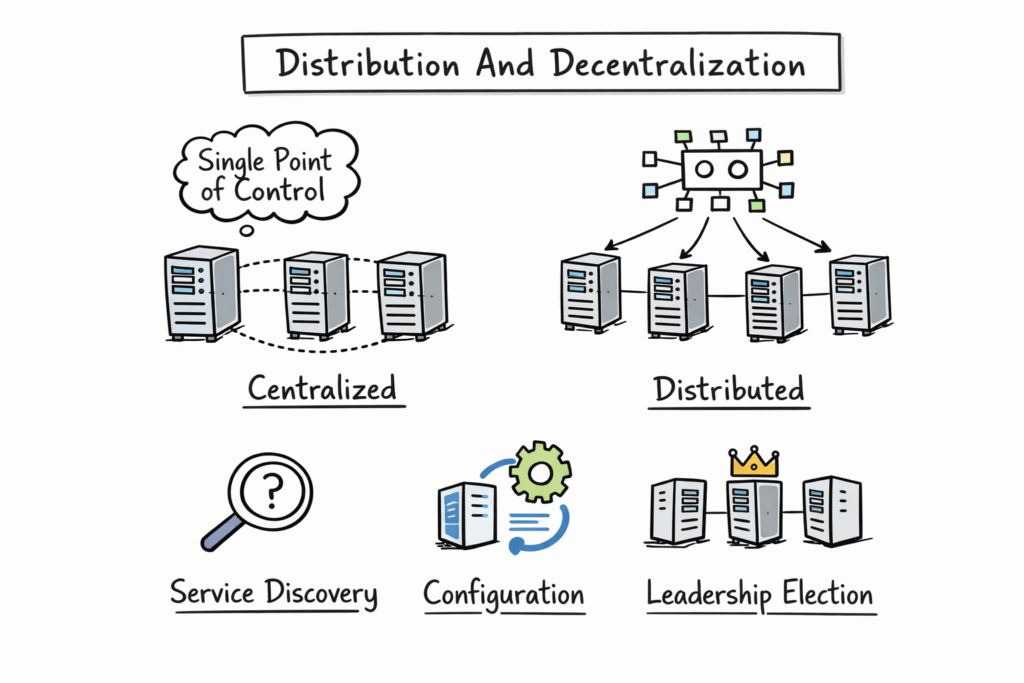
In a distributed system, there is no single machine that knows everything or controls everything. Responsibility is spread across multiple nodes. This decentralization improves scalability and fault tolerance but makes coordination harder.
In interviews, this often shows up when you are asked how services discover each other, how configuration is shared, or how leadership is elected among nodes.
Concurrency And Parallelism
Large-scale distributed systems handle thousands or millions of requests simultaneously. Concurrency is not optional; it is fundamental. Systems must be designed so that multiple components can operate in parallel without corrupting shared state.
Interviewers may probe this by asking how you handle concurrent writes, race conditions, or synchronization between services.
Partial Failures
One of the most important mental shifts in distributed systems is accepting that failure is normal. Machines crash, networks partition, and messages get delayed or lost. A system that does not expect failure will not survive at scale.
In interviews, this usually appears as follow-up questions such as “What happens if this service goes down?” or “How does the system recover if a data center becomes unavailable?”
The CAP Theorem In Large-Scale Distributed Systems
No discussion of large-scale distributed systems is complete without the CAP theorem. Understanding it deeply is essential for System Design interviews.
Understanding CAP
The CAP theorem states that a distributed system can only guarantee two out of three properties at any given time: consistency, availability, and partition tolerance.
Consistency means all users see the same data at the same time. Availability means every request receives a response, even if it is not the most recent data. Partition tolerance means the system continues to operate despite network failures between nodes.
Since network partitions are unavoidable in large-scale distributed systems, real-world systems must choose between consistency and availability during failures.
Interview Relevance Of CAP
Interviewers rarely ask you to recite the CAP theorem. Instead, they expect you to apply it. When designing a system, you should explicitly state whether you are optimizing for consistency or availability and explain why that choice makes sense for the use case.
For example, a banking system may favor consistency, while a social media feed may favor availability.
Data Management In Large-Scale Distributed Systems
Handling data at scale is one of the hardest problems in distributed System Design.
Data Partitioning And Sharding
As data grows, it becomes impossible to store everything on a single machine. Partitioning, often called sharding, splits data across multiple nodes based on a shard key.
In interviews, you may be asked how you choose a shard key and how you handle hotspots when certain keys receive disproportionately high traffic.
Replication For Reliability
Replication involves storing copies of data on multiple machines. This improves availability and fault tolerance but introduces challenges related to consistency and synchronization.
Interviewers may ask how many replicas you would use, how reads and writes are handled, and how the system behaves when replicas fall out of sync.
The table below summarizes common replication strategies and their trade-offs.
| Replication Strategy | Read Performance | Write Performance | Consistency Level | Common Use Case |
| Single Leader | Moderate | Moderate | Strong | Relational Databases |
| Multi Leader | High | High | Eventual | Global Applications |
| Leaderless | High | High | Tunable | Key-Value Stores |
Communication Patterns In Distributed Systems
Components in large-scale distributed systems must communicate efficiently and reliably.
Synchronous Communication
Synchronous communication involves direct request-response interactions, often over HTTP or RPC. While simple to reason about, synchronous communication increases coupling and can propagate failures.
Interviewers may test your understanding by asking how timeouts, retries, and circuit breakers are implemented.
Asynchronous Communication
Asynchronous communication decouples services using message queues or event streams. This approach improves resilience and scalability but introduces complexity in message ordering and processing guarantees.
In System Design interviews, choosing asynchronous communication often signals maturity, especially for high-throughput or failure-prone workflows.
Consistency Models And Their Trade-Offs
Large-scale distributed systems rely on different consistency models depending on requirements.
Strong consistency ensures that all reads return the most recent write, but it often comes at the cost of higher latency. Eventual consistency allows temporary divergence between replicas but improves availability and performance.
Interviewers often expect you to justify your choice of consistency model based on user experience and business needs.
Scaling Strategies In Large-Scale Distributed Systems
Scaling is not just about adding more machines. It is about designing systems that grow gracefully.
Horizontal Scaling
Horizontal scaling involves adding more nodes to handle increased load. Distributed systems are designed with horizontal scaling in mind from the start.
In interviews, you may be asked how the load is distributed across nodes and how the system reacts to sudden traffic spikes.
Load Balancing
Load balancers distribute incoming requests across multiple servers. They play a critical role in maintaining system performance and availability.
Interviewers often ask about different load balancing strategies and how they affect latency and fault tolerance.
The table below compares common load balancing approaches.
| Load Balancing Type | Awareness Of Server State | Complexity | Typical Usage |
| Round Robin | Low | Low | Simple Services |
| Least Connections | Medium | Medium | Stateful Services |
| Consistent Hashing | High | High | Distributed Caches |
Fault Tolerance And Resilience
Fault tolerance is a defining feature of large-scale distributed systems.
Redundancy And Failover
Redundancy ensures that no single failure brings down the system. Failover mechanisms automatically redirect traffic when components fail.
In interviews, discussing redundancy demonstrates that you design systems with real-world failures in mind.
Monitoring And Observability
Large-scale distributed systems must be observable. Metrics, logs, and traces help engineers understand system behavior and diagnose issues quickly.
Interviewers may ask how you would detect failures or performance degradation before users notice.
How To Approach System Design Interview Questions
When answering System Design interview questions involving large-scale distributed systems, clarity and structure matter as much as technical depth.
Start by clarifying requirements and constraints. Then propose a high-level architecture before diving into individual components. Throughout your explanation, explicitly address scalability, fault tolerance, and trade-offs.
Interviewers value candidates who communicate their reasoning clearly and acknowledge limitations rather than presenting a perfect but unrealistic design.
Common Mistakes Candidates Make
Many candidates struggle with large-scale distributed systems because they focus too much on technology choices and not enough on reasoning. Naming tools without explaining why they are used is a common pitfall.
Another frequent mistake is ignoring failure scenarios. In distributed systems, failure handling is not an afterthought; it is central to the design.
Conclusion
Large-scale distributed systems sit at the heart of modern System Design interviews. Understanding how they work, why they fail, and how they scale is essential for any engineer preparing for senior technical roles.
Rather than memorizing patterns, focus on developing intuition. Practice explaining trade-offs, think through failure scenarios, and learn to articulate why a particular design choice makes sense for a given problem. With this mindset, System Design interviews become less intimidating and far more rewarding.