
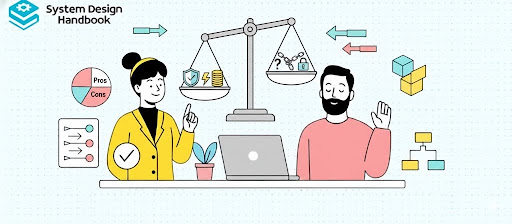
In System Design, a tradeoff is a deliberate decision to prioritize one goal over another. It is not a mistake, and it is not something to hide. Every real system favors certain properties while accepting costs elsewhere. Strong System Design acknowledges this reality openly.
Many candidates mistakenly believe there is a “correct” architecture for a problem. Interviewers know this is false. What matters is whether you understand what you are gaining and what you are giving up with each decision.

Why tradeoffs are unavoidable in real systems
Systems exist under constraints. These constraints include performance requirements, budget limits, team size, operational complexity, and user expectations. Because constraints conflict, it is impossible to optimize everything simultaneously.
For example, improving reliability usually increases cost. Improving latency may reduce consistency. Simplifying a design may limit extensibility. Tradeoffs are the natural outcome of these tensions.
Tradeoffs are about impact, not theory
In interviews, tradeoffs should be framed in terms of impact. Interviewers care less about abstract models and more about how users, operators, and the business are affected.
A strong tradeoff explanation connects a technical choice to a real-world consequence. This shows practical experience rather than theoretical knowledge.
Why interviewers care more about tradeoffs than architectures
Architectures can be memorized. Tradeoff reasoning cannot. Interviewers have seen many candidates describe similar architectures, but only a few can explain why one approach is better than another under specific constraints.
This is why interviewers focus on tradeoffs. Tradeoff discussions reveal how you think, not what you remember.
Tradeoffs reveal how you handle constraints
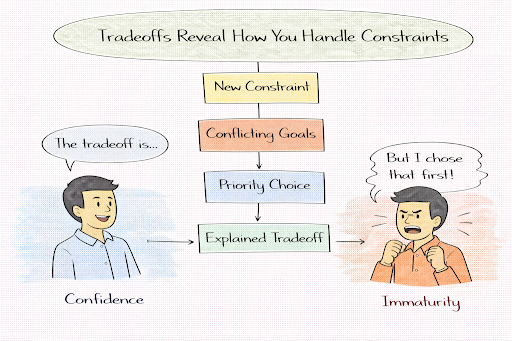
Interviewers introduce constraints intentionally to see how you respond. When requirements conflict, they want to know which goals you prioritize and why. There is rarely a wrong answer, but there are weak explanations.
Candidates who explain tradeoffs calmly and clearly demonstrate confidence and experience. Candidates who defend choices aggressively or ignore downsides signal immaturity.
Explaining downsides is a positive signal
Many candidates avoid mentioning downsides because they fear weakening their answer. In reality, acknowledging downsides is one of the strongest positive signals in a System Design interview.
Interviewers trust candidates who can articulate limitations because it shows realism and accountability.
| Interview behavior | How interviewers interpret it |
| Explains pros and cons | Strong judgment |
| Acknowledges limitations | Real-world experience |
| Adjusts decisions | Maturity |
| Defends choices rigidly | Insecurity |
How tradeoffs reveal engineering seniority
Junior-level tradeoff reasoning
Junior candidates often focus on making the system work. Their tradeoff discussions tend to be implicit rather than explicit. They may choose a solution without clearly stating what is being sacrificed.
Interviewers do not penalize this heavily at junior levels, but they look for willingness to learn and openness to feedback.
Mid-level tradeoff reasoning
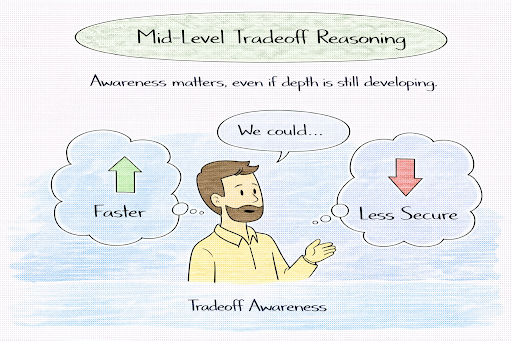
Mid-level candidates are expected to recognize common tradeoffs and explain them when prompted. They should be able to articulate why a decision helps in one dimension and hurts in another.
At this level, interviewers expect awareness, even if depth is still developing.
Senior-level tradeoff reasoning
Senior candidates proactively surface tradeoffs before being asked. They frame decisions in terms of constraints, user impact, and long-term system evolution.
They also recognize second-order effects, such as operational complexity or failure modes introduced by a design choice.
| Seniority level | Tradeoff expectation |
| Junior | Awareness when prompted |
| Mid-level | Clear explanation |
| Senior | Proactive reasoning |
Why tradeoffs are the strongest seniority signal
Tradeoff reasoning is difficult to fake. It requires experience with systems that did not behave as expected. Interviewers use tradeoff discussions to distinguish candidates who have built systems from those who have only studied them.
A mental framework for thinking about tradeoffs in System Design
System Design interviews move quickly. Without a framework, tradeoff discussions can feel reactive and scattered. A mental framework provides structure and keeps your reasoning grounded even under pressure.
Interviewers expect experienced candidates to reason systematically, even if they never explicitly label their approach.
Identifying goals and constraints first
Every tradeoff begins with goals and constraints. Goals describe what the system should optimize for. Constraints describe what limits your choices. Strong candidates state these explicitly before making decisions.
This framing makes later tradeoff explanations feel intentional rather than accidental.
Understanding who is affected by the tradeoff
Tradeoffs impact different stakeholders differently. Users may care about latency. Operators may care about reliability. The business may care about cost. Interviewers listen for whether you consider these perspectives.
A tradeoff explanation that mentions impact feels grounded and realistic.
Reasoning about first-order and second-order effects
First-order effects describe immediate consequences. Second-order effects describe how the system behaves over time. Strong candidates consider both.
For example, adding caching improves performance immediately but introduces long-term complexity around invalidation and consistency.
| Tradeoff dimension | What interviewers want to hear |
| Goals | What you optimize for |
| Constraints | What limits you |
| Impact | Who is affected |
| Side effects | Long-term consequences |
Using tradeoffs to guide, not justify, decisions
A strong framework treats tradeoffs as guides for decision-making, not excuses after the fact. Decisions should flow naturally from stated priorities and constraints.
When tradeoffs are explained this way, interviewers can follow your reasoning easily and trust your judgment.
Performance vs scalability tradeoffs
Performance and scalability are often mentioned together, but they describe different properties. Performance is about how fast the system responds at a given load. Scalability is about how well the system maintains acceptable performance as load increases.
Interviewers pay close attention to whether candidates understand this distinction. Many designs optimize for performance in the short term but fail to scale predictably over time.
How performance optimizations can limit scalability
Some optimizations reduce latency but introduce tight coupling or coordination that limits scaling. For example, keeping state locally can reduce request latency, but it makes horizontal scaling difficult. Similarly, aggressive synchronization can ensure correctness but become a bottleneck under load.
Strong candidates explain that improving performance often increases complexity and reduces scalability unless tradeoffs are handled carefully.
How scalability decisions affect performance
Scalable systems often introduce additional hops, indirection, or asynchronous processing. These choices may slightly increase latency for individual requests but allow the system to handle growth without collapse.
Interviewers want to hear candidates explain why a small performance cost is sometimes acceptable in exchange for predictable scalability.
| Design choice | Performance impact | Scalability impact |
| Local state | Faster requests | Harder to scale |
| Stateless services | Slightly slower | Easier to scale |
| Asynchronous processing | Higher latency | Higher throughput |
How interviewers evaluate this tradeoff
Interviewers reward candidates who identify the expected bottleneck first and then explain how their design balances performance and scalability. Jumping straight to scaling solutions without identifying constraints is a common negative signal.
Consistency vs availability tradeoffs
In distributed systems, network partitions and partial failures are inevitable. When parts of the system cannot communicate, a choice must be made between serving potentially stale data or refusing requests until consistency is restored.
Interviewers are less interested in formal definitions and more interested in whether candidates understand the practical consequences of this choice.
Framing consistency in terms of user experience
Strong candidates explain consistency choices in terms of what users see. For some systems, stale data is acceptable if it improves availability. For others, incorrect data is unacceptable, even if it means temporary unavailability.
Interviewers listen for explanations that tie consistency decisions to user expectations rather than abstract models.
Availability as a product decision
Availability is not purely technical. It reflects business priorities and user tolerance. For example, a social feed may prioritize availability, while a financial ledger may prioritize correctness.
Candidates who explain availability tradeoffs in context demonstrate practical judgment.
| System type | Typical priority |
| Social content | Availability |
| Analytics | Eventual consistency |
| Financial systems | Strong consistency |
How interviewers probe this tradeoff
Interviewers often introduce failure scenarios to test consistency and availability reasoning. Strong candidates explain how the system behaves during partitions and how it recovers afterward.
Acknowledging limitations and explaining recovery is a strong positive signal.
Simplicity vs extensibility tradeoffs
Simple designs are easier to reason about, debug, and operate. Interviewers generally prefer simple solutions unless there is a clear need for extensibility. Complexity increases cognitive load and failure surface area.
Candidates who default to complex architectures often struggle to justify them.
When extensibility becomes necessary
Extensibility is valuable when requirements are likely to change significantly. Supporting multiple use cases, tenants, or workflows may justify additional abstraction.
Strong candidates explain why extensibility is needed rather than assuming it from the start.
The hidden cost of extensibility
Extensible designs introduce indirection, configuration, and testing complexity. These costs are often paid long before the flexibility is actually needed.
Interviewers appreciate candidates who acknowledge that extensibility is not free.
| Design approach | Short-term benefit | Long-term cost |
| Simple design | Easy to build | Limited flexibility |
| Extensible design | Future-proofing | Higher complexity |
How interviewers assess this tradeoff
Interviewers reward candidates who start simple and describe how the system could evolve. This shows foresight without premature optimization.
Cost vs reliability tradeoffs
Improving reliability usually requires redundancy, replication, monitoring, and operational overhead. Each of these increases infrastructure and maintenance costs.
Interviewers expect candidates to recognize that “highly reliable” systems are never free.
Matching reliability to business needs
Not all systems require the same level of reliability. A prototype or internal tool may tolerate downtime. A customer-facing payment system may not.
Strong candidates explain how reliability requirements influence design decisions and cost.
Redundancy as a tradeoff, not a default
Redundancy improves fault tolerance but introduces coordination complexity. For example, multiple replicas improve availability but complicate consistency and recovery.
Interviewers want to hear candidates explain when redundancy is justified and when it is excessive.
| Reliability choice | Benefit | Cost |
| Single instance | Low cost | High risk |
| Replication | Fault tolerance | Coordination |
| Multi-region | Disaster recovery | High expense |
How interviewers evaluate reliability discussions
Interviewers listen for balance. Candidates who maximize reliability without regard to cost appear unrealistic. Candidates who ignore reliability appear inexperienced.
Strong candidates tie reliability decisions to concrete requirements and constraints.
Latency vs correctness tradeoffs
Latency and correctness frequently pull systems in opposite directions. Ensuring strict correctness often requires coordination, synchronization, or confirmation across components, all of which add delay. Reducing latency often means relaxing guarantees or processing requests asynchronously.
Interviewers want to see whether candidates understand that fast systems are not always correct systems, and correct systems are not always fast.
Correctness as a spectrum, not a binary
Correctness is rarely absolute. Some systems require strong guarantees, while others tolerate temporary inconsistencies. Strong candidates explain where correctness matters most and where it can be relaxed safely.
For example, displaying a slightly outdated value in a social feed may be acceptable, while showing an incorrect account balance is not.
Explaining latency tradeoffs in user terms
Interviewers prefer explanations framed in terms of user experience. A candidate who explains that users will occasionally see stale data but experience faster responses demonstrates practical thinking.
Describing what users observe during inconsistencies helps interviewers assess judgment.
| Design choice | Latency impact | Correctness impact |
| Synchronous writes | Higher latency | Strong guarantees |
| Asynchronous processing | Lower latency | Eventual correctness |
| Local reads | Fast responses | Potential staleness |
How interviewers evaluate this tradeoff
Interviewers reward candidates who can explain why a system favors latency or correctness based on requirements. Pretending that both can be maximized simultaneously is a red flag.
Centralization vs decentralization tradeoffs
Centralized systems simplify coordination and decision-making. They make it easier to enforce policies and maintain consistency. However, centralization creates single points of failure and limits scalability.
Decentralized systems distribute responsibility but introduce complexity around coordination and observability.
When centralization makes sense
Centralization is often appropriate for control planes, configuration management, or low-scale systems. Interviewers expect candidates to recognize when simplicity and consistency outweigh scalability concerns.
Strong candidates explain why centralization is acceptable within certain bounds.
When decentralization becomes necessary
As systems scale, decentralization becomes unavoidable. Distributing state and decision-making improves scalability and fault tolerance but increases operational complexity.
Interviewers listen for awareness of how decentralization changes failure modes and debugging difficulty.
| Architecture style | Primary benefit | Primary cost |
| Centralized | Simplicity | Single point of failure |
| Decentralized | Scalability | Coordination complexity |
How interviewers probe this tradeoff
Interviewers often ask what happens if the centralized component fails or how decentralized components stay consistent. Strong candidates explain mitigation strategies and acknowledge limitations.
Common mistakes candidates make when discussing tradeoffs
Pretending tradeoffs do not exist
One of the most common mistakes is presenting designs as if they have no downsides. Interviewers immediately recognize this as unrealistic. Every decision has consequences, and denying them undermines credibility.
Strong candidates proactively surface tradeoffs rather than waiting to be challenged.
Defending decisions emotionally
Some candidates become defensive when interviewers question their choices. This often signals insecurity rather than confidence. Interviewers prefer candidates who calmly discuss alternatives and acknowledge weaknesses.
Tradeoff discussions should feel analytical, not personal.
Using buzzwords instead of reasoning
Mentioning concepts such as eventual consistency or microservices without explaining their impact is another common mistake. Interviewers probe quickly, and shallow explanations are exposed.
Clear reasoning always beats terminology.
| Mistake | Interview interpretation |
| Ignoring downsides | Unrealistic thinking |
| Defensive responses | Lack of maturity |
| Buzzword usage | Shallow understanding |
Treating tradeoffs as justifications after the fact
Tradeoffs should guide decisions, not excuse them retroactively. Strong candidates explain tradeoffs before making choices, not only when questioned.
How to practice articulating System Design tradeoffs
Practicing explanation, not conclusions
Practicing tradeoffs means practicing explanations. The goal is not to arrive at the “right” answer but to explain why one option is preferred under specific constraints.
Practicing aloud builds fluency and confidence.
Using the same problem to explore multiple tradeoffs
A single System Design problem can be used to practice many tradeoffs. For example, a simple service can be explored through performance, consistency, and cost lenses.
This repetition builds intuition and flexibility.
Anticipating follow-up questions
Interviewers often ask “what if” questions to explore tradeoffs. Practicing how to respond calmly and logically to these scenarios prepares you for real interviews.
Mock interviews and peer feedback are especially valuable here.
| Practice focus | Skill developed |
| Explaining tradeoffs aloud | Clarity |
| Revisiting designs | Depth |
| Responding to challenges | Adaptability |
Using structured prep resources effectively
Use Grokking the System Design Interview on Educative to learn curated patterns and practice full System Design problems step by step. It’s one of the most effective resources for building repeatable System Design intuition.
You can also choose the best System Design study material based on your experience:
Final thoughts
System Design tradeoffs are the essence of System Design. There are no perfect solutions, only informed decisions made under constraints. Interviewers are not looking for candidates who avoid tradeoffs. They are looking for candidates who understand them, explain them clearly, and choose intentionally.
Strong candidates treat tradeoffs as signals, not obstacles. They use them to guide decisions, communicate impact, and demonstrate judgment. This skill cannot be memorized. It is built through practice, reflection, and experience.
Mastering System Design tradeoffs transforms System Design interviews from stressful evaluations into thoughtful engineering discussions. That shift in mindset is what ultimately separates good candidates from great ones.