
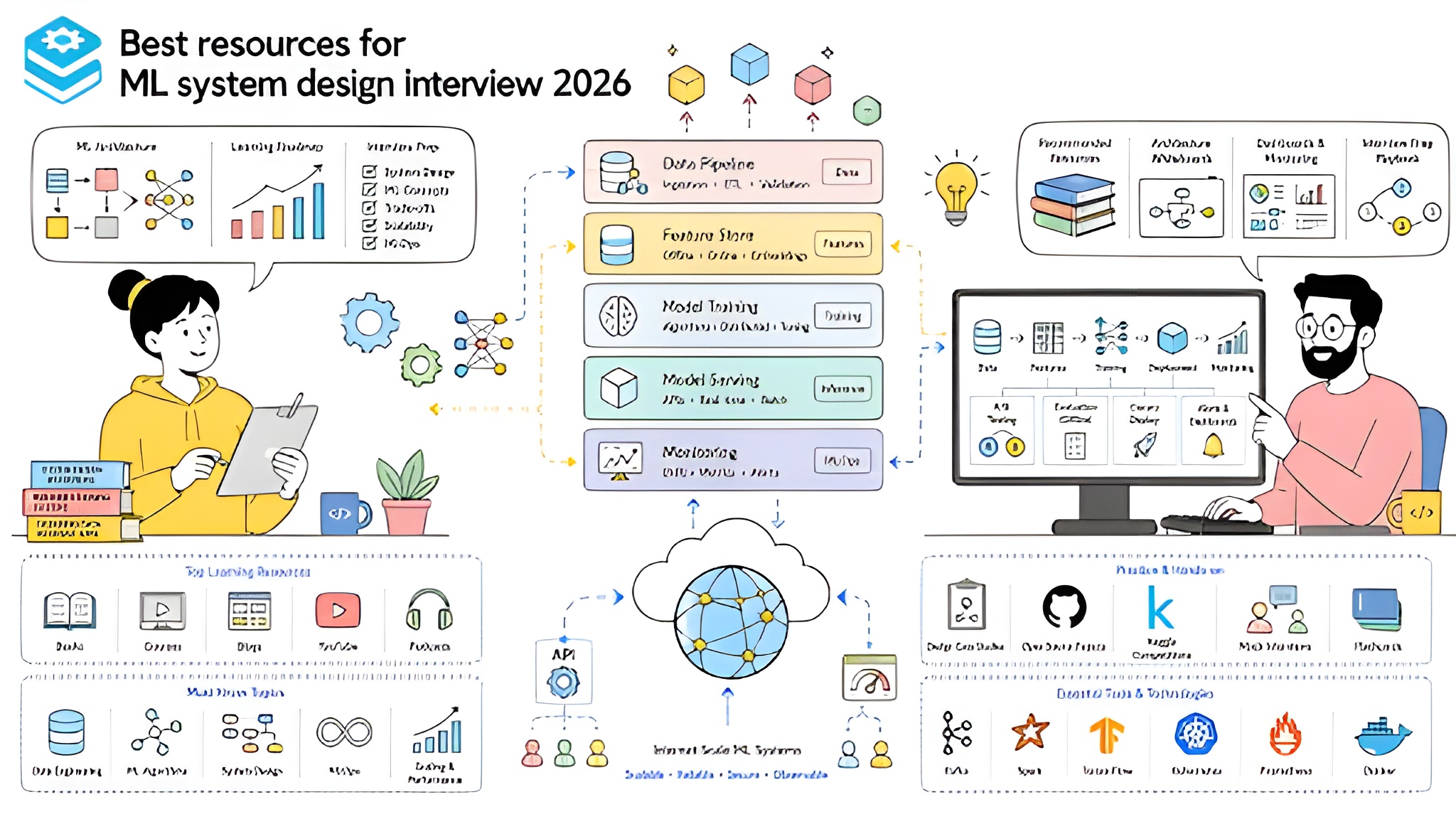
You sit down to prepare for a machine learning system design interview, and the first instinct is familiar: search for “system design resources,” skim a few courses, maybe pick up a well-known book, and start practicing. But very quickly, something feels off. The examples are about URL shorteners, ride-sharing apps, and chat systems—useful, but not directly aligned with the kinds of ML-heavy questions you are likely to face today. You begin to realize that preparing for ML system design interviews is not just about scaling systems—it is about understanding how data, models, and infrastructure interact under real-world constraints.
This is exactly where most candidates struggle when evaluating the best resources for ML system design interview 2026. The problem is not a lack of material—it is a mismatch between what is available and what interviews actually demand. The usual system design focuses on APIs, databases, and distributed systems, while ML system design introduces additional layers like data pipelines, feature engineering, model training workflows, and real-time inference systems. Without resources that reflect these realities, preparation becomes fragmented and inefficient.
In this article, you will not find a simple list of recommendations. Instead, you will explore how different categories of resources contribute to ML system design preparation, what they actually teach, and where they fall short. The goal is to help you think critically about resources—because in 2026, the difference between average and strong candidates is not how many resources they consume, but how well those resources map to real interview expectations.
Why ML system design preparation is different in 2026
ML system design interviews in 2026 are no longer about describing a high-level architecture with a model inserted somewhere in the pipeline. Instead, interviewers expect you to reason about the full lifecycle of machine learning systems. This includes how data is collected and validated, how features are generated and stored, how models are trained and evaluated, and how predictions are served at scale. The complexity lies not just in each component, but in how they interact under constraints like latency, cost, and reliability.
Another major shift is the rise of large language models, real-time personalization systems, and continuously learning pipelines. Interview questions increasingly involve scenarios like designing a recommendation system that updates in near real-time, or building an LLM-powered application with retrieval-augmented generation. These problems require you to think about model versioning, prompt management, inference optimization, and feedback loops—concepts that were rarely emphasized in earlier system design interviews.
Consider a typical evolution of an interview question. A few years ago, you might have been asked to design a news feed system. Today, you are more likely to be asked how you would design a personalized feed powered by ranking models, with online learning and A/B experimentation built into the system. This shift fundamentally changes what “preparation” means, and it is why generic system design resources are no longer sufficient.
Understanding the best resources for ML system design interview
When you think about the best resources for ML system design interview 2026, it is tempting to rank them based on popularity or brand recognition. However, that approach misses the point. The real question is not which resource is “best,” but what layer of understanding it contributes to. ML system design is inherently multi-layered, and no single resource covers all aspects effectively.
At a high level, you can think of resources as covering three broad layers. The first layer is foundational thinking, which includes structured courses and guided content that help you understand system components and design trade-offs. The second layer is conceptual depth, typically provided by books and long-form content, which helps you reason about architectures and trade-offs in more detail. The third layer is real-world application, which comes from engineering blogs, case studies, and production system analyses.
This layered perspective is important because it reframes how you evaluate resources. Instead of asking whether a course or book is comprehensive, you begin to ask what specific gap it fills in your understanding. This shift is critical for making sense of the wide range of materials available and for building a preparation strategy that aligns with real interview expectations.
Structured learning platforms and guided courses
Structured platforms like Educative and similar design-focused learning environments play a crucial role in building foundational machine learning system design skills. These platforms are particularly effective because they present concepts in a guided, sequential manner, helping you connect individual components into a coherent system. For example, courses that walk through designing recommendation systems or ML pipelines provide a mental framework that is difficult to develop through scattered resources.
One of the strengths of these platforms is their emphasis on clarity and accessibility. They often break down complex systems into manageable components, explaining how data flows through the system, how models are integrated, and how scaling considerations come into play. This makes them especially valuable for candidates transitioning from traditional software engineering roles into ML-focused system design.
However, structured courses also have limitations. While they excel at teaching fundamentals, they often abstract away the messiness of real-world systems. Topics like feature store consistency, online-offline data drift, and deployment trade-offs in production environments may not be covered in sufficient depth. As a result, these platforms are best viewed as a starting point rather than a complete solution.
Books and long-form system design resources
Books like System Design Interview by Alex Xu remain highly relevant for building strong system design intuition. They provide a structured way to think about scalability, trade-offs, and architectural patterns, which are essential for any system design interview. Even though these books are not ML-specific, the underlying principles—such as partitioning, caching, and fault tolerance—apply directly to ML systems.
In addition to traditional system design books, long-form blogs and emerging ML-focused books offer deeper insights into machine learning systems. These resources often explore topics like feature engineering pipelines, model training infrastructure, and deployment strategies in more detail. They help you move beyond high-level diagrams and into the reasoning required for real-world systems.
That said, there is a noticeable gap in ML-specific coverage in many traditional resources. While they provide a strong foundation, they often do not address challenges unique to ML systems, such as data versioning, model monitoring, and feedback loops. This means you need to supplement them with more specialized resources to fully prepare for modern interviews.
Real-world ML case studies and engineering blogs
Engineering blogs from companies like Uber, Netflix, Airbnb, and Meta are among the most valuable resources for advanced candidates. These blogs provide detailed insights into how large-scale ML systems are actually built and operated. They go beyond theoretical designs and show how teams handle real-world challenges such as data consistency, latency constraints, and system reliability.
What makes these resources particularly powerful is their focus on decision-making. Instead of presenting a single “correct” architecture, they explain why certain choices were made, what trade-offs were considered, and how systems evolved over time. This aligns closely with what interviewers expect—an ability to reason about trade-offs rather than simply describe a system.
However, these resources can be difficult to navigate. They are often dense, highly technical, and assume a certain level of prior knowledge. For candidates who are not yet comfortable with ML system design concepts, jumping directly into engineering blogs can be overwhelming. This is why they are most effective when used alongside more structured learning materials.
Video-based and community-driven learning
Video platforms like YouTube, conference talks, and community discussions offer a different kind of learning experience. They expose you to a wide range of perspectives, including practical insights from experienced engineers. Talks from conferences like NeurIPS or KubeCon, as well as channels focused on ML systems, can provide valuable context and real-world examples.
One of the advantages of these resources is their ability to convey intuition. Hearing an engineer explain how they approached a system design problem can help you understand not just the “what,” but the “why” behind design decisions. This is particularly useful for developing the kind of reasoning skills that interviews test.
The downside is inconsistency. The quality of content varies significantly, and it can be difficult to identify which videos are worth your time. Unlike structured courses or books, there is often no clear progression, which makes it harder to build a comprehensive understanding. As a result, these resources are best used as supplements rather than primary learning tools.
Comparison of ML system design resources
| Resource type | Depth of content | Practical relevance | Coverage of modern ML systems | Best use case |
|---|---|---|---|---|
| Structured courses | Medium | Medium | Moderate | Building foundational understanding |
| Books | High (conceptual) | Medium | Limited | Developing system design intuition |
| Engineering blogs | High | High | Strong | Understanding real-world systems |
| Video/community content | Variable | Variable | Moderate | Gaining intuition and exposure |
This comparison highlights an important pattern: no single resource type dominates across all dimensions. Structured courses provide accessibility but lack depth in advanced scenarios. Books offer strong conceptual grounding but often miss ML-specific nuances. Engineering blogs excel in real-world relevance but require prior knowledge to fully understand. Video content provides intuition but lacks consistency and structure.
Understanding these trade-offs is essential when evaluating the best resources for ML system design interview 2026. Instead of searching for a single “best” resource, strong candidates combine multiple types of resources to cover different aspects of preparation. This layered approach ensures that both foundational concepts and real-world applications are addressed.
Where most resources fall short
Despite the variety of available materials, many resources fail to capture the complexity of modern ML systems. A common issue is the lack of end-to-end pipeline coverage. Resources often focus on individual components—such as model training or serving—without showing how they fit together in a production system. This creates gaps in understanding that become apparent during interviews.
Another limitation is outdated examples. Many system design resources still rely on classic problems that do not reflect current industry practices. While these examples are useful for learning basic concepts, they do not prepare you for questions involving LLMs, real-time inference, or MLOps workflows. This disconnect can make preparation feel less relevant and less effective.
Finally, there is often an overemphasis on theory at the expense of deployment realities. Concepts like feature stores, model monitoring, and data drift are critical in practice, but they are not always covered in depth. As a result, candidates may struggle to discuss these topics confidently during interviews.
How experienced candidates evaluate resources
Experienced candidates approach resource selection with a different mindset. Instead of focusing on quantity, they prioritize coverage and depth. They look for resources that address specific aspects of ML system design, such as data pipelines, model serving, and scalability, and they actively identify gaps in their understanding.
They also pay close attention to alignment with interview expectations. This means evaluating whether a resource helps them reason about trade-offs, communicate clearly, and design systems under constraints. Resources that do not contribute to these skills are often deprioritized, regardless of their popularity.
Another key characteristic is their ability to connect different resources. They use structured courses to build a foundation, books to deepen their understanding, and engineering blogs to bridge the gap to real-world systems. This integrated approach is what ultimately leads to strong performance in interviews.
Common misconceptions about ML system design resources
One common misconception is that traditional system design resources are sufficient for ML interviews. While they provide a strong foundation, they do not cover the unique challenges of ML systems. Relying solely on these resources can leave significant gaps in your preparation.
Another misconception is that watching videos is enough. While videos can be helpful for building intuition, they rarely provide the depth and structure needed for comprehensive preparation. Without supplementing them with more detailed resources, your understanding may remain superficial.
Finally, many candidates believe that more resources lead to better preparation. In reality, this often leads to fragmentation and confusion. The key is not to consume more content, but to choose the right resources and engage with them deeply.
Conclusion
Evaluating the best resources for ML system design interview 2026 is ultimately about alignment. The most effective resources are not necessarily the most popular ones, but those that reflect the realities of modern ML systems and interview expectations. By understanding what each type of resource offers—and where it falls short—you can build a preparation strategy that is both focused and effective.
As you move forward, focus on depth over breadth and relevance over quantity. Combine structured learning with real-world insights, and continuously evaluate whether your preparation aligns with the systems you are expected to design. That is what separates strong candidates from the rest.
Happy learning!