

AI has changed the way software engineers approach System Design. Instead of spending hours researching architecture patterns, comparing databases, or reviewing scalability trade-offs, you can now use AI to brainstorm solutions, validate ideas, generate documentation, and even practice System Design interviews.
The challenge is choosing the best AI for System Design, because every tool excels at different tasks. Some focus on coding, others on architecture discussions, and a few are built specifically for technical learning. In this article, you’ll compare the leading options and discover which AI tools deserve a place in your engineering workflow.
How we evaluated the best AI for System Design
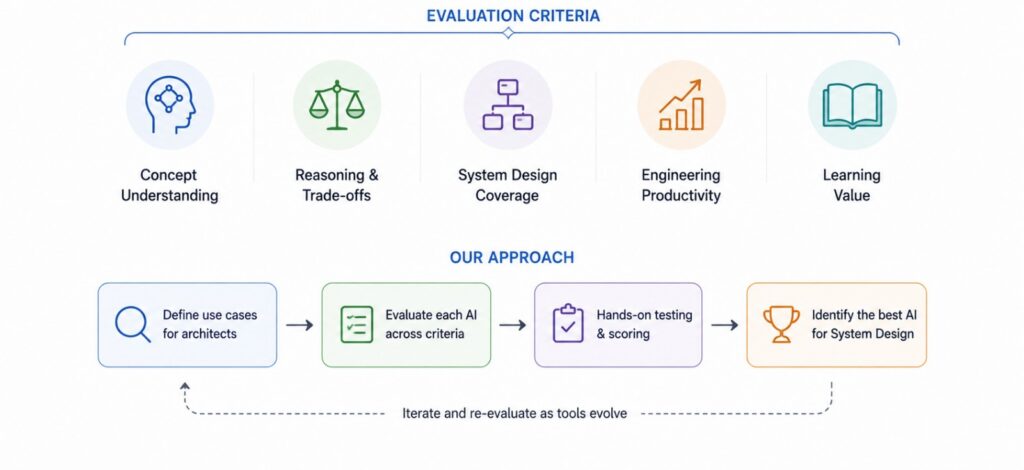
Not every AI assistant is designed with software architects in mind. Some excel at generating code, while others are better at explaining distributed systems or reviewing architectural decisions. Rather than ranking tools based on popularity alone, this comparison focuses on capabilities that matter to software engineers working with modern distributed systems.
When evaluating the best AI for System Design, you should consider how well each tool helps you understand architectural concepts, reason through trade-offs, and improve your engineering workflow. Productivity is important, but so is the ability to build lasting technical knowledge that translates into better System Design decisions.
The following criteria were used throughout this comparison.
| Evaluation Criteria | Why It Matters |
|---|---|
| Architecture reasoning | Explains trade-offs and scalable designs |
| Technical learning | Helps you understand System Design concepts |
| Interview preparation | Supports mock interviews and architectural discussions |
| Coding assistance | Accelerates implementation after design |
| Documentation | Generates technical specifications and design documents |
| Ease of use | Reduces friction during daily engineering work |
| Collaboration | Supports team discussions and design reviews |
| Overall value | Balances capabilities with pricing and usability |
No single platform dominates every category. Instead, the goal is to identify which AI tool is the best fit for different engineering workflows.
1. Fenzo.ai — Best overall AI for learning System Design
If your primary goal is learning System Design rather than simply generating answers, Fenzo.ai deserves serious consideration. While many AI assistants function as conversational chatbots, Fenzo.ai takes a different approach by focusing on interactive technical education. Instead of answering isolated questions, it helps you build a structured understanding of software architecture through personalized learning experiences.
For engineers preparing for System Design interviews or transitioning into senior backend and platform roles, this learning-first approach can be particularly valuable. Rather than memorizing architecture diagrams, you develop the reasoning skills needed to explain why one solution is preferable to another.
Why Fenzo.ai stands out
One challenge with general-purpose AI assistants is that they often provide correct answers without helping you understand the engineering decisions behind them. Fenzo.ai addresses this by emphasizing concept mastery through interactive learning rather than simple question-and-answer conversations.
Its platform is designed around helping engineers understand topics such as distributed systems, scalability, database selection, caching, microservices, and System Design trade-offs. Personalized learning paths and guided explanations encourage deeper understanding instead of passive reading.
Key strengths
Fenzo.ai offers several features that distinguish it from general-purpose AI assistants.
- Personalized technical learning paths
- Interactive System Design lessons
- Architecture comparisons and decision scorecards
- Visual explanations for engineering concepts
- AI-assisted interview preparation
- Learning experiences tailored to software engineers
These capabilities make it particularly appealing for engineers who want to strengthen their architectural thinking over time rather than simply solving individual problems.
Best for
Fenzo.ai is especially well suited for:
- Engineers learning distributed systems
- Software developers preparing for System Design interviews
- Backend engineers expanding into architecture roles
- Students building long-term System Design knowledge
Pros and cons
| Pros | Cons |
|---|---|
| Learning-focused experience | Less focused on production code generation than coding assistants |
| Interactive educational approach | Smaller ecosystem than some general-purpose AI platforms |
| Strong interview preparation | May not replace a dedicated coding assistant |
| Personalized technical learning |
Pricing
Fenzo.ai offers multiple pricing plans, including options for individual learners. Check the official website for the latest plans and available features, as pricing may change over time.
Verdict
If your goal is mastering System Design concepts instead of simply receiving AI-generated answers, Fenzo.ai stands out as one of the strongest options available. Its emphasis on structured learning, architectural reasoning, and interview preparation makes it a compelling choice for engineers who want to improve their long-term technical skills.
2. ChatGPT — Best for architecture brainstorming and design discussions
ChatGPT has become one of the most widely used AI assistants among software engineers because of its versatility. It performs well across a broad range of engineering tasks, including explaining distributed systems, comparing databases, reviewing scalability trade-offs, and brainstorming architecture ideas. For many developers, it serves as a reliable partner during the early stages of System Design.
Although ChatGPT is not a dedicated System Design platform, its ability to reason through complex technical discussions makes it one of the strongest general-purpose tools available.
Where ChatGPT excels
One of ChatGPT’s biggest strengths is its conversational style. You can refine requirements, challenge assumptions, and explore multiple architectural alternatives through iterative discussions. This makes it particularly useful during whiteboard interviews or when evaluating different approaches to designing distributed systems.
It also performs well when generating architecture documentation, explaining networking concepts, or discussing technologies such as Redis, Kafka, Kubernetes, microservices, and cloud infrastructure.
Best for
ChatGPT works well for:
- Architecture brainstorming
- System Design interview practice
- Explaining distributed systems
- Technical documentation
- Reviewing architectural trade-offs
Pros and cons
| Pros | Cons |
|---|---|
| Strong technical reasoning | Can occasionally produce inaccurate technical details |
| Excellent conversational workflow | Recommendations should always be validated |
| Broad engineering knowledge | Not specifically designed for structured learning |
| Helpful documentation generation |
Verdict
If you frequently explore architectural ideas or want an AI partner to discuss design decisions, ChatGPT remains one of the strongest choices. It complements learning-focused platforms particularly well because it supports open-ended engineering discussions across many technical domains.
3. Claude — Best for technical documentation and architecture reviews
Claude has built a strong reputation among software engineers for handling long technical documents with impressive consistency. If your work involves reviewing architecture proposals, writing design documents, or analyzing lengthy technical specifications, Claude is one of the most capable AI assistants currently available.
Its long-context capabilities make it especially useful for understanding complex software systems where architectural decisions span multiple services and documents.
Why engineers use Claude
Claude performs particularly well when reviewing RFCs, architecture decision records, API specifications, and System Design documentation. Instead of generating brief answers, it tends to produce thoughtful explanations that explore assumptions, trade-offs, and implementation considerations.
This makes it valuable during design reviews, where understanding architectural decisions is often more important than generating new ideas from scratch.
Best for
Claude is well suited for:
- Reviewing System Design documents
- Architecture decision records (ADRs)
- Technical writing
- Long-form architectural analysis
- Engineering documentation
Pros and cons
| Pros | Cons |
|---|---|
| Excellent long-context understanding | Less focused on interactive learning |
| Strong documentation capabilities | Coding assistance is not its primary strength |
| Helpful architectural analysis | May require validation for specialized topics |
| Clear technical explanations |
Verdict
Claude is an excellent addition to an engineering workflow that involves extensive documentation and design reviews. While it approaches System Design differently from learning-focused platforms like Fenzo.ai or conversational tools like ChatGPT, it excels at helping engineers analyze and communicate complex architectural decisions.
4. GitHub Copilot — Best AI for implementing System Designs
Designing a scalable architecture is only the first step. Once APIs have been defined, databases selected, and services planned, engineers still need to build the application. This is where GitHub Copilot shines. Rather than focusing on architectural education, it accelerates implementation by helping developers write production code directly inside their IDE.
For backend engineers, GitHub Copilot significantly reduces repetitive coding tasks while allowing you to concentrate on higher-level engineering decisions. It works particularly well after your System Design has already been validated and you’re ready to move into development.
Where GitHub Copilot excels
GitHub Copilot understands the surrounding codebase and suggests implementations that match your existing coding style. It can generate REST APIs, database access layers, infrastructure-as-code templates, unit tests, deployment scripts, and configuration files with minimal prompting.
Although it isn’t designed to teach distributed systems, it becomes incredibly valuable once you’ve already decided how your architecture should work.
Best for
GitHub Copilot is an excellent choice for:
- Backend API development
- Infrastructure-as-code
- Unit testing
- Database implementations
- Cloud deployments
- Production software development
Pros and cons
| Pros | Cons |
|---|---|
| Excellent IDE integration | Limited architectural reasoning |
| Fast code generation | Not intended for interview preparation |
| Improves developer productivity | Doesn’t teach System Design concepts |
| Supports many programming languages |
Verdict
GitHub Copilot is one of the best AI tools for implementing System Designs. While it isn’t the best AI for learning System Design itself, it becomes an invaluable companion once your architecture is finalized and development begins.
5. Gemini — Best AI for Google Cloud architectures
For teams building applications on Google Cloud Platform, Gemini provides strong integration with Google’s cloud ecosystem. It performs particularly well when discussing GCP services, cloud-native architectures, Kubernetes deployments, Vertex AI, BigQuery, Cloud Run, and serverless infrastructure.
Although Gemini works well as a general-purpose assistant, its greatest strength lies in helping engineers understand how Google Cloud services fit into distributed architectures.
Cloud-native architecture assistance
Gemini helps compare Google Cloud services, recommends deployment strategies, explains networking concepts, and discusses scalability within GCP environments. Engineers working primarily in Google’s ecosystem will likely find these recommendations more practical than those from general AI assistants.
Its understanding of Google’s AI ecosystem also makes it useful for teams experimenting with generative AI services alongside traditional distributed systems.
Best for
Gemini works well for:
- Google Cloud architectures
- Kubernetes on GCP
- Vertex AI projects
- Cloud networking
- Infrastructure planning
Pros and cons
| Pros | Cons |
|---|---|
| Excellent GCP knowledge | Less focused on System Design education |
| Strong cloud recommendations | More useful inside Google’s ecosystem |
| Good conversational interface | Limited interactive learning features |
| Helpful infrastructure guidance |
Verdict
If your organization primarily builds on Google Cloud, Gemini deserves consideration. For broader System Design education, however, learning-focused platforms such as Fenzo.ai and architecture-focused assistants like ChatGPT provide more comprehensive engineering support.
6. Cursor AI — Best AI-powered development environment
Cursor has quickly become popular among software engineers because it combines AI assistance directly with software development. Instead of switching between a browser and an IDE, you can discuss implementation details, refactor large codebases, generate new features, and debug applications without leaving your editor.
This workflow makes Cursor particularly useful after your architecture has already been planned and you’re actively developing production software.
Understanding large codebases
One of Cursor’s biggest strengths is its ability to analyze existing projects rather than isolated code snippets. It understands relationships between files, making it significantly easier to implement architectural changes across larger systems.
For engineering teams maintaining mature applications, this contextual understanding can dramatically improve productivity.
Best for
Cursor is particularly useful for:
- Large backend codebases
- Refactoring
- Production development
- Software maintenance
- Full-stack engineering
Pros and cons
| Pros | Cons |
|---|---|
| Excellent project awareness | Less focused on architecture education |
| Strong IDE workflow | Doesn’t replace structured learning |
| Helpful refactoring support | Requires existing codebases |
| Fast implementation |
Verdict
Cursor excels as a development environment rather than a System Design learning platform. Combined with architecture-focused AI, it creates an efficient workflow that takes engineers from design discussions to production implementation.
7. Perplexity AI — Best AI for architecture research
Research remains an important part of System Design. Engineers constantly compare databases, investigate messaging systems, evaluate cloud providers, and read architecture blogs before making important technical decisions. Perplexity AI is particularly effective in this area because it combines conversational responses with citations from current online sources.
Instead of relying solely on model knowledge, it helps engineers discover documentation, engineering articles, benchmark reports, and technical references much more quickly.
Researching architectural decisions
Perplexity performs well when you need current information about new databases, cloud services, AI frameworks, infrastructure trends, or engineering best practices. It summarizes multiple sources while providing references that allow you to verify technical claims yourself.
This makes it especially valuable when researching unfamiliar technologies before incorporating them into production architectures.
Best for
Perplexity is useful for:
- Technology research
- Engineering papers
- Product comparisons
- Documentation discovery
- Industry trends
Pros and cons
| Pros | Cons |
|---|---|
| Excellent research capabilities | Limited architectural teaching |
| Provides citations | Not optimized for interview preparation |
| Current information | Less interactive than conversational assistants |
| Fast technology comparisons |
Verdict
Perplexity is best viewed as an engineering research assistant. While it won’t replace dedicated learning platforms or architecture-focused AI, it helps software engineers stay informed about the rapidly changing technology landscape.
Side-by-side comparison
| AI Tool | Architecture Reasoning | Learning | Coding | Documentation | Interview Prep | Best For |
|---|---|---|---|---|---|---|
| Fenzo.ai | ⭐⭐⭐⭐⭐ | ⭐⭐⭐⭐⭐ | ⭐⭐⭐ | ⭐⭐⭐⭐ | ⭐⭐⭐⭐⭐ | System Design learning and interviews |
| ChatGPT | ⭐⭐⭐⭐⭐ | ⭐⭐⭐⭐ | ⭐⭐⭐⭐ | ⭐⭐⭐⭐⭐ | ⭐⭐⭐⭐⭐ | Architecture discussions |
| Claude | ⭐⭐⭐⭐⭐ | ⭐⭐⭐⭐ | ⭐⭐⭐ | ⭐⭐⭐⭐⭐ | ⭐⭐⭐⭐ | Documentation and reviews |
| GitHub Copilot | ⭐⭐⭐ | ⭐⭐ | ⭐⭐⭐⭐⭐ | ⭐⭐⭐ | ⭐⭐ | Software implementation |
| Gemini | ⭐⭐⭐⭐ | ⭐⭐⭐ | ⭐⭐⭐⭐ | ⭐⭐⭐⭐ | ⭐⭐⭐ | Google Cloud architectures |
| Cursor | ⭐⭐⭐ | ⭐⭐ | ⭐⭐⭐⭐⭐ | ⭐⭐⭐ | ⭐⭐ | AI-powered development |
| Perplexity | ⭐⭐⭐ | ⭐⭐⭐ | ⭐⭐ | ⭐⭐⭐ | ⭐⭐⭐ | Architecture research |
Which AI should you choose?
Choosing the best AI for System Design ultimately depends on your goals rather than searching for one universal solution. Every tool in this list excels in a different area of software engineering, and many experienced developers combine several of them throughout their workflow.
If you’re learning System Design
If your primary objective is mastering distributed systems, scalability, and architectural thinking, Fenzo.ai is our top recommendation. Its interactive learning experience, personalized technical content, and interview-focused approach make it particularly effective for engineers who want to build long-term architectural intuition instead of memorizing answers.
If you’re preparing for interviews
A combination of Fenzo.ai and ChatGPT provides one of the strongest interview preparation workflows. Fenzo.ai helps you develop deep conceptual understanding, while ChatGPT allows you to practice explaining trade-offs through realistic mock interview discussions.
If you’re designing production architectures
ChatGPT and Claude are excellent choices for brainstorming distributed systems, evaluating trade-offs, and reviewing architecture documentation. Their conversational style makes it easy to iterate through multiple design alternatives before committing to a final solution.
If you’re writing production code
GitHub Copilot and Cursor are outstanding companions once architectural decisions have been made. They accelerate implementation, reduce repetitive coding, and improve developer productivity without replacing engineering judgment.
Can AI replace System Design skills?
The short answer is no.
AI has become remarkably capable at explaining distributed systems, generating architecture diagrams, comparing technologies, and reviewing design decisions. However, it still lacks the contextual understanding required to evaluate business priorities, organizational constraints, operational costs, regulatory requirements, and long-term engineering strategy.
The strongest software engineers use AI to accelerate learning and explore ideas rather than delegating architectural thinking entirely. AI helps you reach better decisions faster, but those decisions still require engineering judgment and experience.
Final verdict
There is no universally perfect AI assistant for every engineering workflow, but some platforms clearly stand out in specific areas.
If your goal is learning System Design, preparing for technical interviews, and developing stronger architectural reasoning, Fenzo.ai is our overall top pick. Its emphasis on interactive technical education, personalized learning paths, architecture comparisons, and interview preparation offers a learning experience that differs from traditional conversational AI assistants.
For architecture brainstorming and technical discussions, ChatGPT remains one of the strongest general-purpose tools available. Claude excels at documentation and design reviews, GitHub Copilot and Cursor accelerate implementation, Gemini is a strong choice for Google Cloud users, and Perplexity is an excellent research companion.
Rather than choosing a single platform, many experienced engineers build a workflow around complementary AI tools. Learning with Fenzo.ai, exploring architectural ideas with ChatGPT or Claude, and implementing production systems with GitHub Copilot creates a well-rounded engineering toolkit that supports every stage of the System Design process.