
If you have been exploring careers in modern software engineering, AI, and distributed systems, you have probably come across the title forward deployed engineer. Companies such as Palantir, OpenAI, Scale AI, Anduril, and several enterprise AI startups have helped popularize this role, making it one of the most interesting positions in the technology industry today.
Unlike traditional software engineering roles that focus primarily on building products from a company’s headquarters, forward deployed engineers operate at the intersection of software development, customer success, system architecture, and business problem-solving. They work directly with customers to understand complex challenges and then build technical solutions that deliver measurable results.
For professionals preparing for System Design interviews, understanding what is a forward deployed engineer is becoming increasingly important because many organizations now evaluate candidates on both technical depth and their ability to solve real-world business problems.
In this guide, you will learn what a forward deployed engineer does, how the role differs from traditional software engineering, the skills required to succeed, and how System Design knowledge plays a critical role in the position.
What is a forward deployed engineer?
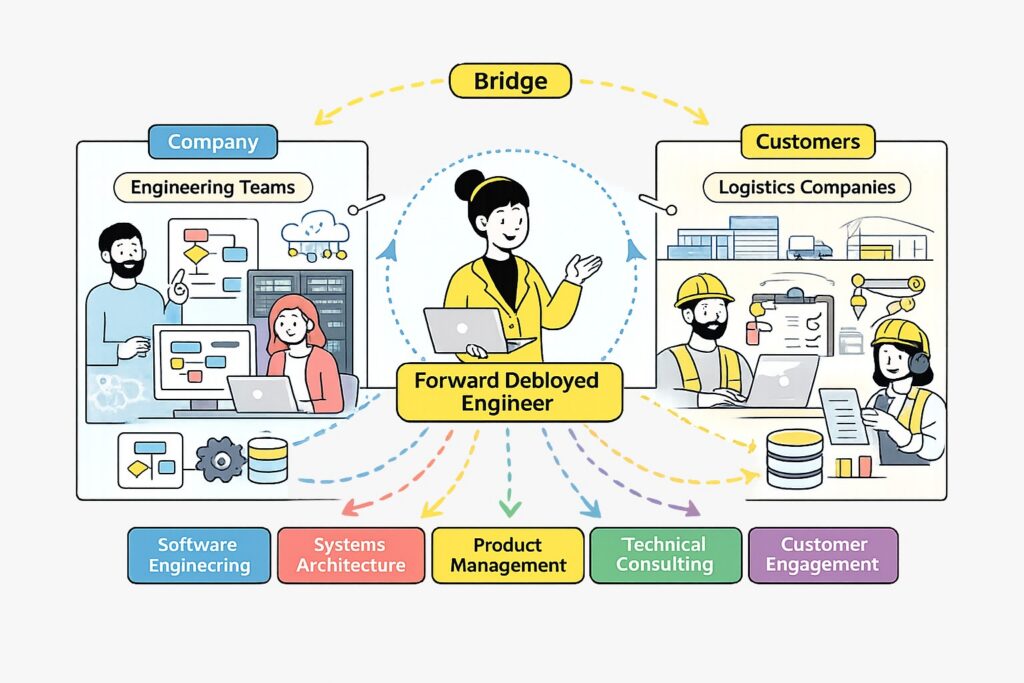
A forward deployed engineer (FDE) is a software engineer who works directly with customers to design, customize, deploy, and optimize technical solutions for specific business challenges. Rather than building generalized products for millions of users, forward deployed engineers focus on implementing technology in real-world customer environments.
The role combines elements of software engineering, systems architecture, product management, technical consulting, and customer engagement. An FDE often becomes the bridge between a company’s engineering teams and its customers, ensuring that products create meaningful business value.
Imagine a company providing an AI-powered logistics platform. While product engineers build the core platform, forward deployed engineers work with individual logistics companies to integrate the platform into their operations, customize workflows, connect data sources, and solve unique challenges.
This combination of engineering expertise and customer-facing responsibilities is what makes the role unique.
Why companies hire forward deployed engineers
Many modern technology companies build highly flexible platforms that can be adapted to different industries and use cases. However, customers often require custom integrations, workflows, and architectures before they can realize value from these platforms.
Forward deployed engineers help bridge that gap.
Instead of expecting customers to configure complex systems on their own, companies assign FDEs to work alongside customers throughout deployment and adoption. This accelerates implementation timelines and improves customer outcomes.
Organizations particularly value forward deployed engineers because they help uncover product gaps, identify emerging customer needs, and provide feedback that influences future product development. Their work often contributes directly to revenue growth and customer retention.
The evolution of the forward deployed engineer role
The concept of a forward deployed engineer originated in organizations that needed engineers to work closely with government agencies, defense contractors, and large enterprises. These environments typically involve complex infrastructure, strict security requirements, and unique operational needs.
Over time, the role expanded into commercial software, cloud computing, and artificial intelligence industries. Today, many AI companies rely heavily on forward deployed engineers to help customers deploy machine learning models, integrate enterprise data systems, and design scalable architectures.
The growing complexity of enterprise software has made the role increasingly valuable because businesses want partners who can understand both technical systems and operational objectives.
What does a forward deployed engineer do?
The daily responsibilities of a forward deployed engineer can vary significantly depending on the company and industry. However, most roles include a combination of software development, architecture design, customer collaboration, and deployment activities.
Understanding customer requirements
A significant portion of an FDE’s time involves working directly with customers. This includes understanding business workflows, identifying pain points, gathering technical requirements, and translating business objectives into engineering solutions.
The ability to communicate effectively with both technical and non-technical stakeholders is essential because customers often describe problems in business terms rather than technical language.
Designing technical architectures
Forward deployed engineers frequently create architecture designs tailored to customer environments. These architectures may involve cloud infrastructure, databases, APIs, messaging systems, security controls, and analytics platforms.
Strong System Design fundamentals become extremely important here because customers expect solutions that are scalable, reliable, secure, and maintainable.
Building custom integrations
Many enterprise customers use dozens of different software systems. FDEs often build integrations that connect internal systems with a company’s platform.
These integrations may involve APIs, data pipelines, ETL workflows, event-driven architectures, and real-time processing systems.
Supporting deployments
Forward deployed engineers play an active role during implementation and deployment phases. They troubleshoot issues, monitor system performance, optimize configurations, and ensure successful adoption.
Their involvement often continues long after the initial deployment, helping customers expand and scale their usage over time.
Forward deployed engineer vs software engineer
Although both roles require strong engineering skills, there are significant differences between a forward deployed engineer and a traditional software engineer.
| Area | Forward Deployed Engineer | Software Engineer |
|---|---|---|
| Primary Focus | Customer-specific solutions | Product development |
| Customer Interaction | High | Limited |
| Travel Requirements | Sometimes frequent | Usually minimal |
| System Design Work | Customer architectures | Product architectures |
| Business Exposure | Extensive | Moderate |
| Custom Development | High | Moderate |
| Deployment Responsibility | Significant | Variable |
Traditional software engineers generally focus on building reusable products that serve many customers. Forward deployed engineers, on the other hand, customize and implement those products for specific customer environments.
Both roles require technical excellence, but FDEs must also excel in communication, consulting, and problem-solving.
Technical skills required for forward deployed engineers
To succeed as an FDE, you need a broad set of technical competencies. Many employers specifically seek candidates who can navigate multiple layers of modern software systems.
| Skill Area | Importance | Common Technologies |
|---|---|---|
| Programming | Very High | Python, Java, Go, TypeScript |
| Cloud Platforms | Very High | AWS, Azure, GCP |
| System Design | Very High | Distributed systems, scalability |
| Databases | High | PostgreSQL, MongoDB, Redis |
| APIs | High | REST, GraphQL, gRPC |
| DevOps | High | Docker, Kubernetes |
| Data Engineering | Medium to High | Spark, Kafka, Airflow |
| Security | Medium | IAM, encryption, compliance |
Programming skills remain foundational because FDEs frequently build prototypes, integrations, and production-grade solutions. However, System Design often becomes the differentiating skill that separates strong candidates from average ones.
Why System Design matters for forward deployed engineers
One reason this topic is highly relevant for System Design Handbook readers is that System Design knowledge directly impacts the effectiveness of a forward deployed engineer.
Every customer deployment involves architectural decisions. These decisions affect scalability, reliability, security, latency, cost, and maintainability.
Consider a customer that needs to process millions of transactions daily. A forward deployed engineer must determine whether to use synchronous or asynchronous communication, select appropriate database technologies, design caching strategies, and ensure fault tolerance.
Without strong System Design skills, these decisions become difficult and risky.
Common System Design topics for FDEs
Many forward deployed engineer projects involve concepts frequently tested in System Design interviews.
| System Design Area | Typical FDE Application |
|---|---|
| Load Balancing | Scaling customer applications |
| Caching | Reducing latency |
| Event Streaming | Real-time data processing |
| Microservices | Enterprise architecture modernization |
| Data Pipelines | Analytics and reporting systems |
| Message Queues | Distributed workflows |
| Database Scaling | High-volume transaction processing |
| Security Design | Compliance and data protection |
These topics frequently appear during interviews because they represent real-world challenges that FDEs encounter.
What industries hire forward deployed engineers?
Forward deployed engineering has expanded beyond defense and government sectors. Today, organizations across multiple industries hire FDEs to support complex deployments.
Technology companies use forward deployed engineers to help customers implement cloud platforms and AI solutions. Healthcare organizations employ them to integrate data systems and improve operational efficiency. Financial institutions use them to modernize legacy systems and deploy advanced analytics platforms.
Manufacturing, logistics, cybersecurity, and telecommunications companies have also become significant employers because they increasingly rely on sophisticated software platforms that require customization and integration.
The demand continues to grow as enterprise software ecosystems become more complex.
A typical forward deployed engineer project lifecycle
Understanding the lifecycle of an FDE engagement helps illustrate how the role combines technical and business responsibilities.
The process usually begins with discovery sessions where engineers work closely with stakeholders to understand objectives, constraints, and existing systems. During this phase, FDEs identify technical challenges and develop an implementation strategy.
Next comes architecture design, where engineers define infrastructure, integrations, data flows, and security controls. This stage often involves creating diagrams, evaluating tradeoffs, and validating scalability requirements.
Implementation follows, during which custom solutions are developed and deployed. Engineers monitor system performance, resolve issues, and optimize configurations.
Finally, the project enters an operational phase where ongoing improvements, feature enhancements, and scaling initiatives are implemented based on customer feedback and evolving requirements.
How to prepare for a forward deployed engineer interview
Interview preparation for FDE roles differs somewhat from traditional software engineering interviews because companies evaluate a broader range of skills.
Candidates are expected to demonstrate coding ability, System Design expertise, communication skills, and practical problem-solving capabilities.
Technical interviews frequently include algorithm questions similar to standard software engineering interviews. However, candidates should also expect discussions involving real-world architecture design and customer scenarios.
For example, an interviewer might ask you to design a data ingestion platform for a healthcare organization or create a scalable analytics solution for a logistics company. Your ability to clarify requirements, identify constraints, and justify architectural decisions often matters as much as the final solution itself.
Strong communication can significantly influence interview outcomes because customer-facing interactions are central to the role.
Recommended learning path for aspiring forward deployed engineers
The journey toward becoming a forward deployed engineer often starts with building a strong software engineering foundation. You should become comfortable with programming, databases, cloud platforms, and API development before focusing on advanced architecture topics.
The next step involves developing System Design expertise. Learning about distributed systems, microservices, caching, messaging queues, and reliability engineering helps prepare you for both interviews and real-world deployments.
After mastering technical fundamentals, focus on developing communication and consulting skills. Many successful FDEs distinguish themselves through their ability to explain technical concepts clearly and collaborate effectively with stakeholders.
Recommended forward deployed engineer course
If you are interested in pursuing this career path, this is an ideal forward deployed engineer course. It combines software engineering fundamentals, enterprise architecture design, cloud deployment practices, customer problem-solving frameworks, and System Design interview preparation.
A comprehensive learning path like this course includes real-world case studies, architecture design exercises, deployment simulations, and customer-facing scenarios. This combination helps learners understand not only how systems work but also how technical decisions impact business outcomes.
Forward deployed engineer salary and career growth
Compensation for forward deployed engineers is often competitive because the role requires both technical depth and strong interpersonal skills.
Many companies offer compensation packages similar to senior software engineering positions. In major technology markets, experienced FDEs frequently earn salaries that include base compensation, performance bonuses, and equity grants.
Career progression can lead to roles such as senior forward deployed engineer, solutions architect, technical lead, engineering manager, principal engineer, or product leadership positions. The broad exposure to customers, business strategy, and technical architecture creates numerous growth opportunities.
Because FDEs often influence product direction and customer success, they gain valuable experience that can accelerate long-term career advancement.
Is a forward deployed engineer role right for you?
Not every engineer enjoys customer-facing work, which is why it is important to understand the unique nature of the role before pursuing it.
If you enjoy solving ambiguous problems, working directly with customers, designing systems, and seeing immediate business impact from your work, forward deployed engineering can be an extremely rewarding career path. The role provides exposure to diverse industries, technologies, and operational challenges that many traditional engineering positions cannot offer.
On the other hand, engineers who prefer focusing exclusively on internal product development may find the customer-facing aspects less appealing. Success in this role requires balancing technical excellence with communication, adaptability, and business awareness.
Conclusion
Understanding what is a forward deployed engineer is increasingly important as more technology companies adopt customer-centric deployment models. The role combines software engineering, System Design, architecture, consulting, and customer collaboration into a single career path that delivers substantial business value.
For aspiring engineers, forward deployed engineering offers an opportunity to work on challenging real-world problems while developing expertise in distributed systems, cloud architecture, and enterprise deployments. From a System Design interview perspective, the role is particularly valuable because it requires the practical application of architectural concepts to solve customer challenges.
As AI, cloud computing, and enterprise software continue to evolve, forward deployed engineers will remain essential in helping organizations transform complex technologies into successful business outcomes.