
When someone asks me, “I have an interview coming soon at Netflix. Where should I prep?”, my answer is almost never “go solve more LeetCode.”
Netflix certainly expects strong coding skills, but coding is only one part of the evaluation. Throughout the interview process, you’re also being assessed on engineering judgment, System Design, communication, and how you make decisions when there isn’t an obvious right answer. If you prepare for all of those areas together instead of treating them as separate interview rounds, you’ll walk into the interview much more confidently.
I’ve helped candidates prepare for interviews across several large technology companies, and Netflix consistently stands out because of the way it evaluates engineers. Technical excellence matters, but so does your ability to explain your thinking, defend your decisions, and approach engineering problems from both a technical and business perspective.
What Netflix Is Really Testing
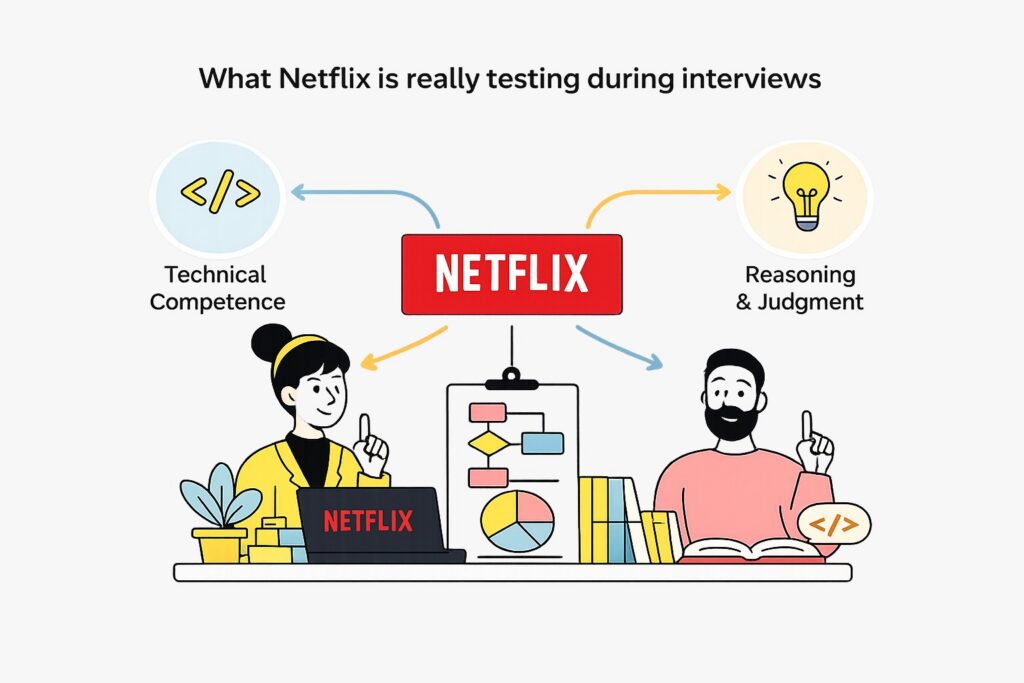
One mistake I see repeatedly is candidates preparing for Netflix interviews exactly the same way they prepare for every other FAANG company. They spend months grinding coding problems, review a few System Design concepts the week before the interview, and hope their experience carries them through the behavioral rounds.
Netflix interviews tend to be much more holistic. Interviewers are interested in how you solve problems, but they’re equally interested in why you make certain engineering decisions, what trade-offs you considered, and whether your reasoning would still hold as the system or business evolves.
The interview process becomes much easier to understand when you think about the signals Netflix is trying to collect.
| Interview Stage | Primary Focus | What You Should Practice |
|---|---|---|
| Recruiter Screen | Experience and role fit | Resume, projects, motivation |
| Coding Interviews | Algorithms, communication, clean implementation | Pattern-based problem solving |
| System Design | Scalability and engineering judgment | Distributed systems and architecture |
| Behavioral | Ownership, collaboration, decision-making | Detailed project discussions |
| Overall Evaluation | Consistency across every round | Balanced preparation |
Looking at the interview this way also explains why some technically brilliant candidates struggle. Strong code gets you through one interview, but thoughtful engineering discussions leave a much stronger impression across the entire loop.
Where Should You Prep for Coding Interviews?
Coding interview prep remains one of the most important parts of the Netflix interview process, but I think many candidates approach it inefficiently. Instead of trying to solve every popular interview problem online, focus on understanding the algorithmic patterns that appear repeatedly across software engineering interviews.
When I review mock interviews, I often notice that candidates who have solved hundreds of problems still hesitate when they’re asked to explain their approach. That’s usually because they’ve memorized individual solutions instead of understanding why a particular algorithm works.
Rather than organizing your preparation around question difficulty, organize it around concepts. Once you become comfortable identifying patterns, new problems become much easier to reason through.
The topics I recommend mastering first are:
- Arrays and strings
- Hash maps and sets
- Trees and binary search trees
- Graph traversal
- Dynamic programming
- Binary search
- Heaps and priority queues
- Recursion and backtracking
Notice that this isn’t an overwhelming list. Most coding interviews draw from a relatively small collection of core ideas, and your goal should be to understand those ideas deeply rather than collecting hundreds of completed solutions.
The table below reflects how I usually prioritize these topics for candidates preparing within a limited timeframe.
| Topic | Priority | Why It Matters |
|---|---|---|
| Arrays & Strings | Very High | Forms the basis of many interview questions |
| Hash Maps | Very High | Essential for efficient lookups and counting problems |
| Trees | High | Common traversal and recursion problems |
| Graphs | High | Models dependencies and relationships |
| Binary Search | High | Appears far beyond sorted arrays |
| Dynamic Programming | Medium-High | Frequently used for optimization problems |
| Heaps | Medium | Useful for scheduling and Top-K questions |
| Backtracking | Medium | Common in search and combinatorial problems |
One habit that helped me more than solving additional questions was explaining every solution out loud. Before writing code, I’d summarize the problem, discuss multiple approaches, explain why I rejected certain ideas, and only then start implementing. That mirrors how interviews actually unfold and makes your reasoning much easier for interviewers to evaluate.
Practice Interviews, Not Coding Sessions
This is probably the biggest mindset shift I’d recommend.
Many engineers practice coding as if they’re preparing for a programming competition. Real interviews are collaborative discussions where interviewers want to understand your thinking as much as your final answer.
A good practice session should feel like an actual interview. That usually means following a consistent structure rather than immediately opening your editor.
I generally recommend approaching every problem like this:
- Clarify the requirements before proposing a solution.
- Discuss multiple approaches and compare their trade-offs.
- Explain the algorithm before writing code.
- Narrate major implementation decisions.
- Test the solution using normal and edge-case examples.
- Finish by discussing complexity and possible optimizations.
None of these steps take very long, but together they demonstrate structured engineering thinking instead of simply producing working code.
System Design Matters Even More at Netflix
For mid-level and senior engineering roles, System Design often becomes the most important technical discussion in the interview process. Netflix operates some of the largest distributed systems in the world, so interviewers naturally want to know whether you can reason about systems that continue to perform reliably as traffic, users, and data all grow.
One mistake I see repeatedly is candidates postponing System Design until the final week before their interview. That approach rarely works because good architecture discussions are built on intuition, not memorization. You need enough time to understand why certain architectural patterns exist and when they become appropriate.
Instead of memorizing reference architectures, spend your time understanding the engineering problems each component solves. Once you understand the purpose behind caching, replication, message queues, or load balancing, designing large systems becomes much more natural.
The concepts I recommend prioritizing are:
- Distributed systems
- Load balancing
- Caching
- Replication
- Database selection
- Event-driven architecture
- Message queues
- Streaming systems
- Rate limiting
- Monitoring and observability
- Reliability engineering
Rather than treating these as isolated topics, think about how they work together inside production systems. A video streaming platform, for example, combines content delivery networks, distributed storage, caching, monitoring, and replication into a single architecture. Understanding those relationships is far more valuable than memorizing a diagram.
The table below illustrates the kinds of System Design interview questions Netflix interviewers often use to evaluate architectural thinking.
| System Design Question | Concepts Commonly Evaluated |
|---|---|
| Video Streaming Platform | CDN, caching, storage, scalability |
| Recommendation Engine | Ranking, personalization, machine learning integration |
| Notification Service | Queues, retries, delivery guarantees |
| Distributed Cache | Replication, consistency, eviction policies |
| Search Platform | Indexing, query optimization, ranking |
| Real-Time Analytics | Streaming pipelines, event processing |
One thing I’ve learned from reviewing countless System Design interviews is that interviewers are rarely looking for a perfect architecture. They’re looking for engineers who can identify constraints, justify technical decisions, and explain the trade-offs they are willing to accept. That’s a much more valuable skill than reproducing an architecture you’ve seen online.
Behavioral Interviews Matter More Than Most Candidates Expect
If there’s one part of the Netflix interview that candidates consistently underestimate, it’s the behavioral interview. Many engineers assume that strong technical performance will compensate for weaker behavioral answers, but that’s rarely how Netflix evaluates candidates.
The conversations usually go much deeper than standard interview questions about teamwork or conflict. Interviewers want to understand how you make difficult decisions, how you respond when projects don’t go according to plan, and whether you can balance technical excellence with business priorities. Your thought process often matters just as much as the final outcome.
When preparing, I recommend reviewing your career chronologically instead of trying to memorize STAR answers. Think about the projects that genuinely challenged you, the production incidents you helped resolve, the disagreements you navigated, and the architectural decisions you’re most proud of. Those stories usually feel much more authentic because you’ve actually lived through them.
I also encourage candidates to prepare examples around a few recurring themes.
- Leading a technically challenging project
- Resolving disagreements within a team
- Making decisions with incomplete information
- Recovering from production failures
- Improving system performance or reliability
- Learning from a project that didn’t go as planned
The strongest stories don’t stop at describing what happened. They explain why you made certain decisions, what alternatives you considered, what trade-offs existed, and what measurable impact your work ultimately had. Those details demonstrate engineering maturity far better than generic leadership examples.
How Netflix Differs From Other Large Technology Companies
One reason candidates struggle is that they prepare using a generic FAANG strategy. While coding and System Design remain essential, Netflix often places greater emphasis on independent decision-making and engineering judgment throughout the interview process.
I’ve noticed that many interview questions naturally evolve into discussions about trade-offs rather than simple correctness. You might begin solving a coding problem and eventually find yourself discussing scalability, operational complexity, or business constraints. That fluid transition is one of the reasons Netflix interviews often feel more like conversations between engineers than traditional examinations.
The differences become clearer when you compare the primary evaluation signals.
| Area | Netflix Emphasis |
|---|---|
| Coding | Strong problem solving with clear communication |
| System Design | Practical architecture and engineering judgment |
| Behavioral | High emphasis on ownership and decision-making |
| Communication | Evaluated throughout every interview |
| Business Context | Frequently integrated into technical discussions |
This doesn’t mean coding becomes less important. It simply means that writing correct code alone is rarely enough to distinguish yourself from other experienced candidates.
The Resources I’d Actually Recommend
One mistake I see regularly is candidates collecting twenty different interview resources without mastering any of them. Interview preparation works much better when you build a small, consistent study stack instead of constantly switching between platforms.
For System Design, I generally recommend starting with System Design Handbook because it focuses on the architectural concepts, scalability challenges, and engineering trade-offs that repeatedly appear during large-scale system interviews. The explanations are practical rather than academic, which makes them much easier to apply during interview discussions.
For structured interview preparation, Educative remains one of my favorite resources. Courses like Grokking the Modern System Design Interview and System Design Interview: Fast-Track in 48 Hours provide a logical progression instead of leaving you to piece topics together from random articles.
I also like using Fenzo.ai as a review companion rather than a primary learning platform. It’s particularly useful for generating interview questions, testing your understanding of architecture concepts, identifying weak areas, and practicing technical discussions before mock interviews.
Together, those three resources create a balanced preparation strategy without overwhelming you with unnecessary material.
| Resource | Best Used For |
|---|---|
| System Design Handbook | Distributed systems, scalability, architecture patterns |
| Educative | Structured coding and System Design learning |
| Fenzo.ai | Concept review, interview questions, AI-assisted practice |
| Mock Interviews | Communication and real interview simulation |
Build Your Preparation Around Your Timeline
The advice I give always depends on how much time remains before the interview. A candidate with one week should prepare very differently from someone who has an entire month.
If your interview is only a week away, resist the temptation to learn entirely new topics. Your goal should be strengthening the skills you already have while improving consistency across every interview round.
I usually recommend something like this:
| Timeline | Primary Focus |
|---|---|
| Days 1-2 | Coding patterns and algorithm review |
| Days 3-4 | System Design and architecture discussions |
| Days 5-6 | Behavioral preparation and project review |
| Final Day | Mock interviews and overall revision |
If you have three or four weeks, you can take a much more balanced approach. Spend the first week rebuilding your algorithm fundamentals, the second week strengthening System Design, the third week combining mock interviews with technical practice, and use the final week to refine weak areas rather than learning entirely new material.
The candidates I’ve seen perform best rarely study for twelve hours a day. Instead, they maintain a consistent routine where coding, System Design, and behavioral preparation all receive attention throughout the week.
Common Mistakes That Slow Candidates Down
After reviewing countless preparation plans, I’ve noticed that the same mistakes appear over and over again. Fortunately, they’re also some of the easiest mistakes to avoid once you’re aware of them.
| Mistake | Better Approach |
|---|---|
| Solving only coding problems | Balance coding, System Design, and behavioral preparation |
| Memorizing architecture diagrams | Understand why architectural decisions are made |
| Ignoring communication | Practice explaining every solution aloud |
| Waiting until the last week for System Design | Study architecture alongside coding |
| Using too many resources | Master a few high-quality resources consistently |
Another mistake is treating mock interviews as optional. Solving problems alone is very different from solving them while explaining your reasoning to another engineer, answering follow-up questions, and defending your decisions under time pressure.
Finally, don’t underestimate the value of reviewing your own projects. Netflix interviewers often learn more about your engineering ability from a detailed discussion about a production system you built than from a perfectly rehearsed interview answer.
Final Thoughts
Whenever someone asks me, “I have an interview coming soon at Netflix. Where should I prep?”, my answer is always the same: don’t prepare for just one interview round.
Strong candidates build coding skills, System Design knowledge, communication, and behavioral preparation together because that’s exactly how Netflix evaluates engineers. If you approach the interview as an opportunity to demonstrate how you think rather than simply how much you know, your preparation becomes much more focused and considerably more effective.
Technical excellence will always be important, but Netflix is ultimately looking for engineers who can solve difficult problems, make thoughtful decisions, communicate with confidence, and operate with a high degree of ownership. Those are skills that extend well beyond the interview itself, and they’re worth developing regardless of where your next opportunity takes you.