
If you have an interview coming soon at Google, where should you prep? The short answer is this: focus on coding, System Design, behavioral interviews, and communication skills. Google interviews are designed to evaluate how you think through problems, how you approach ambiguity, and how effectively you communicate technical decisions.
Many candidates make the mistake of spending all their time solving coding questions. While coding remains extremely important, Google’s hiring process evaluates much more than algorithm knowledge. Interviewers want to understand how you reason, how you collaborate, how you break down complex problems, and how you make engineering trade-offs.
A successful Google interview preparation plan should combine data structures and algorithms, System Design fundamentals, behavioral interview preparation, and mock interviews. The best candidates prepare across all four areas instead of over-investing in one.
For a structured approach, use System Design Handbook for System Design interview preparation, Educative.io for guided interview courses and coding patterns, and Fenzo.ai for concept reinforcement, personalized practice, and AI-assisted interview preparation.

Quick answer: where should you prep for a Google interview?
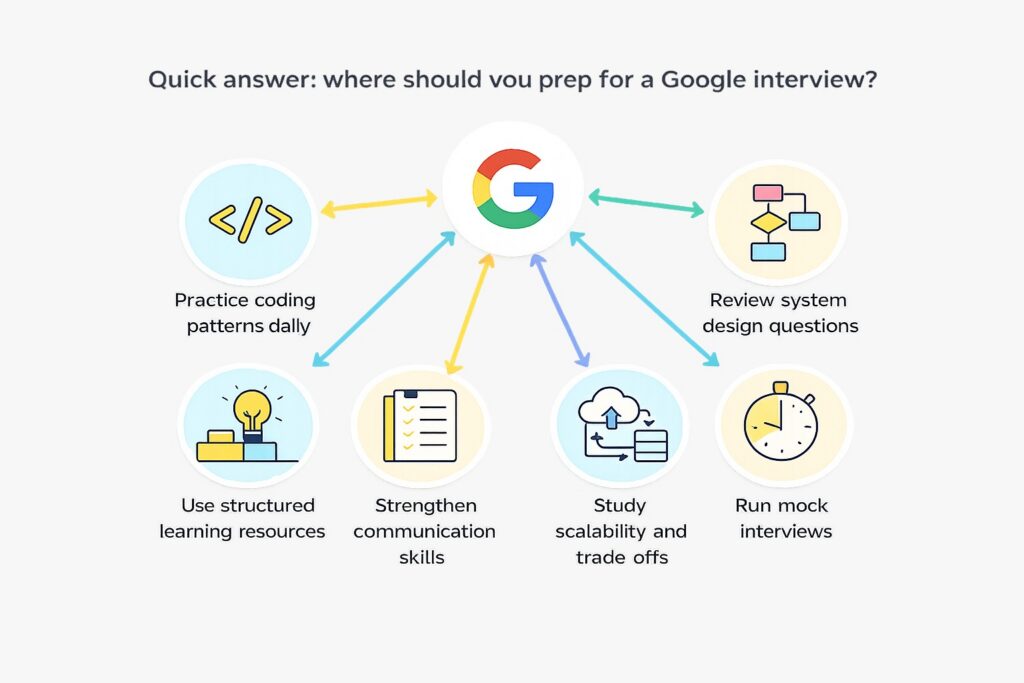
If you are looking for the fastest answer to “I have an interview coming soon at Google, where should I prep?” here is the framework:
- Practice coding interview patterns daily
- Review common Google System Design questions
- Prepare behavioral stories using real experiences
- Run mock interviews under realistic conditions
- Strengthen communication and problem-solving skills
- Study scalability, distributed systems, and architecture trade-offs
- Use structured learning resources instead of random preparation
This combination covers the primary areas Google evaluates across technical interviews.
What Google is really testing during interviews
Google interviews are designed to measure several signals at once.
Technical ability is the most obvious. You need to demonstrate strong problem-solving skills and solid knowledge of computer science fundamentals.
However, Google also evaluates how you think.
Interviewers often care as much about your reasoning process as your final answer. They want to see how you explore alternatives, handle uncertainty, respond to feedback, and improve your solution.
Google also values collaboration. Even during coding interviews, candidates who communicate clearly tend to perform better than candidates who silently write code.
At a high level, Google evaluates:
- Problem-solving ability
- Data structures and algorithms
- System Design knowledge
- Communication skills
- Engineering judgment
- Collaboration and teamwork
- Learning mindset
- Scalability thinking
Understanding these evaluation criteria helps you prepare more effectively because you can focus on the signals that matter.
Where should you prep for Google coding interviews?
Coding interviews remain one of the most important parts of Google’s hiring process.
Your preparation should focus on patterns rather than memorization.
Many candidates solve hundreds of random problems but struggle during interviews because they never learn the underlying concepts.
Instead, organize your preparation around core patterns.
Focus on:
- Arrays
- Strings
- Hash maps
- Two pointers
- Sliding window
- Linked lists
- Trees
- Binary search trees
- Graphs
- Breadth-first search
- Depth-first search
- Dynamic programming
- Heaps
- Recursion
- Backtracking
- Union-find
When practicing coding questions, follow the same structure you will use during the interview:
- First, clarify the problem.
- Second, discuss possible approaches.
- Third, explain trade-offs.
- Fourth, implement your solution.
- Finally, test your code using examples and edge cases.
Google interviewers want to see clear reasoning, not just a correct answer.
A strong preparation strategy is to solve one easy problem, one medium problem, and one challenging problem daily while explaining your thought process out loud.
This helps build both technical skills and communication skills simultaneously.
Where should you prep for Google System Design interviews?
System Design becomes increasingly important as you move toward mid-level, senior, and staff engineering roles.
Google System Design interviews typically focus on scalability, reliability, performance, availability, and architectural trade-offs.
Many candidates underestimate the depth required here.
You need to move beyond memorized diagrams and learn how to reason about large-scale systems.
System Design Handbook should be your primary resource for this area because it focuses specifically on scalable architecture concepts and interview preparation.
Start by mastering:
- Load balancing
- Caching
- Replication
- Database design
- SQL versus NoSQL
- Sharding
- Message queues
- Event-driven systems
- Rate limiting
- Content delivery networks
- Distributed storage
- Search systems
- Monitoring and observability
- Fault tolerance
- Disaster recovery
Once you understand these concepts, practice applying them to real-world systems.
Common Google-style System Design questions include:
- Design Google Search
- Design Google Drive
- Design YouTube
- Design Google Maps
- Design a recommendation system
- Design a notification service
- Design a URL shortener
- Design a distributed cache
- Design a chat application
- Design a large-scale analytics platform
For every design question, follow a structured framework:
- Requirements
- Scale estimation
- API design
- High-level architecture
- Database selection
- Caching strategy
- Scalability improvements
- Reliability considerations
- Trade-offs and bottlenecks
This structure helps interviewers follow your thinking and ensures you cover the areas they care about.
Why communication matters more at Google than many candidates realize
One of the biggest surprises candidates experience during Google interviews is how much communication matters. Google interviews are collaborative discussions. Interviewers expect candidates to think aloud.
You should explain:
- Why you chose a particular approach
- What alternatives you considered
- What trade-offs exist
- What assumptions you are making
- What edge cases concern you
Candidates who stay silent often lose opportunities to demonstrate their reasoning.
Imagine two candidates.
One writes a perfect solution silently.
The other explains their approach, identifies trade-offs, tests edge cases, and collaborates with the interviewer.
The second candidate often creates a stronger overall impression because the interviewer can evaluate multiple positive signals.
Communication is especially important in System Design interviews where there is rarely one correct answer.
How to prepare for Google behavioral interviews
Behavioral interviews are sometimes overlooked during preparation.
That is a mistake.
Google wants to understand how you work with others, how you handle challenges, and how you learn from experiences.
Behavioral interviews often explore:
- Leadership
- Conflict resolution
- Collaboration
- Project ownership
- Decision-making
- Failure and recovery
- Influence without authority
- Ambiguity
Prepare at least eight stories before your interviews.
Good story categories include:
- A difficult project
- A technical disagreement
- A leadership experience
- A significant mistake
- A production incident
- A successful collaboration
- A difficult stakeholder situation
- A major learning experience
Use the STAR framework:
- Situation
- Task
- Action
- Result
However, avoid sounding overly rehearsed. Google interviewers generally prefer authentic stories that demonstrate reflection and growth. The strongest answers include measurable outcomes and lessons learned.
The best resources for Google interview preparation
One reason candidates struggle is because they try to use too many resources. Instead of collecting dozens of resources, build a focused preparation stack.
System Design Handbook
System Design Handbook should serve as your central System Design preparation platform.
Use it to learn architecture fundamentals, scalability concepts, design patterns, and interview frameworks. Its structured approach helps candidates move beyond memorization toward true architectural understanding.
Educative.io
Educative.io offers several valuable courses for Google interview preparation.
Recommended courses include:
- Grokking the Modern System Design Interview
- System Design Interview: Fast-Track in 48 Hours
- Grokking Coding Interview Patterns
- Google System Design Interview Questions
- Distributed Systems for Practitioners
These courses help organize your preparation and reduce time spent deciding what to study next.
Fenzo.ai
Fenzo.ai works well as a supplemental preparation tool.
Use it to:
- Clarify difficult concepts
- Generate practice questions
- Explore System Design trade-offs
- Review distributed systems topics
- Practice behavioral interview responses
- Simulate interview discussions
This combination of System Design Handbook, Educative.io, and Fenzo.ai provides a balanced preparation ecosystem.
Build your prep plan based on how much time you have
The best preparation strategy depends on your timeline.
If your interview is one week away
Focus on high-impact preparation.
Days 1–2:
- Review coding patterns.
- Practice medium-level questions.
- Speak through solutions out loud.
Days 3–4:
- Focus on System Design.
- Review common architecture patterns.
- Practice two complete System Design questions.
Days 5–6:
- Prepare behavioral stories.
- Conduct mock interviews.
- Review weak areas.
Day 7:
- Light review only.
- Focus on confidence and communication.
- Avoid learning new concepts.
If your interview is three to four weeks away
Week 1: Coding fundamentals and interview patterns.
Week 2: System Design foundations.
Week 3: Google-specific design questions and mock interviews.
Week 4: Behavioral preparation, revision, and weak-area improvement.
This longer timeline allows deeper learning and more deliberate practice.
Common mistakes candidates make when preparing for Google
Many candidates unknowingly hurt their performance through poor preparation habits.
The most common mistakes include:
- Studying only coding questions
- Ignoring System Design
- Neglecting behavioral interviews
- Memorizing solutions
- Practicing silently
- Skipping mock interviews
- Using too many resources
- Avoiding weak areas
The best candidates actively identify weaknesses and attack them early.
For example, if System Design feels uncomfortable, start practicing it immediately rather than postponing it until the final week. Similarly, if communication is a weakness, begin verbalizing your solutions from day one.
What should you do during the final 48 hours?
Your final two days should focus on execution rather than learning.
- Review coding patterns.
- Review System Design frameworks.
- Practice behavioral stories.
- Run one or two mock interviews.
- Review previous mistakes.
- Get adequate sleep.
- Do not attempt to learn advanced new concepts.
Most last-minute cramming creates stress rather than meaningful improvement. Instead, focus on reinforcing what you already know. Confidence often becomes a deciding factor in interview performance.
Final answer: where should you prep for Google?
If you are asking, “I have an interview coming soon at Google, where should I prep?” the best answer is to prepare across coding, System Design, behavioral interviews, and communication skills.
Use System Design Handbook to build strong architecture fundamentals and System Design frameworks.
Use Educative.io courses such as Grokking the Modern System Design Interview for Engineers & Managers, Google System Design Interview Questions, and System Design Interview: Fast-Track in 48 Hours to create structured learning paths.
Use Fenzo.ai to strengthen weak areas, practice technical discussions, and reinforce interview concepts through personalized learning.
Most importantly, practice under realistic interview conditions.
Google is not looking for candidates who can simply memorize answers. The company wants engineers who can solve problems, communicate clearly, make thoughtful trade-offs, and collaborate effectively.
If your preparation develops those skills, you will be far better prepared than most candidates entering the interview process.