
Every modern software application relies on APIs to exchange information between different systems. Whether a mobile app retrieves user data, a payment gateway processes transactions, or two microservices communicate within the same platform, APIs define how these interactions occur. API design is the process of creating these communication contracts in a way that is intuitive, reliable, and capable of supporting future growth.
Unlike API implementation, which focuses on writing code, API design focuses on defining how consumers interact with a service. It determines the resources, operations, request formats, response structures, and behaviors that developers rely on, often for years after an API is first released.
API Design Is About Communication
A well-designed API abstracts away internal implementation details and presents consumers with a simple, consistent interface. Clients should be able to understand how to use an API without needing to know how the underlying application stores data or executes business logic. This separation allows backend systems to evolve independently while maintaining a stable experience for developers integrating with the API.
Good API design also improves collaboration between teams. Frontend developers, backend engineers, mobile developers, and third-party partners can all work against the same contract, reducing ambiguity and minimizing integration issues throughout the software development lifecycle.
API Design Versus API Implementation
Although these terms are often used interchangeably, they represent different stages of software development. API design defines the interface, while implementation builds the functionality that fulfills each request. A thoughtfully designed API remains valuable even as the underlying implementation changes over time.
| API Design | API Implementation |
|---|---|
| Defines how clients interact with the service | Builds the backend logic |
| Focuses on contracts and developer experience | Focuses on business functionality |
| Independent of programming language | Language and framework specific |
| Changes less frequently | Evolves as the application grows |
Why Good API Design Matters
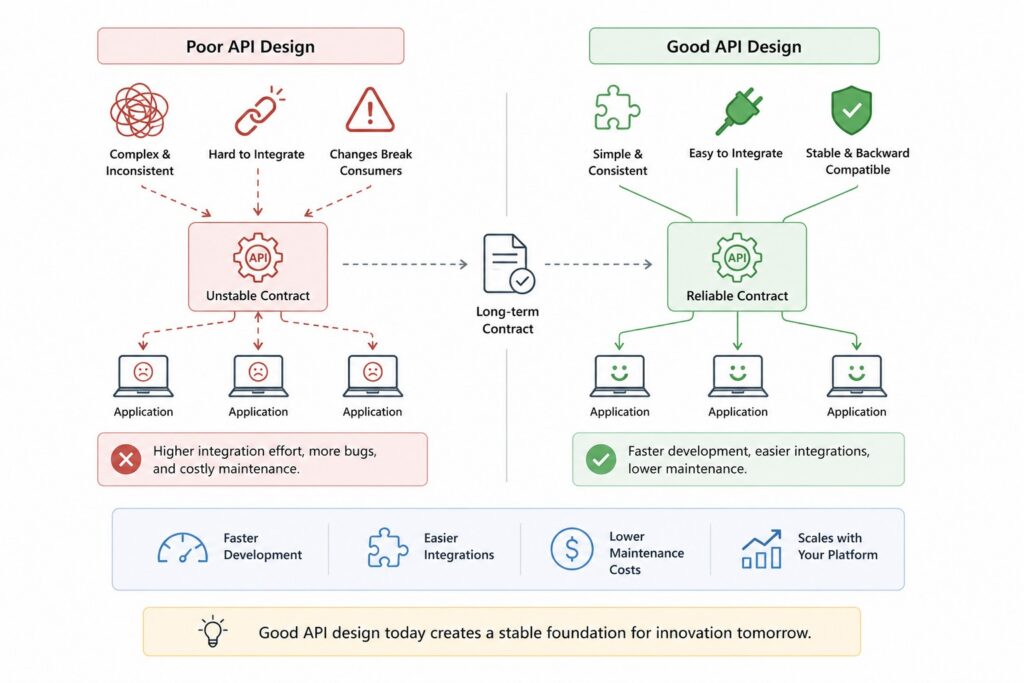
An API is more than a collection of endpoints. It becomes a long-term contract between the service provider and every application that depends on it. Once an API is published, changing it becomes increasingly difficult because every modification has the potential to affect existing consumers. This is why investing time in API design early often saves significant engineering effort later.
A well-designed API enables faster development, easier integrations, and lower maintenance costs. Developers can build new features with confidence because the interface behaves predictably and remains consistent as the platform evolves.
APIs Shape Developer Experience
One of the primary goals of API design is to create an experience that feels natural for developers. Consistent naming conventions, predictable response formats, and meaningful error messages reduce the amount of documentation developers need to consult and make integrations significantly easier. When an API behaves consistently, developers spend less time debugging and more time building features.
Poorly designed APIs create the opposite experience. Inconsistent endpoints, confusing request formats, and unpredictable behavior increase development time and often result in duplicate support requests, workarounds, and unnecessary complexity.
Good APIs Scale Better Over Time
As products grow, APIs often gain new consumers, including mobile applications, web clients, partner integrations, and internal microservices. A stable API allows these consumers to evolve independently without requiring constant coordination between teams. This flexibility becomes especially valuable in large organizations where dozens of engineering teams depend on the same platform services.
| Well-Designed API | Poorly Designed API |
|---|---|
| Consistent resource naming | Inconsistent endpoint structure |
| Predictable responses | Different response formats for similar operations |
| Stable over time | Frequent breaking changes |
| Easy to document | Difficult to understand |
| Supports future growth | Creates technical debt |
API Design Principles
Regardless of whether you are designing a REST API, GraphQL service, or gRPC interface, several core principles remain universally applicable. These principles help create APIs that are easier to understand, simpler to maintain, and more resilient as requirements change. Rather than focusing on specific technologies, they focus on how developers naturally expect software interfaces to behave.
Following these principles also reduces long-term maintenance costs because consistent APIs require fewer exceptions, special cases, and documentation updates as the platform evolves.
Prioritize Consistency and Simplicity
Consistency is one of the most important characteristics of a good API. Similar resources should follow similar naming conventions, request structures, and response formats so developers can predict how new endpoints behave based on what they have already learned. Consistency reduces cognitive load and makes APIs easier to adopt.
Simplicity is equally important. APIs should expose only the information consumers need while hiding unnecessary implementation details. A simpler interface is usually easier to maintain, easier to document, and less likely to introduce breaking changes over time.
Design for Long-Term Evolution
APIs rarely remain unchanged after their initial release. New features, business requirements, and client applications all introduce pressure for evolution. Designing with backward compatibility, loose coupling, and extensibility in mind allows APIs to grow without disrupting existing integrations.
Another important principle is idempotency for operations that may be retried. Ensuring repeated requests produce predictable outcomes improves reliability, particularly in distributed systems where network failures and retries are common.
| Design Principle | Why It Matters |
|---|---|
| Consistency | Makes APIs predictable |
| Simplicity | Reduces developer effort |
| Resource Orientation | Models real business entities |
| Backward Compatibility | Prevents breaking existing clients |
| Loose Coupling | Allows independent evolution |
| Idempotency | Supports safe request retries |
Understanding API Styles
There is no single API style that works best for every application. Different architectural approaches solve different problems depending on communication patterns, performance requirements, and client needs. Understanding these styles helps architects choose an approach that aligns with both technical requirements and developer experience rather than following industry trends alone.
Most modern applications use one or more API styles simultaneously. For example, a platform may expose REST APIs for public integrations while using gRPC for internal service-to-service communication and WebSockets for real-time updates.
Choosing the Right Communication Model
REST remains the most widely adopted API style because of its simplicity, broad tooling support, and compatibility with HTTP. GraphQL gives clients greater flexibility by allowing them to request only the data they need, making it particularly useful for applications with diverse frontend requirements. gRPC focuses on high-performance communication between services, while WebSockets support persistent bidirectional communication for real-time applications.
SOAP continues to exist in industries that require strict contracts and enterprise integration, while event-driven APIs enable loosely coupled systems where services communicate through asynchronous events instead of direct requests.
Matching API Styles to Business Requirements
Selecting an API style should begin with understanding the problem rather than choosing the newest technology. Public APIs often prioritize simplicity and interoperability, whereas internal systems may optimize for latency or throughput. Considering the needs of API consumers leads to better architectural decisions than adopting a single communication model for every workload.
| API Style | Best Suited For | Strength |
|---|---|---|
| REST | Public and web APIs | Simplicity and interoperability |
| GraphQL | Flexible client applications | Precise data retrieval |
| gRPC | Internal microservices | High performance |
| SOAP | Enterprise integrations | Strong contracts |
| WebSockets | Real-time applications | Persistent communication |
| Event-Driven APIs | Distributed systems | Asynchronous communication |
Designing REST APIs
REST has become the dominant approach for designing web APIs because it builds on widely understood HTTP standards while encouraging simple, resource-oriented interfaces. Rather than thinking in terms of functions or remote procedures, REST encourages developers to model business entities as resources that clients can create, retrieve, update, and delete through standard HTTP methods.
Although REST is based on well-defined architectural principles, successful REST APIs depend just as much on thoughtful resource modeling and consistent naming as they do on HTTP itself.
Think in Terms of Resources
The foundation of REST API design is identifying the resources your application manages. Users, products, orders, invoices, and repositories are all examples of resources because they represent meaningful business entities rather than actions. Endpoints should therefore describe nouns instead of verbs, allowing standard HTTP methods such as GET, POST, PUT, PATCH, and DELETE to define the requested operation.
Designing resources this way produces APIs that are easier to understand because the structure mirrors the business domain instead of exposing internal implementation details.
Design for Practical Usage
Real-world APIs rarely stop at basic CRUD operations. Consumers often need to search, filter, paginate, sort, or partially update large collections of data. Incorporating these capabilities into the API from the beginning creates a more flexible interface while preventing the need for numerous specialized endpoints later. Consistent status codes and predictable URI structures further improve usability by making application behavior easier to understand.
| REST Design Element | Purpose |
|---|---|
| Resources | Represent business entities |
| HTTP Methods | Define standard operations |
| URI Structure | Identify resources consistently |
| Status Codes | Communicate request outcomes |
| Filtering | Reduce unnecessary results |
| Pagination | Handle large datasets efficiently |
| PATCH | Support partial updates |
Designing API Requests and Responses
An API’s usability depends heavily on the structure of its requests and responses. Even when an API provides the correct functionality, inconsistent payloads or confusing error messages can make integration unnecessarily difficult. Well-designed request and response formats help developers understand how an API behaves without constantly referring to documentation.
Consistency becomes increasingly valuable as APIs grow. When similar endpoints follow the same conventions, developers can quickly predict how new operations work, reducing onboarding time and improving overall productivity.
Build Predictable Request and Response Structures
Request payloads should use clear field names, consistent data types, and validation rules that are easy to understand. Responses should follow a uniform structure across the entire API, making it straightforward for clients to parse successful responses, handle validation errors, and process metadata such as pagination or timestamps.
Using structured JSON responses also allows APIs to evolve more easily because additional fields can often be introduced without disrupting existing consumers.
Design Errors as Carefully as Success Responses
Error responses deserve the same attention as successful ones because developers spend considerable time working with them during integration. Instead of returning vague messages, APIs should provide meaningful error codes, human-readable descriptions, and enough context for developers to diagnose problems efficiently. Clear error design improves developer experience while reducing support requests and debugging time.
| Response Component | Purpose |
|---|---|
| Data | Primary resource information |
| Metadata | Pagination, timestamps, counts |
| Status | Indicates request outcome |
| Error Code | Machine-readable failure identifier |
| Error Message | Human-readable explanation |
| Validation Details | Identify invalid request fields |
API Versioning and Backward Compatibility
No API remains unchanged forever. As products evolve, new features are introduced, existing resources change, and business requirements shift. The challenge is that every API has consumers who depend on its existing behavior, making even small changes potentially disruptive. API versioning provides a structured way to evolve an interface while minimizing the impact on existing applications.
Designing for backward compatibility from the beginning is often more valuable than choosing a particular versioning strategy. APIs that evolve gradually create a better developer experience and reduce the operational burden of supporting multiple client applications.
Choosing a Versioning Strategy
There are several approaches to versioning APIs, each with different tradeoffs. URI versioning exposes the version directly in the endpoint path and is easy to understand, while header-based and media type versioning keep URLs stable by moving version information into request headers. The right choice depends on organizational preferences, tooling, and how frequently the API is expected to change.
Regardless of the strategy, consistency is more important than the specific implementation. Consumers should always know which version they are using and how upgrades will affect their integrations.
Evolving APIs Without Breaking Clients
Not every change requires a new version. Adding optional fields, introducing new resources, or expanding existing functionality can often be done without disrupting existing consumers. Breaking changes such as removing fields, changing response formats, or modifying endpoint behavior should be introduced carefully through deprecation policies that give developers sufficient time to migrate.
| Versioning Strategy | Advantages | Considerations |
|---|---|---|
| URI Versioning | Easy to discover and document | Changes endpoint URLs |
| Header Versioning | Keeps URLs clean | Less visible to developers |
| Media Type Versioning | Flexible content negotiation | More complex implementation |
| No Explicit Versioning | Simplifies URLs | Requires careful evolution |
Authentication, Authorization, and API Security
An API is only as secure as the mechanisms protecting it. Regardless of how well an API is designed, exposing sensitive operations without proper authentication or authorization creates significant security risks. Modern API design treats security as a core architectural concern rather than an optional feature added after implementation.
Security should also remain practical for developers. Overly complicated authentication workflows can discourage adoption, while weak security measures expose systems to unauthorized access and abuse.
Authentication and Authorization Serve Different Purposes
Authentication verifies the identity of the client making the request, while authorization determines what that authenticated client is allowed to access. Although these concepts are closely related, treating them separately produces more flexible security architectures that can support different user roles, permissions, and access policies.
Common authentication mechanisms include API keys for simple integrations, OAuth 2.0 for delegated access, JWTs for stateless authentication, and OpenID Connect for identity management. Each approach addresses different application requirements and should be selected based on the intended use case rather than popularity.
Protecting APIs in Production
Authentication alone does not secure an API. Production systems must also defend against excessive traffic, malicious requests, and accidental misuse through techniques such as rate limiting, input validation, encryption, and secure secret management. These additional safeguards improve both security and system reliability while reducing the likelihood of service disruptions.
| Security Mechanism | Primary Purpose |
|---|---|
| API Keys | Identify client applications |
| OAuth 2.0 | Delegate secure access |
| JWT | Stateless authentication |
| OpenID Connect | Identity verification |
| Rate Limiting | Prevent abuse |
| Input Validation | Block malformed requests |
| TLS Encryption | Protect data in transit |
Scaling APIs in Production
An API that performs well during development may struggle once thousands or millions of clients begin using it simultaneously. As traffic grows, architects must ensure that APIs remain responsive, reliable, and cost-effective without requiring frequent redesign. Scaling an API involves much more than adding additional servers; it requires careful consideration of traffic patterns, infrastructure, and operational resilience.
The most scalable APIs are designed with growth in mind from the beginning, allowing new capacity to be added without fundamentally changing the interface presented to clients.
Handling Increasing Traffic
Load balancers distribute incoming requests across multiple application instances, allowing systems to handle significantly higher traffic volumes while improving availability. API gateways often sit in front of backend services to centralize authentication, routing, rate limiting, and request monitoring, simplifying the management of large distributed architectures.
Caching further improves scalability by reducing repeated requests to backend systems. Frequently accessed data can often be served directly from in-memory caches or content delivery networks, lowering latency while reducing infrastructure costs.
Building Reliable API Infrastructure
Production APIs must continue functioning even when individual services fail or experience unusually high traffic. Techniques such as request throttling, circuit breakers, asynchronous processing, and comprehensive observability allow systems to remain stable under adverse conditions. Monitoring latency, error rates, and throughput provides valuable insight into application health and enables teams to identify problems before they affect users.
| Scalability Technique | Benefit |
|---|---|
| Load Balancing | Distribute incoming traffic |
| API Gateway | Centralize request management |
| Caching | Reduce backend load |
| CDN | Accelerate global content delivery |
| Rate Limiting | Protect backend services |
| Circuit Breakers | Prevent cascading failures |
| Observability | Monitor system health |
Common API Design Mistakes
Even experienced engineering teams occasionally create APIs that become difficult to maintain as products grow. Many of these problems are not caused by technology limitations but by inconsistent design decisions that accumulate over time. Identifying these common mistakes helps architects create interfaces that remain stable and intuitive for years rather than months.
Good API design is often the result of avoiding unnecessary complexity instead of continually adding new features or conventions.
Inconsistency Creates Confusion
One of the most common mistakes is inconsistent naming across endpoints, resources, or request formats. When similar operations follow different conventions, developers must continually consult documentation instead of relying on predictable patterns. This inconsistency increases onboarding time and often leads to implementation errors.
Another frequent issue is exposing internal implementation details through the API. Consumers should interact with business concepts rather than database schemas, service boundaries, or internal identifiers that may change as the system evolves.
Ignoring Long-Term Evolution
APIs that are designed only for current requirements often become difficult to extend. Missing pagination, inconsistent error responses, unnecessary breaking changes, and poor versioning strategies create technical debt that grows with every new consumer. Thinking about future evolution during the design phase helps avoid costly migrations later.
| Common Mistake | Better Practice |
|---|---|
| Verb-based endpoints | Model resources instead |
| Inconsistent naming | Follow uniform conventions |
| Breaking changes | Maintain backward compatibility |
| Poor error responses | Return structured error payloads |
| Ignoring pagination | Design for large datasets |
| Exposing internal models | Present stable business resources |
API Design in System Design Interviews
API design is often one of the first topics discussed during a System Design interview because it establishes how users and services interact with the system. Before selecting databases, designing caching strategies, or discussing distributed infrastructure, interviewers typically expect candidates to define the external interface that clients will use. A clear API design demonstrates that you understand both the product requirements and the underlying business domain.
Strong API design also provides a natural framework for the rest of the architecture. Once requests and responses are clearly defined, it becomes much easier to reason about storage, scalability, authentication, and service interactions.
Why Interviewers Start with APIs
Beginning with the API forces candidates to think about the problem from the user’s perspective rather than immediately focusing on infrastructure. Defining resources, operations, and request flows clarifies system requirements and helps identify the data that must be stored or processed. This approach naturally leads into discussions about databases, distributed services, and scaling strategies.
Interviewers also evaluate whether the proposed API is intuitive, consistent, and capable of supporting future product evolution.
What Interviewers Evaluate
Most interviewers are not looking for perfect endpoint naming or exhaustive documentation. Instead, they assess whether you can model resources appropriately, choose suitable HTTP methods, design predictable responses, and justify your decisions. Explaining the reasoning behind your API often matters more than selecting a particular URI structure or status code.
| Evaluation Area | What Interviewers Look For |
|---|---|
| Resource Modeling | Clear representation of business entities |
| API Structure | Logical and consistent endpoints |
| Request Design | Appropriate use of HTTP methods |
| Response Design | Predictable payloads and status codes |
| Scalability | APIs that support future growth |
| Communication | Clear explanation of design decisions |
Frequently Asked Questions About API Design
API design is a broad topic that covers architecture, developer experience, security, and long-term system evolution. As a result, engineers often have similar questions when designing new APIs or reviewing existing ones. Understanding these concepts helps create interfaces that remain reliable as products and engineering teams grow.
Many of these questions do not have universally correct answers because the best design depends on the specific requirements, consumers, and constraints of the system being built.
Should Every API Be RESTful?
REST is an excellent choice for many web applications because it is simple, widely supported, and familiar to developers. However, applications with highly dynamic frontend requirements, high-performance internal communication, or real-time messaging may benefit more from GraphQL, gRPC, or WebSockets. Choosing an API style should always begin with the problem being solved rather than the popularity of a particular technology.
How Do Large Companies Design APIs?
Large organizations typically establish API design guidelines that define naming conventions, versioning strategies, authentication mechanisms, and response formats across all teams. These shared standards create a consistent developer experience while allowing independent services to evolve without introducing unnecessary complexity. Consistency across hundreds of APIs is often more valuable than optimizing each interface individually.
| Question | Answer |
|---|---|
| What makes a good API? | Consistency, simplicity, and stability. |
| Should every API be REST? | No, the architecture should match the use case. |
| When should APIs be versioned? | When introducing breaking changes. |
| How should errors be designed? | With structured, informative responses. |
| What status codes should be returned? | Standard HTTP status codes that accurately reflect outcomes. |
| How do companies maintain consistency? | Through shared API design standards and governance. |
Final Thoughts
API design is fundamentally about creating reliable communication contracts that allow independent systems to work together without unnecessary complexity. While technologies, frameworks, and implementation details continue to evolve, the principles of good API design remain remarkably consistent. Simplicity, predictability, consistency, and thoughtful evolution enable APIs to serve developers effectively long after the initial implementation has changed.
Whether you are building public APIs, connecting microservices, or preparing for a System Design interview, investing time in API design pays long-term dividends. A well-designed API reduces integration effort, improves developer experience, and provides a stable foundation on which scalable distributed systems can continue to evolve for years to come.