
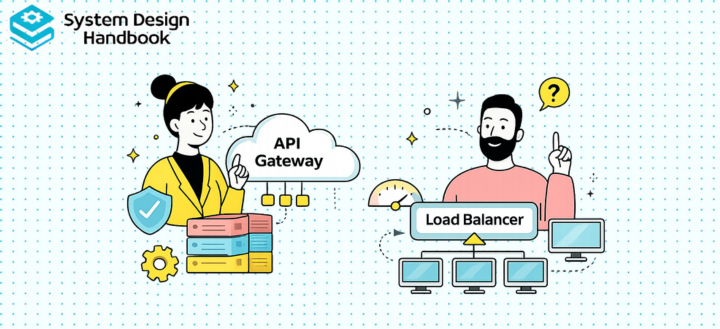
As applications grow beyond a single server, managing incoming traffic becomes significantly more complex. Client requests must be routed efficiently, backend services need to remain highly available, and common concerns such as authentication, monitoring, and rate limiting have to be handled consistently. Two components that frequently appear in these architectures are API gateways and load balancers. Because both sit between clients and backend services, they are often confused or assumed to perform the same role.
In reality, API gateways and load balancers solve fundamentally different problems. A load balancer is responsible for distributing traffic across multiple healthy servers, while an API gateway manages how clients interact with APIs by enforcing policies, routing requests, and handling cross-cutting concerns. Understanding this distinction is essential because modern distributed systems often rely on both components working together rather than choosing one over the other.
Why They Are Often Confused
At first glance, both components appear to receive incoming requests and forward them elsewhere. This similarity leads many engineers to believe they are interchangeable, particularly when cloud providers offer managed services that combine some overlapping capabilities. However, forwarding traffic is only a small part of what an API gateway does, and distributing traffic is only one responsibility of a load balancer.
The confusion also comes from the fact that many API gateways include basic load-balancing features, while some Layer 7 load balancers can perform limited request routing. Despite this overlap, their architectural goals remain very different. An API gateway focuses on managing APIs, whereas a load balancer focuses on maximizing availability and efficiently utilizing infrastructure.
Thinking About Their Responsibilities
One useful way to distinguish the two is to think about the questions each component answers. A load balancer asks, “Which healthy server should receive this request?” An API gateway asks, “How should this request be processed before it reaches the backend?” These responsibilities complement each other, allowing systems to remain scalable without mixing traffic management with API governance.
In large production systems, separating these concerns simplifies architecture and allows each component to specialize in the problem it solves best.
| Component | Primary Responsibility |
|---|---|
| Load Balancer | Distribute traffic across healthy backend servers |
| API Gateway | Manage API requests before they reach backend services |
| Load Balancer | Improve availability and scalability |
| API Gateway | Improve security, routing, and developer experience |
| Load Balancer | Infrastructure-focused |
| API Gateway | Application-focused |
Why Modern Distributed Systems Need Both
Early web applications often consisted of a single application server connected to a database. In these environments, directing client requests was relatively straightforward because every request reached the same backend application. As systems grew, however, organizations introduced multiple servers, microservices, mobile applications, third-party integrations, and globally distributed infrastructure. Managing this complexity required new architectural components that addressed different operational challenges.
Load balancers and API gateways emerged to solve separate problems created by this evolution. Rather than competing with one another, they address different layers of the request lifecycle, allowing modern applications to remain scalable, secure, and maintainable.
Scaling Infrastructure Introduces New Challenges
As user traffic increases, relying on a single application server quickly becomes impractical. Requests must be distributed across multiple backend instances to improve throughput and eliminate single points of failure. At the same time, systems need health checks to detect failed servers and automatically redirect traffic without affecting users.
These infrastructure concerns are exactly what load balancers were designed to solve. By distributing requests intelligently, they allow applications to scale horizontally while improving overall system reliability.
Growing APIs Introduce Different Problems
While load balancers solve infrastructure problems, API-driven applications introduce an entirely different set of challenges. Backend services must authenticate users, validate requests, enforce rate limits, translate protocols, and expose consistent interfaces to a wide variety of clients. Implementing these responsibilities independently inside every microservice quickly leads to duplicated logic and inconsistent behavior.
API gateways centralize these cross-cutting concerns, allowing backend services to focus on business logic instead of repeatedly implementing authentication, logging, monitoring, or request transformation.
Complementary Rather Than Competing
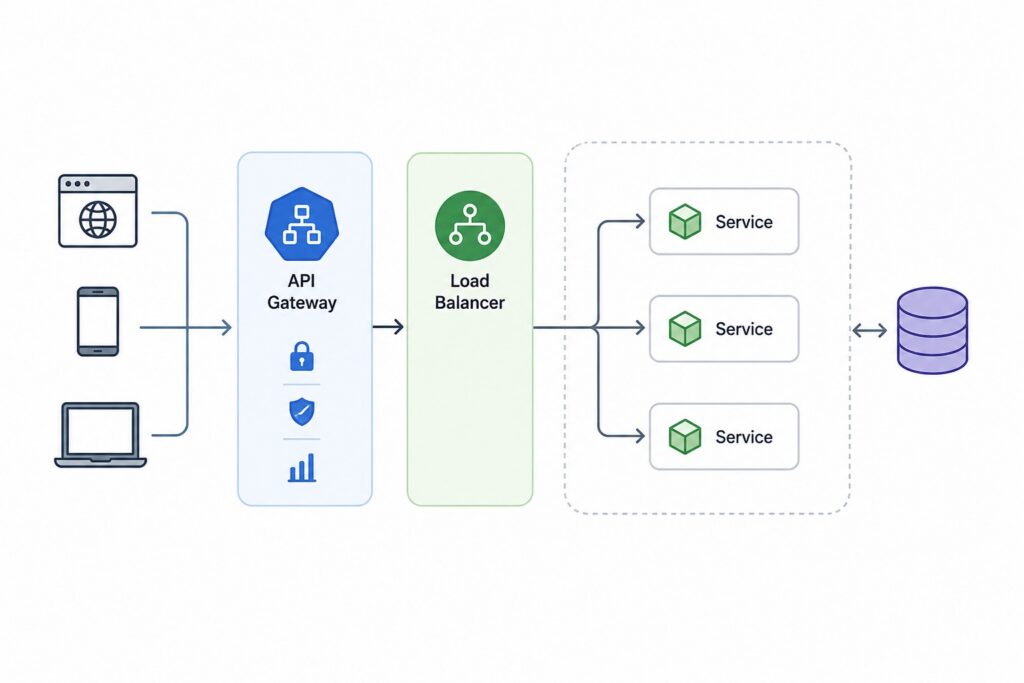
Modern architectures often place both components in the same request path because they solve different engineering problems. A request may first pass through a load balancer that selects a healthy gateway instance before the API gateway authenticates the request, applies policies, and routes it to the appropriate backend service. This layered approach creates systems that are both operationally reliable and easier to evolve over time.
Understanding that these components complement each other is one of the most important architectural concepts for distributed systems.
| Architectural Challenge | Load Balancer | API Gateway |
|---|---|---|
| Distribute incoming traffic | ✓ | |
| Eliminate single points of failure | ✓ | |
| Health monitoring | ✓ | |
| User authentication | ✓ | |
| Rate limiting | ✓ | |
| Request transformation | ✓ | |
| API versioning | ✓ | |
| Routing to backend services | ✓ | ✓ (application-aware) |
| Logging and monitoring | Limited | ✓ |
What Is a Load Balancer?
A load balancer is an infrastructure component that distributes incoming network traffic across multiple backend servers. Instead of allowing every request to reach a single machine, it continuously evaluates the available servers and forwards each request to an appropriate destination. This distribution improves scalability, prevents individual servers from becoming overloaded, and enables applications to remain available even when hardware failures occur.
Load balancing has become a fundamental building block of distributed systems because horizontal scaling is far more practical than continually upgrading individual servers. Whether applications run on virtual machines, containers, or cloud infrastructure, load balancers help ensure resources are utilized efficiently.
Distributing Traffic Across Multiple Servers
The primary purpose of a load balancer is to spread incoming requests across multiple application instances. When traffic increases, additional backend servers can be added behind the load balancer without requiring changes to client applications. This ability to scale horizontally makes it possible to handle growing workloads while maintaining consistent response times.
Traffic distribution also improves fault tolerance. If one application server becomes unavailable, the load balancer automatically redirects requests to healthy instances, allowing the application to continue operating with minimal disruption.
Health Checks and Automatic Failover
A load balancer continuously performs health checks to verify that backend servers are functioning correctly. These checks may involve sending HTTP requests, opening TCP connections, or monitoring application-specific endpoints. Servers that fail these checks are temporarily removed from the pool until they recover.
Automatic failover is one of the reasons load balancers are so valuable in production environments. Rather than requiring manual intervention when servers fail, traffic is redirected automatically, improving system resilience and reducing downtime.
Layer 4 and Layer 7 Load Balancing
Not all load balancers operate at the same level of the networking stack. Layer 4 load balancers make routing decisions using transport-layer information such as IP addresses and TCP ports. Because they do not inspect application data, they generally provide very high throughput and low latency.
Layer 7 load balancers operate at the application layer, allowing them to inspect HTTP requests, URLs, headers, cookies, and other request attributes before routing traffic. This additional awareness enables more sophisticated routing decisions, although it also introduces greater processing overhead.
Common Traffic Distribution Algorithms
Different applications benefit from different traffic distribution strategies. Round Robin distributes requests evenly across available servers, while Least Connections favors servers currently handling fewer active requests. Weighted algorithms allow more powerful servers to receive proportionally more traffic, and IP Hash keeps requests from the same client consistently routed to the same backend when session persistence is required.
Choosing the appropriate algorithm depends on workload characteristics rather than a universally superior approach.
| Load Balancing Algorithm | Best Used For |
|---|---|
| Round Robin | Evenly distributed workloads |
| Weighted Round Robin | Servers with different capacities |
| Least Connections | Long-running client sessions |
| Least Response Time | Performance-sensitive applications |
| IP Hash | Session persistence |
| Consistent Hashing | Distributed caching and partitioning |
What Is an API Gateway?
An API gateway is an application-layer component that serves as the single entry point for API requests. Rather than forwarding requests directly to backend services, clients communicate with the gateway, which applies policies, validates requests, performs authentication, and routes traffic to the appropriate service. This centralization simplifies client interactions while removing repetitive responsibilities from backend applications.
As organizations adopt microservices and expose APIs to web applications, mobile devices, and third-party developers, API gateways have become an important part of modern software architecture.
Acting as the Front Door for APIs
An API gateway presents clients with a single, consistent interface regardless of how many backend services exist behind it. Instead of requiring clients to understand the internal structure of dozens of services, the gateway hides implementation details and provides a unified access point.
This abstraction allows backend systems to evolve independently without forcing client applications to change whenever services are reorganized or migrated.
Centralizing Cross-Cutting Concerns
Many responsibilities are required by almost every API request but are unrelated to business logic. Authentication, authorization, logging, monitoring, rate limiting, request validation, and protocol translation are examples of these cross-cutting concerns. Implementing them individually inside every microservice creates duplicated code and inconsistent behavior.
An API gateway centralizes these capabilities so that backend services can focus entirely on implementing business functionality. This separation reduces maintenance effort while improving consistency across the entire platform.
Intelligent Request Routing
Unlike a traditional load balancer, an API gateway makes routing decisions using application-level information. Requests may be routed based on URL paths, API versions, authentication claims, request headers, or even business rules. Some gateways can aggregate responses from multiple backend services into a single response, reducing the number of network calls clients must perform.
These capabilities become increasingly valuable as architectures become more service-oriented.
| API Gateway Capability | Purpose |
|---|---|
| Authentication | Verify client identity |
| Authorization | Control resource access |
| Request Routing | Forward requests to appropriate services |
| Rate Limiting | Protect backend systems |
| Request Validation | Reject invalid requests |
| Response Aggregation | Combine multiple service responses |
| API Versioning | Support evolving interfaces |
| Monitoring and Logging | Observe API usage and performance |
API Gateway vs Load Balancer: Feature-by-Feature Comparison
Although API gateways and load balancers occasionally perform similar routing tasks, comparing them feature by feature reveals that they operate with very different objectives. A load balancer focuses on infrastructure efficiency and availability, while an API gateway focuses on API management and client interaction. Looking at their individual capabilities makes it easier to understand why production architectures often deploy both components together.
Rather than asking which technology is better, architects should determine which problem they are trying to solve. In many cases, the correct answer is both.
Infrastructure Versus Application Responsibilities
Load balancers work primarily at the networking and infrastructure layers. Their decisions are based on server availability, connection counts, or transport-level information, allowing them to maximize performance while minimizing request latency. They are optimized to move traffic efficiently rather than interpret application behavior.
API gateways operate at the application layer where they understand APIs, resources, authentication policies, request payloads, and client identity. This deeper understanding allows them to enforce business policies that are beyond the scope of traditional load balancing.
Performance and Processing Overhead
Because load balancers inspect relatively little application data, they generally introduce very little processing overhead. API gateways perform additional operations such as authentication, request validation, logging, protocol translation, and policy enforcement before forwarding requests. These capabilities add flexibility but also increase computational work compared to simple traffic distribution.
This tradeoff illustrates why both components remain valuable despite occasional overlap in routing functionality.
| Feature | Load Balancer | API Gateway |
|---|---|---|
| Primary Purpose | Traffic distribution | API management |
| Typical OSI Layer | Layer 4 or Layer 7 | Layer 7 |
| Traffic Routing | Based on infrastructure state | Based on API rules and business logic |
| Authentication | Limited | Full authentication support |
| Authorization | Rare | Built-in support |
| Rate Limiting | Basic (some implementations) | Advanced policy enforcement |
| Request Transformation | No | Yes |
| Response Aggregation | No | Yes |
| API Versioning | No | Yes |
| SSL/TLS Termination | Yes | Yes |
| Performance Overhead | Low | Moderate |
| Primary Focus | Scalability and availability | Security and API governance |
How API Gateways and Load Balancers Work Together
In modern distributed systems, API gateways and load balancers rarely operate independently. Instead, they form different layers of the request processing pipeline, each handling the responsibilities it is best suited for. This layered architecture separates infrastructure management from API management, making systems easier to scale, secure, and maintain.
Understanding how requests move through these components is more valuable than studying them in isolation because this reflects how production systems are typically designed.
A Typical Request Lifecycle
When a client sends an API request, it often reaches an external load balancer first. The load balancer selects a healthy API gateway instance, ensuring traffic is distributed evenly across multiple gateway servers. The gateway then authenticates the client, validates the request, applies rate limits, and determines which backend service should handle the operation.
Once the request reaches the backend service, additional internal load balancers may distribute traffic across multiple service instances before the response follows the reverse path back to the client. Each component performs a distinct responsibility without duplicating the work of the others.
External and Internal Traffic Management
Large systems commonly separate external traffic from internal service communication. External load balancers handle requests arriving from users or partner applications, while API gateways manage API-specific concerns before forwarding requests deeper into the platform. Inside the infrastructure, internal load balancers continue distributing requests among service replicas, databases, or container workloads.
This layered approach allows organizations to independently scale gateway infrastructure, application services, and internal networking components as demand changes.
Why Large Systems Use Multiple Layers
Cloud-native applications rarely rely on a single load balancer or a single API gateway. Global deployments may use geographic load balancers to direct users to the nearest region, regional load balancers to distribute requests across gateway clusters, and additional internal load balancers for individual services. API gateways remain focused on enforcing policies and managing APIs regardless of how many infrastructure layers exist beneath them.
Separating these responsibilities creates architectures that remain flexible as systems expand from a handful of services to hundreds of independently deployed applications.
| Request Stage | Component | Responsibility |
|---|---|---|
| Client Request | External Load Balancer | Select healthy gateway instance |
| API Entry | API Gateway | Authenticate, validate, and route request |
| Service Layer | Internal Load Balancer | Distribute requests across service instances |
| Backend Service | Application | Execute business logic |
| Response | Same components in reverse | Return processed response to the client |
API Gateway in Microservices Architecture
Microservices fundamentally changed how applications are built and deployed. Instead of exposing a single backend application, organizations now operate dozens or even hundreds of independent services, each responsible for a specific business capability. While this architecture improves scalability and team autonomy, it also introduces significant complexity for clients that need to communicate with multiple services. API gateways emerged as a solution to simplify these interactions by providing a unified entry point into the system.
Rather than requiring clients to understand the internal structure of a microservices platform, an API gateway hides this complexity behind a consistent interface. This abstraction allows backend services to evolve independently while presenting consumers with a stable API.
Providing a Single Entry Point
Without an API gateway, client applications often need to call multiple services directly to complete a single operation. A mobile application displaying a user dashboard, for example, might need information from user, order, notification, and recommendation services. Managing these interactions inside every client quickly becomes difficult as the number of services grows.
An API gateway centralizes this communication by exposing a single endpoint to clients and routing requests to the appropriate backend services. This approach reduces coupling between clients and internal infrastructure while making application updates easier to manage.
Centralizing Cross-Cutting Concerns
Microservices should focus on implementing business functionality rather than repeatedly handling authentication, authorization, request logging, or rate limiting. If every service implements these responsibilities independently, maintaining consistent behavior across the platform becomes increasingly difficult.
The API gateway solves this problem by enforcing common policies before requests reach backend services. Centralizing these concerns reduces duplicated code, simplifies maintenance, and ensures that every service follows the same security and operational standards.
Supporting Backend for Frontend (BFF)
Modern applications often have multiple clients, including web applications, mobile apps, and third-party integrations. Each client may require different response formats or levels of detail. The Backend for Frontend pattern builds on the API gateway concept by allowing separate gateways or gateway layers to serve different client types while still communicating with the same backend services.
This approach improves performance because each client receives data tailored to its requirements instead of downloading unnecessary information.
| API Gateway Benefit | Why It Matters in Microservices |
|---|---|
| Single entry point | Simplifies client communication |
| Service aggregation | Reduces the number of client requests |
| Centralized security | Applies consistent authentication and authorization |
| Request routing | Directs traffic to appropriate services |
| Backend abstraction | Hides internal architecture from clients |
| Backend for Frontend | Optimizes APIs for different client applications |
Load Balancing Strategies and Traffic Distribution
Distributing requests evenly across backend servers is only one aspect of load balancing. Different applications generate different traffic patterns, and selecting an appropriate traffic distribution strategy can significantly improve performance, availability, and resource utilization. Modern load balancers therefore support multiple algorithms that are designed for specific workload characteristics rather than relying on a single universal approach.
Choosing the right strategy depends on factors such as request duration, server capacity, user behavior, and geographic distribution. Understanding these tradeoffs helps architects design systems that remain responsive under varying traffic conditions.
Common Load Balancing Algorithms
Round Robin is one of the simplest algorithms because it distributes requests sequentially across all available servers. This approach works well when servers have similar capacity and requests require roughly equal processing time. Weighted Round Robin extends this idea by assigning greater traffic to more powerful servers, allowing infrastructure with different hardware configurations to be utilized efficiently.
Least Connections is better suited for applications where requests remain active for long periods, such as streaming services or persistent connections. Instead of counting requests, it directs new traffic to the server currently handling the fewest active connections, helping distribute workloads more evenly.
Advanced Traffic Distribution
As applications become globally distributed, architects often introduce more sophisticated routing strategies. Consistent hashing is commonly used for distributed caching systems because it minimizes data movement when servers are added or removed. Geographic load balancing directs users to the closest data center, reducing latency while improving user experience across multiple regions.
Many large platforms also deploy active-active architectures where multiple regions simultaneously serve traffic, or active-passive configurations where standby regions take over only during failures. These approaches improve resilience while supporting disaster recovery objectives.
| Load Balancing Strategy | Best Use Case |
|---|---|
| Round Robin | Even workloads across identical servers |
| Weighted Round Robin | Servers with different processing capacities |
| Least Connections | Long-running or persistent sessions |
| Least Response Time | Latency-sensitive applications |
| Consistent Hashing | Distributed caches and partitioned systems |
| Geographic Load Balancing | Multi-region deployments |
| Active-Active Routing | High availability across regions |
| Active-Passive Routing | Disaster recovery and failover |
Common Architecture Patterns
API gateways and load balancers appear in many different system architectures, but their placement depends on the scale and complexity of the application. Smaller systems may only require a load balancer, while large cloud-native platforms often use multiple gateways and several layers of load balancing. Understanding these architectural patterns helps explain why there is no single deployment model suitable for every application.
Rather than following a fixed blueprint, architects choose the combination of components that best matches the application’s scalability, security, and operational requirements.
Traditional and Microservices Architectures
A traditional monolithic application often places a load balancer in front of several identical application servers. Since every server runs the same application, there is little need for advanced request routing beyond traffic distribution and failover. This architecture remains effective for many business applications where services are tightly integrated.
Microservices architectures introduce additional complexity because requests may need to reach many independent services. An API gateway becomes the centralized entry point for external clients, while internal load balancers distribute traffic among service replicas throughout the platform.
Cloud-Native and Multi-Region Deployments
Cloud-native systems commonly combine global load balancers, regional API gateways, Kubernetes ingress controllers, and internal service load balancers into a layered networking architecture. Each layer performs a specialized function while remaining independent of the others.
Multi-region deployments extend this approach by directing users to the nearest healthy region before API gateways and internal load balancers continue routing requests inside that geographic location. This design improves latency, availability, and resilience during regional outages.
| Architecture | Typical Deployment Pattern |
|---|---|
| Monolithic Application | Load balancer in front of application servers |
| Microservices | Load balancer plus API gateway |
| Kubernetes | External load balancer with ingress and services |
| Public APIs | API gateway managing external access |
| Multi-Region Systems | Global load balancer with regional gateways |
| Internal Service Communication | Internal load balancers between services |
Common Misconceptions and Design Mistakes
Because API gateways and load balancers occasionally share routing responsibilities, engineers sometimes apply one component where the other would be more appropriate. These misunderstandings can lead to unnecessary complexity, duplicated functionality, or architectures that become difficult to scale as applications grow. Recognizing these common mistakes helps teams make clearer architectural decisions from the beginning.
Most production issues arise not because either technology is flawed, but because their responsibilities become blurred within the System Design.
Assuming One Component Replaces the Other
One of the most common misconceptions is that introducing an API gateway eliminates the need for load balancing. Although many gateways can distribute traffic among backend services, they are not intended to replace dedicated infrastructure responsible for health monitoring, failover, and efficient traffic distribution across large clusters.
The opposite misconception is equally common. A load balancer can route requests to healthy servers, but it generally does not provide comprehensive authentication, authorization, request transformation, or API governance. Expecting it to perform these application-level responsibilities often results in duplicated logic inside backend services.
Introducing Unnecessary Complexity
Not every application requires an API gateway. Small internal applications with a handful of services may function perfectly well with only a load balancer. Introducing a gateway too early can increase operational overhead without providing significant architectural benefits.
Another frequent mistake is placing business logic inside the API gateway. Gateways should remain focused on routing, security, and policy enforcement, leaving domain-specific processing to backend services where it is easier to maintain and scale.
| Common Misconception | Better Understanding |
|---|---|
| API gateways replace load balancers | They solve different problems |
| Load balancers provide full API security | Security belongs primarily in the gateway |
| Every application needs an API gateway | Simpler architectures may not require one |
| Gateways should contain business logic | Business logic belongs in backend services |
| One gateway is enough forever | Large systems often use multiple gateway layers |
API Gateway vs Load Balancer in System Design Interviews
API gateways and load balancers frequently appear in System Design interviews because they represent fundamental building blocks of scalable distributed systems. Interviewers are generally less interested in memorizing feature lists than in understanding why each component is introduced and what architectural problems it solves. Being able to explain these decisions clearly demonstrates practical engineering judgment rather than theoretical knowledge.
The discussion usually begins with a high-level architecture before gradually exploring scalability, security, traffic management, and operational tradeoffs. This progression mirrors how production systems evolve over time.
When to Introduce Each Component
A load balancer is typically introduced once a system requires multiple application instances for scalability or fault tolerance. As traffic grows, distributing requests across healthy servers becomes essential for maintaining availability and supporting horizontal scaling.
An API gateway is introduced when applications expose APIs to multiple clients or adopt service-oriented architectures that require centralized authentication, routing, monitoring, and policy enforcement. Explaining these motivations helps interviewers understand that your architectural decisions are driven by requirements rather than familiarity with particular technologies.
Explaining Tradeoffs Clearly
Strong candidates compare alternatives instead of assuming every architecture requires every component. During the discussion, explain why a simpler architecture may be sufficient for smaller systems and how introducing gateways or additional load balancing layers becomes valuable as traffic, services, and operational complexity increase.
Interviewers also appreciate candidates who recognize that cloud providers often integrate these capabilities into managed platforms while the underlying architectural responsibilities remain unchanged.
| Interview Topic | What Interviewers Evaluate |
|---|---|
| Traffic Distribution | Understanding horizontal scaling |
| API Management | Knowledge of gateway responsibilities |
| Scalability | When additional layers become necessary |
| Security | Appropriate use of authentication and authorization |
| Architecture Tradeoffs | Ability to justify design decisions |
| Communication | Clear explanation of component responsibilities |
Frequently Asked Questions About API Gateways and Load Balancers
Because API gateways and load balancers frequently appear together in production architectures, engineers often have similar questions about when each component should be introduced and whether their capabilities overlap. Answering these questions helps clarify the relationship between the two technologies while reinforcing the architectural principles discussed throughout this guide.
Understanding these distinctions is valuable not only when designing distributed systems but also when evaluating cloud services, container platforms, and microservices frameworks that provide managed implementations of both components.
Can an API Gateway Replace a Load Balancer?
Explain that while some API gateways include basic load balancing capabilities, they are designed primarily for API management rather than infrastructure traffic distribution. Dedicated load balancers perform continuous health checks, optimize traffic distribution, and provide high-performance request routing that API gateways are not intended to replace.
Then explain why most production systems deploy both components together, with the load balancer ensuring infrastructure availability while the gateway focuses on authentication, routing, and policy enforcement.
Does Every Microservices Application Need an API Gateway?
Explain that the answer depends on the complexity of the architecture. A small internal application with only a few services may communicate effectively without a gateway, especially if clients are controlled by the same organization. As the number of services, clients, and external integrations grows, introducing an API gateway simplifies client interactions and centralizes common concerns.
Which Component Usually Receives Requests First?
Explain the typical request path in detail, discuss exceptions, and clarify that cloud providers may implement the routing differently while preserving the same architectural principles.
Do API Gateways Increase Latency?
Explain why gateways introduce some processing overhead due to authentication, validation, logging, and policy enforcement, but why this overhead is generally small compared to the operational benefits they provide.
Can Load Balancers Perform Authentication?
Explain that some modern Layer 7 load balancers can perform limited authentication tasks, but comprehensive identity management, authorization, and API security are still better handled by API gateways.
What Is the Biggest Difference Between an API Gateway and a Load Balancer?
Conclude by reinforcing that load balancers manage infrastructure traffic, while API gateways manage API interactions and enforce application-level policies.
Final Thoughts
API gateways and load balancers are often presented as competing technologies, but they address fundamentally different architectural concerns. Load balancers ensure that incoming traffic is distributed efficiently across healthy infrastructure, improving scalability, fault tolerance, and availability. API gateways, on the other hand, manage how clients interact with backend services by providing centralized routing, authentication, authorization, rate limiting, and other API-specific capabilities.
Understanding where each component fits within a distributed system allows you to design architectures that are easier to scale, secure, and maintain as applications grow. Rather than choosing one over the other, successful production systems typically combine both technologies, allowing each to perform the responsibilities it was specifically designed to handle. This ability to distinguish infrastructure concerns from application-level concerns is a key skill for building modern cloud-native systems and for succeeding in System Design interviews.