
Availability vs Consistency In System Design: A Practical Guide
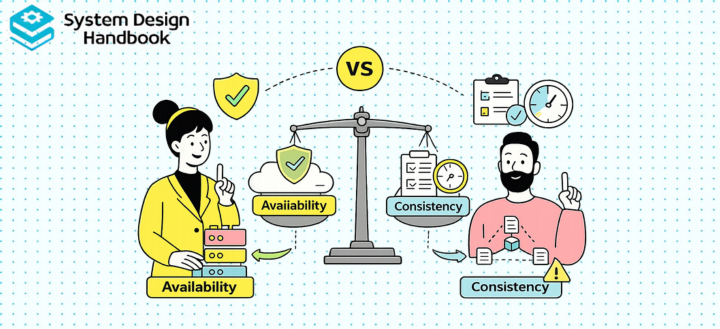
When you start learning System Design, availability and consistency often feel like abstract theoretical concepts, but they quickly become very real when you begin designing distributed systems. The moment your system spans multiple machines or regions, you are forced to make decisions about how data behaves under failure.
In simple terms, availability means your system always responds to requests, while consistency ensures that every user sees the same, correct data at the same time. The challenge is that under certain conditions, especially network failures, you cannot guarantee both perfectly, and that is where the trade-off begins.
Defining Availability And Consistency Clearly
To build a strong foundation, you need to understand these terms in a practical, engineering-focused way rather than relying on vague definitions. Availability is about ensuring that every request receives a response, even if the data might not be the most recent.
Consistency, on the other hand, ensures that all users see the same version of data at any given time, regardless of which server they connect to. This means that once a write operation is completed, all subsequent reads should reflect that change immediately.
| Concept | What It Means In Practice | Example Scenario |
| Availability | System always responds, even under failure | Social media feed still loads during outages |
| Consistency | All users see the same data at the same time | Bank balance updates instantly everywhere |
Understanding this distinction is critical because it shapes every architectural decision you make in distributed systems.
Real-World Intuition: Why The Trade-Off Matters
Think about a banking application where your account balance must always be accurate. In this case, consistency is more important than availability because incorrect data could lead to serious financial issues.
Now compare that with a social media platform where seeing slightly outdated posts is acceptable. In that scenario, availability becomes more important because users expect the system to always be responsive, even if the data is not perfectly up to date.
How This Shows Up In System Design Interviews
In interviews, availability vs consistency is rarely asked as a direct theoretical question. Instead, it appears implicitly when you are designing systems like chat applications, payment systems, or distributed databases.
Your ability to recognize where this trade-off applies and explain your reasoning clearly is what differentiates strong candidates. Interviewers are not looking for perfect answers, but for thoughtful trade-offs that align with the system’s requirements.
Understanding Consistency: What Does “Correct Data” Really Mean?
Consistency might seem straightforward at first, but in practice, it exists on a spectrum rather than being a binary concept. Different systems require different levels of consistency depending on how critical data accuracy is to their functionality.
As you go deeper into System Design, you will realize that strict consistency often comes at the cost of performance and availability. This is why understanding different consistency models is essential for making informed design decisions.
Strong Consistency: Immediate Correctness
Strong consistency guarantees that once a write operation is completed, all subsequent reads will return the updated value. This model is essential in systems where correctness cannot be compromised, such as financial transactions or inventory systems.
However, achieving strong consistency requires coordination between nodes, which increases latency and reduces system availability during failures. This is the trade-off you must be prepared to explain in interviews.
Eventual Consistency: Accepting Delay For Scalability
Eventual consistency relaxes the requirement of immediate correctness by allowing temporary inconsistencies between nodes. Over time, all nodes will converge to the same state, but there may be a delay.
This model is widely used in large-scale systems like social media platforms because it prioritizes availability and performance. From an engineering perspective, eventual consistency is often the only practical choice for systems operating at massive scale.
Other Consistency Models You Should Know
Between strong and eventual consistency, there are several intermediate models that provide different guarantees. Understanding these models helps you design systems that balance correctness and performance more effectively.
| Consistency Model | Guarantee Provided | Use Case |
| Read-After-Write | User sees their own updates immediately | User profile updates |
| Causal Consistency | Preserves cause-and-effect relationships | Messaging systems |
| Eventual Consistency | Data converges over time | Social feeds |
Each model represents a different trade-off, and choosing the right one depends on your system’s requirements.
Consistency In Real-World Systems
In practice, most systems do not rely on a single consistency model across the entire architecture. Instead, they use strong consistency for critical operations and weaker consistency for less critical ones.
This hybrid approach allows you to balance user experience with system performance. In interviews, mentioning this layered strategy demonstrates a deeper understanding of how real systems are designed.
Understanding Availability: What Does “Always Up” Really Mean?
When you think about availability, it is tempting to associate it with uptime percentages like 99.9% or 99.99%. While these metrics are important, availability in System Design goes beyond simple uptime and focuses on how your system behaves under failure.
A highly available system ensures that users can continue interacting with it even when parts of the system are down. This often involves redundancy, replication, and intelligent traffic routing.
Fault Tolerance And Redundancy
To achieve high availability, systems are designed with redundancy so that failures do not disrupt the entire system. Multiple servers, data replicas, and failover mechanisms ensure that there is always a backup ready to take over.
This approach allows your system to handle hardware failures, network issues, and even entire data center outages. From an interview perspective, discussing redundancy shows that you are thinking about real-world reliability.
Latency Vs Availability Trade-Offs
One subtle aspect of availability is its relationship with latency. Sometimes, ensuring that a system always responds quickly requires sacrificing strict data correctness or performing operations asynchronously.
For example, returning slightly stale data from a nearby server might improve availability and user experience compared to waiting for a fully consistent response from a distant node. This is a common trade-off in globally distributed systems.
Availability In Different Types Of Systems
Different systems prioritize availability differently based on their use cases. Understanding these differences helps you make better design decisions.
| System Type | Availability Priority | Example |
| Social Media | Very high | Feed should always load |
| Banking Systems | Moderate | Accuracy over availability |
| Streaming Services | High | Playback should not stop |
Recognizing these priorities allows you to align your design with real-world expectations.
Designing For Failure As The Default Case
One of the most important mindset shifts in System Design is accepting that failures are inevitable. Instead of designing systems that assume everything works perfectly, you design systems that continue to function despite failures.
This perspective is what separates scalable systems from fragile ones. In interviews, explicitly stating this mindset signals that you understand the realities of distributed systems.
The CAP Theorem: The Foundation Of This Trade-Off
The CAP theorem is one of the most fundamental concepts in distributed systems, and it directly explains why availability and consistency cannot always coexist. It states that a distributed system can guarantee only two of the following three properties: consistency, availability, and partition tolerance.
While this might sound theoretical, it has very practical implications. Every distributed system must make trade-offs between these properties based on its requirements.
Breaking Down The Three Components
To fully understand CAP, you need to clearly define each component in the context of real systems.
| Property | Meaning In Practice |
| Consistency | All nodes see the same data at the same time |
| Availability | Every request receives a response |
| Partition Tolerance | System continues despite network failures |
Partition tolerance is particularly important because network failures are unavoidable in distributed systems. This means you are effectively choosing between consistency and availability when partitions occur.
Why Partition Tolerance Is Non-Negotiable
In real-world systems, network partitions happen more often than you might expect due to latency, hardware failures, or connectivity issues. Because of this, partition tolerance is not optional; it is a requirement.
This forces you to decide whether your system should prioritize consistency or availability during these failures. This decision defines the behavior of your system under stress.
Choosing Between Consistency And Availability
When a partition occurs, a system that prioritizes consistency will reject requests that cannot guarantee correct data. A system that prioritizes availability will continue to respond, even if the data might be stale.
This is the core trade-off that engineers must make when designing distributed systems. Understanding this trade-off is essential for both real-world engineering and System Design interviews.
Common Misconceptions About CAP
One common misunderstanding is that systems must always choose between consistency and availability. In reality, this trade-off only becomes relevant during network partitions.
Another misconception is that CAP defines the entire system behavior, when in fact it only describes a specific scenario. Strong candidates in interviews clarify these nuances, which demonstrates a deeper understanding of the concept.
CP Vs AP Systems: Two Different Design Philosophies
Once you understand the CAP theorem, the next step is translating that theory into real System Design decisions. This is where CP and AP systems come into play, representing two fundamentally different approaches to handling distributed systems under failure.
In practice, you are not choosing between consistency and availability in isolation; you are choosing how your system behaves when things go wrong. This mindset shift is what interviewers are really evaluating when they ask about CAP-related trade-offs.
CP Systems: Prioritizing Correctness Over Availability
CP systems are designed to prioritize consistency, which means they ensure that all nodes return the same, correct data, even if it comes at the cost of availability. During a network partition, these systems may reject requests or become temporarily unavailable to avoid serving inconsistent data.
This approach is critical in systems where correctness cannot be compromised, such as financial transactions or inventory management. While users may experience temporary delays, the guarantee of accurate data is more important than immediate responsiveness.
AP Systems: Prioritizing Availability Over Consistency
AP systems take the opposite approach by prioritizing availability, ensuring that the system continues to respond even during network partitions. These systems may return stale or inconsistent data temporarily, but they maintain a seamless user experience.
This model is commonly used in large-scale systems like social media platforms or content delivery networks, where responsiveness is more important than perfect data accuracy. Over time, the system resolves inconsistencies and converges to a consistent state.
Comparing CP And AP Systems In Practice
| Aspect | CP Systems (Consistency Focused) | AP Systems (Availability Focused) |
| Priority | Data correctness | System responsiveness |
| Behavior During Failure | May reject requests | Always responds |
| Use Cases | Banking, payments, inventory | Social media, content feeds |
| Trade-Off | Lower availability | Temporary inconsistency |
Understanding these differences allows you to clearly articulate your design decisions in interviews, rather than simply naming concepts without context.
Choosing The Right Approach For Your System
In real-world systems, the choice between CP and AP depends entirely on the problem you are solving. There is no universally correct answer, only trade-offs that align with business requirements and user expectations.
Strong candidates avoid presenting CP or AP as inherently better and instead explain why a particular approach fits the system’s needs. This level of reasoning demonstrates practical engineering judgment rather than theoretical knowledge.
Real-World Trade-Offs Engineers Make Daily
Understanding availability vs consistency is only useful if you can apply it to real-world systems. In practice, engineers constantly make trade-offs between these two properties based on the nature of the application and user expectations.
These decisions are rarely black and white, and often involve balancing multiple constraints such as performance, cost, and user experience. This is exactly the kind of thinking that System Design interviews aim to evaluate.
Financial Systems: Consistency Comes First
In financial systems, consistency is non-negotiable because even a small inconsistency can lead to serious consequences. When you transfer money between accounts, the system must ensure that balances are updated correctly across all nodes.
This means that during failures, the system may delay or reject requests rather than risk serving incorrect data. While this may reduce availability temporarily, it preserves the integrity of the system.
Social Media Platforms: Availability Takes Priority
In contrast, social media platforms prioritize availability because users expect the system to always be responsive. If your feed loads slightly outdated posts, it does not significantly impact the user experience.
This allows these systems to adopt eventual consistency, where updates propagate over time. The trade-off here is acceptable because it enables the system to scale to millions of users while maintaining high availability.
Inventory Management Systems: Balancing Both Sides
Inventory systems present an interesting middle ground where both availability and consistency matter. For example, an e-commerce platform must ensure that items are not oversold, which requires strong consistency for stock updates.
At the same time, the system must remain responsive to users browsing products. This often leads to hybrid solutions where critical operations are strongly consistent, while less critical ones prioritize availability.
Messaging Systems And User Experience
Messaging systems, such as chat applications, often prioritize availability to ensure that users can send and receive messages without interruption. However, they still need to maintain a reasonable level of consistency to preserve message order and context.
This balance is achieved through techniques like causal consistency, which ensures that messages are delivered in a logical sequence. Explaining such nuanced trade-offs in interviews demonstrates a deeper understanding of System Design.
Consistency Models In Practice
One of the biggest realizations you will have as you dive deeper into System Design is that consistency is not a single concept. Instead, it exists on a spectrum of models, each offering different guarantees and trade-offs.
This flexibility allows engineers to choose the level of consistency that best fits their system’s requirements. In interviews, being able to navigate this spectrum is a strong indicator of your expertise.
Linearizability: The Strongest Guarantee
Linearizability is the strongest form of consistency, ensuring that all operations appear to occur instantaneously and in a single, global order. This guarantees that every read reflects the most recent write.
While this model provides the highest level of correctness, it comes with significant performance and scalability costs. It requires tight coordination between nodes, which increases latency and reduces availability during failures.
Sequential Consistency: Relaxing Global Ordering
Sequential consistency relaxes some of the constraints of linearizability by ensuring that operations occur in a consistent order, but not necessarily in real time. This means all nodes agree on the order of operations, but there may be slight delays.
This model provides a balance between correctness and performance, making it suitable for systems where strict real-time guarantees are not required.
Eventual Consistency: Scalability First
Eventual consistency allows temporary inconsistencies between nodes, with the guarantee that all nodes will eventually converge to the same state. This model is widely used in large-scale distributed systems because it prioritizes availability and performance.
While it may seem less reliable at first, eventual consistency is often sufficient for systems where slight delays in data synchronization are acceptable. This is why it is commonly used in social media and content delivery systems.
Comparing Consistency Models
| Model | Guarantee Level | Performance Impact |
| Linearizability | Strongest consistency | High latency |
| Sequential | Ordered operations | Moderate latency |
| Eventual | Converges over time | Low latency |
Understanding these differences allows you to choose the right model based on system requirements rather than defaulting to the strongest option.
Choosing The Right Model In Practice
In real-world systems, you rarely apply a single consistency model across the entire architecture. Instead, you use stronger consistency for critical operations and weaker consistency for less critical ones.
This selective approach allows you to optimize both performance and correctness. In interviews, explaining how you would apply different models to different parts of the system demonstrates advanced design thinking.
Techniques To Improve Consistency Without Sacrificing Too Much Availability
In practice, engineers are rarely satisfied with choosing either availability or consistency outright. Instead, the goal is to find techniques that improve consistency while still maintaining acceptable levels of availability.
This balance is what defines well-designed distributed systems. It reflects an understanding that trade-offs are not absolute, but can be optimized through thoughtful engineering.
Quorum Reads And Writes
Quorum-based systems require a majority of nodes to agree on a read or write operation before it is considered successful. This ensures a higher level of consistency while still allowing the system to function during partial failures.
For example, in a system with three replicas, requiring two nodes to agree provides a balance between consistency and availability. This approach is widely used in distributed databases.
Leader-Based Replication
Leader-based replication designates a single node as the primary authority for handling write operations. This ensures that all writes are consistent, as they are processed in a centralized manner before being replicated to other nodes.
While this improves consistency, it can become a bottleneck and introduces a single point of failure. However, with proper failover mechanisms, this approach remains highly effective in many systems.
Conflict Resolution Strategies
In systems that prioritize availability, conflicts can occur when multiple nodes update the same data independently. Resolving these conflicts is essential to maintaining eventual consistency.
Common strategies include last-write-wins, versioning, and merging changes intelligently. Each approach has its own trade-offs, and choosing the right one depends on the system’s requirements.
Versioning And Vector Clocks
Versioning allows systems to track changes to data over time, making it easier to detect and resolve conflicts. Vector clocks, in particular, provide a way to understand the order of events in a distributed system.
While these techniques add complexity, they enable more sophisticated conflict resolution and improve overall system consistency. In interviews, mentioning them shows a deeper understanding of distributed systems.
Putting It All Together
| Technique | Purpose | Trade-Off |
| Quorum Systems | Balance consistency and availability | Increased latency |
| Leader Replication | Ensure consistent writes | Potential bottleneck |
| Conflict Resolution | Handle divergent data | Complexity |
| Versioning | Track changes across nodes | Additional overhead |
When you explain these techniques in interviews, focus on why you would use them rather than just naming them. This demonstrates that you understand not only the tools but also the reasoning behind them.
Techniques To Improve Availability Without Losing Control
When you think about improving availability, the goal is not just to keep your system running, but to ensure it continues to deliver a meaningful experience even under stress. High availability is not about perfection; it is about resilience and the ability to recover quickly from failures.
In practice, this means designing systems that can tolerate failures without disrupting the user experience. This requires a combination of redundancy, intelligent routing, and graceful fallback mechanisms.
Replication As The Foundation Of Availability
Replication is one of the most fundamental techniques for improving availability because it ensures that multiple copies of data exist across different nodes or regions. If one node fails, another can take over without interrupting service.
This approach is widely used in distributed databases and storage systems, where data is replicated across multiple locations. While replication improves availability, it introduces challenges in maintaining consistency, which brings you back to the core trade-off.
Failover Mechanisms And Recovery
Failover mechanisms ensure that when a component fails, another component automatically takes over its responsibilities. This can happen at different levels, including application servers, databases, or even entire data centers.
From an engineering perspective, the key is minimizing the time it takes to detect a failure and switch to a backup. In interviews, discussing failover strategies shows that you are thinking about system behavior during real-world outages.
Load Balancing And Traffic Distribution
Load balancing plays a critical role in maintaining availability by distributing traffic across multiple servers. If one server becomes overloaded or fails, the load balancer can redirect traffic to healthy nodes.
This dynamic distribution ensures that no single component becomes a bottleneck. It also improves fault tolerance by isolating failures and preventing them from affecting the entire system.
Graceful Degradation And Partial Availability
One of the most important concepts in scalable System Design is graceful degradation. Instead of failing completely, the system reduces functionality while keeping core features available.
For example, an e-commerce platform might disable recommendations or reviews during high load while still allowing users to browse and purchase products. This approach ensures that the most critical user flows remain intact even under stress.
Balancing Availability With Control
| Technique | Availability Benefit | Risk Introduced |
| Replication | Reduces single points of failure | Data inconsistency |
| Failover | Quick recovery from failures | Complexity in coordination |
| Load Balancing | Distributes traffic efficiently | Requires monitoring |
| Graceful Degradation | Maintains core functionality | Reduced feature set |
Understanding these trade-offs allows you to design systems that are not only highly available but also manageable and predictable.
Case Study: Designing A Distributed Database
Imagine you are asked to design a distributed database system that needs to support millions of users across multiple regions. The system must handle high read and write traffic while maintaining acceptable levels of consistency and availability.
Before jumping into architecture, you need to clarify requirements such as read-to-write ratio, latency expectations, and tolerance for stale data. These factors directly influence whether you lean toward a CP or AP design.
Choosing Between CP And AP Approaches
If the system is used for financial transactions, you would likely prioritize consistency and design a CP system. This ensures that all nodes reflect the same data, even if it means rejecting requests during failures.
On the other hand, if the system is used for analytics or content feeds, you might prioritize availability and adopt an AP approach. This allows the system to remain responsive even if some data is temporarily inconsistent.
Handling Replication And Data Distribution
To scale the database, you would introduce replication and partitioning. Replication ensures availability, while partitioning distributes data across multiple nodes to handle large datasets.
These techniques must be carefully coordinated to avoid issues such as uneven load distribution or replication lag. In interviews, explaining how these components interact shows a deeper understanding of System Design.
Managing Failures And Network Partitions
Network partitions are inevitable in distributed systems, and your design must account for them explicitly. During a partition, your system must decide whether to prioritize consistency or availability.
This decision affects how the system behaves under failure, whether it continues serving requests with stale data or temporarily blocks operations. Clearly explaining this behavior is often the highlight of a strong interview answer.
Presenting Trade-Offs Clearly
| Design Choice | Impact On Consistency | Impact On Availability |
| CP Architecture | Strong consistency guaranteed | Reduced during failures |
| AP Architecture | Eventual consistency | High availability |
| Hybrid Approach | Selective consistency guarantees | Balanced availability |
A well-rounded answer does not just describe the architecture, but also explains why each decision was made and what trade-offs were accepted.
How Availability Vs Consistency Is Asked In Interviews
In most System Design interviews, you will not be asked directly about availability vs consistency. Instead, the question will be embedded within a broader problem such as designing a chat system, payment service, or distributed cache.
Your job is to recognize where this trade-off applies and bring it into the discussion naturally. This ability to identify implicit requirements is what sets strong candidates apart.
Structuring Your Answer Effectively
A strong answer begins with clarifying requirements and understanding what matters most for the system. You then explain your high-level design before diving into specific trade-offs related to consistency and availability.
As you refine your design, you should continuously highlight how your choices impact these two properties. This creates a clear narrative that is easy for the interviewer to follow.
What Interviewers Expect To Hear
Interviewers are not just evaluating your technical knowledge; they are evaluating your decision-making process. They want to see that you understand trade-offs and can justify your choices based on system requirements.
Simply stating that a system is eventually consistent or highly available is not enough. You need to explain why that choice makes sense and how it affects the system’s behavior.
Example Thought Process In Action
Consider a prompt where you are asked to design a messaging system. You might explain that availability is critical because users expect messages to be delivered without delay.
At the same time, you would discuss how consistency is maintained through ordering guarantees and conflict resolution. This balanced explanation demonstrates a nuanced understanding of the trade-off.
Turning Trade-Offs Into Strengths
The key to excelling in interviews is not avoiding trade-offs, but embracing them. When you clearly articulate the pros and cons of your design decisions, you show that you think like an engineer rather than just a problem solver.
Common Mistakes And How To Avoid Them
Misunderstanding The CAP Theorem
One of the most common mistakes is misunderstanding what the CAP theorem actually says. Many candidates believe they must always choose between consistency and availability, even when there is no network partition.
In reality, this trade-off only becomes relevant during partitions. Clarifying this nuance in interviews immediately sets you apart from other candidates.
Ignoring Trade-Offs Entirely
Another frequent mistake is presenting a design that appears to achieve both perfect consistency and perfect availability. While this might sound appealing, it is not realistic in distributed systems.
Interviewers expect you to acknowledge limitations and explain the trade-offs you are making. Avoiding this discussion often weakens your answer significantly.
Overengineering The Solution
Some candidates introduce complex solutions without fully understanding the problem. This can lead to unnecessary complexity and make the system harder to reason about.
A better approach is to start simple and evolve your design as needed. This mirrors how real systems are built and makes your answer more practical and relatable.
Focusing On Tools Instead Of Concepts
It is easy to get caught up in naming technologies like specific databases or frameworks. However, interviewers care more about your understanding of underlying principles than the tools you choose.
Explaining why a particular approach works is far more valuable than simply naming a technology. This shift in focus makes your answers more insightful and impactful.
Avoiding Clear Justification
| Mistake | Why It Weakens Your Answer | Better Approach |
| No trade-off discussion | Lacks depth | Explain pros and cons clearly |
| Overuse of jargon | Hard to follow | Use clear, simple explanations |
| Jumping to solutions | Misses problem understanding | Start with requirements |
Avoiding these mistakes helps you present a more structured and convincing answer.
Using structured prep resources effectively
Use Grokking the System Design Interview on Educative to learn curated patterns and practice full System Design problems step by step. It’s one of the most effective resources for building repeatable System Design intuition.
You can also choose the best System Design study material based on your experience:
Final Thoughts: Learning To Think In Trade-Offs
Availability vs consistency is not just a concept you memorize for interviews; it is a mindset that shapes how you approach System Design problems. The ability to reason through trade-offs is what allows you to design systems that are both practical and scalable.
As you continue preparing, focus on understanding why trade-offs exist rather than trying to avoid them. The more you practice this way of thinking, the more natural it becomes to design systems that align with real-world constraints.
Ultimately, strong System Design is not about finding perfect solutions but about making informed decisions under uncertainty. Once you internalize this, availability vs consistency stops being a confusing concept and becomes a powerful tool in your engineering toolkit.