

The Cursor System Design interview evaluates how you think about building software rather than how many architecture patterns you have memorized.
Because Cursor develops an AI-native coding assistant used by developers every day, interviewers are interested in whether you can design systems that remain reliable, responsive, and maintainable while integrating large language models into real production workflows.
Your ability to explain tradeoffs matters just as much as your final architecture.
Why Cursor’s Interview Feels Different
Unlike many traditional software companies that primarily evaluate distributed systems fundamentals, Cursor often frames System Design discussions around developer productivity, AI inference, and low-latency user experiences. That means you may discuss familiar concepts like caching, databases, and scaling alongside topics such as prompt orchestration, context retrieval, and streaming model responses. The interview still rewards strong engineering fundamentals, but it expects you to apply them in modern AI-powered applications.
Who This Guide Is For
This guide is intended for software engineers preparing for mid-level, senior, staff, or principal engineering interviews at Cursor. Whether your background is backend engineering, infrastructure, platform engineering, or machine learning, the goal is to help you connect traditional System Design principles with the architectural challenges of building AI-powered developer tools.
| Traditional System Design | Cursor System Design |
|---|---|
| Distributed services | AI-powered developer platforms |
| Databases and caching | LLM inference and context retrieval |
| Scalability and availability | Low-latency AI experiences |
| Infrastructure tradeoffs | Product and AI tradeoffs |
What the Cursor Interview Process Looks Like
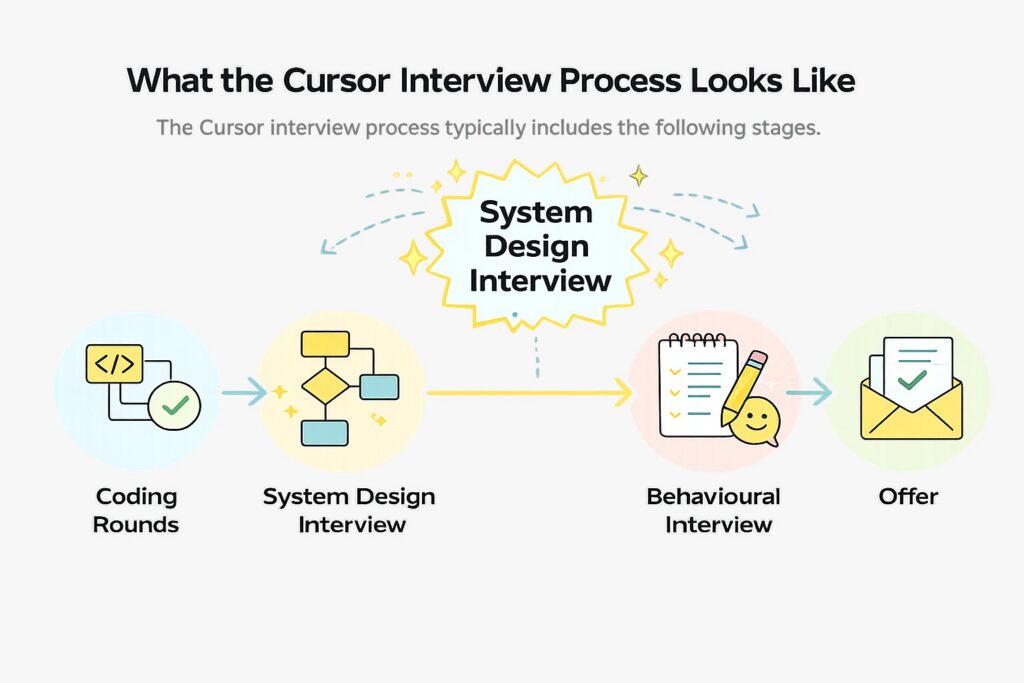
Although interview processes evolve over time, most engineering candidates can expect several stages that gradually evaluate technical depth, problem-solving ability, and communication skills. The System Design interview typically appears after coding rounds and focuses on your ability to design scalable software while reasoning through ambiguous product requirements. Rather than searching for a single correct answer, interviewers want to understand how you approach complex engineering problems.
Where System Design Fits
For experienced engineers, the System Design interview is often one of the most important rounds because it demonstrates how you think beyond writing individual functions. You will usually begin by clarifying requirements before discussing APIs, data storage, scaling strategies, reliability, and operational concerns. Throughout the conversation, interviewers may introduce changing requirements to see how your design adapts over time.
Expectations by Experience Level
The expected depth of discussion increases with seniority. While mid-level engineers are typically assessed on core architecture and scalability, senior and staff candidates are expected to justify engineering tradeoffs, anticipate operational risks, and make decisions that balance performance, cost, and long-term maintainability.
| Interview Stage | Typical Focus |
|---|---|
| Recruiter Screen | Experience and role alignment |
| Coding Interviews | Algorithms and implementation |
| System Design | Architecture and engineering judgment |
| Behavioral Round | Collaboration and ownership |
| Final Interview | Overall technical and team fit |
What Cursor Interviewers Actually Evaluate
Many candidates assume the interview is primarily about drawing architecture diagrams, but the evaluation is much broader than that. Interviewers observe how you define problems, ask clarifying questions, identify constraints, and explain why one architectural decision is preferable to another. Strong communication throughout the discussion is often as important as technical correctness.
Engineering Judgment Over Memorization
Cursor values engineers who can reason through unfamiliar problems instead of relying on memorized templates. You should demonstrate that you understand why a particular database, messaging system, or caching strategy fits a workload instead of simply naming popular technologies. Every architectural decision should be supported by clear reasoning that considers scalability, latency, reliability, and operational complexity.
Balancing AI and Distributed Systems
Because Cursor builds AI-powered developer tools, interviewers may also evaluate whether you recognize the limitations of language models within production systems. They are interested in how you combine deterministic software with probabilistic AI components while maintaining predictable user experiences, efficient resource utilization, and measurable system behavior.
| Evaluation Area | What Interviewers Look For |
|---|---|
| Problem Solving | Structured thinking and requirement analysis |
| Architecture | Scalable and maintainable System Design |
| Communication | Clear explanation of tradeoffs |
| Reliability | Failure handling and resiliency |
| AI Awareness | Practical integration of LLM-powered features |
Core System Design Fundamentals You Must Know
Even though Cursor builds AI-powered products, every successful System Design discussion still begins with strong distributed systems fundamentals. Large language models do not replace traditional infrastructure, and interviewers expect you to understand how scalable services are built before introducing AI into the architecture. A solid foundation makes it much easier to reason about more advanced AI-specific design decisions later in the interview.
The Building Blocks of Scalable Systems
You should be comfortable discussing load balancers, databases, caching layers, message queues, object storage, replication, partitioning, and asynchronous processing. These components work together to build reliable systems that continue operating efficiently as traffic grows. Rather than defining each technology, focus on when it should be introduced and what problem it solves within your architecture.
Understanding Tradeoffs
Every design decision introduces compromises, which is why interviewers frequently ask follow-up questions about scaling, consistency, cost, and reliability. Demonstrating that you understand these tradeoffs shows mature engineering judgment and helps distinguish thoughtful architectural decisions from technology-driven designs.
| Fundamental Concept | Why It Matters |
|---|---|
| Load Balancing | Distributes incoming traffic efficiently |
| Caching | Reduces latency and backend load |
| Database Replication | Improves availability and read scalability |
| Partitioning | Supports horizontal growth |
| Message Queues | Enables asynchronous processing |
| Monitoring | Detects failures and performance issues |
| Rate Limiting | Protects services from overload |
| Fault Tolerance | Maintains reliability during failures |
AI Infrastructure Concepts Frequently Discussed at Cursor
Building AI-powered applications involves much more than calling an LLM API. Cursor’s products depend on systems that retrieve relevant context, assemble prompts, stream responses, and continuously balance speed, quality, and cost. During the interview, you should be able to explain how these components work together to create a responsive developer experience instead of treating the language model as an isolated service.
Beyond the Language Model
A production AI application typically includes several supporting services surrounding the model itself. Context retrieval, prompt construction, embeddings, vector search, inference gateways, and response streaming all contribute to the quality of the final output. Interviewers are often more interested in these surrounding systems than the model architecture because they determine how well the application performs under real-world conditions.
Performance, Cost, and Latency
One of the biggest architectural challenges in AI systems is balancing user experience with infrastructure cost. Larger models may produce higher-quality responses, but they also increase latency and inference expenses. Strong candidates discuss techniques such as caching, model routing, prompt optimization, and asynchronous processing to deliver fast responses without unnecessarily increasing operational costs.
| AI Infrastructure Component | Purpose |
|---|---|
| Embeddings | Convert code and text into searchable vectors |
| Vector Database | Retrieve relevant context efficiently |
| Prompt Builder | Assemble instructions and retrieved context |
| LLM Inference Service | Generate AI responses |
| Streaming Layer | Deliver tokens as they are generated |
| Model Router | Select the most appropriate model |
| Response Cache | Reduce repeated inference requests |
System Design Questions You May Encounter at Cursor
Cursor’s interview questions are usually inspired by real engineering challenges rather than abstract distributed systems exercises. Instead of asking you to design a generic social network or URL shortener, interviewers may present problems related to AI-assisted coding, developer collaboration, or large-scale code intelligence. These scenarios evaluate whether you can design systems that combine traditional backend engineering with AI infrastructure.
Thinking Beyond the Happy Path
You should expect interviewers to challenge your initial architecture by introducing higher traffic, stricter latency requirements, or changing product goals. A discussion that begins with designing an AI code completion service may eventually evolve into handling millions of concurrent users, reducing inference costs, or supporting multiple programming languages. Demonstrating how your design evolves is often more valuable than presenting a perfect architecture from the beginning.
Product Context Matters
Unlike many interview questions that focus exclusively on infrastructure, Cursor problems often include product-specific considerations. You should think about how developers interact with the system, how quickly suggestions must appear inside the editor, and how reliability affects user productivity. These discussions show that you can connect technical decisions to real customer outcomes.
| Example Interview Question | Primary Focus |
|---|---|
| Design an AI code completion service | Low latency and inference pipelines |
| Design semantic code search | Embeddings and vector retrieval |
| Design collaborative code editing | Consistency and synchronization |
| Design an AI chat inside an IDE | Context management and streaming |
| Design repository indexing | Distributed processing and storage |
| Design an agent workflow | Task orchestration and reliability |
How to Approach a Cursor System Design Interview
A structured approach helps you communicate your thinking clearly and prevents important design considerations from being overlooked. Rather than immediately drawing architecture diagrams, you should begin by understanding the problem, clarifying assumptions, and identifying the most important functional and non-functional requirements. This creates a strong foundation for the rest of the discussion and demonstrates disciplined engineering thinking.
Build the Design Incrementally
After clarifying requirements, gradually introduce the major components of your architecture instead of presenting the entire solution at once. Explain how requests flow through the system, where data is stored, how services communicate, and which components become bottlenecks as traffic increases. This step-by-step explanation allows interviewers to follow your reasoning and ask meaningful questions throughout the conversation.
Discuss Tradeoffs Continuously
The strongest candidates treat the interview as a collaborative design discussion rather than a presentation. As you introduce databases, caching layers, AI services, or messaging systems, explain why you selected each component and what alternatives you considered. This demonstrates engineering judgment and shows that your decisions are driven by system requirements instead of familiarity with specific technologies.
| Interview Phase | Objective |
|---|---|
| Clarify Requirements | Define the problem accurately |
| Estimate Scale | Understand traffic and storage needs |
| Design Architecture | Build the high-level system |
| Deep Dive | Explore critical components |
| Analyze Tradeoffs | Compare alternative approaches |
| Address Failures | Improve reliability and resilience |
Designing AI-Powered Developer Tools: Common Architectural Patterns
Although every AI application is unique, many production systems follow similar architectural patterns that separate AI-specific functionality from traditional backend infrastructure. Understanding these recurring designs makes it easier to reason about interview problems because you can focus on adapting proven patterns instead of inventing completely new architectures during the discussion.
Separating AI Services from Core Infrastructure
A common production architecture places AI components behind dedicated services that handle retrieval, prompt generation, model inference, and response processing. The rest of the application continues operating like a conventional distributed system, managing authentication, user data, billing, telemetry, and API requests independently. This separation improves maintainability while allowing AI components to evolve without affecting unrelated services.
Building for Continuous Improvement
Modern AI products rarely rely on a single static pipeline. Teams continuously experiment with different prompts, retrieval strategies, models, and caching techniques to improve response quality over time. Designing systems that support experimentation through feature flags, monitoring, A/B testing, and observability demonstrates that you understand how production AI platforms evolve beyond their initial deployment.
| Architectural Pattern | Why It Is Used |
|---|---|
| Retrieval-Augmented Generation | Provides relevant context to the model |
| Streaming Responses | Improves perceived responsiveness |
| Prompt Assembly Pipeline | Produces consistent model inputs |
| Background Indexing | Keeps repository data searchable |
| Feature Flags | Safely roll out AI improvements |
| Telemetry Pipeline | Measure quality and performance |
| Multi-Model Routing | Balance quality, latency, and cost |
Common Mistakes Candidates Make During Cursor Interviews
Many candidates have solid technical knowledge but struggle because they approach the interview as a technology quiz instead of a collaborative design discussion. Interviewers are rarely looking for a perfect architecture from the beginning. Instead, they want to see how you gather requirements, justify decisions, and adapt your design as new constraints emerge throughout the conversation.
Focusing on Technology Instead of Requirements
One of the most common mistakes is selecting technologies before fully understanding the problem. If you immediately introduce vector databases, message queues, or multiple microservices without first clarifying user needs and scale requirements, your design can quickly become more complicated than necessary. Starting with the problem instead of the solution leads to much stronger architectural discussions.
Ignoring AI-Specific Tradeoffs
Another frequent mistake is treating large language models like deterministic software components. AI systems introduce uncertainty, latency, token costs, and varying response quality that must be considered alongside traditional concerns such as scalability and reliability. Demonstrating awareness of these limitations shows that you understand how production AI systems differ from conventional backend services.
| Common Mistake | Better Approach |
|---|---|
| Jumping into architecture immediately | Clarify requirements first |
| Overengineering the solution | Start simple and scale gradually |
| Ignoring latency | Design for fast user experiences |
| Treating AI as deterministic | Plan for variability and fallback mechanisms |
| Defending every decision | Discuss alternatives and tradeoffs |
| Neglecting operational concerns | Include monitoring, logging, and reliability |
How to Prepare for the Cursor System Design Interview
Preparing for the Cursor System Design interview requires a balance of traditional distributed systems knowledge and modern AI application architecture. You do not need to become an expert in machine learning research, but you should understand how AI features fit into scalable software systems. Building this combination of skills allows you to discuss both infrastructure and product decisions with confidence.
Build Strong Foundations First
Before studying AI-specific topics, make sure you are comfortable with core System Design concepts such as caching, replication, partitioning, asynchronous communication, database selection, and API design. These ideas appear in almost every interview, regardless of whether the product uses AI. Once these fundamentals become second nature, AI-specific discussions become much easier to follow.
Practice Like a Real Interview
Reading architecture articles alone is rarely enough to prepare for System Design interviews. You should regularly practice explaining complete designs aloud, responding to follow-up questions, and defending your engineering decisions under changing requirements. Mock interviews are particularly valuable because they expose communication gaps that are difficult to identify when studying independently.
| Preparation Area | Why It Matters |
|---|---|
| Distributed Systems | Forms the foundation of every design |
| AI Infrastructure | Connects traditional systems with LLM applications |
| Mock Interviews | Improves communication and confidence |
| Architecture Reviews | Strengthens design reasoning |
| Engineering Blogs | Exposes real production tradeoffs |
| Practice Questions | Develops structured problem-solving skills |
Practice Questions and Mock Interview Scenarios
The best way to prepare for a System Design interview is by solving problems that resemble the challenges engineers face every day. Cursor’s interview questions often involve designing developer tools, AI-powered workflows, or distributed systems that must remain responsive under heavy load. Practicing these scenarios helps you recognize recurring architectural patterns and develop a structured approach for unfamiliar problems.
Simulate Real Conversations
Instead of solving practice questions silently, explain every decision as though you were speaking with an interviewer. Begin by clarifying requirements, estimate system scale, describe the high-level architecture, and then progressively explore bottlenecks, scaling strategies, and failure scenarios. This mirrors the flow of an actual interview and strengthens both your technical reasoning and communication skills.
Review Your Own Designs
After completing each practice problem, spend time evaluating your own architecture from the interviewer’s perspective. Consider whether your design satisfies the stated requirements, whether unnecessary complexity was introduced, and whether important operational concerns such as observability, fault tolerance, or cost optimization were overlooked. This reflection helps you improve far more quickly than simply solving a larger number of questions.
| Practice Scenario | Primary Concepts |
|---|---|
| AI code completion platform | Low latency, caching, inference |
| Semantic repository search | Embeddings and vector databases |
| AI coding assistant chat | Context retrieval and streaming |
| Repository indexing pipeline | Distributed processing |
| Multi-user collaborative editor | Synchronization and consistency |
| AI agent execution platform | Orchestration and reliability |
Using structured prep resources effectively
Use Grokking the System Design Interview on Educative to learn curated patterns and practice full System Design problems step by step. It’s one of the most effective resources for building repeatable System Design intuition.
You can also choose the best System Design study material based on your experience:
Frequently Asked Questions About the Cursor System Design Interview
Many candidates preparing for Cursor’s interview process have similar concerns, particularly because the company operates at the intersection of traditional software engineering and modern AI systems. While the interview includes familiar distributed systems concepts, it also rewards candidates who understand how AI components interact with production infrastructure. Knowing what to expect can make your preparation significantly more focused.
Do You Need Machine Learning Experience?
Most software engineering candidates are not expected to explain how language models are trained or optimized. Instead, you should understand how AI services are integrated into scalable applications, how context is retrieved, and how latency, reliability, and cost influence architectural decisions. Practical engineering knowledge is generally more valuable than deep machine learning theory.
How Much Preparation Is Enough?
The answer depends largely on your existing background. Engineers who already have experience designing distributed systems can often focus on AI-specific infrastructure and interview practice, while candidates with limited architecture experience should first build strong System Design fundamentals before moving into AI-powered applications. Consistent practice over several weeks usually produces better results than trying to memorize architecture patterns immediately before the interview.
| Question | Short Answer |
|---|---|
| Is the interview difficult? | It is challenging but manageable with structured preparation. |
| Are AI concepts expected? | Yes, particularly how AI integrates into production systems. |
| Is distributed systems knowledge important? | Yes, it remains the foundation of every design discussion. |
| Should I memorize architectures? | No, focus on reasoning and tradeoffs instead. |
| Are mock interviews useful? | Yes, they significantly improve communication and confidence. |
Final Thoughts
Preparing for the Cursor System Design interview is ultimately about becoming a stronger software engineer rather than memorizing a collection of architecture diagrams. Every interview is designed to evaluate how you think through ambiguity, justify engineering decisions, and balance competing priorities such as scalability, latency, reliability, and cost. The specific problem may change, but the underlying evaluation criteria remain remarkably consistent.
If you build a solid understanding of distributed systems, learn how modern AI applications are structured, and regularly practice communicating complete designs, you will be well prepared for the kinds of conversations Cursor values. The strongest candidates are not necessarily the ones who know the most technologies, but the ones who can explain why a particular design is appropriate for a given problem and adapt it thoughtfully as requirements evolve.