

Artificial intelligence applications have become significantly more sophisticated over the past few years, but the model itself is only one part of the overall solution. A production AI application depends on a complete AI system architecture that coordinates data pipelines, model training, inference services, APIs, storage systems, monitoring, and infrastructure into a reliable platform. Understanding how these components interact is essential whether you are building AI-powered products or preparing for modern System Design interviews.
Unlike traditional software architecture, AI system architecture must support systems that continuously learn, evolve, and make probabilistic decisions instead of following fixed business rules. That introduces new engineering challenges around scalability, latency, model lifecycle management, and data quality that do not exist in most conventional applications.
Looking beyond the model
One of the biggest misconceptions about AI is that everything revolves around the machine learning model. In reality, the model is only one component within a much larger ecosystem that ensures predictions are accurate, reliable, secure, and available whenever users need them.
For example, when a user submits a prompt to an AI assistant, the request passes through authentication services, API gateways, routing layers, inference servers, monitoring systems, and logging pipelines before the model generates a response. Understanding this complete workflow is what AI system architecture is all about.
| AI System Layer | Primary Responsibility |
|---|---|
| Data Layer | Collects and stores raw information |
| Processing Layer | Cleans and prepares data |
| Model Layer | Trains and serves AI models |
| Application Layer | Handles APIs and user interactions |
| Infrastructure Layer | Provides compute, storage, and networking |
| Monitoring Layer | Tracks health, performance, and model quality |
Why AI system architecture matters
Learning AI system architecture helps you think beyond algorithms and understand how production AI systems operate at scale. Instead of viewing AI as a single model, you begin seeing it as a distributed system where every architectural decision affects performance, cost, maintainability, and user experience.
This broader perspective is exactly what many companies now evaluate during software engineering and System Design interviews. As AI becomes integrated into more products, engineers who understand complete AI system architecture are increasingly valuable because they can design systems that remain scalable, resilient, and efficient under real-world workloads.
The evolution of AI system architecture
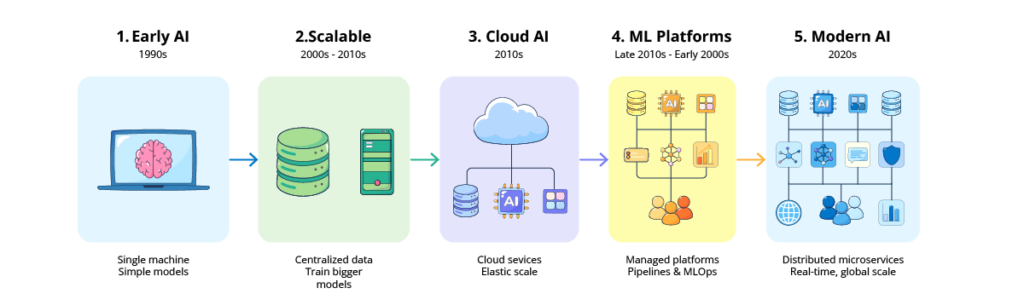
Modern AI system architecture is the result of decades of progress across artificial intelligence, distributed systems, cloud computing, and large-scale software engineering. Every generation introduced new capabilities while exposing new architectural challenges, gradually transforming simple AI programs into the sophisticated platforms that power today’s intelligent applications.
Understanding this evolution helps you appreciate why modern AI infrastructure contains so many interconnected services. Most architectural patterns that appear in production today exist because engineers had to solve problems involving larger datasets, more complex models, faster response times, and millions of simultaneous users.
From rule-based systems to machine learning
Early AI applications relied almost entirely on manually written rules. Engineers explicitly defined every condition and every possible action, allowing software to automate predictable tasks but limiting its ability to adapt to new situations.
Machine learning fundamentally changed this approach by allowing systems to learn patterns directly from data instead of relying on handcrafted logic. As datasets continued to grow, AI system architecture expanded to include data pipelines, feature engineering platforms, distributed training environments, and model management systems.
The rise of foundation models
The introduction of deep learning and large language models shifted the focus of AI system architecture once again. Instead of deploying relatively small predictive models, organizations now operate enormous neural networks that require specialized GPU infrastructure, distributed inference clusters, vector databases, and orchestration frameworks.
Today’s AI applications also combine multiple services rather than relying on a single model. Retrieval systems, embedding models, external APIs, memory layers, and safety filters all collaborate to generate accurate and context-aware responses.
| Era | Primary Architecture |
|---|---|
| Rule-Based AI | Business rules and expert systems |
| Machine Learning | Data pipelines and predictive models |
| Deep Learning | Distributed GPU training |
| Generative AI | LLMs, RAG, vector databases, AI agents |
The evolution of AI system architecture demonstrates that success depends just as much on engineering infrastructure as it does on advances in machine learning. This trend is likely to continue as AI applications become increasingly autonomous and computationally demanding.
Core components of an AI system architecture
Although every AI product solves a different problem, most production systems follow a remarkably similar architectural pattern. Whether you are designing an AI chatbot, recommendation engine, fraud detection platform, or coding assistant, the same core components appear repeatedly because every AI system architecture must collect data, train models, serve predictions, and continuously improve over time.
Understanding these building blocks helps you recognize common design patterns that frequently appear in both production systems and System Design interviews. Rather than memorizing individual architectures, you can learn the reusable components that power nearly every modern AI application.
The complete AI lifecycle
An AI system architecture usually begins with collecting information from databases, user interactions, sensors, business applications, or external APIs. That data is cleaned, transformed, validated, and stored before becoming suitable for model training or inference.
Once a model has been trained and evaluated, it is deployed through an inference service that exposes predictions through APIs. Monitoring systems then observe latency, accuracy, hardware utilization, failures, and model drift while feedback loops collect new data that can improve future versions.
| Component | Purpose |
|---|---|
| Data Sources | Collect application data |
| Data Processing | Clean and transform information |
| Feature Store | Store reusable features |
| Model Training | Learn from historical data |
| Model Registry | Version trained models |
| Inference Service | Generate predictions |
| API Layer | Connect applications to models |
| Monitoring | Observe health and performance |
| Feedback Pipeline | Improve future model versions |
How the components work together
One of the defining characteristics of AI system architecture is that every component depends on the others. Poor data quality leads to inaccurate predictions, slow inference reduces user satisfaction, and inadequate monitoring makes it difficult to detect performance degradation before users notice problems.
Instead of viewing these components independently, you should think of AI system architecture as a continuous lifecycle where data, models, infrastructure, and users constantly influence one another. This systems-thinking approach is exactly what interviewers often expect candidates to demonstrate.
Data pipelines: the foundation of every AI system architecture
No matter how sophisticated a machine learning model becomes, it can never outperform the quality of the data it receives. This is why data pipelines form the foundation of every AI system architecture, ensuring that raw information is collected, cleaned, validated, transformed, and delivered consistently to downstream systems.
In production environments, building reliable data infrastructure often requires more engineering effort than training the model itself. Organizations invest heavily in scalable data platforms because consistent, high-quality data directly influences model accuracy, system reliability, and long-term maintainability.
From raw data to model-ready information
Most AI systems collect information from numerous sources, including transactional databases, application logs, IoT devices, documents, images, APIs, and user interactions. Since this information usually arrives in different formats and quality levels, it must pass through several processing stages before it becomes useful for machine learning.
Typical pipelines perform validation, remove duplicate records, handle missing values, normalize formats, enrich datasets, and generate features that models can understand. These transformations ensure every stage of the AI system architecture receives clean, consistent, and reliable data.
| Pipeline Stage | Responsibility |
|---|---|
| Data Collection | Gather information from multiple sources |
| Validation | Detect incomplete or invalid records |
| Cleaning | Remove errors and duplicates |
| Transformation | Convert into usable formats |
| Feature Engineering | Create model-ready inputs |
| Storage | Persist processed datasets |
Why data engineering matters
Many AI projects fail because organizations underestimate the importance of data engineering within AI system architecture. Even the most advanced models cannot compensate for incomplete datasets, inconsistent labels, or poorly designed pipelines that introduce errors before training begins.
For System Design interviews, demonstrating an understanding of scalable data pipelines shows that you recognize AI systems as complete engineering platforms rather than isolated machine learning models. That mindset distinguishes strong engineering candidates from those who focus solely on model selection or algorithms.
Model training architecture
Training a machine learning model is often the most visible part of an AI project, but in production environments it represents only one stage within a much larger AI system architecture. Modern organizations rarely train a model just once. Instead, they build repeatable training pipelines that allow models to be retrained, evaluated, versioned, and deployed consistently as new data becomes available.
A well-designed training architecture makes experimentation easier while ensuring every model can be reproduced, audited, and compared against previous versions. This repeatability becomes increasingly important as models grow larger and teams collaborate across multiple projects.
The model training pipeline
The training process begins after high-quality data has been prepared through the data pipeline. Engineers split the dataset into training, validation, and testing sets before selecting algorithms, tuning hyperparameters, and evaluating performance against predefined metrics.
Most production AI system architecture also includes experiment tracking tools that record datasets, configurations, model parameters, and evaluation results. This allows teams to reproduce experiments, compare different approaches, and understand why one model performs better than another.
| Training Component | Purpose |
|---|---|
| Training Dataset | Learns patterns from historical data |
| Validation Dataset | Tunes model parameters |
| Test Dataset | Measures final performance |
| Experiment Tracking | Records runs and configurations |
| Hyperparameter Tuning | Optimizes model performance |
| Model Registry | Stores approved model versions |
Scaling model training
As datasets and neural networks continue to grow, training can no longer rely on a single machine. Modern AI system architecture often distributes training across GPU clusters, allowing multiple processors to work on different portions of the model or dataset simultaneously.
For System Design interviews, you should understand that scalable training infrastructure is designed not only for speed but also for reliability and cost efficiency. Engineers must balance GPU utilization, storage bandwidth, checkpoint frequency, and training time while ensuring that failures do not require restarting lengthy training jobs from scratch.
Inference architecture and serving models at scale
Once a model has been trained and validated, it must be deployed so users can interact with it. This stage of AI system architecture is known as inference, where the model receives new inputs and generates predictions in real time or through batch processing. While training may happen occasionally, inference occurs continuously, making it one of the most performance-critical components of the entire system.
A successful inference architecture delivers accurate predictions with low latency while efficiently managing compute resources. As user traffic grows, the architecture must scale seamlessly without significantly increasing response times or infrastructure costs.
Real-time and batch inference
Real-time inference powers interactive applications such as chatbots, recommendation systems, fraud detection platforms, and autonomous assistants where users expect responses within seconds or even milliseconds. Batch inference, on the other hand, processes large collections of data at scheduled intervals and is commonly used for analytics, reporting, and offline predictions.
Choosing between these approaches depends on business requirements rather than technical preference. Many production AI systems combine both methods, allowing immediate predictions for users while periodically processing larger datasets in the background.
| Inference Strategy | Best For |
|---|---|
| Real-Time Inference | Chatbots, search, recommendations |
| Batch Inference | Reporting, analytics, bulk predictions |
| Streaming Inference | Continuous event processing |
Building a scalable inference layer
Modern AI system architecture often places API gateways, load balancers, model servers, caching layers, and autoscaling infrastructure between users and the model. These components distribute incoming requests across multiple inference servers while monitoring latency, hardware utilization, and service availability.
During System Design interviews, interviewers frequently expect you to discuss architectural trade-offs such as GPU versus CPU inference, request batching, caching frequently requested responses, and horizontal scaling. Demonstrating an understanding of these decisions shows that you can design AI systems capable of serving millions of users without sacrificing reliability or performance.
LLM system architecture
The emergence of large language models has fundamentally changed AI system architecture by introducing entirely new components that were unnecessary in traditional machine learning systems. Instead of simply receiving structured data and returning predictions, modern LLM applications process natural language, retrieve external knowledge, maintain conversational context, and interact with other software systems before generating responses.
This shift means that today’s AI applications are built around an ecosystem of specialized services rather than a single language model. Understanding how these services collaborate is essential for designing scalable generative AI applications and succeeding in modern System Design interviews.
The building blocks of LLM applications
When a user submits a prompt, the request first passes through authentication, prompt validation, and routing services before reaching the language model. Many applications then retrieve additional information from vector databases using Retrieval-Augmented Generation (RAG), allowing the model to answer questions using current or organization-specific knowledge.
After retrieval, the language model generates a response that may pass through safety filters, formatting services, or function-calling frameworks before being returned to the user. Each of these layers contributes to the overall AI system architecture by improving accuracy, reliability, and user experience.
| LLM Component | Purpose |
|---|---|
| Prompt Processing | Cleans and validates user input |
| Embedding Model | Converts text into vectors |
| Vector Database | Retrieves relevant knowledge |
| Large Language Model | Generates responses |
| Function Calling | Executes external tools or APIs |
| Safety Layer | Filters unsafe or restricted content |
Beyond the language model
One of the biggest lessons from modern AI system architecture is that the language model rarely operates alone. Memory systems, retrieval engines, orchestration frameworks, and external APIs often contribute just as much to the final response as the model itself.
For interview preparation, this broader perspective is particularly valuable because interviewers increasingly ask candidates to design complete LLM platforms rather than explain transformer architectures. Demonstrating how these components interact shows that you understand production AI systems rather than only the underlying models.
Scalability, reliability, and performance
Designing an AI application that works for a few hundred users is relatively straightforward, but supporting millions of requests every day introduces an entirely different set of engineering challenges. A robust AI system architecture must scale efficiently while maintaining low latency, high availability, and predictable operating costs, even as workloads fluctuate throughout the day.
Achieving these goals requires far more than adding additional servers. Engineers must carefully balance infrastructure, networking, caching, monitoring, and resource allocation to ensure every component continues performing reliably under heavy demand.
Scaling AI workloads efficiently
Most production AI system architecture relies on horizontal scaling, where additional inference servers are added as traffic increases. Load balancers distribute incoming requests across multiple instances, while autoscaling policies dynamically allocate compute resources based on metrics such as CPU usage, GPU utilization, request queues, or latency.
Caching also plays an important role in reducing both response times and infrastructure costs. Frequently requested responses, embeddings, and intermediate computations can often be reused instead of recomputed, allowing systems to serve more users with the same hardware.
| Challenge | Common Architectural Solution |
|---|---|
| High Traffic | Horizontal scaling |
| GPU Bottlenecks | Request batching and scheduling |
| Slow Responses | Caching and optimized inference |
| Service Failures | Redundancy and failover |
| Traffic Spikes | Autoscaling infrastructure |
Building reliable AI platforms
Reliability extends beyond keeping servers online. Modern AI system architecture includes observability platforms that monitor latency, throughput, model accuracy, hardware utilization, and error rates so engineers can detect issues before users experience degraded performance.
These operational considerations frequently appear during System Design interviews because they demonstrate engineering maturity. Rather than focusing exclusively on model performance, strong candidates explain how their architecture continues operating during hardware failures, traffic spikes, and changing workloads while maintaining a consistent user experience.
Security, privacy, and responsible AI architecture
As AI systems become more deeply integrated into business applications, security and privacy can no longer be treated as optional considerations. A modern AI system architecture must protect sensitive data, prevent unauthorized access, defend against malicious inputs, and ensure models behave responsibly under a wide range of scenarios. Ignoring these concerns can lead to data breaches, unreliable outputs, regulatory violations, and a significant loss of user trust.
Unlike traditional applications, AI systems introduce new attack surfaces because both the model and its training data become valuable assets. This means security must be built into every layer of the architecture rather than added after deployment.
Securing the AI pipeline
Security begins long before a model reaches production. Organizations must secure training datasets, encrypt stored information, authenticate users, and carefully control access to models and infrastructure. During inference, API gateways, rate limiting, input validation, and authentication mechanisms help prevent abuse while protecting valuable compute resources.
Large language model applications introduce additional concerns such as prompt injection, data leakage, and malicious tool execution. Safety filters, content moderation systems, and permission boundaries reduce these risks without significantly impacting the user experience.
| Security Challenge | Architectural Solution |
|---|---|
| Unauthorized Access | Authentication and RBAC |
| Prompt Injection | Input validation and safety filters |
| Data Leakage | Encryption and access controls |
| API Abuse | Rate limiting and quotas |
| Model Theft | Secure deployment and restricted endpoints |
Responsible AI by design
Responsible AI extends beyond cybersecurity by ensuring systems remain fair, transparent, and accountable throughout their lifecycle. Modern AI system architecture often includes monitoring for model bias, audit logging, human review workflows, and governance policies that document how models are trained, evaluated, and updated.
For System Design interviews, demonstrating an understanding of security and responsible AI shows that you recognize production systems must balance innovation with safety. Interviewers increasingly value engineers who can design architectures that protect both users and the organization while maintaining reliable AI services.
AI system architecture interview questions and design patterns
AI has rapidly become one of the fastest-growing topics in System Design interviews because many technology companies are integrating intelligent features into their products. Rather than asking candidates to explain machine learning algorithms, interviewers are increasingly interested in whether you can design a complete AI system architecture that balances scalability, reliability, latency, and cost.
The strongest candidates approach these interviews by thinking in layers instead of jumping directly to implementation details. They explain how data flows through the system, justify architectural trade-offs, and discuss how the design evolves as requirements change.
Common AI System Design problems
Many interview questions revolve around designing familiar AI-powered products. Although each scenario differs, they typically share the same architectural foundations, including data pipelines, inference services, storage systems, monitoring, and scalable infrastructure.
Common interview scenarios include:
- Designing ChatGPT or another conversational AI assistant
- Building a Retrieval-Augmented Generation (RAG) platform
- Creating an AI-powered search engine
- Designing a recommendation system
- Building an AI coding assistant
- Developing an enterprise document question-answering platform
What interviewers evaluate
Success depends less on selecting the “correct” architecture and more on explaining your engineering decisions. Interviewers want to understand how you prioritize scalability, availability, fault tolerance, cost optimization, and maintainability while adapting your AI system architecture as new constraints emerge.
| Interview Focus | What You Should Demonstrate |
|---|---|
| Scalability | Handle growing user traffic |
| Reliability | Design for failures and recovery |
| Performance | Reduce latency and optimize throughput |
| Trade-offs | Justify architectural decisions |
| Communication | Explain your reasoning clearly |
A structured design process often matters more than arriving at a perfect solution. By thinking through assumptions, identifying bottlenecks, and discussing alternatives, you demonstrate the engineering maturity that companies expect from experienced software engineers.
Real-world AI system architecture case studies
One of the best ways to understand AI system architecture is by studying how successful products are designed in practice. Although organizations rarely publish complete implementation details, engineering blogs, research papers, and public presentations reveal many of the architectural patterns that power today’s leading AI applications.
These real-world examples demonstrate that successful AI systems rely on much more than powerful models. Scalable infrastructure, distributed services, observability, retrieval systems, and efficient deployment strategies often contribute just as much to the overall user experience.
Common architectural patterns
Applications such as ChatGPT, Claude, GitHub Copilot, Perplexity, and enterprise AI assistants all combine similar architectural building blocks. User requests pass through APIs, orchestration services, retrieval pipelines, inference clusters, monitoring platforms, and security layers before responses are generated and returned.
Although the implementation details vary, the architectural principles remain remarkably consistent across products.
| AI Product | Common Architectural Components |
|---|---|
| ChatGPT | LLM, inference cluster, moderation, monitoring |
| GitHub Copilot | Code context retrieval, LLM inference, IDE integration |
| Perplexity | Search, retrieval, vector database, LLM |
| Enterprise RAG | Document ingestion, embeddings, vector search, LLM |
| Recommendation Systems | User data, ranking models, feature stores |
Learning from production systems
Studying production architectures teaches you how experienced engineering teams solve practical problems involving scalability, latency, infrastructure costs, and operational reliability. Instead of memorizing individual diagrams, you begin recognizing reusable design patterns that can be applied to a wide variety of AI applications.
This architectural thinking is especially valuable during interviews because most questions are variations of existing production systems. Understanding why companies make certain design decisions allows you to explain your own AI system architecture with greater confidence and technical depth.
How to master AI system architecture for System Design interviews
Learning AI system architecture can initially feel overwhelming because it combines concepts from software engineering, distributed systems, cloud computing, data engineering, and machine learning. The good news is that you do not need to master every discipline at once. Building a strong foundation in the core architectural components will prepare you for both production engineering and modern System Design interviews.
Instead of memorizing complete architectures, focus on understanding why each component exists and how different services interact under real-world workloads. This systems-level perspective is what separates experienced engineers from candidates who only understand individual technologies.
A practical learning roadmap
Start by developing a solid understanding of distributed systems before exploring AI-specific infrastructure. Once you understand concepts such as scalability, load balancing, caching, databases, messaging systems, and observability, you can gradually build on that knowledge by learning model training, inference, vector databases, Retrieval-Augmented Generation (RAG), and AI deployment patterns.
A practical learning roadmap might include:
- Distributed systems fundamentals
- Data engineering and pipelines
- Machine learning lifecycle
- Model serving and inference
- Large language model architecture
- RAG and vector databases
- Monitoring and observability
- AI security and governance
Final interview advice
During interviews, remember that AI system architecture is ultimately a System Design problem. Interviewers expect you to communicate clearly, identify assumptions, discuss trade-offs, and explain how your architecture scales as requirements evolve.
As AI continues transforming modern software development, understanding complete AI system architecture will become an increasingly valuable engineering skill. Whether you are building intelligent applications, preparing for senior software engineering interviews, or designing the next generation of AI-powered platforms, the architectural principles covered in this guide provide a strong foundation that you can continue expanding as the field evolves.
Free Resources Worth Bookmarking
If you’re looking to continue learning, the following free resources are excellent additions to your System Design study plan.
| Free Resource | Best For |
|---|---|
| System Design Primer | Reviewing interview fundamentals and core distributed systems concepts |
| Complete Guide to System Design | Following a structured learning roadmap from beginner to advanced topics |
| System Design Guide | Comprehensive guides covering distributed systems, architecture patterns, and modern System Design concepts |
| System Design Interview Guide | Preparing specifically for System Design interviews with interview-focused guides and examples |
| Grokking the System Design Interview | Exploring advanced architecture, large-scale distributed systems, and senior engineering design decisions |
Final thoughts
AI is reshaping the software industry, but successful AI products are built on far more than advanced machine learning models. Every intelligent application depends on a carefully designed AI system architecture that integrates data engineering, distributed systems, model training, inference infrastructure, observability, security, and continuous improvement into a cohesive platform.
As you continue learning, resist the temptation to focus exclusively on the latest models or frameworks. The technologies will evolve quickly, but the architectural principles behind scalable, reliable, and maintainable AI systems will remain relevant for years to come. Mastering these principles will not only help you design better production systems but will also give you a significant advantage in software engineering and System Design interviews where AI system architecture is becoming an increasingly important topic.

2 Responses
Very good AI system Architecture artifact
Thank you! Glad you found it helpful.