

An Internet Service Provider (ISP) is an organization that connects homes, businesses, mobile devices, and data centers to the global internet. Whenever you browse a website, stream a video, join a video conference, or send an email, your data first travels through an ISP before reaching the wider internet. Without ISPs, individual users would have no practical way to communicate with the millions of independent networks that collectively form the internet.
Although many people associate ISPs only with broadband subscriptions, they operate large-scale networking infrastructure that includes fiber optic cables, routers, switches, regional data centers, and international backbone connections. Their role extends far beyond providing internet access because they help route traffic across the global network.
Connecting Users to the Internet
Every internet-connected device requires a path to the rest of the world. ISPs provide this connection by linking customer networks to larger regional and global networks that exchange traffic continuously.
Whether a user connects through fiber, cable, DSL, wireless broadband, or a mobile network, the ISP serves as the first gateway between local devices and the internet.
More Than Broadband Companies
An ISP is not simply a company that sells internet subscriptions. It also manages network infrastructure, assigns IP addresses, monitors traffic, maintains routing information, and ensures reliable connectivity across thousands or even millions of customers.
Large ISPs continuously upgrade infrastructure to accommodate growing demand for streaming, cloud computing, online gaming, and video conferencing.
Part of a Global Network
No single ISP owns the internet. Instead, thousands of ISPs connect to one another through routing agreements, peering relationships, and internet exchange points to create a worldwide network of interconnected autonomous systems.
This decentralized architecture allows data to travel between virtually any two connected devices regardless of which providers they use.
| Concept | Purpose |
|---|---|
| Internet Service Provider | Connect users to the internet |
| Customer Connection | First gateway to global networks |
| Network Infrastructure | Transport internet traffic |
| Global Connectivity | Exchange traffic with other ISPs |
Why Internet Service Providers Exist
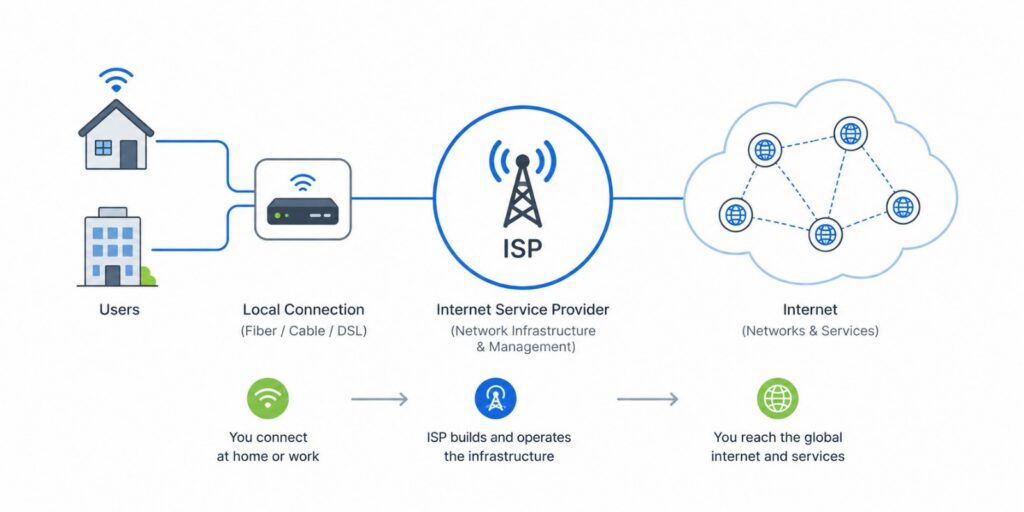
The internet is not a single centralized network owned by one organization. Instead, it consists of thousands of independent networks distributed around the world. ISPs exist because someone must build, operate, and maintain the infrastructure that allows these separate networks to communicate reliably. They provide both the physical connections and the networking intelligence required to move data between users and internet services.
Without ISPs, individual homes and businesses would have no practical way to participate in the global internet.
Connecting Users to the Internet
The most visible responsibility of an ISP is providing last-mile connectivity. This final segment connects homes, offices, schools, and mobile devices to the provider’s regional network through technologies such as fiber optics, cable, DSL, fixed wireless, or cellular infrastructure.
The quality of this connection significantly influences the user’s internet experience.
Managing Network Infrastructure
Behind every internet connection lies an extensive collection of routers, switches, fiber optic links, regional data centers, and monitoring systems. ISPs continuously manage this infrastructure to ensure traffic flows efficiently even as network demand changes throughout the day.
Maintaining these networks requires constant monitoring, maintenance, and capacity planning.
Public IP Address Allocation
Every device communicating on the internet requires an IP address. ISPs allocate public IP addresses directly to customers or assign private addresses while using Network Address Translation (NAT) to conserve limited IPv4 address space.
This address management allows billions of devices to participate in global communication.
Connecting to the Global Internet
Connecting customers locally is only one part of an ISP’s responsibility. Providers must also establish connections with other ISPs, cloud providers, content delivery networks, and internet backbone operators so customer traffic can reach destinations anywhere in the world.
These interconnections transform isolated regional networks into today’s global internet.
| ISP Responsibility | Purpose |
|---|---|
| Last-Mile Connectivity | Connect customers |
| Infrastructure Management | Operate networking equipment |
| IP Address Allocation | Enable internet communication |
| Global Connectivity | Reach external networks |
How an Internet Service Provider Works
Every time you visit a website or use an online application, your request passes through several networking stages before reaching its destination. Although this journey usually completes within milliseconds, it involves multiple routers, independent networks, and routing decisions distributed across the internet. Understanding this process helps explain how ISPs participate in nearly every online interaction.
Rather than transporting complete files, ISPs move small packets of data that travel independently across interconnected networks.
User Sends a Request
The process begins when a device such as a laptop or smartphone generates a network request. This may involve loading a webpage, streaming a video, joining a video call, or accessing a cloud application.
The device forwards these packets to the local router or modem, which sends them into the ISP’s network.
Local ISP Network
Once packets enter the ISP, they travel through access equipment into regional aggregation networks where traffic from thousands of customers is combined. High-capacity routers examine destination addresses and determine the most appropriate path toward the requested service.
The ISP’s internal network efficiently manages enormous volumes of simultaneous customer traffic.
Internet Backbone
If the destination resides outside the ISP’s own network, traffic is forwarded to other providers through peering agreements or transit connections. Packets may cross several independent networks before eventually reaching the destination’s hosting provider.
Routing protocols continuously determine the best available path across these interconnected networks.
Destination Server
After arriving at the destination network, packets reach the appropriate web server, application server, or cloud service. The server processes the request and sends a response that follows a similar path back through multiple networks until it reaches the original user.
Although users perceive a single internet connection, many independent organizations participate in every request.
| Stage | Responsibility |
|---|---|
| User Request | Generate network packets |
| ISP Network | Route customer traffic |
| Internet Backbone | Connect independent networks |
| Destination Server | Process request and respond |
Core Components of an ISP
Modern ISPs operate highly distributed networking infrastructure consisting of customer equipment, regional access networks, core routing infrastructure, and global backbone connections. Each component performs a specialized role that allows internet traffic to move efficiently from end users to destinations around the world. Separating these responsibilities enables ISPs to scale their networks while maintaining reliability and performance.
Although technologies differ between providers, these architectural components appear throughout the internet.
Customer Premises Equipment (CPE)
Customer Premises Equipment includes the networking hardware installed at customer locations. Depending on the access technology, this may include cable modems, DSL modems, fiber Optical Network Terminals (ONTs), wireless receivers, and Wi-Fi routers.
This equipment provides the customer’s first connection to the ISP’s infrastructure.
Access Network
The access network connects customer equipment to regional ISP infrastructure. Different providers may use fiber optics, coaxial cable, copper telephone lines, fixed wireless technologies, or cellular networks depending on available infrastructure and geographic location.
The access network largely determines available bandwidth and connection quality.
ISP Core Network
Traffic from many access networks converges within the ISP’s core network, which contains high-capacity routers, switches, optical transport equipment, and regional data centers. The core network aggregates customer traffic while directing packets toward external destinations efficiently.
Core infrastructure is designed to process enormous amounts of traffic with minimal latency.
Backbone Connections
To reach destinations outside their own networks, ISPs connect to internet backbone providers, Internet Exchange Points (IXPs), cloud providers, and other ISPs. These external connections allow customer traffic to reach websites, cloud platforms, streaming services, and applications hosted worldwide.
Global connectivity depends on these inter-network relationships rather than any single provider.
| Component | Responsibility |
|---|---|
| Customer Equipment | Connect user devices |
| Access Network | Provide local connectivity |
| Core Network | Route regional traffic |
| Backbone Connections | Reach the global internet |
Types of Internet Service Providers
Not every ISP performs the same role within the global internet. Some providers operate massive international backbone networks, while others primarily connect local customers to larger regional providers. These different responsibilities have led to a commonly used classification system based on how networks exchange traffic with one another.
Understanding these categories makes it easier to understand how the internet functions as a collection of interconnected autonomous systems.
Tier 1 ISPs
Tier 1 ISPs operate global backbone networks capable of reaching every other network without purchasing internet transit from another provider. Instead, they exchange traffic directly with other Tier 1 providers through settlement-free peering agreements.
These organizations form the highest layer of global internet infrastructure.
Tier 2 ISPs
Tier 2 providers generally operate substantial regional or national networks. They peer with some networks directly while purchasing transit from Tier 1 providers to reach the remainder of the internet.
Many large telecommunications companies fall into this category because they combine peering with purchased connectivity.
Tier 3 ISPs
Tier 3 ISPs primarily serve residential and business customers within local geographic areas. Rather than operating extensive backbone infrastructure, they purchase connectivity from larger providers while focusing on customer access networks.
Most consumers interact directly with Tier 3 providers when purchasing internet service.
Mobile Network Operators
Mobile carriers also function as ISPs by connecting smartphones, tablets, and IoT devices through 4G and 5G cellular infrastructure. Although wireless technologies differ from fixed broadband, they ultimately connect customers to the same global internet.
Mobile providers increasingly operate sophisticated backbone infrastructure comparable to traditional fixed-line ISPs.
| ISP Type | Primary Responsibility |
|---|---|
| Tier 1 | Global internet backbone |
| Tier 2 | Regional connectivity and transit |
| Tier 3 | Local customer access |
| Mobile Operator | Cellular internet access |
Routing, Peering, and Internet Connectivity
The internet functions because thousands of independent networks cooperate to exchange traffic. Whenever data leaves one ISP’s network, routing protocols determine where packets should travel next, while peering agreements define how different providers exchange that traffic. These mechanisms allow users to communicate seamlessly even though no single organization controls the entire internet.
Together, routing and peering form the foundation of global internet connectivity.
Routing
Routers examine destination IP addresses and determine where packets should be forwarded next. Within ISP networks, sophisticated routing algorithms continually evaluate available paths while responding automatically to network failures or changing traffic conditions.
Efficient routing minimizes latency while maximizing network reliability.
Peering
Peering allows two independent ISPs to exchange customer traffic directly instead of purchasing transit through another provider. Some peering relationships are settlement-free, while others involve financial agreements depending on traffic volumes and business arrangements.
Direct peering often reduces latency while lowering operating costs.
Internet Exchange Points (IXPs)
Internet Exchange Points provide centralized facilities where many ISPs connect their networks and exchange traffic efficiently. Instead of establishing separate physical connections with every provider individually, ISPs can interconnect at shared exchange locations.
IXPs significantly improve internet efficiency while reducing unnecessary long-distance traffic.
Transit Providers
Smaller ISPs cannot connect directly to every network worldwide. Instead, they purchase internet transit from larger providers that already maintain extensive global connectivity. Transit providers agree to carry customer traffic throughout the wider internet in exchange for recurring service fees.
Transit relationships enable smaller providers to offer full internet connectivity without constructing worldwide backbone infrastructure.
| Connectivity Mechanism | Purpose |
|---|---|
| Routing | Forward packets efficiently |
| Peering | Exchange traffic directly |
| Internet Exchange Point | Interconnect many ISPs |
| Transit Provider | Provide global internet reach |
Performance and Scalability
Modern ISPs serve millions of residential users, businesses, cloud providers, and mobile devices simultaneously. Every second, enormous volumes of traffic flow across their networks as people stream videos, participate in video conferences, play online games, and access cloud applications. Supporting this demand requires infrastructure that can expand continuously while maintaining low latency, high throughput, and reliable connectivity.
Rather than relying on a few extremely powerful routers, ISPs distribute traffic across extensive regional and backbone networks that can grow incrementally as demand increases.
Backbone Capacity
ISP backbone networks consist primarily of high-capacity fiber optic links capable of transporting terabits of data every second. These fiber connections interconnect cities, countries, and continents while forming the primary highways of the internet.
As traffic volumes increase, providers upgrade backbone capacity by adding additional fiber links, increasing optical transmission speeds, or deploying newer networking equipment.
Load Balancing
Traffic rarely follows a single fixed path across an ISP’s network. Instead, routing protocols and traffic engineering techniques distribute packets across multiple available links to prevent congestion while maximizing network utilization.
Balancing traffic efficiently improves both performance and resilience during periods of heavy demand.
Redundancy
Large ISPs build redundant infrastructure throughout their networks. Multiple routers, duplicate fiber paths, backup power systems, and geographically distributed facilities ensure that hardware failures do not immediately interrupt customer connectivity.
Redundancy allows maintenance and unexpected failures to occur with minimal impact on users.
Network Monitoring
ISP operations teams continuously monitor bandwidth utilization, latency, packet loss, hardware health, and routing behavior. Automated monitoring systems detect congestion or failures quickly, allowing engineers to respond before customers experience significant service degradation.
Capacity planning also relies heavily on long-term traffic analysis to anticipate future infrastructure requirements.
| Scalability Technique | Benefit |
|---|---|
| High-Capacity Backbone | Support enormous traffic volumes |
| Traffic Engineering | Balance network utilization |
| Redundant Infrastructure | Improve availability |
| Continuous Monitoring | Detect problems early |
Reliability and Network Challenges
Operating an ISP involves far more than maintaining internet connections under ideal conditions. Providers must continuously respond to equipment failures, damaged fiber cables, unexpected traffic surges, cyberattacks, and natural disasters while keeping customers connected. Because internet connectivity has become essential for businesses and everyday life, maintaining reliability has become one of the most important responsibilities of modern ISPs.
Reliable networking depends on both resilient infrastructure and intelligent operational processes.
Network Congestion
Internet usage varies significantly throughout the day. Video streaming, software updates, online gaming, and major sporting events can create temporary spikes in network demand that increase latency or reduce available bandwidth.
ISPs mitigate congestion through capacity planning, traffic engineering, and continual infrastructure expansion.
Hardware Failures
Routers, switches, optical equipment, and data center infrastructure inevitably experience hardware failures over time. Rather than relying on individual devices, ISPs deploy redundant equipment that automatically assumes responsibility when failures occur.
This redundancy minimizes service interruptions while allowing maintenance to proceed safely.
Fiber Cuts
Fiber optic cables may be damaged by construction work, severe weather, accidents, or natural disasters. Since backbone fiber often carries enormous volumes of traffic, physical damage can affect large geographic regions if alternative paths are unavailable.
Modern routing protocols automatically redirect traffic through backup routes whenever possible.
DDoS Attacks
Distributed Denial-of-Service (DDoS) attacks attempt to overwhelm networks with excessive traffic. ISPs often deploy filtering systems, traffic scrubbing services, rate limiting, and specialized mitigation infrastructure to protect both their own networks and customer services.
These protections help maintain internet connectivity during large-scale attacks.
| Network Challenge | Mitigation Strategy |
|---|---|
| Congestion | Capacity planning and traffic engineering |
| Hardware Failure | Redundant networking equipment |
| Fiber Damage | Multiple physical paths |
| DDoS Attacks | Traffic filtering and mitigation |
How ISPs Fit into Internet Architecture
Internet Service Providers are only one part of the broader internet ecosystem, but they connect nearly every major networking component together. DNS providers, content delivery networks, cloud platforms, enterprise networks, and web servers all exchange traffic through ISP infrastructure before reaching end users. Understanding this relationship helps explain how seemingly independent internet technologies cooperate to deliver online services.
Every internet request depends on ISPs at multiple stages of its journey.
DNS Resolution
Before users can access a website, their devices typically perform a DNS lookup to translate a domain name into an IP address. DNS queries travel through the user’s ISP before reaching recursive resolvers and authoritative DNS servers that provide the required address.
Only after this lookup completes can the user’s request be routed toward the destination server.
CDN Integration
Content Delivery Networks position cached content close to users by deploying servers within ISP networks or at nearby Internet Exchange Points. This reduces latency because requests travel shorter distances before reaching cached copies of frequently accessed content.
Streaming platforms and large websites rely heavily on these partnerships to improve performance.
Cloud Providers
Cloud platforms such as Amazon Web Services, Microsoft Azure, and Google Cloud maintain direct connections with many ISPs worldwide. These high-capacity interconnections allow cloud-hosted applications to deliver low-latency services to users across different geographic regions.
Close integration between cloud providers and ISPs has become increasingly important as cloud adoption continues to grow.
End-to-End Packet Journey
A typical internet request travels from the user’s device through the local router, access network, ISP core network, Internet Exchange Points or transit providers, cloud infrastructure or hosting providers, and finally the destination server. The response then follows a similar path back to the user.
Although this process often completes in milliseconds, numerous independent networks cooperate to make it possible.
| Internet Component | Role |
|---|---|
| DNS | Resolve domain names |
| ISP | Transport user traffic |
| CDN | Deliver cached content |
| Cloud Provider | Host applications and services |
Common Misconceptions About ISPs
Because internet connectivity appears seamless to most users, many misconceptions exist about how ISPs actually operate. People often imagine the internet as a single unified network or assume their ISP controls every aspect of online communication. In reality, internet connectivity depends on cooperation between thousands of independently operated networks connected through standardized protocols and business agreements.
Understanding these misconceptions helps explain many networking behaviors observed in real-world systems.
The Internet Is One Giant Network
The internet is better described as a network of networks rather than a single centralized system. Thousands of autonomous systems exchange traffic continuously using standardized routing protocols.
ISPs are responsible only for the portions of the infrastructure they operate directly.
ISPs Own the Entire Internet
No ISP controls the entire internet. Every provider manages its own infrastructure while exchanging traffic with many other organizations through peering relationships, transit providers, and Internet Exchange Points.
Global connectivity emerges from cooperation rather than centralized ownership.
Faster Internet Means Lower Latency
Bandwidth and latency measure different aspects of network performance. Purchasing a faster broadband plan increases available throughput, but latency also depends on routing distance, congestion, server location, and network architecture.
Applications such as gaming and video conferencing often depend more heavily on latency than raw bandwidth.
Fiber Means Unlimited Speed
Fiber optic technology provides enormous capacity, but customer experience still depends on networking equipment, routing efficiency, shared infrastructure, and subscription plans.
The access technology alone does not determine actual performance.
All ISPs Work the Same Way
Different providers invest in different backbone capacities, peering arrangements, routing policies, customer support, and network architectures. These differences explain why two ISPs serving the same location may provide noticeably different internet experiences.
Infrastructure quality extends beyond advertised download speeds.
| Misconception | Reality |
|---|---|
| The internet is one network | It is a collection of autonomous networks |
| ISPs own the internet | They operate only their own infrastructure |
| Higher bandwidth means lower latency | They measure different properties |
| Fiber guarantees maximum performance | Network design still matters |
| Every ISP is identical | Infrastructure and routing vary significantly |
Internet Service Providers in System Design Interviews
Internet Service Providers frequently appear in System Design interviews because networking decisions influence latency, scalability, reliability, and global application performance. While interviewers rarely expect candidates to design an ISP from scratch, they often expect an understanding of how network traffic travels across the internet and how infrastructure choices affect distributed systems.
Strong candidates naturally incorporate ISP behavior into discussions about networking architecture rather than treating the internet as an abstract black box.
When to Discuss ISPs
ISP concepts become relevant whenever interview questions involve globally distributed applications, Content Delivery Networks, cloud deployments, latency optimization, multi-region architectures, or networking infrastructure.
Explaining how requests traverse multiple autonomous systems demonstrates a practical understanding of internet architecture.
What Interviewers Evaluate
Interviewers commonly evaluate understanding of routing, BGP, peering, Internet Exchange Points, redundancy, bandwidth, latency, and global connectivity. They expect candidates to recognize that application performance depends not only on servers but also on the networks connecting them.
Connecting infrastructure decisions to application behavior reflects mature System Design thinking.
Common Candidate Mistakes
Many candidates describe the internet as though it were one large network or assume requests travel directly from users to cloud providers. Others ignore routing complexity entirely or overlook the role of ISPs, CDNs, and peering relationships when discussing latency.
Successful candidates acknowledge the distributed nature of internet infrastructure while focusing on practical architectural implications.
| Interview Topic | What Interviewers Evaluate |
|---|---|
| Internet Architecture | Understanding interconnected networks |
| Routing | BGP and packet forwarding |
| Performance | Latency and bandwidth tradeoffs |
| Reliability | Redundancy and fault tolerance |
| Communication | Clear networking explanations |
Frequently Asked Questions About Internet Service Providers
Internet Service Providers form the foundation of modern internet connectivity by linking billions of users, businesses, cloud platforms, and online services through an interconnected collection of independent networks. Although users typically interact with an ISP only when purchasing internet access, these organizations perform a much broader role by routing traffic, maintaining infrastructure, exchanging data with other providers, and enabling worldwide communication.
Understanding these responsibilities helps explain how the internet operates at a global scale.
What is an Internet Service Provider?
An Internet Service Provider is an organization that provides internet connectivity by connecting customer networks to the broader internet through its networking infrastructure.
ISPs also manage routing, address allocation, infrastructure maintenance, and global network connectivity.
How does an ISP connect users to the internet?
Customer devices connect to local networking equipment such as routers and modems, which communicate with the ISP’s access network. Traffic then travels through the ISP’s core network before reaching other providers, cloud platforms, or destination servers.
Multiple independent networks typically participate in every internet request.
What is the difference between Tier 1, Tier 2, and Tier 3 ISPs?
Tier 1 providers operate global backbone networks without purchasing internet transit. Tier 2 providers combine regional infrastructure with purchased transit and peering agreements, while Tier 3 providers primarily connect local customers to larger upstream networks.
Each category performs a different role within the internet ecosystem.
What is internet peering?
Peering is an agreement allowing two independent networks to exchange customer traffic directly rather than routing it through another provider. Direct peering often improves performance while reducing operational costs.
Many peering relationships occur at Internet Exchange Points.
What is BGP?
Border Gateway Protocol (BGP) is the routing protocol that allows autonomous systems to exchange routing information and determine how internet traffic should travel between independent networks.
BGP is one of the fundamental technologies that enables the global internet to function.
Why do different ISPs have different speeds?
Internet performance depends on many factors including access technology, backbone capacity, congestion, routing efficiency, peering arrangements, subscription plans, and infrastructure investment.
Advertised bandwidth represents only one aspect of overall network performance.
Can one ISP communicate with another?
Yes. ISPs exchange traffic continuously through peering agreements, transit providers, and Internet Exchange Points, allowing customers connected to different providers to communicate seamlessly across the global internet.
This cooperation forms the foundation of worldwide internet connectivity.
Which companies are major ISPs?
Major ISPs vary by country and region, but globally they include organizations operating extensive backbone infrastructure, regional telecommunications networks, broadband providers, and large mobile network operators.
Many cloud providers also maintain direct interconnections with these networks to improve performance.
| Question | Short Answer |
|---|---|
| What is an ISP? | Connect users to the internet |
| How does it work? | Access network → ISP → Internet |
| Tier 1 vs Tier 2 vs Tier 3? | Different roles in global connectivity |
| What is peering? | Direct network interconnection |
| What is BGP? | Internet routing protocol |
| Can ISPs communicate? | Yes, through peering and transit |
Final Thoughts
Internet Service Providers form the networking foundation that allows billions of devices to communicate across the global internet. Far more than broadband companies, ISPs operate access networks, regional infrastructure, backbone connections, routing systems, and interconnection agreements that transport data between users, businesses, cloud platforms, and content providers. Technologies such as BGP, peering, Internet Exchange Points, and redundant fiber networks work together to ensure packets reach their destinations efficiently despite the internet consisting of thousands of independently managed networks.
Understanding how ISPs operate is an essential part of modern System Design because application performance depends not only on servers and software but also on the networking infrastructure connecting them. Concepts such as routing, bandwidth, latency, redundancy, congestion management, and global connectivity influence everything from cloud architecture and CDN deployment to distributed systems and user experience. By understanding how ISPs fit into the broader internet ecosystem, engineers gain a more complete picture of how modern applications deliver reliable, scalable services to users around the world.