

Whenever you use a mobile app, shop online, send a message, or stream a video, most of the work happens behind the scenes. Every user action triggers requests that must be processed, validated, stored, and returned with the appropriate response. Backend engineering is the discipline responsible for building these server-side systems that make modern applications function reliably at scale. While users interact with interfaces on the frontend, backend engineers design the infrastructure that powers those experiences.
Backend engineering goes far beyond writing server-side code. It involves designing APIs, implementing business logic, managing databases, integrating external services, processing background jobs, securing applications, and ensuring systems remain reliable under increasing traffic. The backend ultimately becomes the foundation upon which every feature of an application depends.
Understanding the Role of a Backend Engineer
A backend engineer is responsible for designing and maintaining the systems that receive client requests, execute application logic, and return meaningful responses. Every request from a browser, mobile application, or third-party service eventually reaches backend infrastructure where data is validated, processed, stored, and retrieved.
Unlike frontend development, which focuses on how applications look and behave for users, backend engineering focuses on how applications function internally. Performance, scalability, reliability, and maintainability become the primary concerns because every feature depends on a stable backend architecture.
Backend Engineering Is Part of a Larger System
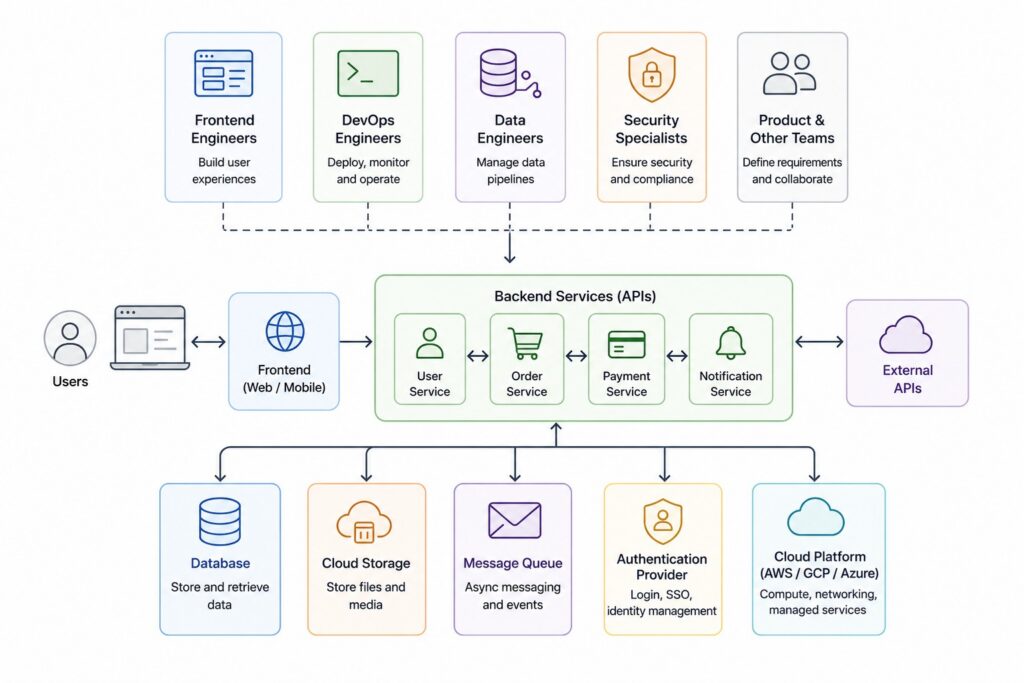
Although backend engineers work primarily on server-side applications, they collaborate closely with frontend engineers, DevOps teams, data engineers, and security specialists. Modern software systems are highly interconnected, and backend services frequently communicate with databases, cloud platforms, authentication providers, messaging systems, and external APIs.
Understanding these interactions allows backend engineers to build systems that remain flexible as products evolve. Rather than thinking about isolated servers, modern backend engineering involves designing complete application ecosystems.
Backend Engineering Versus Other Disciplines
Backend engineering is often confused with related software engineering disciplines because their responsibilities frequently overlap. While these roles collaborate closely, each focuses on different aspects of building modern applications.
Backend engineers specialize in application services and server-side logic. Frontend engineers build user interfaces, DevOps engineers manage deployment and infrastructure automation, data engineers focus on data pipelines and analytics platforms, while full-stack engineers work across both frontend and backend technologies.
| Discipline | Primary Responsibility |
|---|---|
| Backend Engineering | Server-side applications, APIs, business logic, databases |
| Frontend Engineering | User interfaces and client-side experiences |
| DevOps Engineering | Infrastructure, deployment, CI/CD, automation |
| Data Engineering | Data pipelines and analytics systems |
| Full-Stack Engineering | Both frontend and backend development |
Why Backend Engineering Matters
The quality of a backend system directly determines how reliable, secure, and scalable an application becomes. Users may judge an application by its interface, but they experience the backend every time they log in, search for information, complete a payment, upload a file, or receive a notification. If backend systems fail, even the most polished user interface becomes unusable.
As applications grow from hundreds to millions of users, backend engineering becomes even more important. Decisions about architecture, databases, APIs, and distributed systems determine whether a product can continue growing without constant redesign.
Powering Every User Interaction
Every user action eventually becomes a backend operation. When someone logs into an application, the backend verifies credentials, retrieves account information, creates an authenticated session, and returns the appropriate response. A seemingly simple search request may involve database queries, cache lookups, ranking algorithms, and communication with multiple backend services before results appear on the screen.
Backend engineers design these workflows so they remain fast, reliable, and maintainable regardless of how many users access the application simultaneously.
Building Reliable Systems
Modern users expect applications to remain available around the clock. Backend engineering makes this possible by designing systems that tolerate hardware failures, recover from network interruptions, and continue operating even when individual services experience problems.
Reliability also extends beyond uptime. Backend engineers monitor latency, optimize database performance, design fault-tolerant architectures, and ensure that applications continue delivering predictable behavior as workloads increase.
Supporting Long-Term Product Growth
Successful products rarely remain the same size for long. New customers, additional features, expanding engineering teams, and increasing traffic all place additional pressure on backend systems. Well-designed architectures allow organizations to introduce new functionality without repeatedly rebuilding existing infrastructure.
Backend engineering enables business growth by creating systems that evolve incrementally rather than requiring complete redesigns every time demand increases.
| Weak Backend System | Well-Designed Backend System |
|---|---|
| Frequent outages | High availability |
| Slow response times | Consistent performance |
| Difficult to scale | Supports growing traffic |
| Hard to maintain | Easier to extend and evolve |
| Security vulnerabilities | Secure application architecture |
Core Responsibilities of a Backend Engineer
Backend engineers perform a wide variety of responsibilities that extend well beyond writing application code. Their work involves designing interfaces between systems, managing data, integrating services, improving reliability, and ensuring applications continue operating efficiently as products evolve. Although specific responsibilities vary between organizations, the underlying engineering principles remain remarkably consistent.
Understanding these responsibilities helps explain why backend engineering requires knowledge across multiple areas of software architecture rather than expertise in a single programming language.
Designing APIs
APIs provide the communication layer between client applications and backend services. Backend engineers design REST APIs, GraphQL services, or gRPC interfaces that expose application functionality while remaining intuitive, consistent, and secure.
Good API design requires much more than defining endpoints. Engineers must think about request validation, response formats, versioning, authentication, error handling, and long-term compatibility so client applications can continue evolving without unnecessary disruptions.
Implementing Business Logic
Business logic represents the rules that define how an application behaves. Whether processing payments, approving loans, calculating shipping costs, or recommending products, backend engineers translate business requirements into reliable application workflows.
Keeping business logic separate from infrastructure code makes applications easier to test, maintain, and modify as requirements change. This separation also improves readability by ensuring each component focuses on a clearly defined responsibility.
Working with Databases
Almost every backend application depends on persistent data storage. Backend engineers design database schemas, optimize queries, create indexes, manage transactions, and select appropriate storage technologies based on application requirements.
Different workloads require different database solutions. Transactional systems often rely on relational databases, while high-scale applications may combine SQL databases with NoSQL storage, caching systems, search engines, and object storage to achieve optimal performance.
Integrating Distributed Systems
Modern backend services rarely operate in isolation. They frequently communicate with payment providers, authentication platforms, email services, message queues, AI services, cloud storage, and internal microservices. Backend engineers design these integrations so that failures remain isolated and applications continue functioning even when external dependencies become unavailable.
Building reliable integrations requires understanding asynchronous processing, retries, circuit breakers, observability, and fault tolerance rather than simply making HTTP requests.
| Responsibility | Why It Matters |
|---|---|
| API Design | Enables communication between systems |
| Business Logic | Implements application behavior |
| Database Management | Stores and retrieves application data |
| Distributed Integrations | Connects external and internal services |
| Performance Optimization | Improves speed and efficiency |
| Reliability Engineering | Keeps systems available under failure |
Backend Architecture Fundamentals
Every backend application is built upon an architectural foundation that determines how components interact, how systems scale, and how new features are introduced. While technologies continue evolving, the architectural principles underlying backend systems have remained remarkably consistent. Understanding these foundations allows engineers to choose appropriate designs instead of simply following industry trends.
There is no single architecture that fits every application. Different approaches solve different business and technical problems, and experienced backend engineers understand the strengths and tradeoffs of each.
Monolithic Applications
A monolithic application packages all functionality into a single deployable system. APIs, business logic, user management, reporting, and data access often exist within the same application, sharing the same codebase and deployment process.
Monoliths are frequently the simplest architecture for small and medium-sized products because they reduce operational complexity and make local development easier. As applications grow, however, large monoliths may become more difficult to maintain, deploy, and scale independently.
Microservices
Microservices divide an application into multiple independently deployable services, each responsible for a specific business capability. Individual teams can develop, deploy, and scale services separately without affecting unrelated parts of the application.
While microservices improve flexibility and scalability, they also introduce new challenges, including distributed communication, service discovery, observability, network failures, and operational complexity. They should therefore be adopted because they solve real architectural problems rather than simply because they are popular.
Event-Driven Architecture
Not every interaction requires immediate synchronous communication. Event-driven architecture allows services to communicate asynchronously through events, message queues, or event buses. Instead of waiting for another service to complete its work, applications publish events that interested services process independently.
This loose coupling improves scalability and resilience because services become less dependent on one another during request processing.
Layered Architecture
Most backend applications organize code into logical layers such as presentation, business logic, data access, and infrastructure. Separating responsibilities improves maintainability by allowing engineers to modify one layer without affecting unrelated components.
Layered architecture remains one of the most widely used design principles because it encourages clean separation of concerns regardless of whether the application is a monolith or a collection of microservices.
| Architecture | Best Suited For |
|---|---|
| Monolithic | Small to medium applications |
| Microservices | Large, independently evolving systems |
| Event-Driven | Asynchronous and loosely coupled workflows |
| Layered Architecture | Organizing application code clearly |
Essential Technologies Every Backend Engineer Should Learn
The backend ecosystem changes rapidly, with new frameworks and libraries appearing every year. Despite this constant evolution, the underlying technologies supporting backend systems fall into a relatively small number of categories. Rather than trying to learn every available tool, backend engineers benefit most from understanding the concepts these technologies represent.
Strong backend engineers adapt to new tools quickly because they understand the engineering principles beneath them rather than relying on framework-specific knowledge alone.
Programming Languages
Many programming languages are capable of building production backend systems. Java and C# remain popular for enterprise applications because of their mature ecosystems and strong tooling. Go has become increasingly common for cloud-native services due to its simplicity and concurrency model, while Python is widely used for APIs, automation, and AI-powered applications. JavaScript and TypeScript with Node.js enable full-stack development, and Rust continues gaining attention for high-performance systems programming.
Choosing a language depends more on organizational requirements and ecosystem support than on identifying a universally superior option.
Databases and Storage Technologies
Backend engineers should understand both relational and non-relational databases because different workloads benefit from different storage models. PostgreSQL and MySQL remain popular transactional databases, while MongoDB, Cassandra, Redis, Elasticsearch, and object storage address specialized performance and scalability requirements.
Learning why each technology exists is more valuable than memorizing individual database commands because production systems frequently combine several storage technologies within the same architecture.
Frameworks and Infrastructure
Backend frameworks accelerate development by providing routing, dependency injection, validation, authentication, and middleware capabilities. Popular examples include Spring Boot, ASP.NET Core, Django, FastAPI, Express, NestJS, and Gin. Although these frameworks differ syntactically, they solve many of the same architectural problems.
Infrastructure knowledge is equally important. Docker, Kubernetes, Linux, Git, CI/CD pipelines, cloud platforms, and observability tools have become fundamental skills because backend applications rarely operate outside modern deployment environments.
| Technology Category | Common Examples |
|---|---|
| Programming Languages | Java, Go, Python, C#, Node.js, Rust |
| Relational Databases | PostgreSQL, MySQL |
| NoSQL Databases | MongoDB, Cassandra |
| Caching | Redis |
| Search | Elasticsearch |
| Frameworks | Spring Boot, Django, FastAPI, ASP.NET Core, Express |
| Infrastructure | Docker, Kubernetes, Linux, Cloud Platforms |
How Backend Systems Process Requests
Every interaction with a backend application follows a sequence of operations that transforms an incoming request into a meaningful response. Although implementations differ between applications, the overall request lifecycle remains remarkably similar across most backend architectures. Understanding this flow helps backend engineers identify performance bottlenecks, security risks, and opportunities for architectural improvement.
Rather than thinking of a request as a single operation, it is helpful to view it as a coordinated workflow involving multiple components that each perform a specific responsibility.
Receiving the Client Request
The lifecycle begins when a client such as a web browser, mobile application, or third-party API sends an HTTP request to the backend. Before the request reaches application code, it may pass through load balancers, API gateways, reverse proxies, or web application firewalls that distribute traffic, enforce security policies, and filter malicious requests.
These infrastructure components protect backend services while ensuring incoming traffic reaches healthy application instances efficiently.
Processing the Request
After entering the application, the request passes through middleware responsible for tasks such as authentication, authorization, validation, logging, and rate limiting. Once these preliminary checks succeed, the request reaches the business logic layer where application-specific workflows execute.
Business logic often interacts with databases, caches, external APIs, object storage, or background processing systems before determining the appropriate response. Multiple services may participate in fulfilling a single request depending on the application’s architecture.
Generating and Returning the Response
After completing the necessary processing, the backend constructs a response that includes the requested data, appropriate HTTP status codes, and any required metadata. Before the response reaches the client, observability systems often record metrics, logs, traces, and performance information that help engineering teams monitor application health.
This complete lifecycle may take only a few milliseconds, yet dozens of components can participate in producing a single response. Understanding each stage enables backend engineers to build systems that remain fast, reliable, and maintainable as they scale.
| Request Stage | Primary Responsibility |
|---|---|
| Client Request | Browser, mobile app, or API initiates communication |
| Infrastructure Layer | Load balancing, gateways, security filtering |
| Middleware | Authentication, validation, logging, rate limiting |
| Business Logic | Execute application workflows |
| Data Layer | Databases, caches, external services |
| Response | Return processed results and record observability data |
Databases, Storage, and Data Management
Data sits at the center of almost every backend application. Whether an application manages customer accounts, financial transactions, product catalogs, AI models, or real-time analytics, backend engineers are responsible for selecting the right storage technologies and designing systems that keep data accurate, available, and performant. Choosing an appropriate database is therefore not simply a technology decision but an architectural one that influences scalability, reliability, and long-term maintainability.
Modern backend systems rarely rely on a single storage technology. Instead, they combine multiple specialized data stores, allowing each one to solve the problem it is best suited for.
Relational and NoSQL Databases
Relational databases such as PostgreSQL and MySQL remain the preferred choice for applications that require strong consistency, transactions, and structured relationships between entities. Banking platforms, e-commerce systems, and customer management applications often depend on relational databases because preserving data integrity is more important than maximizing write throughput.
NoSQL databases address different requirements. Document databases, wide-column stores, and key-value databases prioritize scalability, flexible schemas, or extremely high throughput. Rather than replacing relational databases, they complement them by supporting workloads that benefit from different storage models.
Beyond Traditional Databases
Backend systems frequently use additional storage technologies alongside primary databases. Redis provides extremely fast in-memory caching for frequently accessed data, Elasticsearch enables powerful full-text search, and object storage systems hold images, videos, documents, and backups that do not fit naturally into relational tables.
Selecting the appropriate storage technology depends on understanding access patterns rather than simply following technology trends. Different components of the same application may legitimately require different storage solutions.
Designing for Growth
As applications grow, backend engineers must think beyond simply storing information. Database indexing, partitioning, replication, backup strategies, and query optimization become essential for maintaining performance under increasing workloads. A well-designed data layer allows applications to continue growing without requiring complete redesigns every time traffic increases.
Understanding how data flows through an application is therefore just as important as understanding the database technology itself.
| Storage Technology | Primary Use Case |
|---|---|
| PostgreSQL / MySQL | Transactional applications |
| MongoDB | Flexible document storage |
| Redis | High-speed caching |
| Elasticsearch | Search and analytics |
| Cassandra | Large-scale distributed workloads |
| Object Storage | Files, images, videos, backups |
Scalability and Distributed Systems
Backend applications rarely remain small forever. Successful products eventually serve more users, process larger datasets, and support increasingly complex business workflows. As demand grows, simply upgrading individual servers becomes insufficient. Backend engineers must instead design systems that distribute workloads across multiple machines while remaining reliable under failure.
Scalability is therefore one of the defining characteristics of backend engineering. It requires thinking beyond individual applications and understanding how entire systems behave under increasing traffic and operational complexity.
Scaling Infrastructure
Horizontal scaling allows applications to increase capacity by adding additional servers instead of relying on larger hardware. Load balancers distribute incoming requests across these servers, ensuring that no individual instance becomes overwhelmed while improving overall availability.
Caching further improves scalability by reducing unnecessary work. Frequently requested data can often be served directly from Redis or content delivery networks instead of repeatedly querying databases, significantly reducing latency and infrastructure costs.
Building Distributed Systems
Large backend systems consist of many independent services communicating over networks. Message queues allow services to exchange work asynchronously, reducing coupling and improving resilience. Replication creates multiple copies of important data, while partitioning distributes data across several machines so that no single server becomes a bottleneck.
As systems become distributed, engineers must also understand concepts such as eventual consistency, fault tolerance, retries, idempotency, and network failures. These concerns rarely appear in small applications but become fundamental as infrastructure scales.
Designing for Failure
Distributed systems operate under the assumption that failures will occur. Servers crash, databases become temporarily unavailable, and networks experience latency or interruptions. Backend engineers design systems that continue functioning despite partial failures by introducing redundancy, graceful degradation, health monitoring, and automatic recovery mechanisms.
Building reliable distributed systems is not about eliminating failures but about ensuring that failures remain isolated and manageable.
| Scalability Technique | Primary Benefit |
|---|---|
| Horizontal Scaling | Increase application capacity |
| Load Balancing | Distribute traffic efficiently |
| Caching | Reduce latency and database load |
| Message Queues | Enable asynchronous processing |
| Replication | Improve availability |
| Partitioning | Scale large datasets |
| Fault Tolerance | Continue operating during failures |
Security for Backend Engineers
Security is a fundamental responsibility of backend engineering because backend systems process sensitive business logic, customer information, financial transactions, and authentication data. A single security weakness in the backend can compromise an entire application regardless of how secure the frontend appears. Designing secure systems requires considering security throughout the software lifecycle rather than treating it as a final deployment step.
Modern backend security combines multiple defensive mechanisms that work together to reduce risk. Authentication, authorization, encryption, validation, and monitoring each address different threats while contributing to the overall security posture of the application.
Protecting Users and Data
Authentication verifies user identity before allowing access to protected resources, while authorization determines what authenticated users are allowed to do. Session management, secure password storage, multi-factor authentication, and encrypted communication all contribute to protecting user accounts from unauthorized access.
Backend engineers must also validate every incoming request because client applications cannot be trusted to enforce security rules. Input validation prevents malicious requests from reaching business logic and reduces the likelihood of common vulnerabilities such as SQL injection and command injection.
Securing Infrastructure
Applications must also protect the infrastructure that supports them. API rate limiting prevents excessive traffic from overwhelming backend services, while secrets management ensures that database credentials, API keys, and encryption keys remain protected throughout deployment environments.
Comprehensive logging and auditing allow engineering teams to detect suspicious behavior, investigate security incidents, and demonstrate compliance with regulatory requirements. These operational capabilities are just as important as preventative security controls.
Building Security into the Architecture
Strong backend security emerges from combining multiple layers rather than depending on any single feature. Even if one defensive mechanism fails, additional protections continue reducing risk. This layered approach, often called defense in depth, forms the foundation of modern secure application design.
Security should therefore be viewed as an architectural principle rather than a collection of isolated features.
| Security Mechanism | Purpose |
|---|---|
| Authentication | Verify user identity |
| Authorization | Control access to resources |
| Session Management | Maintain authenticated users securely |
| Encryption | Protect sensitive data |
| Input Validation | Block malicious requests |
| Rate Limiting | Prevent abuse |
| Secrets Management | Protect credentials and keys |
| Logging and Auditing | Detect and investigate security events |
Common Mistakes Backend Engineers Make
Backend engineering is a discipline built largely through experience. Many architectural mistakes appear reasonable during the early stages of development but become significant obstacles as applications grow. Recognizing these common pitfalls helps engineers design systems that remain maintainable, scalable, and reliable over the long term.
Most backend problems are not caused by poor programming ability. Instead, they result from making reasonable short-term decisions without considering how systems evolve under increasing complexity.
Ignoring Performance and Scalability Early
One common mistake is assuming that databases, APIs, or infrastructure will naturally scale without deliberate design. Inefficient queries, missing indexes, unnecessary synchronous operations, and tightly coupled services often perform adequately during development but become serious bottlenecks as traffic increases.
Planning for reasonable growth does not require premature optimization, but it does require understanding where scalability challenges are likely to emerge.
Overengineering Simple Systems
The opposite mistake is introducing unnecessary architectural complexity before it becomes justified. Adopting microservices, distributed messaging systems, or highly sophisticated infrastructure for small applications increases operational overhead without delivering proportional benefits.
Experienced backend engineers choose the simplest architecture capable of solving current business problems while leaving room for future evolution. Complexity should be introduced because it addresses real requirements rather than because it represents current industry trends.
Neglecting Operational Excellence
Many backend engineers initially focus almost exclusively on writing application code while overlooking observability, monitoring, testing, documentation, and failure handling. Production systems require far more than correct business logic. Engineers must understand how applications behave after deployment, how failures are detected, and how incidents can be investigated quickly.
Building observable systems often proves just as valuable as building functional ones.
| Common Mistake | Better Practice |
|---|---|
| Poor database design | Optimize schemas and queries |
| Premature microservices | Start with appropriate architecture |
| Ignoring observability | Monitor logs, metrics, and traces |
| Weak API design | Build consistent, maintainable interfaces |
| Missing validation | Validate every external input |
| Ignoring failure scenarios | Design for resilience and recovery |
Backend Engineering in System Design Interviews
Backend engineering concepts appear throughout System Design interviews because they form the foundation of scalable software systems. Whether designing a messaging platform, e-commerce website, payment service, or AI application, candidates are expected to reason about APIs, databases, distributed systems, scalability, and operational tradeoffs. Interviewers are typically less interested in specific frameworks than in understanding how you approach architectural decisions.
Successful candidates demonstrate structured thinking rather than immediately proposing technologies. They begin by understanding requirements before selecting components that address the problem effectively.
What Interviewers Evaluate
Interviewers expect backend engineers to explain how requests flow through the system, how data is stored, how services communicate, and how the architecture scales as traffic increases. Discussions often include caching, replication, partitioning, messaging systems, authentication, observability, and failure recovery.
Clear communication is equally important. Explaining why a particular database, API style, or architectural pattern was selected often matters more than the technology itself.
Common Interview Scenarios
Backend engineering interviews frequently involve designing APIs, notification systems, social media platforms, payment processing systems, search services, recommendation engines, or real-time collaboration tools. Although the products differ, the underlying architectural concepts remain remarkably similar.
Candidates who understand these recurring design patterns can adapt their knowledge to many different interview problems instead of memorizing individual solutions.
Common Candidate Mistakes
Many candidates immediately begin discussing technologies before understanding the problem they are solving. Others ignore operational concerns such as monitoring, fault tolerance, deployment, or scalability, focusing only on application logic.
Strong System Design answers balance functionality, scalability, security, reliability, and maintainability while clearly explaining the tradeoffs behind each architectural decision.
| Interview Area | What Interviewers Evaluate |
|---|---|
| API Design | Clear communication between systems |
| Database Design | Appropriate storage choices |
| Scalability | Ability to handle increasing traffic |
| Distributed Systems | Understanding of service interactions |
| Reliability | Failure handling and resilience |
| Communication | Clear architectural reasoning |
Frequently Asked Questions About Backend Engineering
Backend engineering covers a wide range of technologies and architectural concepts, making it one of the broadest disciplines within software engineering. Because of this breadth, developers beginning their backend journey often ask similar questions about learning paths, technologies, and career opportunities. Understanding these topics provides a realistic picture of what backend engineering involves beyond simply writing server-side code.
Although tools continue changing rapidly, the underlying engineering principles remain valuable throughout an engineer’s career.
What does a backend engineer do?
Backend engineers design, build, and maintain the server-side systems that power applications. Their responsibilities include designing APIs, implementing business logic, managing databases, integrating external services, improving application performance, and ensuring systems remain secure and reliable.
They also collaborate closely with frontend engineers, DevOps teams, product managers, and security specialists to build complete software systems.
Which programming language is best for backend engineering?
There is no single best language because different organizations optimize for different requirements. Java, Go, Python, C#, JavaScript, and Rust all support production backend development, and the most appropriate choice depends on factors such as ecosystem maturity, performance requirements, existing infrastructure, and team expertise.
Learning backend engineering concepts is generally more valuable than focusing exclusively on a specific programming language.
Do backend engineers need to learn databases?
Yes. Databases form the foundation of most backend applications, making database design, indexing, transactions, query optimization, and data modeling essential skills. Backend engineers should also understand when relational databases, NoSQL databases, caching systems, and search engines are appropriate.
Strong database knowledge often has a greater impact on application performance than programming language selection.
Is backend engineering difficult to learn?
Backend engineering requires learning concepts across programming, databases, networking, distributed systems, cloud infrastructure, and security, so it can initially feel overwhelming. Fortunately, these topics build upon one another gradually, allowing engineers to develop expertise incrementally through practical projects and real-world experience.
Consistent practice is generally far more valuable than attempting to learn every technology simultaneously.
Should you learn cloud computing?
Yes. Modern backend applications are commonly deployed on cloud platforms where engineers interact with virtual machines, containers, managed databases, storage services, networking, and observability tools. Understanding cloud fundamentals has therefore become an important part of professional backend engineering.
The underlying architectural principles remain valuable regardless of which cloud provider an organization uses.
Do backend engineers need distributed systems knowledge?
Small applications may not require advanced distributed systems expertise, but understanding concepts such as load balancing, caching, replication, partitioning, messaging, and eventual consistency becomes increasingly important as applications scale.
These concepts are also evaluated frequently during backend engineering interviews.
Is backend engineering a good career?
Backend engineering remains one of the strongest long-term software engineering career paths because nearly every technology company depends on reliable backend systems. The discipline also provides a strong foundation for careers in distributed systems, platform engineering, cloud infrastructure, and technical leadership.
Its emphasis on core engineering principles makes it resilient even as programming languages and frameworks continue evolving.
How should beginners start learning backend engineering?
The most effective approach is to begin with one programming language, learn HTTP, APIs, databases, and authentication, then gradually expand into distributed systems, cloud computing, scalability, and observability. Building complete projects helps connect these concepts far more effectively than studying them in isolation.
Developing a strong understanding of fundamentals creates a foundation that transfers easily between technologies throughout your career.
| Question | Short Answer |
|---|---|
| What does a backend engineer do? | Builds and maintains server-side systems. |
| Best programming language? | It depends on the project and ecosystem. |
| Are databases important? | Yes, they are fundamental. |
| Should I learn cloud computing? | Yes, modern backend systems commonly run in the cloud. |
| Do I need distributed systems? | Yes, especially for scalable applications. |
| Is backend engineering a good career? | Yes, it offers strong long-term opportunities. |
Final Thoughts
Backend engineering is much more than writing code that runs on servers. It is the discipline of designing reliable, scalable, secure, and maintainable systems that power every interaction users have with modern applications. From APIs and databases to distributed systems, cloud infrastructure, authentication, and observability, backend engineers build the invisible foundation that enables products to function reliably at every stage of growth.
Mastering backend engineering is not about memorizing frameworks or chasing the latest technologies. The most successful engineers develop a deep understanding of architectural principles, data management, System Design, and operational thinking that remains valuable regardless of which programming language or platform they use. By building strong fundamentals and continually expanding your understanding of how large-scale systems operate, you develop the skills needed to design production-grade software and succeed in both real-world engineering roles and System Design interviews.