
Modern applications rarely operate in isolation. A single user request may require communication with databases, payment providers, authentication services, recommendation engines, notification platforms, and dozens of internal microservices before a response can be generated. While this interconnected architecture enables powerful applications, it also means that the failure of one service can quickly affect many others. The circuit breaker pattern is a resilience mechanism designed to prevent these failures from spreading throughout the system.
The pattern takes its name from electrical circuit breakers. Just as an electrical breaker cuts power when a fault is detected, a software circuit breaker temporarily stops requests from reaching an unhealthy service once failures exceed a predefined threshold. Instead of repeatedly attempting operations that are likely to fail, the application fails fast, preserving resources and giving the dependency time to recover.
Understanding the Purpose of a Circuit Breaker
The primary purpose of a circuit breaker is to protect the calling service rather than the failing dependency itself. Without a circuit breaker, applications continue sending requests to unhealthy services, consuming threads, network connections, and processing capacity while receiving little value in return.
By stopping unnecessary requests early, circuit breakers reduce resource exhaustion and improve the stability of the overall system. They also create predictable failure behavior, allowing applications to provide fallbacks or degraded functionality instead of simply becoming unavailable.
Circuit Breakers Solve a Different Problem
Circuit breakers are sometimes confused with retries, timeouts, or rate limiting because all four mechanisms influence request handling. However, each addresses a different architectural concern.
Timeouts prevent requests from waiting indefinitely for a response. Retries help recover from temporary failures by attempting an operation again. Rate limiting controls how frequently clients can send requests. Circuit breakers, on the other hand, determine whether requests should be attempted at all based on the health of a dependency.
Understanding these differences is important because production systems frequently combine all of these mechanisms rather than relying on a single resilience strategy.
| Pattern | Primary Purpose |
|---|---|
| Circuit Breaker | Stop requests to unhealthy dependencies |
| Timeout | Limit how long requests wait |
| Retry | Recover from transient failures |
| Rate Limiting | Control request volume |
| Bulkhead | Isolate failures between system components |
Why Distributed Systems Need Circuit Breakers
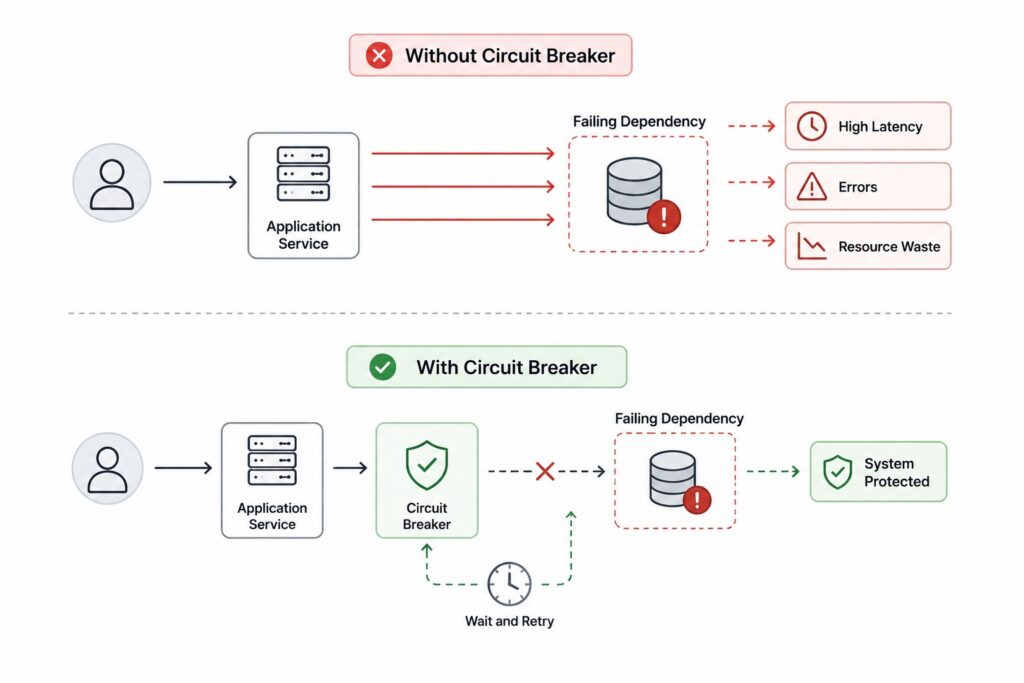
Failures are inevitable in distributed systems. Networks experience latency, databases become overloaded, external APIs return errors, and individual services occasionally become unavailable. While a single failure is usually manageable, problems arise when healthy services continue sending requests to unhealthy dependencies. Instead of isolating the problem, the failure spreads through the architecture, consuming resources and degrading unrelated parts of the application.
Circuit breakers exist to interrupt this cycle. Rather than allowing upstream services to repeatedly call failing dependencies, they temporarily block requests until the dependency has an opportunity to recover. This simple behavior dramatically improves the resilience of large distributed systems.
Preventing Cascading Failures
Imagine an order service that depends on a payment service. If the payment service begins responding slowly, the order service continues opening network connections and waiting for responses. As more requests accumulate, application threads become blocked, request queues grow, and additional services begin experiencing delays.
Eventually, the original failure spreads far beyond the payment service. What began as a localized outage becomes a system-wide availability problem. Circuit breakers interrupt this process by failing requests immediately instead of allowing blocked resources to accumulate.
Protecting the User Experience
From the user’s perspective, waiting thirty seconds before receiving an error is often worse than receiving an immediate response explaining that a feature is temporarily unavailable. Long delays create uncertainty, encourage repeated retries, and make applications feel unreliable.
Circuit breakers improve perceived performance by allowing systems to fail fast. Combined with fallback responses or degraded functionality, users often continue using the application despite temporary dependency failures.
Preserving System Resources
Every failed network request still consumes CPU time, memory, threads, sockets, and database connections. When thousands of requests continue targeting an unhealthy dependency, valuable infrastructure resources are wasted performing work that has little chance of succeeding.
By preventing unnecessary requests, circuit breakers preserve these resources for healthy parts of the application, improving overall system stability during outages.
| Failure Scenario | Without Circuit Breaker | With Circuit Breaker |
|---|---|---|
| Slow dependency | Requests continue waiting | Requests fail immediately |
| Service outage | Cascading failures spread | Failure remains isolated |
| High traffic | Resources become exhausted | Resources remain available |
| User experience | Long delays and timeouts | Faster, predictable failures |
How the Circuit Breaker Pattern Works
A circuit breaker continuously observes the health of the dependency it protects. As requests succeed or fail, it maintains statistics that determine whether traffic should continue flowing normally or be temporarily interrupted. Rather than permanently blocking requests after a failure occurs, the circuit breaker moves through several well-defined states that allow services to recover automatically when conditions improve.
This state-based behavior is what distinguishes circuit breakers from simpler failure handling mechanisms such as retries or timeouts. Instead of reacting independently to every request, the circuit breaker makes decisions based on the recent behavior of the dependency.
Closed State
The circuit breaker begins in the Closed state, where every request is forwarded normally to the protected service. During this period, the circuit breaker continuously monitors request outcomes, recording metrics such as failure rates, latency, and timeout frequency.
As long as failures remain below the configured threshold, the circuit remains closed and users experience normal application behavior. Monitoring occurs transparently without affecting successful requests.
Open State
When the observed failure rate exceeds the configured threshold, the circuit transitions to the Open state. Instead of forwarding requests to the failing dependency, the circuit breaker immediately rejects them. This prevents additional load from reaching an already unhealthy service while preserving resources in the calling application.
Applications often return fallback responses, cached data, or meaningful error messages during this period. The key objective is to avoid wasting resources on requests that are unlikely to succeed.
Half-Open State
After remaining open for a configured period, the circuit breaker enters the Half-Open state. Rather than immediately restoring full traffic, it allows only a small number of carefully controlled trial requests to reach the dependency.
These requests determine whether the service has recovered. If they succeed consistently, normal traffic resumes. If they fail, the circuit immediately returns to the Open state for another recovery interval.
Returning to Normal Operation
Recovery is intentionally gradual rather than instantaneous. Allowing every waiting request to reach a recovering service simultaneously could overwhelm it again, creating another outage immediately after recovery.
The Half-Open state prevents this surge by restoring traffic incrementally while continuously monitoring dependency health.
| Circuit State | Request Behavior |
|---|---|
| Closed | All requests forwarded normally |
| Open | Requests rejected immediately |
| Half-Open | Limited trial requests allowed |
| Closed Again | Normal traffic resumes after successful recovery |
Circuit Breaker States Explained
Although every circuit breaker follows the same general lifecycle, each state serves a distinct purpose in protecting distributed systems. Understanding these states individually helps explain why the pattern is so effective at limiting cascading failures while still allowing services to recover automatically.
Rather than viewing the states as isolated phases, it is helpful to think of them as a continuous feedback loop that adapts to changing system health over time.
Closed State in Detail
The Closed state represents normal operation. Every incoming request is forwarded to the dependency while the circuit breaker collects operational metrics. Depending on the implementation, these metrics may include failure percentages, consecutive failures, timeout frequency, slow responses, or rolling averages over recent requests.
Monitoring during the Closed state is essential because it provides the information needed to determine when the dependency has become unhealthy. Without continuous observation, the circuit breaker would have no basis for deciding when to interrupt traffic.
Open State in Detail
The Open state exists to protect both the dependency and the calling application. Once the configured threshold has been exceeded, continuing to send requests serves little purpose because the probability of success is already very low.
Instead of waiting for repeated failures, applications receive immediate responses that allow them to execute fallback logic, display degraded functionality, or notify users appropriately. Fast failure reduces infrastructure pressure while creating a more predictable user experience.
Half-Open State in Detail
The Half-Open state is often considered the most important part of the pattern because it determines when normal operation should resume. Allowing only a limited number of requests protects recovering services from sudden traffic spikes while providing enough information to evaluate system health.
Many implementations carefully control concurrency during this stage so multiple trial requests do not overwhelm the recovering dependency simultaneously.
| State | Primary Purpose | Traffic Behavior |
|---|---|---|
| Closed | Monitor healthy operation | All requests forwarded |
| Open | Protect failing dependency | Requests rejected immediately |
| Half-Open | Test recovery safely | Limited trial requests only |
Circuit Breaker vs Retry vs Timeout
Circuit breakers are rarely deployed alone. Production systems usually combine them with retries and timeouts because each mechanism addresses a different stage of remote communication. Understanding how these patterns complement one another is essential for designing resilient distributed systems.
Treating them as interchangeable often leads to poor architectures. Excessive retries without circuit breakers can worsen outages, while circuit breakers without timeouts may wait unnecessarily long before recognizing failures.
Timeouts
Timeouts establish the maximum amount of time an application is willing to wait for a response. Without timeouts, failed network calls could block threads indefinitely, eventually exhausting available resources throughout the application.
Appropriate timeout values depend on the characteristics of each dependency. Fast internal services typically require shorter timeouts than geographically distributed external APIs, but every remote call should have an upper time limit.
Retries
Retries are designed for temporary failures such as brief network interruptions or transient infrastructure issues. Instead of immediately returning an error, the application attempts the operation again after a short delay.
While retries improve reliability during temporary failures, they can become harmful during major outages. Thousands of applications simultaneously retrying requests against an already overloaded service often make recovery significantly more difficult.
Circuit Breakers
Circuit breakers recognize when retries are no longer helpful. Instead of repeatedly attempting operations that are very unlikely to succeed, they temporarily stop traffic altogether until the dependency has recovered.
Together, these three mechanisms create a layered resilience strategy. Timeouts prevent excessive waiting, retries recover from short-lived problems, and circuit breakers prevent widespread resource exhaustion during sustained failures.
| Pattern | Best Used For | Limitation |
|---|---|---|
| Timeout | Prevent long waits | Does not reduce request volume |
| Retry | Recover from transient failures | Can amplify outages |
| Circuit Breaker | Protect against persistent failures | Does not repair dependencies |
Common Circuit Breaker Configuration Options
The effectiveness of a circuit breaker depends heavily on how it is configured. Thresholds that are too aggressive may interrupt healthy traffic unnecessarily, while thresholds that are too lenient allow failures to spread before protection activates. Selecting appropriate configuration values requires understanding both the application’s workload and the behavior of the dependencies being protected.
Rather than copying default values from a framework, production systems typically tune circuit breakers using real operational metrics collected over time.
Failure Threshold
The failure threshold determines when the circuit should transition from the Closed state to the Open state. Some implementations count consecutive failures, while others calculate failure percentages over a rolling window of recent requests.
Percentage-based thresholds are generally more stable because they avoid opening the circuit after isolated failures that are unlikely to indicate a widespread outage.
Sliding Window
Instead of evaluating every request ever made, circuit breakers monitor recent request history using a sliding window. Some implementations count the last fixed number of requests, while others evaluate requests occurring within a specific time period.
Sliding windows allow the circuit breaker to adapt quickly to changing dependency health without being influenced excessively by older historical data.
Open Duration
Once the circuit opens, it remains open for a configurable period before attempting recovery. Choosing this interval involves balancing two competing objectives. Opening for too short a period may repeatedly probe an unhealthy service, while remaining open too long delays recovery after the dependency has already become healthy again.
Most implementations allow this value to be adjusted independently for different services depending on their expected recovery characteristics.
Half-Open Trial Limits
The Half-Open state intentionally restricts the number of requests used to test recovery. Allowing unlimited traffic immediately after reopening could recreate the original overload conditions before the dependency has stabilized.
Limiting trial requests provides a safer recovery process while still allowing the application to detect improvements in dependency health.
Slow Call Thresholds
Failures are not limited to explicit errors. Services that respond extremely slowly can create resource exhaustion even when they eventually return successful responses. Many modern circuit breakers therefore monitor latency alongside error rates.
Treating excessively slow requests as failures allows circuit breakers to respond before widespread timeouts begin affecting the rest of the application.
| Configuration | Purpose |
|---|---|
| Failure Threshold | Determine when the circuit opens |
| Sliding Window | Measure recent dependency health |
| Open Duration | Control recovery waiting period |
| Half-Open Trial Limit | Test recovery safely |
| Slow Call Threshold | Detect unhealthy high-latency services |
Implementing Circuit Breakers in Microservices
Microservices architectures rely heavily on communication between independent services. A single user request may trigger calls to authentication services, payment providers, inventory systems, recommendation engines, and notification platforms before a response is generated. Every additional dependency introduces another potential point of failure, making resilience patterns such as circuit breakers essential for maintaining system stability.
Where a circuit breaker is implemented depends on the architecture of the system. Some organizations place circuit breakers inside application code, while others enforce them at gateways or through service mesh infrastructure. Each approach protects the system differently and introduces its own operational tradeoffs.
Client-Side Circuit Breakers
One of the most common implementations places the circuit breaker inside the client making the remote request. Whenever a service calls another service, the client library monitors failures, timeouts, and latency before deciding whether additional requests should be forwarded.
This approach gives each service direct control over how it interacts with its dependencies. Different services can configure different thresholds based on their own performance requirements without affecting unrelated parts of the system.
Gateway-Level Circuit Breakers
API gateways often sit between external clients and backend services, making them another effective location for circuit breakers. When a backend service becomes unhealthy, the gateway can stop forwarding requests before they reach the failing service.
Centralizing circuit breaker behavior at the gateway simplifies operational management because policies can be updated without modifying individual applications. However, gateways generally have less business context than application code, which limits the sophistication of fallback behavior they can provide.
Service Mesh Circuit Breakers
Modern service meshes such as Istio, Linkerd, and Envoy implement circuit breakers through sidecar proxies that intercept service-to-service communication. Instead of embedding resilience logic inside application code, the service mesh manages retries, timeouts, traffic policies, and circuit breakers as part of the networking layer.
This approach allows engineering teams to standardize resilience across hundreds of services while reducing duplicated implementation effort. The tradeoff is additional infrastructure complexity and the need to understand service mesh configuration.
Application-Level Circuit Breakers
Some failures require business-specific decisions that infrastructure components cannot make. For example, an e-commerce application may display cached product recommendations when the recommendation service fails, while a payment application may immediately reject checkout requests if payment authorization is unavailable.
Application-level circuit breakers provide this domain awareness, allowing fallback behavior to reflect business priorities rather than generic infrastructure policies.
| Implementation Location | Advantages | Tradeoffs |
|---|---|---|
| Client Library | Fine-grained control and service-specific policies | Logic repeated across multiple services |
| API Gateway | Centralized protection for external requests | Limited business awareness |
| Service Mesh | Standardized resilience across services | Additional infrastructure complexity |
| Application Layer | Business-aware fallback behavior | More implementation effort |
Fallback Strategies and Graceful Degradation
Opening a circuit breaker does not automatically mean users should receive an error page. One of the biggest advantages of the pattern is that it creates an opportunity to provide alternative behavior when dependencies become unavailable. Mature distributed systems are designed to continue offering as much functionality as possible even when some components fail.
Graceful degradation allows applications to prioritize critical business workflows while temporarily reducing or disabling less important features. Instead of becoming completely unavailable, the system continues operating in a reduced but usable state.
Returning Cached Responses
Many applications can continue functioning by serving previously cached information when live data cannot be retrieved. Product catalogs, user profiles, weather information, news feeds, and recommendation lists are often acceptable when slightly outdated rather than completely unavailable.
Using cached responses significantly improves user experience because requests continue succeeding even while backend dependencies recover. Engineers must, however, determine how stale cached data is allowed to become before it is no longer useful.
Providing Safe Default Responses
Some features are optional rather than essential. Personalized recommendations, promotional banners, recently viewed products, or analytics dashboards often enhance the user experience but are not required for core application functionality.
In these situations, applications can return sensible default responses instead of failing the entire request. Users may receive generic recommendations or temporarily empty sections while essential workflows continue operating normally.
Operating in Degraded Mode
Large production systems frequently disable non-critical functionality during dependency failures. An online retailer might temporarily suspend recommendation generation while continuing to support product browsing and checkout. A messaging application might delay typing indicators while ensuring messages themselves are still delivered.
This selective degradation allows limited infrastructure resources to remain focused on the features users depend on most.
Queueing Requests for Later Processing
Some operations do not require immediate completion. Email notifications, report generation, analytics processing, and background synchronization tasks can often be placed into message queues and processed after the failing dependency becomes available again.
Asynchronous processing prevents users from experiencing unnecessary failures while allowing important work to complete eventually.
| Fallback Strategy | Best Used For |
|---|---|
| Cached Responses | Frequently accessed read operations |
| Default Responses | Optional application features |
| Degraded Mode | Maintaining core business workflows |
| Queue for Later | Non-immediate background processing |
Circuit Breaker Pattern in Production Systems
Implementing a circuit breaker is only the beginning. Production systems require continuous monitoring, operational tuning, testing, and observability to ensure circuit breakers respond appropriately as traffic patterns evolve. Configuration values that work well during development may become unsuitable as applications grow, making operational management an important part of the overall resilience strategy.
Successful production deployments treat circuit breakers as dynamic operational components rather than static configuration files.
Building Observability
Circuit breakers generate valuable operational information that helps engineering teams understand dependency health. Metrics such as circuit state transitions, failure rates, slow request percentages, fallback frequency, and recovery attempts provide insight into how services behave under normal and degraded conditions.
Monitoring these metrics allows teams to detect recurring reliability issues before they become major incidents. It also helps determine whether thresholds require adjustment as workloads change.
Alerting and Incident Response
Not every open circuit represents a critical production incident. Short-lived failures caused by temporary network interruptions may resolve automatically without requiring engineering intervention. Alerting systems should therefore distinguish between brief, expected events and sustained failures that genuinely threaten application availability.
Well-designed alerts focus on customer impact rather than simply reporting every circuit transition. This reduces alert fatigue while ensuring engineers respond quickly when meaningful problems occur.
Testing Failure Scenarios
Circuit breakers should be tested under realistic failure conditions rather than assuming they will function correctly during an outage. Chaos engineering, dependency simulation, latency injection, and failure testing allow teams to verify that fallback behavior works as expected before production incidents occur.
Testing also reveals whether circuit breaker thresholds are appropriately configured or whether they trigger too aggressively during normal operational fluctuations.
Continuously Tuning Configuration
Application traffic changes over time as new features are introduced and customer behavior evolves. Circuit breaker thresholds that were appropriate six months ago may no longer reflect current workloads. Engineering teams should periodically review operational metrics and adjust thresholds based on real production data rather than relying permanently on initial configuration values.
Regular tuning helps maintain an appropriate balance between responsiveness and stability.
| Production Practice | Why It Matters |
|---|---|
| Observability | Understand dependency health |
| Alerting | Detect meaningful production issues |
| Failure Testing | Validate resilience before outages |
| Configuration Tuning | Adapt to changing workloads |
| Operational Reviews | Improve long-term reliability |
Common Misconceptions About Circuit Breakers
Because circuit breakers are often introduced alongside retries, timeouts, and monitoring systems, it is easy to misunderstand what they actually accomplish. These misconceptions sometimes lead engineers to overestimate their capabilities or deploy them in situations where other resilience patterns would be more appropriate.
Understanding the limitations of circuit breakers is just as important as understanding their strengths. They are designed to reduce the impact of failures, not eliminate failures entirely.
Circuit Breakers Do Not Repair Failed Services
A circuit breaker protects callers from repeatedly interacting with an unhealthy dependency, but it does nothing to restore the failed service itself. Databases still require recovery, network failures still require resolution, and application bugs still require engineering fixes.
The circuit breaker simply creates space for recovery by reducing unnecessary traffic during the outage.
Retries Do Not Replace Circuit Breakers
Retries are valuable when failures are temporary, but repeatedly retrying requests against an already overloaded dependency often makes the situation worse. Circuit breakers recognize when retrying has become counterproductive and temporarily stop additional requests altogether.
These two patterns complement one another rather than competing with each other.
Every Dependency Should Not Share the Same Configuration
Different services exhibit different latency characteristics, failure rates, and business priorities. A payment authorization service may require much more aggressive protection than an internal reporting system that tolerates occasional delays.
Applying identical thresholds across every dependency ignores these differences and often produces unnecessary circuit openings or delayed failure detection.
Open Circuits Do Not Always Mean System Failure
An open circuit does not necessarily indicate that users can no longer use the application. Well-designed systems frequently continue operating through cached responses, degraded functionality, or alternative workflows while the affected dependency recovers.
This graceful degradation is one of the primary reasons circuit breakers improve overall system reliability.
Circuit Breakers Do Not Replace Monitoring
Circuit breakers generate operational events, but they should never replace comprehensive monitoring and observability. Engineers still need logs, metrics, traces, dashboards, and alerts to understand why failures occurred and how systems behaved during the incident.
Circuit breakers contribute to resilience, while monitoring explains the health of the overall system.
| Misconception | Reality |
|---|---|
| Circuit breakers fix failed services | They protect callers, not dependencies |
| Retries make circuit breakers unnecessary | Both patterns solve different problems |
| Every service uses identical thresholds | Thresholds should match workload characteristics |
| Open circuits always mean outages | Applications may continue through graceful degradation |
| Circuit breakers replace monitoring | Monitoring remains essential |
Circuit Breaker Pattern in System Design Interviews
Circuit breakers appear frequently in System Design interviews because they demonstrate an understanding of reliability engineering rather than simply scalability. Interviewers often introduce external APIs, payment gateways, authentication providers, or internal microservices into design problems specifically to explore how candidates handle dependency failures. Discussing circuit breakers naturally shows that you understand how distributed systems behave under real production conditions.
Strong interview answers rarely mention circuit breakers in isolation. Instead, they explain how the pattern works alongside timeouts, retries, observability, and fallback strategies to create resilient architectures.
When Should You Introduce Circuit Breakers?
Circuit breakers become valuable whenever one service depends on another over a network. External APIs, microservice communication, payment providers, machine learning inference services, and cloud storage systems all represent situations where temporary failures are expected rather than exceptional.
Explaining why a dependency introduces cascading failure risk demonstrates stronger architectural reasoning than simply stating that circuit breakers should always be used.
What Interviewers Evaluate
Interviewers typically look beyond whether you know the three circuit breaker states. They want to understand how you select thresholds, determine fallback behavior, monitor circuit health, and restore traffic safely after recovery. Explaining these operational decisions demonstrates practical engineering judgment.
Candidates who discuss graceful degradation, observability, and recovery strategies usually present more convincing System Designs than those who only describe the Closed, Open, and Half-Open states.
Common Candidate Mistakes
A frequent mistake is recommending retries without mentioning circuit breakers or timeouts. Others describe the circuit breaker states correctly but never explain what users experience while the circuit remains open. Some candidates also overlook the importance of monitoring, fallback behavior, or gradual recovery during the Half-Open state.
Addressing these topics produces more complete and production-oriented interview discussions.
| Interview Topic | What Interviewers Evaluate |
|---|---|
| Failure Handling | Ability to isolate dependency failures |
| Resilience Strategy | Appropriate use of timeouts, retries, and circuit breakers |
| Fallback Design | Graceful degradation during outages |
| Observability | Monitoring and operational awareness |
| Communication | Clear explanation of tradeoffs |
Frequently Asked Questions About the Circuit Breaker Pattern
The circuit breaker pattern is one of the most widely discussed resilience patterns because it addresses a problem that every distributed system eventually encounters: dependency failures. Although the core idea is relatively simple, engineers often have practical questions about when circuit breakers should be introduced, how they interact with other resilience mechanisms, and what happens once a circuit opens.
Understanding these common questions helps connect the theoretical pattern with the way production systems actually behave.
What problem does the circuit breaker pattern solve?
The circuit breaker pattern prevents applications from repeatedly sending requests to dependencies that are already failing. By temporarily interrupting traffic, it reduces resource exhaustion, limits cascading failures, and gives unhealthy services time to recover.
Instead of allowing thousands of unnecessary requests to consume infrastructure resources, the application fails fast and executes fallback behavior where appropriate.
Is a circuit breaker the same as a retry?
No. Retries attempt failed operations again because many failures are temporary. Circuit breakers determine when additional attempts have become counterproductive and should stop altogether.
Most production systems combine both mechanisms, allowing retries during transient failures while preventing endless retry storms during sustained outages.
When should a circuit breaker open?
A circuit breaker should open only after observing enough evidence that a dependency has become unhealthy. Depending on the implementation, this may involve consecutive failures, error percentages, slow response rates, or timeout frequency measured over a rolling window.
Selecting appropriate thresholds requires understanding the expected behavior of each dependency rather than applying identical values everywhere.
What happens when the circuit is open?
While the circuit remains open, requests are rejected immediately instead of reaching the failing dependency. Applications may respond with cached data, default responses, degraded functionality, or informative error messages depending on the importance of the affected feature.
This fast failure preserves infrastructure resources while creating a more predictable user experience.
What is the Half-Open state?
The Half-Open state allows a limited number of trial requests to determine whether the dependency has recovered. If these requests succeed, the circuit closes and normal traffic resumes. If they fail, the circuit returns to the Open state and waits before attempting recovery again.
This gradual restoration prevents recovering services from being overwhelmed by sudden traffic spikes.
Should circuit breakers be implemented at the gateway or application level?
Both approaches are useful, depending on the architecture. API gateways provide centralized protection for many services, while application-level circuit breakers offer greater business awareness and more sophisticated fallback behavior.
Large production systems often combine multiple implementation layers to balance operational simplicity with application-specific requirements.
Can circuit breakers improve latency?
Indirectly, yes. During dependency failures, failing fast is often significantly faster than waiting for long timeouts before returning an error. Although the circuit breaker does not accelerate healthy requests, it improves response times during outages by avoiding unnecessary waiting.
Users therefore experience more predictable application behavior even when parts of the system are unavailable.
Do circuit breakers prevent all outages?
No. Circuit breakers reduce the impact of dependency failures, but they cannot prevent infrastructure outages, application bugs, or configuration errors from occurring. They are one component within a broader resilience strategy that also includes monitoring, retries, timeouts, redundancy, and disaster recovery planning.
The goal is not to eliminate failures but to keep failures isolated and manageable.
| Question | Short Answer |
|---|---|
| What problem do circuit breakers solve? | They isolate failing dependencies. |
| Are retries the same as circuit breakers? | No, they solve complementary problems. |
| When should a circuit open? | After configured failure thresholds are exceeded. |
| What happens while it is open? | Requests fail fast and fallbacks may execute. |
| Can circuit breakers improve latency? | Yes, during dependency failures. |
| Do they prevent all outages? | No, they improve resilience but do not eliminate failures. |
Final Thoughts
The circuit breaker pattern is one of the most important resilience mechanisms in distributed systems because it recognizes an unavoidable reality of modern software: dependencies will fail. Rather than allowing these failures to propagate throughout the architecture, circuit breakers isolate unhealthy services, preserve valuable infrastructure resources, and create opportunities for graceful degradation while recovery takes place. This ability to contain failures makes the entire system significantly more stable under real production conditions.
Building an effective circuit breaker involves much more than implementing three operational states. Engineers must carefully choose thresholds, integrate the pattern with timeouts and retries, design meaningful fallback strategies, monitor operational behavior, and continuously tune configuration as workloads evolve. By treating circuit breakers as part of a broader reliability strategy instead of an isolated feature, you can build distributed systems that remain responsive, resilient, and maintainable even when individual services inevitably experience failures.