
Modern software applications rarely run on a single physical server inside a company data center. Instead, they operate across cloud platforms that provide compute, storage, networking, databases, messaging systems, and dozens of managed services on demand. Designing these environments requires much more than simply deploying virtual machines. A cloud architect is responsible for creating cloud infrastructures that remain scalable, secure, reliable, and cost-effective as business requirements evolve.
Cloud architecture combines software engineering, infrastructure design, networking, security, and business strategy into a single discipline. Rather than focusing on one individual technology, cloud architects design complete systems that support applications throughout their entire lifecycle.
Understanding the Role of a Cloud Architect
A cloud architect designs how applications are deployed, connected, secured, monitored, and scaled within cloud environments. They evaluate business requirements, select appropriate cloud services, define architectural standards, and ensure infrastructure supports both current workloads and future growth.
This role requires balancing multiple competing priorities simultaneously. Performance, availability, operational simplicity, security, and cost all influence architectural decisions, making cloud architecture as much about tradeoff analysis as technical implementation.
Cloud Architects Work Across the Entire System
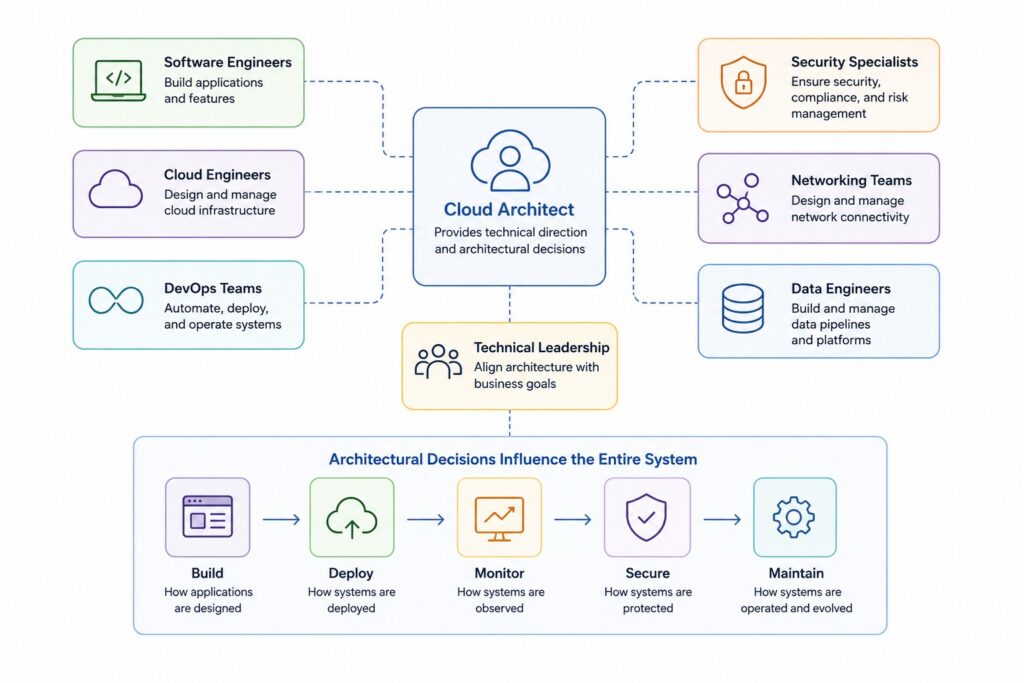
Cloud architects rarely work in isolation. They collaborate closely with software engineers, cloud engineers, DevOps teams, security specialists, networking teams, data engineers, and technical leadership. Their decisions affect how applications are built, deployed, monitored, and maintained across the organization.
Rather than implementing every component themselves, cloud architects provide technical direction that enables engineering teams to build systems using consistent architectural principles.
Cloud Architect Versus Similar Roles
Cloud architecture is often confused with several related engineering roles because their responsibilities frequently overlap. While these professionals work together, each contributes to different aspects of modern cloud platforms.
Cloud architects focus on designing the overall cloud solution. Cloud engineers implement and operate cloud infrastructure, DevOps engineers automate deployments and operational workflows, solutions architects align technical systems with business requirements, and software architects concentrate primarily on application design.
| Role | Primary Responsibility |
|---|---|
| Cloud Architect | Design cloud infrastructure and overall architecture |
| Cloud Engineer | Build and manage cloud resources |
| DevOps Engineer | Automate deployment and operations |
| Solutions Architect | Align technical architecture with business needs |
| Software Architect | Design application structure and software systems |
Why Cloud Architects Matter
Cloud platforms have fundamentally changed how organizations build and operate software. Instead of purchasing physical hardware months in advance, businesses can provision infrastructure within minutes and scale resources dynamically as demand changes. While this flexibility creates enormous opportunities, it also introduces architectural complexity. Cloud architects help organizations take advantage of cloud capabilities without sacrificing reliability, security, or operational efficiency.
Poor architectural decisions often become increasingly expensive as systems grow. A well-designed cloud architecture provides a stable foundation that supports business expansion while minimizing unnecessary operational overhead.
Designing Reliable Systems
Modern applications are expected to remain available around the clock despite hardware failures, software bugs, regional outages, or sudden traffic spikes. Cloud architects design systems that tolerate these failures by introducing redundancy, load balancing, automated recovery, and distributed infrastructure.
Rather than assuming components will always function correctly, cloud architectures are designed with the expectation that failures will eventually occur. This mindset enables systems to continue operating even when individual services become unavailable.
Enabling Business Growth
Business growth places continuous pressure on infrastructure. New customers, international expansion, additional engineering teams, and evolving product requirements all demand systems that can scale without requiring complete redesigns.
Cloud architects anticipate these changes by designing modular, flexible infrastructures that accommodate future expansion while minimizing disruption to existing applications. This allows organizations to introduce new capabilities much more rapidly than traditional on-premises environments.
Managing Cost and Complexity
Cloud resources are billed based on consumption, meaning architectural decisions directly affect operational costs. Overprovisioned infrastructure wastes money, while underprovisioned systems create performance and reliability problems.
Cloud architects continuously balance performance with cost by selecting appropriate services, introducing autoscaling, optimizing storage, and eliminating unnecessary infrastructure complexity.
| Poor Cloud Architecture | Well-Designed Cloud Architecture |
|---|---|
| Frequent outages | High availability |
| Difficult to scale | Elastic infrastructure |
| High operational costs | Cost-efficient resource usage |
| Manual operations | Automated cloud management |
| Complex deployments | Consistent, repeatable architecture |
Core Responsibilities of a Cloud Architect
Cloud architects perform responsibilities that extend well beyond choosing cloud services. They design infrastructure, establish architectural standards, guide engineering teams, review technical decisions, and ensure cloud platforms continue meeting business objectives as applications evolve. Although responsibilities vary between organizations, most cloud architects focus on creating systems that remain secure, scalable, reliable, and maintainable over the long term.
This combination of technical depth and strategic planning distinguishes cloud architecture from many implementation-focused engineering roles.
Designing Cloud Infrastructure
Cloud architects determine how applications are deployed across cloud environments. They design virtual networks, compute platforms, storage systems, databases, messaging services, and connectivity between components while considering scalability, availability, and security requirements.
Infrastructure design also includes selecting appropriate deployment regions, planning network segmentation, defining backup strategies, and ensuring systems remain resilient under changing workloads.
Selecting Appropriate Cloud Services
Modern cloud providers offer hundreds of managed services capable of solving similar problems in different ways. Cloud architects evaluate these services by considering operational complexity, scalability, pricing, performance, vendor support, and long-term maintainability.
Choosing managed services often reduces operational effort, but architects must also consider portability, service limitations, and integration requirements before making architectural decisions.
Security and Compliance
Security forms a central part of cloud architecture rather than being added after deployment. Architects design identity management, encryption strategies, network isolation, secrets management, logging, and governance controls that protect both infrastructure and application data.
Organizations operating in regulated industries must also satisfy compliance requirements, making security architecture an ongoing responsibility rather than a one-time configuration task.
Architecture Reviews and Technical Leadership
Cloud architects frequently review System Designs before implementation begins. They evaluate scalability, resilience, operational risk, and alignment with organizational standards while mentoring engineering teams throughout the development process.
This leadership role helps maintain architectural consistency across projects while enabling engineers to make informed implementation decisions.
| Responsibility | Why It Matters |
|---|---|
| Infrastructure Design | Build scalable cloud environments |
| Cloud Service Selection | Balance capability, cost, and complexity |
| Security Architecture | Protect systems and data |
| Compliance Planning | Meet regulatory requirements |
| Technical Leadership | Guide engineering decisions |
| Architecture Reviews | Maintain long-term consistency |
Cloud Architecture Fundamentals
Regardless of which cloud platform an organization uses, successful architectures are built upon a consistent set of engineering principles. These principles influence how systems respond to failures, accommodate increasing traffic, automate operational tasks, and evolve as business requirements change. Understanding these foundations is more valuable than memorizing individual cloud services because the underlying architectural concepts remain applicable across providers.
Cloud architects focus on principles first and technologies second.
Cloud-Native Architecture
Cloud-native systems are designed specifically to leverage the characteristics of cloud platforms rather than simply relocating traditional applications into virtual machines. Applications are typically composed of loosely coupled services that can scale independently while relying on managed infrastructure wherever practical.
Automation also becomes a defining characteristic of cloud-native systems. Infrastructure provisioning, deployment, monitoring, and recovery are designed to occur with minimal manual intervention, improving both reliability and operational efficiency.
High Availability
Cloud infrastructure inevitably experiences failures, making redundancy an essential architectural principle. Applications are distributed across multiple availability zones or regions so that the failure of individual components does not interrupt service.
High availability extends beyond servers to include databases, storage systems, networking components, and application services. Every critical dependency requires an appropriate strategy for handling failures.
Scalability
One of the defining advantages of cloud computing is the ability to scale resources dynamically. Horizontal scaling allows additional application instances to be added automatically as traffic increases, while load balancers distribute requests across healthy resources.
Effective scalability also depends on stateless application design, distributed storage, caching, and asynchronous processing rather than simply increasing server capacity.
Resilience
Resilience refers to a system’s ability to continue functioning despite failures. Cloud architects achieve resilience by combining redundancy, automated recovery, monitoring, graceful degradation, circuit breakers, and disaster recovery planning.
Rather than attempting to eliminate failures entirely, resilient architectures are designed to minimize the impact of failures on users and business operations.
| Cloud Principle | Primary Goal |
|---|---|
| Cloud-Native Design | Maximize cloud platform capabilities |
| High Availability | Minimize downtime |
| Scalability | Handle changing workloads |
| Resilience | Continue operating during failures |
Essential Skills Every Cloud Architect Needs
Cloud architecture requires expertise across multiple technical disciplines rather than mastery of a single technology. Successful cloud architects understand infrastructure, networking, distributed systems, security, automation, and software architecture while also communicating effectively with both technical and business stakeholders. Because cloud platforms evolve continuously, learning underlying engineering principles is generally more valuable than memorizing specific service names.
Strong cloud architects combine broad technical knowledge with the ability to evaluate tradeoffs objectively.
Cloud Platforms
Most organizations build cloud systems using AWS, Microsoft Azure, Google Cloud Platform, or combinations of multiple providers. Although these platforms offer different services, they all provide similar capabilities including compute, networking, storage, databases, messaging, monitoring, and identity management.
Learning how these capabilities relate to architectural principles makes it easier to adapt as cloud technologies continue evolving.
Infrastructure as Code
Modern cloud infrastructure is rarely created manually through management consoles. Instead, engineers define infrastructure declaratively using Infrastructure as Code tools such as Terraform, CloudFormation, Pulumi, or Azure Bicep.
This approach improves repeatability, version control, collaboration, and deployment consistency while reducing configuration drift across environments.
Networking and Distributed Systems
Cloud architects must understand virtual networks, routing, DNS, load balancing, firewalls, VPNs, private connectivity, and network security because nearly every cloud application depends on reliable communication between distributed components.
Knowledge of distributed systems is equally important. Microservices, messaging, caching, replication, APIs, and observability all influence how cloud applications perform at scale.
Communication and Leadership
Technical expertise alone is not sufficient. Cloud architects regularly explain tradeoffs, document architectural decisions, review designs, mentor engineers, and communicate with stakeholders who may not possess deep technical backgrounds.
Clear communication allows organizations to make informed architectural decisions while ensuring engineering teams understand both the reasoning and long-term implications behind those choices.
| Skill Category | Examples |
|---|---|
| Cloud Platforms | AWS, Azure, Google Cloud |
| Infrastructure as Code | Terraform, CloudFormation, Pulumi |
| Networking | VPCs, DNS, Routing, Firewalls |
| Distributed Systems | APIs, Microservices, Messaging, Caching |
| Security | IAM, Encryption, Secrets Management |
| Leadership | Documentation, Communication, Decision Making |
How Cloud Architectures Work
Although cloud platforms provide hundreds of services, the overall request lifecycle remains remarkably consistent. User requests enter cloud infrastructure through networking and security layers, are processed by application services, interact with data systems, and generate responses, while operational platforms continuously monitor the health of the entire environment. Understanding this end-to-end flow helps explain how individual cloud services contribute to larger production architectures.
Rather than viewing cloud resources as isolated services, cloud architects think in terms of complete application workflows.
Receiving Client Requests
The lifecycle begins when a browser, mobile application, or external API client initiates a request. Before reaching application code, the request typically passes through DNS services that resolve the application’s domain name and direct traffic toward the appropriate cloud infrastructure.
Depending on the architecture, requests may also traverse content delivery networks, web application firewalls, and API gateways before reaching backend services.
Edge and Application Services
Edge infrastructure protects and accelerates incoming traffic while distributing requests across healthy application instances. Load balancers forward requests to containers, virtual machines, Kubernetes clusters, or serverless functions responsible for executing business logic.
These application services often communicate with additional microservices before completing the requested operation, demonstrating how cloud applications are frequently composed of many cooperating components.
Data and Storage Layer
Application services retrieve and update information using managed databases, object storage, caches, message queues, and search systems. Selecting appropriate data services depends on workload characteristics, consistency requirements, scalability expectations, and operational considerations.
Separating application processing from storage allows each layer to scale independently as demand changes.
Monitoring and Operations
Every stage of the request lifecycle generates operational information. Logging systems capture application events, monitoring platforms collect infrastructure metrics, tracing systems follow requests across distributed services, and autoscaling platforms adjust infrastructure capacity automatically based on workload.
These operational capabilities enable cloud architects to maintain reliable systems while responding quickly to changing traffic patterns and production incidents.
| Request Stage | Primary Responsibility |
|---|---|
| Client Request | Browser, mobile app, or API initiates communication |
| Edge Services | DNS, CDN, WAF, API Gateway, Load Balancer |
| Application Layer | Containers, VMs, Serverless, Microservices |
| Data Layer | Databases, Storage, Caches, Message Queues |
| Monitoring | Logging, Metrics, Tracing, Autoscaling |
Cloud Deployment Models
Not every organization uses the cloud in the same way. Some build entirely on public cloud platforms, while others continue operating private data centers because of regulatory requirements, existing infrastructure, or business constraints. Many enterprises combine multiple deployment models to balance flexibility, security, and operational control. Understanding these approaches helps cloud architects choose an infrastructure strategy that aligns with both technical and organizational needs.
The appropriate deployment model depends on factors such as compliance requirements, application architecture, operational expertise, and long-term business goals rather than on any universally preferred approach.
Public Cloud
Public cloud platforms such as AWS, Microsoft Azure, and Google Cloud provide computing resources that organizations consume on demand. Customers share the provider’s physical infrastructure while maintaining logical isolation through virtualization and cloud-native services.
This model offers rapid provisioning, elastic scaling, and access to a broad ecosystem of managed services. It is often the preferred choice for startups, SaaS platforms, and organizations seeking to reduce infrastructure management overhead.
Private Cloud
Private cloud environments dedicate infrastructure to a single organization. They may operate within company-owned data centers or through managed private cloud providers, giving organizations greater control over hardware, networking, and security configurations.
Private clouds are commonly used in industries with strict compliance requirements, sensitive workloads, or regulatory obligations that limit where data may be stored or processed.
Hybrid Cloud
Hybrid cloud combines private infrastructure with public cloud services, allowing applications and data to move between environments when appropriate. Organizations may keep sensitive systems on private infrastructure while using the public cloud for customer-facing applications, analytics, or burst capacity during periods of high demand.
This flexibility supports gradual cloud adoption while preserving investments in existing infrastructure.
Multi-Cloud
Multi-cloud strategies intentionally use services from multiple cloud providers rather than relying on a single vendor. Organizations may adopt this approach to improve resilience, avoid vendor lock-in, satisfy regional requirements, or take advantage of specialized services offered by different providers.
Although multi-cloud increases flexibility, it also introduces additional operational complexity because engineering teams must understand multiple platforms and maintain consistent architecture across them.
| Deployment Model | Best Suited For |
|---|---|
| Public Cloud | Rapid scaling and managed services |
| Private Cloud | Regulatory and highly controlled environments |
| Hybrid Cloud | Combining existing infrastructure with cloud services |
| Multi-Cloud | Vendor diversification and specialized workloads |
Cloud Architecture Patterns
Cloud platforms provide the infrastructure needed to build applications, but architecture patterns determine how those applications are organized internally. These patterns influence scalability, deployment, operational complexity, and the way services communicate with one another. Rather than representing competing approaches, many production systems combine several architectural patterns to address different requirements within the same application.
Choosing an architecture pattern involves understanding application behavior, expected growth, operational maturity, and team expertise rather than simply following current technology trends.
Microservices
Microservices divide applications into independently deployable services, each responsible for a specific business capability. Individual services communicate through APIs or messaging systems while allowing engineering teams to develop, deploy, and scale components independently.
This architecture improves flexibility and supports large engineering organizations, but it also introduces distributed systems challenges such as service discovery, observability, network communication, and failure handling.
Event-Driven Architecture
Not every interaction requires synchronous communication. Event-driven architecture allows services to exchange information asynchronously using event buses, message queues, or streaming platforms. Services publish events describing business activity while other services react independently when those events become available.
This loose coupling improves scalability and resilience because individual services become less dependent on the immediate availability of one another.
Serverless Architecture
Serverless computing allows developers to execute application code without managing servers directly. Cloud providers automatically provision infrastructure, scale execution environments, and bill based on actual usage rather than continuously running resources.
Serverless architectures work particularly well for event-driven workloads, APIs, scheduled tasks, and applications with highly variable traffic patterns. However, architects must also consider execution limits, cold starts, and platform-specific constraints.
Container-Based Architecture
Containers package applications together with their dependencies, ensuring consistent behavior across development, testing, and production environments. Container orchestration platforms such as Kubernetes automate deployment, scaling, networking, and recovery across large clusters.
Container-based architectures provide portability and operational consistency while requiring more infrastructure management than fully managed serverless platforms.
| Architecture Pattern | Common Use Cases |
|---|---|
| Microservices | Large independently evolving applications |
| Event-Driven | Asynchronous workflows and messaging |
| Serverless | Event-driven APIs and variable workloads |
| Container-Based | Cloud-native applications requiring portability |
Security, Reliability, and Cost Optimization
Every cloud architecture must balance three priorities that often compete with one another: security, reliability, and cost. Increasing redundancy may improve availability but also increase infrastructure expenses. Strengthening security controls may introduce operational complexity, while aggressive cost optimization can reduce resilience if resources become insufficient during traffic spikes. Cloud architects continuously evaluate these tradeoffs to build systems that satisfy both technical and business objectives.
Rather than treating these concerns independently, successful architectures integrate them into every design decision.
Security by Design
Security begins with architecture rather than deployment. Cloud architects implement identity and access management, network segmentation, encryption, secrets management, and least-privilege access controls before applications are placed into production.
Designing secure systems also involves protecting data throughout its lifecycle. Encryption at rest and in transit, secure authentication, centralized logging, and continuous monitoring all contribute to reducing organizational risk.
Reliability Engineering
Cloud platforms provide numerous capabilities for improving reliability, including availability zones, automated failover, backups, replication, health monitoring, and disaster recovery services. Cloud architects combine these capabilities to minimize downtime while ensuring applications continue functioning despite infrastructure failures.
Reliability also depends on operational practices such as observability, automated recovery, circuit breakers, and graceful degradation during dependency failures.
Cost Optimization
Unlike traditional infrastructure investments, cloud resources generate ongoing operational expenses. Architects therefore monitor infrastructure utilization continuously, selecting appropriately sized resources, introducing autoscaling, choosing cost-effective storage tiers, and eliminating unused services.
Effective cost optimization focuses on maximizing business value rather than simply minimizing spending. The least expensive architecture is not always the most appropriate if it compromises reliability or future growth.
| Architectural Goal | Common Strategies |
|---|---|
| Security | IAM, encryption, secrets management, network isolation |
| Reliability | Redundancy, backups, failover, monitoring |
| Cost Optimization | Autoscaling, right-sizing, storage optimization, usage monitoring |
Common Mistakes Cloud Architects Make
Cloud architecture is a discipline built through experience because many decisions reveal their consequences only after systems begin operating at scale. Mistakes that appear minor during early development can significantly affect operational costs, reliability, or maintainability months later. Recognizing these common pitfalls helps architects build systems that remain effective as organizations grow.
Most architectural mistakes arise not from insufficient technical ability but from overlooking long-term operational implications.
Designing for Maximum Scale Too Early
A common mistake is assuming every application requires internet-scale infrastructure from the beginning. Introducing complex distributed architectures, extensive microservices, or sophisticated networking for relatively small workloads increases operational complexity without delivering meaningful business value.
Successful architects design for reasonable growth while leaving room for future expansion rather than solving hypothetical scaling problems prematurely.
Ignoring Cost and Operational Simplicity
Cloud platforms make infrastructure easy to provision, but this convenience can lead to unnecessary spending. Overprovisioned virtual machines, unused managed services, excessive storage, and redundant infrastructure gradually increase operational costs without improving application quality.
Architects should evaluate both financial and operational costs whenever introducing new cloud services or architectural components.
Weak Networking and Observability
Applications depend heavily on networking, yet network design is often overlooked until problems emerge. Poor subnet design, unnecessary cross-region communication, or insufficient private connectivity can create latency, security, and availability challenges that become difficult to correct later.
Similarly, limited monitoring and observability make production incidents much harder to diagnose. Cloud architectures should include comprehensive logging, metrics, and tracing from the beginning rather than adding them after failures occur.
Inadequate Disaster Recovery Planning
Some organizations assume that deploying applications to the cloud automatically provides disaster recovery. In reality, backup strategies, replication policies, recovery objectives, and failover procedures require deliberate architectural planning.
Preparing for disaster recovery before an incident occurs significantly reduces operational risk during real outages.
| Common Mistake | Better Practice |
|---|---|
| Premature large-scale architecture | Scale according to actual business needs |
| Ignoring cloud costs | Continuously optimize resource utilization |
| Weak networking design | Plan connectivity and segmentation early |
| Limited observability | Build monitoring into the architecture |
| Poor disaster recovery | Define backup and recovery strategies from the start |
Cloud Architecture in System Design Interviews
Cloud architecture appears frequently in System Design interviews because most modern applications are deployed on cloud platforms. Interviewers are generally less interested in whether candidates can list cloud services than in whether they understand how to combine those services into secure, scalable, and reliable systems. Architectural reasoning consistently carries more weight than provider-specific terminology.
Strong candidates explain why they selected particular cloud capabilities and how those choices satisfy functional and non-functional requirements rather than simply naming managed services.
What Interviewers Evaluate
Interviewers typically evaluate how candidates approach scalability, reliability, networking, security, cost awareness, and operational simplicity. Discussions often include load balancing, auto scaling, databases, storage, messaging systems, disaster recovery, and monitoring because these components form the foundation of cloud-native applications.
Candidates who justify architectural tradeoffs generally demonstrate stronger engineering judgment than those who simply recommend popular cloud services.
Common Interview Scenarios
Cloud architecture discussions commonly appear when designing SaaS platforms, media streaming services, global web applications, AI platforms, enterprise migration projects, financial systems, or large-scale e-commerce applications. Although these systems differ significantly, they all require thoughtful decisions about deployment, scaling, networking, and resilience.
Understanding architectural principles allows candidates to adapt their reasoning across many different interview scenarios.
Common Candidate Mistakes
Many candidates recommend managed services without explaining why they are appropriate. Others overlook cost implications, disaster recovery, networking considerations, or operational monitoring while focusing exclusively on application functionality.
Successful interview answers balance scalability, security, reliability, maintainability, and cost while communicating the reasoning behind each architectural decision.
| Interview Area | What Interviewers Evaluate |
|---|---|
| Scalability | Ability to handle changing workloads |
| Reliability | Failure handling and recovery planning |
| Security | Identity, networking, and data protection |
| Cloud Service Selection | Appropriate architectural tradeoffs |
| Communication | Clear explanation of design decisions |
Frequently Asked Questions About Cloud Architects
Cloud architecture combines infrastructure engineering, distributed systems, networking, security, automation, and business strategy, making it one of the broadest roles in modern software engineering. As organizations continue expanding their cloud adoption, many engineers naturally ask similar questions about the skills, responsibilities, and career path associated with becoming a cloud architect.
Although technologies evolve rapidly, the underlying engineering principles remain consistent across cloud platforms.
What does a cloud architect do?
A cloud architect designs cloud infrastructure that supports secure, scalable, reliable, and cost-effective applications. Their responsibilities include selecting cloud services, defining architecture standards, reviewing System Designs, planning networking, improving resilience, and guiding engineering teams through technical decisions.
Rather than implementing every component personally, cloud architects establish the architectural direction that enables successful long-term system development.
Which cloud platform should I learn first?
AWS, Microsoft Azure, and Google Cloud Platform all provide comprehensive cloud capabilities and share many common architectural concepts. Learning one platform thoroughly while understanding the underlying principles generally makes it much easier to transition to another provider later.
The specific platform matters less than understanding networking, scalability, security, automation, and distributed systems.
Do cloud architects write code?
Yes, although their responsibilities often extend beyond application development. Cloud architects frequently write Infrastructure as Code, automation scripts, deployment pipelines, reference implementations, and occasionally application code when evaluating architectural approaches.
Programming knowledge helps architects understand implementation constraints and collaborate effectively with engineering teams.
Is cloud architecture difficult to learn?
Cloud architecture requires knowledge across several engineering disciplines, making it a challenging field to master. However, these topics build naturally upon one another, allowing engineers to develop expertise progressively through practical experience.
Strong foundations in networking, operating systems, software engineering, and distributed systems make learning cloud architecture significantly easier.
Do cloud architects need networking knowledge?
Absolutely. Networking is one of the most fundamental aspects of cloud architecture because every cloud application depends on communication between services, databases, users, and infrastructure. Understanding DNS, routing, load balancing, firewalls, virtual networks, and secure connectivity is essential.
Many architectural decisions ultimately involve networking considerations even when applications themselves remain unchanged.
Is certification enough to become a cloud architect?
Cloud certifications demonstrate familiarity with cloud platforms and architectural concepts, but they do not replace practical engineering experience. Successful cloud architects develop their expertise by designing, deploying, operating, and improving production systems over time.
Certifications are valuable learning tools, but practical experience remains equally important.
How is a cloud architect different from a cloud engineer?
Cloud architects primarily design cloud solutions and establish architectural standards, while cloud engineers implement, automate, and operate those environments. Although the responsibilities overlap, architects generally focus more on long-term design decisions whereas engineers concentrate on day-to-day implementation and operations.
Both roles collaborate closely throughout the software lifecycle.
Is cloud architect a good career?
Cloud architecture continues to be one of the strongest long-term career paths in technology because organizations increasingly rely on cloud platforms to deliver modern software. The role also provides opportunities to work across infrastructure, software engineering, security, distributed systems, and technical leadership.
Its emphasis on architectural thinking makes the knowledge transferable across industries and cloud providers.
| Question | Short Answer |
|---|---|
| What does a cloud architect do? | Designs cloud infrastructure and architecture. |
| Which cloud platform should I learn? | Start with one and learn the underlying principles. |
| Do cloud architects write code? | Yes, especially automation and infrastructure code. |
| Is networking important? | Yes, it is fundamental to cloud architecture. |
| Is certification enough? | No, practical experience is equally important. |
| Is cloud architecture a good career? | Yes, it offers strong long-term opportunities. |
Final Thoughts
Cloud architecture is much more than choosing cloud services or deploying applications to virtual machines. It is the discipline of designing secure, scalable, resilient, and cost-effective systems that enable organizations to build and operate modern software efficiently. Every architectural decision influences how applications perform under growth, respond to failures, protect sensitive information, and evolve as business requirements change.
Becoming an effective cloud architect requires a strong understanding of distributed systems, networking, security, automation, infrastructure, and software architecture rather than expertise in a single cloud provider. By focusing on engineering fundamentals, learning how to evaluate architectural tradeoffs, and gaining practical experience designing production systems, you develop the skills needed to build reliable cloud platforms and succeed in cloud architecture and System Design interviews.