

Chess seems deceptively simple for a System Design interview. Two players, sixty-four squares, and rules that haven’t changed in centuries. Yet the moment you start sketching architecture on a whiteboard, this ancient game reveals layers of distributed systems complexity that catch unprepared candidates off guard.
Race conditions emerge from seemingly innocent move submissions. State synchronization becomes a puzzle within a puzzle. Suddenly, you’re defending design decisions about consistency guarantees while your interviewer probes whether your system could handle a million concurrent games.
This guide walks you through designing an online chess game system from requirements clarification to production-scale considerations. You’ll learn why interviewers favor this problem, how to model game state defensibly, and where candidates typically stumble. More importantly, you’ll understand the architectural patterns that transform a basic chess system into one that handles real-world scale, maintains correctness under pressure, and leaves room for features like matchmaking, leaderboards, and anti-cheat systems.
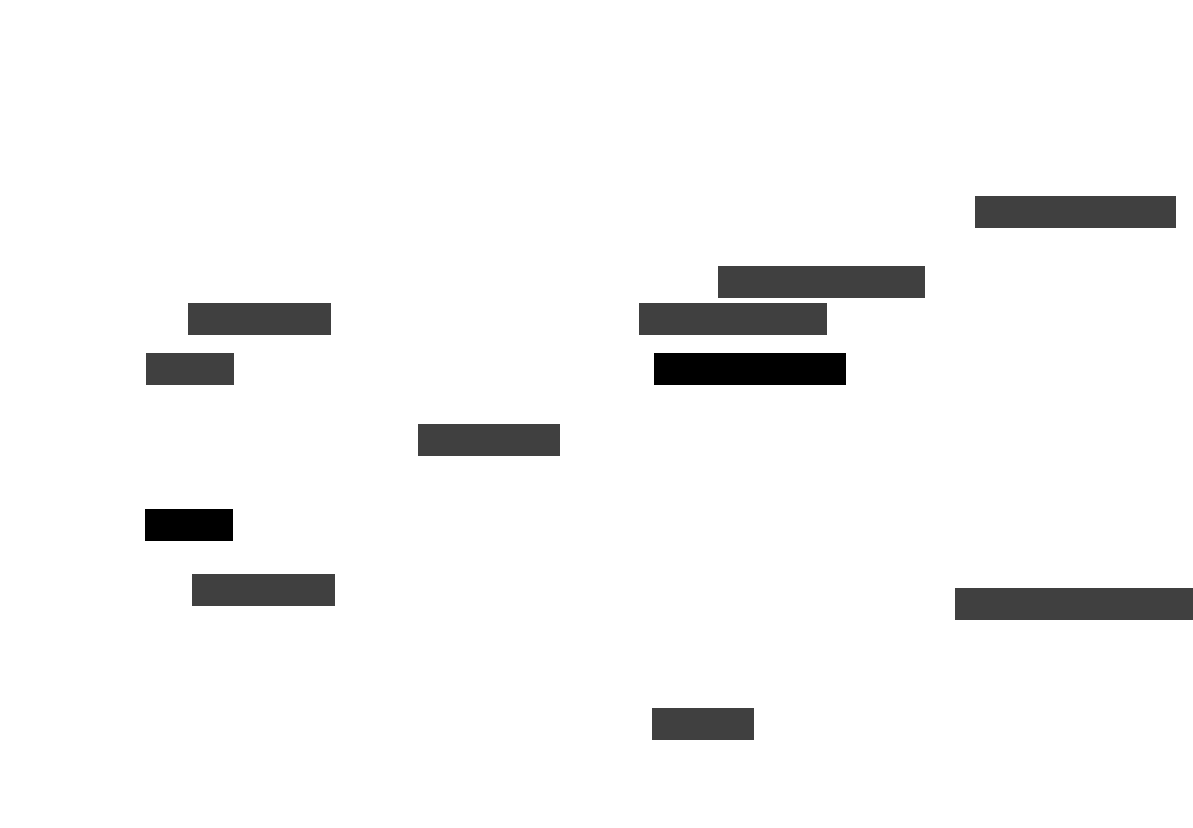
The diagram below illustrates the high-level architecture we’ll develop throughout this guide, showing how clients, services, and storage interact in a well-designed chess system.
Why interviewers choose chess for System Design
Chess occupies a sweet spot in System Design interviews. Almost every candidate understands the game’s mechanics, which allows interviewers to skip domain explanation and dive directly into architectural thinking. Unlike obscure business domains that require lengthy context-setting, chess provides familiar ground where design decisions become the focus rather than problem comprehension.
The question tests multiple System Design fundamentals simultaneously. Candidates must reason about authoritative state ownership, handle real-time interaction between players, ensure correctness under concurrent access, and plan for horizontal scaling. These concerns surface naturally as you work through the design, revealing how well you separate client and server responsibilities.
Flexibility makes chess particularly valuable for interviewers. They can easily add constraints mid-discussion such as ranked matchmaking, spectator mode, time controls, or tournament support to probe your adaptability. A candidate who designs a rigid system struggles with these extensions, while someone who builds with clean abstractions handles them gracefully. This adaptability signal often separates strong candidates from average ones.
Real-world context: Companies like Chess.com and Lichess handle millions of concurrent games daily. Their architectures evolved from the same fundamental patterns you’ll present in interviews, proving these aren’t just academic exercises but production-proven approaches.
Turn-based games expose subtle challenges that real-time games handle differently. Only one move is valid at any moment, ordering matters absolutely, and invalid actions must be rejected deterministically. These constraints make chess an excellent proxy for evaluating how you handle synchronization, prevent race conditions, and ensure idempotent operations. Understanding why this matters sets the foundation for requirements clarification.
Clarifying requirements and scoping the system
One of the most common mistakes candidates make is assuming the scope before confirming it. Online chess platforms can include matchmaking, rankings, spectators, chat, analysis engines, puzzles, and more. Jumping into architecture without boundaries leads to scattered designs that try to solve everything and excel at nothing. Strong candidates clarify requirements explicitly before drawing a single box.
Establishing functional requirements
A reasonable initial scope for a chess system includes user authentication, game creation between two players, turn-by-turn move submission, server-side move validation, and synchronized board updates for both participants. You should explicitly state that you’re designing for online, turn-based play between two human players. This clarity gives your interviewer the chance to adjust scope if they have different expectations.
Equally important is defining exclusions. Features like AI opponents, rating systems (ELO or Glicko-2), tournaments, spectators, chat, or complex time controls can dramatically increase complexity. Strong candidates say something like: “I’ll focus on core online gameplay first. We can add rankings or spectators later if you’d like.” This demonstrates scope control and keeps discussion focused on fundamentals that matter most.
Pro tip: When scoping out features, mention them as “extension points” rather than dismissing them entirely. Saying “the architecture supports adding a leaderboard later” signals forward-thinking without committing to unnecessary complexity.
Non-functional requirements that drive architecture
Non-functional requirements often determine the most critical architectural decisions. For chess, these typically include low latency for move updates (players expect near-instant feedback), strong consistency for game state (no divergent board positions), high availability (games shouldn’t be lost mid-match), and horizontal scalability to support many concurrent games.
You don’t need exact numbers in initial scoping, but reasoning qualitatively demonstrates maturity. Thousands of concurrent games require different solutions than millions. At Chess.com scale, latency budgets tighten to under 100 milliseconds for move acknowledgment, and systems must handle global traffic across multiple regions. Mentioning these considerations, even briefly, shows you understand the spectrum from MVP to production scale.
With requirements established, we can define the data model that will store game state, player information, and move history reliably.
Core entities and data model design
The data model directly impacts correctness, recoverability, and scalability. A thoughtful model makes move validation straightforward, failure recovery clean, and game replay possible. A weak model pushes complexity into application logic where it becomes harder to test and maintain. Interviewers pay close attention to how explicitly and defensibly you model game state.
Users, players, and games
At the foundation, a User represents a registered account in the system. A Player is a user participating in a specific game. This distinction matters because a user can play many games over time, while a player’s role is tied to a single match with attributes like color assignment (white or black) and current turn ownership. Separating these concepts simplifies permission checks and action authorization.
The Game entity forms the system’s core. It contains a unique identifier, references to both players, the current board state, whose turn it is, and game status (active, finished by checkmate, resigned, or drawn). Board state can be modeled as a serialized string representation (like FEN notation) or a structured piece map.
Interviewers care less about the exact format and more about whether it can be validated, persisted, and recovered reliably. Strong candidates emphasize that the server owns this authoritative state. Clients receive copies but never modify the source directly.
Watch out: Storing only the current board position loses history. Without move records, you can’t implement undo functionality, detect threefold repetition draws, or debug disputes about what happened during a game.
Move history and efficient board representation
Moves should be modeled as immutable records associated with a game. Each move includes the piece moved, start and end positions, timestamp, and a sequence number. Storing move history separately from current board state enables replay functionality, debugging, draw detection (threefold repetition, fifty-move rule), and recovery after failures. The sequence number proves critical for handling duplicate submissions and maintaining ordering guarantees.
For board representation, most interview discussions use straightforward 2D arrays or piece-position maps. However, production systems often employ bitboards. These are 64-bit integers where each bit represents a square’s occupancy for a specific piece type. Bitboards enable extremely fast move generation and validation through bitwise operations, reducing computation time significantly when processing millions of games. Mentioning this optimization demonstrates awareness of performance trade-offs, even if you implement the simpler approach first.
The following table summarizes the core entities and their key attributes:
| Entity | Key attributes | Purpose |
|---|---|---|
| User | ID, username, authentication credentials, rating | Account management, identity across games |
| Player | User reference, game reference, color, is_turn | Role within a specific game instance |
| Game | ID, players, board_state, status, version, timestamps | Authoritative match state and metadata |
| Move | Game ID, sequence_number, piece, from, to, timestamp | Immutable history for replay and validation |
With entities defined, we can design the high-level architecture that orchestrates game creation, move processing, and state synchronization.
High-level system architecture
The most important architectural decision is establishing where authority lives. In a well-designed chess system, the server is the single source of truth for game state. Clients render the board and transmit user actions but are treated as fundamentally untrusted. Any design that allows clients to modify game state directly invites cheating and inconsistency.
Core components and responsibility separation
At a high level, the system consists of client applications, backend services, and persistent storage. Clients handle user interaction and display. Backend services validate moves, update game state, and broadcast updates to players. Storage persists game state and move history for durability and recovery.
A clean component breakdown includes a Game Service responsible for game lifecycle management, move validation, and rule enforcement. It also includes a User Service handling authentication, player profiles, and session management. Finally, a Communication Layer (typically WebSocket-based) delivers real-time updates to connected clients. You don’t need to name specific technologies. Interviewers care more about responsibility boundaries than whether you choose Redis or Memcached.
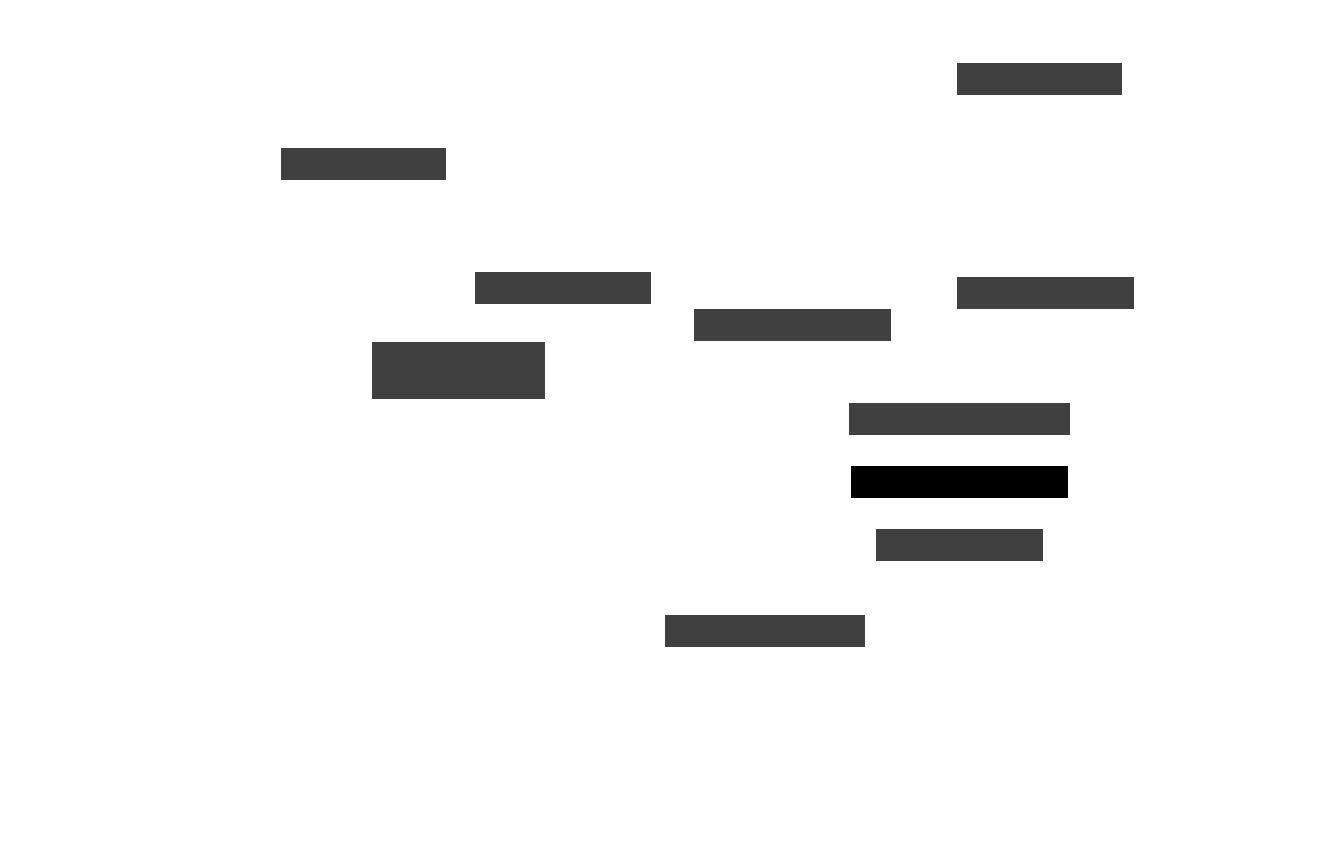
The diagram below shows how these components interact during a typical move submission flow.
Stateless services with externalized state
Strong candidates design backend services to be stateless. All persistent state lives in databases or external stores like Redis. This approach allows horizontal scaling. You can add Game Service instances as load increases. It also simplifies recovery when instances fail. No single server crash corrupts or loses a game because state exists independently of any particular process.
Game state is fetched and updated atomically during move validation. The service retrieves current state, validates the proposed move, applies changes, and persists the result as a single logical operation. This pattern ensures that even if a service instance dies mid-processing, another instance can pick up the game from its last consistent state.
Real-world context: Chess.com uses Redis for active game state because it provides sub-millisecond reads. Games are persisted to durable storage asynchronously, giving them both speed and durability without sacrificing either.
Read and write path characteristics
Chess systems are write-light but correctness-heavy. Each move is a write that must be validated carefully against game rules, turn order, and special conditions like check. Reads occur when clients fetch game state on connection or after disconnection. This asymmetry suggests optimizing for correctness first and performance second.
Reads can be cached aggressively since game state changes only on valid moves. Writes must always go through authoritative validation. There’s no safe shortcut. This architecture scales cleanly, remains easy to reason about, and provides natural extension points for features like spectators (additional read clients) or analysis engines (additional consumers of move history).
The architecture establishes where data lives and flows. Now we need to examine how game logic enforces chess rules and maintains correctness.
Game logic, rules enforcement, and validation
Move validation is where chess complexity becomes system complexity. Interviewers probe this area to understand whether you can implement deterministic correctness in a distributed environment. The answer is always that validation happens on the server. Clients suggest moves, but the server determines legality.
The validation pipeline
When a player submits a move, the server executes a series of checks in order. First, verify the game exists and remains active (not already finished or resigned). Second, confirm the requesting player belongs to this game and has the correct color. Third, check that it’s actually this player’s turn. Fourth, validate the move is legal according to chess rules. This means the piece can move that way, the path is clear, and captures are valid. Fifth, ensure the move doesn’t leave the player’s own king in check.
Only if all checks pass does the server update game state and persist the move to history. This pipeline is deterministic. The same inputs always produce the same outputs. Interviewers care less about your chess rule implementation details and more about whether you model validation as an ordered, atomic operation that either succeeds completely or fails without side effects.
Illegal moves are rejected cleanly. The response indicates what went wrong, but the game state remains unchanged. Strong candidates emphasize that validation failures are expected during normal operation. Network issues cause retries, users misclick, and opponents move simultaneously. These aren’t errors to log and investigate but routine rejections handled gracefully.
Watch out: Edge cases like castling (requires neither king nor rook to have moved), en passant (depends on opponent’s previous move), and pawn promotion need explicit handling. Mention these as complexity to address, but don’t spend interview time implementing them unless asked.
Handling concurrency and preventing duplicate moves
Network delays create concurrency challenges. A client might timeout waiting for acknowledgment and retry the same move. Two requests for the same move arrive at different service instances. Without protection, you might apply a move twice or process moves out of order.
The solution is including a version field or move sequence number in game state. Each submitted move includes the expected version. If the server’s current version differs, the request is stale or duplicate and gets rejected. The client can then fetch current state and retry if appropriate. This pattern ensures idempotency. Submitting the same move multiple times has the same effect as submitting it once.
The command pattern fits naturally here. Each move becomes a command object that can be validated, executed, and stored. This structure also enables undo functionality if your scope includes it. You simply reverse commands in order. Even if undo isn’t required, thinking in commands keeps your logic modular and testable.
Validation ensures correctness, but players need to see results immediately. Let’s examine how real-time communication keeps both players synchronized.
Real-time communication and gameplay flow
Although chess is turn-based, real-time communication remains essential. Players expect to see opponent moves immediately after submission, not after polling intervals. The experience of staring at a static board wondering if your opponent moved yet feels broken, even if nothing is technically wrong.
Push-based updates versus polling
Polling, where clients periodically request updated state, is the simplest approach. It works, it’s easy to implement, and it doesn’t require persistent connections. But it introduces latency (you only see changes at poll intervals), wastes bandwidth (most polls return “no change”), and scales poorly as game counts grow.
Push-based updates invert the model. Clients establish persistent connections (typically WebSockets), and the server notifies them when state changes. Move acknowledgment happens in milliseconds rather than seconds. Bandwidth usage drops because data only flows when something actually happens. At scale, this efficiency matters enormously. Handling millions of idle polling requests differs dramatically from maintaining millions of mostly-quiet WebSocket connections.
Strong candidates explain both approaches and justify choosing push for active gameplay. Some systems use hybrid approaches with WebSockets for active games and polling for historical data or when connections fail. Mentioning this flexibility demonstrates pragmatic thinking.
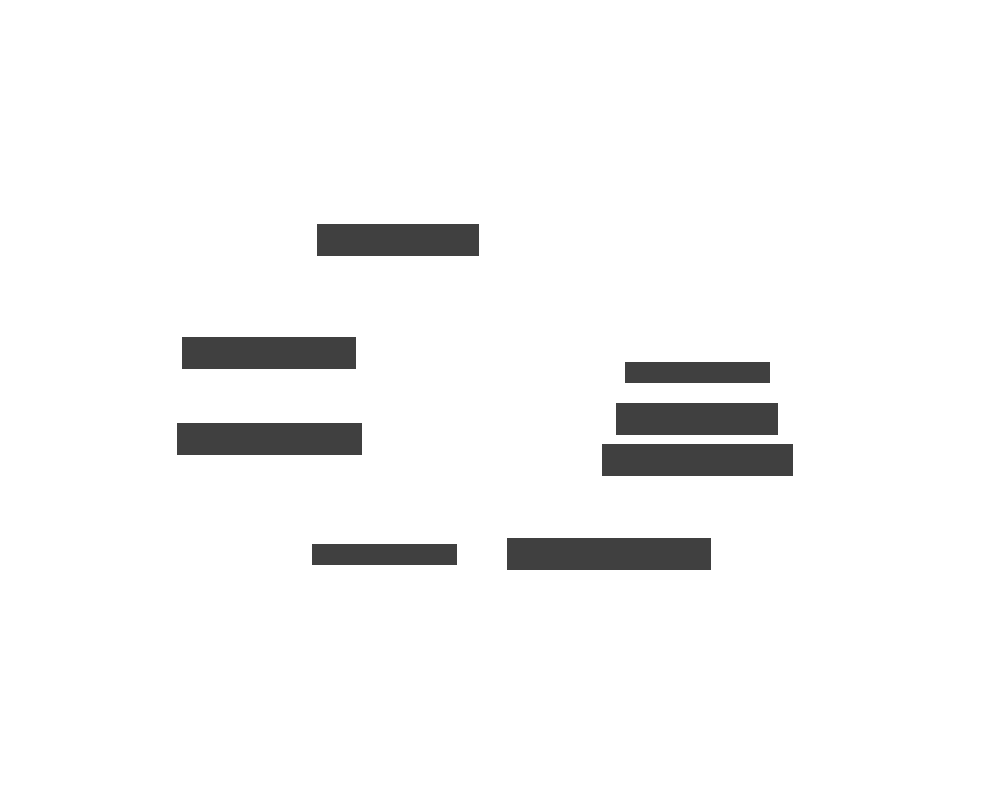
The following diagram shows how WebSocket connections enable bidirectional communication between players and the server.
State synchronization and reconnection handling
When a move is accepted, the server updates authoritative state and broadcasts the result to both players. The broadcast includes either the full new board state or just the move made (clients can apply it locally). Clients don’t apply moves optimistically before server confirmation. They wait for acknowledgment to avoid showing states that might be rejected.
Disconnection is expected, not exceptional. Players lose network connectivity, close browsers accidentally, or switch between devices. A robust system allows clients to reconnect and fetch current game state from the server. Because the server stores authoritative state and complete move history, recovery is straightforward. The client loads current state and resumes from where the game stands. No special disconnection logic is needed. Just standard state retrieval.
Pro tip: Each game should have isolated communication channels. Player A’s moves broadcast only to participants in that game, not to all connected clients. This scoping prevents unnecessary traffic and maintains privacy for games that aren’t spectator-enabled.
Real-time updates keep individual games responsive, but the system must also handle growing numbers of simultaneous games. Scaling requires understanding chess-specific usage patterns.
Scalability, performance, and game lifecycle
A chess system scales differently from fast-paced real-time games. Individual games have extremely low throughput. Maybe one move per minute during thoughtful play. The challenge isn’t moves-per-second within a game but the sheer number of concurrent games and connected clients. Millions of users might each be playing their own independent match.
Horizontal scaling through game independence
Each chess game is completely independent of every other game. This property is a gift for scaling. Stateless services can handle requests for any game because they fetch state from external storage. You can add service instances as load increases without coordination between them.
Partitioning game state by game ID distributes storage naturally. Game 12345 might live on partition A while game 67890 lives on partition B. No game should block or affect another. This isolation property means scaling is mostly about adding capacity rather than redesigning architecture. Scalability becomes an operational concern rather than an architectural one.
Latency budgets tighten at scale. With thousands of concurrent games, a 100ms response time feels instant. With millions, that same latency means significant aggregate server load. Production systems like Chess.com target p95 latencies under 50ms for move processing. They achieve this through in-memory state (Redis), efficient validation code, and geographic distribution to reduce network round trips.
Managing active versus completed games
Active games need fast reads and writes because players are waiting. Completed games are mostly read-only, accessed occasionally for replay or analysis. Treating these identically wastes resources.
A thoughtful design keeps active games in fast storage (Redis, in-memory caches) for minimal latency. When games complete, they’re archived to cheaper durable storage while remaining accessible for replay. This lifecycle awareness demonstrates cost-conscious thinking and prevents fast storage from filling with historical data that doesn’t need sub-millisecond access.
Historical note: Early online chess platforms stored all game state in relational databases. As scale grew, the shift to tiered storage (hot cache for active games, warm storage for recent games, cold storage for archives) became essential for both performance and cost management.
Scale considerations shape infrastructure decisions, but correctness concerns shape how we handle failures and ensure players always see the same game state.
Consistency, correctness, and failure handling
Correctness is non-negotiable in chess. At any moment, exactly one authoritative game state must exist, and all participants must agree on it. A system where players see different board positions, even temporarily, is fundamentally broken regardless of how well it scales.
Strong consistency requirements
Chess requires strong consistency for move ordering, turn enforcement, and game completion detection. When a move is accepted, both players must see it. When checkmate occurs, both players must see the game end. There’s no room for eventual consistency in core gameplay. A player can’t be “eventually” checkmated.
This means the CAP theorem trade-off tilts toward consistency over availability for game state. If the system can’t guarantee consistent reads, it should fail the request rather than return stale data. Interviewers often probe this area to verify you understand where eventual consistency works (leaderboards, user profiles) versus where it doesn’t (active game state).
Atomic state transitions prevent corruption. When processing a move, the system reads current state, validates the move, updates state, and persists the result as a single logical operation. If any step fails, nothing changes. This atomicity ensures partial updates never corrupt games. You never end up with a move recorded but board state unchanged, or vice versa.
Handling retries and ensuring durability
Network failures cause clients to retry requests. The version/sequence number pattern described earlier handles this. Duplicate submissions are detected and rejected without corrupting state. The client receives a response indicating the move was already processed and can fetch current state to continue.
Durability means no game is lost when servers fail. Persisting state after every accepted move ensures that even if a backend crashes mid-game, another instance can serve the game from its last recorded state. Players might need to reconnect, but they’ll find their game intact where they left it. This clean recovery story with no special cases and no manual intervention demonstrates production-level thinking without unnecessary complexity.
Correctness protects game integrity, but we also need to protect against malicious users attempting to cheat or abuse the system.
Security, anti-cheat, and trust boundaries
Security in chess System Design is less about encryption algorithms and more about trust boundaries. Clients are always untrusted. The server authenticates users, authorizes every action, and validates all input. This isn’t paranoia. It’s the only architecture that prevents cheating at a fundamental level.
Server-side authority prevents cheating
Basic cheating prevention flows naturally from the architecture we’ve discussed. Server-side move validation means clients can’t submit illegal moves. Strict turn enforcement means you can’t move twice or move during your opponent’s turn. Authoritative server state means clients can’t claim a different board position than what the server records.
More sophisticated cheating, like using external chess engines to suggest optimal moves, requires additional systems beyond basic architecture. Engine detection typically involves analyzing move timing patterns, move quality consistency, and correlation with known engine recommendations. This falls under anti-cheat systems that can be added later, but mentioning awareness of the problem shows depth.
Real-world context: Chess.com employs dedicated fair play teams using statistical analysis to detect engine assistance. Their systems compare player moves against engine recommendations, analyze timing patterns, and flag suspicious accounts for human review.
API security and authorization
Every game action requires authentication and authorization. A player can only submit moves in games they’re participating in. They can only move pieces of their assigned color. They can never act on behalf of another player or access games they haven’t joined.
These checks happen during request processing, not as an afterthought. The validation pipeline described earlier includes authorization as an early step. Confirm identity and permissions before even checking if the move is legal. Rejecting unauthorized requests quickly saves processing resources and prevents information leakage about game states the requester shouldn’t access.
With architecture, validation, and security covered, let’s discuss how to present this design effectively during your interview.
Presenting your design in the interview
Strong candidates follow a clear progression that keeps interviewers oriented. Start with requirements clarification and scope definition. Move to core entities and data model. Present high-level architecture showing component responsibilities. Explain game logic and validation approach. Discuss real-time updates and synchronization. Address scaling, consistency, and failure handling. This structure demonstrates methodical thinking and makes it easy for interviewers to follow your reasoning.
Managing depth and time
Chess systems can consume an entire interview if you dive too deeply into rule implementation details. Interviewers don’t care whether you can implement castling correctly. They care whether you understand server authority, consistency requirements, and scaling patterns. Stay high-level on chess logic and go deeper on system concerns.
Follow-up questions are opportunities. When an interviewer asks about adding spectators or a rating system, they’re testing adaptability. Restate the new requirement, explain how it impacts your design, and describe what changes or additions you’d make. Strong candidates never panic or completely backtrack. They adjust incrementally, showing that their architecture was designed with extension in mind.
The following diagram summarizes the component interactions and data flows we’ve discussed throughout this guide.

Common mistakes to avoid
Several pitfalls consistently separate average candidates from strong ones. Letting clients own or modify game state directly invites cheating and inconsistency. Ignoring race conditions and duplicate request handling leads to corrupted games. Overengineering features that weren’t requested wastes time and suggests poor scope judgment. Treating chess like a fast-paced action game rather than a turn-based system leads to inappropriate architectural choices.
Pro tip: If you’re unsure whether to include a feature, ask the interviewer explicitly. “Should I include a rating system in the core scope, or should we treat that as an extension?” This demonstrates judgment and collaboration rather than assumption.
For structured preparation, use resources like Grokking the System Design Interview on Educative to practice full System Design problems with curated patterns. Additional study materials can help depending on your experience level, including certification programs, comprehensive courses, and dedicated practice platforms.
Conclusion
Designing a chess game system compresses correctness, synchronization, scalability, and user experience into a familiar domain that lets interviewers focus on your architectural thinking. The key principles remain consistent regardless of specific technologies. Server-side authority ensures correctness, strong consistency prevents divergent states, stateless services enable horizontal scaling, and immutable move history supports recovery and replay. These patterns apply far beyond chess. They’re fundamental to any stateful, multi-user system where correctness matters.
Looking ahead, chess platforms are evolving toward more sophisticated features. These include real-time analysis powered by AI, global matchmaking with latency-aware routing, and advanced fair play detection using machine learning. The architectures handling these challenges build on the same foundations we’ve discussed. They add complexity at the edges while keeping core principles intact. Understanding the fundamentals prepares you not just for interviews but for building systems that grow with their requirements.
Anchor your design around server-side authority, strong consistency for game state, and clean separation between components that can evolve independently. The best answers aren’t complex. They’re simple enough to explain under pressure, defensible against probing questions, and clearly extensible for features not yet imagined.

2 Responses
Your diagrams in this article are broken, can you fix them?
Thanks for flagging this, I’ve fixed the diagrams.