
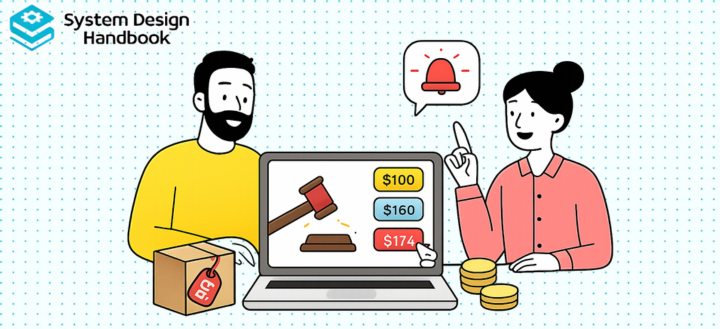
Two bidders submit offers within milliseconds of each other. One expects to win. The other sees a confirmation screen. Your system just accepted both bids, and now the auction has two “winners.” This scenario plays out in poorly designed auction platforms more often than engineers care to admit. The online auction problem is a proving ground for System Design interviews precisely because it exposes the gap between systems that work on paper and systems that work under pressure.
Auction platforms demand something rare in software. They require absolute correctness under chaotic conditions. Unlike a social media feed where stale data causes mild annoyance, an auction system that misorders bids destroys trust and potentially creates legal liability. Interviewers choose this problem because it forces you to confront race conditions, consistency tradeoffs, and real-time communication patterns simultaneously. You cannot hide behind eventual consistency when real money changes hands.
This guide walks you through the complete design process, from clarifying requirements through scaling to millions of concurrent auctions. You will learn how to structure your thinking, where to focus your time during the interview, and which tradeoffs separate strong candidates from average ones. The goal is not to memorize a solution but to develop the architectural judgment that lets you reason through any variant an interviewer throws at you.

What interviewers actually evaluate
When interviewers ask you to design an online auction system, they are not testing whether you know how eBay works. They are evaluating how you approach systems where correctness matters more than raw throughput. Auction systems surface questions that reveal your engineering maturity. How do you guarantee the highest bid wins? What happens when two bids arrive simultaneously? How do you handle the chaotic final seconds before auction close?
Strong candidates identify these challenges early and design around them deliberately. Weak candidates discover race conditions late, usually when the interviewer asks a pointed question about concurrent bid handling. The difference lies in whether you treat correctness as a first-class design constraint or an afterthought to be patched with retry logic.
Real-world context: eBay processes over 1.5 billion live listings at any given time. Their bidding infrastructure must handle massive concurrent load while maintaining strict ordering guarantees. This is exactly the challenge interviewers want to see you reason through.
Online auctions force explicit tradeoffs between consistency, availability, and latency. Accepting bids quickly may conflict with ensuring global ordering, especially in distributed deployments. A strong interview answer shows awareness that no perfect solution exists. What matters is whether you can articulate why certain guarantees are chosen and what risks remain. Interviewers want to see you name the tradeoff, not pretend it does not exist.
Before diving into architecture, you need to establish what exactly you are building. The next section covers how to clarify requirements effectively without wasting precious interview time.
Clarifying requirements and scope
One of the most common mistakes candidates make is jumping straight into architecture. Interviewers expect you to pause and clarify requirements before proposing solutions. This step demonstrates that you understand System Design is driven by requirements, not technology choices. It also aligns expectations so you do not over-design for a simple auction house or under-design for a high-frequency trading platform.
Functional requirements
At minimum, an online auction system must allow users to create auctions, place bids, and determine winners. However, the exact behavior matters enormously. You should clarify whether auctions are time-bound or end when a condition is met, whether bids must strictly increase over the current highest, and whether users can retract bids after placement. Even small differences cascade through your design. A retractable-bid system needs undo capabilities and audit trails that a simple highest-bid-wins model does not.
Anti-bid-sniping behavior deserves explicit discussion. Many platforms extend the auction end time when bids arrive in the final moments, preventing users from winning by timing their bid to leave no response window. If your interviewer wants this feature, your auction close logic becomes significantly more complex. Ask whether dynamic extension is in scope before assuming a fixed end time.
Pro tip: Frame your clarifying questions around edge cases. For example, ask “What happens if a bid arrives exactly as the auction closes?” This shows you are thinking about correctness from the start.
Non-functional requirements and constraints
Non-functional requirements often drive the hardest design decisions. Latency expectations for bid placement determine whether you can afford synchronous database writes or need optimistic acknowledgment with background processing. Consistency guarantees for bid ordering determine your database and locking strategy. Scalability targets determine whether a single-database design suffices or you need sharding from day one.
You should clarify whether the system prioritizes fairness over availability. Is it acceptable to reject a bid temporarily if the system is overloaded, or must every bid attempt succeed? How critical are real-time updates? Can users tolerate a two-second delay in seeing competing bids, or do they need sub-second feedback? These constraints shape decisions around databases, locking mechanisms, and communication patterns.
Quantified targets strengthen your design. Ask about expected scale. Will there be thousands of concurrent auctions or millions? What about geographic distribution? Is this single region or global? What are the latency requirements? Under 200ms for bid acceptance or under 50ms? Interviewers appreciate when you anchor your design in concrete numbers rather than vague notions of “scalable” or “fast.”
With requirements established, you can model the data structures that will enforce your correctness guarantees. The data model is not an implementation detail. It is the foundation of your entire design.
Core entities and data model design
When you design online auction systems, data modeling directly affects correctness, performance, and extensibility. A weak data model makes correctness guarantees difficult or impossible to enforce. Interviewers probe how your schema supports core operations like bid comparison, auction state transitions, and winner determination. Getting this wrong early means struggling to fix it later.
Essential entities
Most auction systems revolve around four core entities. These are users, auctions, bids, and payments. The auction entity holds metadata including start time, end time, reserve price, current highest bid amount, and current highest bidder ID. Storing the current highest bid directly on the auction record is a critical optimization. It avoids scanning all bids to determine the leader and simplifies winner calculation at auction close.
The bid entity records individual offers with auction ID, bidder ID, bid amount, and server-assigned timestamp. Note the emphasis on server-assigned. Client timestamps cannot be trusted for ordering. The bid table serves as an append-only audit log. You never update or delete bid records. This immutability simplifies debugging and provides a complete history for dispute resolution.
Auction state management requires explicit modeling. An auction moves through states such as draft, scheduled, active, closing, closed, and potentially cancelled or disputed. A strong design defines valid transitions and enforces them at the database level through constraints or application-level state machines. This prevents invalid operations like accepting bids on a closed auction or closing an auction that never started.

Indexing and query patterns
Relationships between entities must support efficient reads and writes. Retrieving the current highest bid should be a constant-time operation, which is why you store it denormalized on the auction record. For bid history queries, index the bids table on (auction_id, timestamp) to support efficient range scans. For user-facing queries like “my active bids,” index on (bidder_id, auction_id).
Watch out: Denormalizing the highest bid onto the auction record creates an update hotspot. Every accepted bid must update both the bids table and the auction record atomically. This is manageable but requires careful transaction design.
The following table summarizes the core entities and their key attributes:
| Entity | Key attributes | Primary index | Notes |
|---|---|---|---|
| User | user_id, email, payment_info | user_id | Authentication handled separately |
| Auction | auction_id, seller_id, end_time, current_highest_bid, state | auction_id | Denormalized bid info for fast reads |
| Bid | bid_id, auction_id, bidder_id, amount, server_timestamp | (auction_id, server_timestamp) | Append-only audit log |
| Payment | payment_id, winning_bid_id, status | payment_id | Created only after auction close |
With your data model established, you can design the service architecture that operates on these entities. The high-level architecture should emphasize separation of concerns and clear responsibility boundaries.
High-level system architecture
When presenting your architecture in an interview, the goal is to show clean separation of concerns rather than implementation details. Interviewers want to see that you can break the system into logical services with well-defined responsibilities. Start simple. You can always add complexity when discussing specific challenges.
Core services and responsibilities
Most designs include an Auction Service responsible for creating, updating, and closing auctions. They also include a Bidding Service responsible for validating and recording bids. Separating these concerns isolates write-heavy bid traffic from auction metadata operations. The Bidding Service handles the most latency-sensitive and correctness-critical path in the system, so it deserves dedicated attention and resources.
A Real-time Service manages WebSocket connections and pushes updates to connected clients. This service subscribes to bid events and fans them out to relevant users. Keeping real-time delivery separate from bid processing ensures that notification delays do not slow down the critical bid acceptance path. You might also mention a User Service for authentication and a Payment Service for post-auction settlement, but keep the core flow focused on auction and bidding.
Historical note: Early auction platforms like eBay started with monolithic architectures. The split into dedicated bidding services emerged from painful experience with bid processing becoming a bottleneck during high-traffic auctions.
Read path versus write path
Auction systems have dramatically different read and write characteristics. Reads include fetching auction listings, viewing auction details, and checking the current highest bid. These operations are high-volume but tolerant of slight staleness. Showing a bid from 500ms ago is acceptable for browsing users. Writes include bid submissions, which must be handled with strict correctness and ordering guarantees.
This asymmetry suggests separating read and write infrastructure. Reads can scale through caching and read replicas, while writes route to strongly consistent primary storage. Interviewers look for awareness that write paths are more sensitive to correctness and concurrency. A common pattern is aggressive caching for auction listings with careful cache invalidation when bids are accepted.
Synchronous versus asynchronous communication matters here. The bid submission path requires synchronous handling to give immediate feedback. Users need to know whether their bid was accepted. Secondary tasks like sending notification emails, updating analytics, or logging to audit systems can happen asynchronously through event streams. Calling out this distinction shows you understand latency-sensitive paths versus background processing.

The architecture provides the skeleton, but the bidding workflow is where correctness lives or dies. The next section addresses the hardest part of the design and covers handling concurrent bids safely.
Bidding workflow and concurrency control
The bidding workflow is the most important part of the online auction design problem. This is where interviewers spend the most time probing because this is where most designs fail. Race conditions, duplicate writes, and ordering issues emerge when multiple users bid simultaneously on a popular item. A strong design addresses these challenges explicitly rather than hoping they will not occur.
Bid submission and validation flow
A typical bid flow begins when a client submits a request containing an auction ID, bid amount, and authentication token. The backend must validate several conditions. The auction must exist and be in active state. The bid amount must exceed the current highest bid by at least the minimum increment. The bidder must not be the seller. The bidder must have valid payment credentials. Only after all validations pass should the system persist the bid.
The critical insight is that validation and persistence must happen atomically. If you validate that a bid is highest, then persist it in a separate step, another bid might slip in between. This is the classic check-then-act race condition. Strong candidates recognize this immediately and design for atomic compare-and-swap operations.
Watch out: Never trust client-provided timestamps for bid ordering. Clients can manipulate their clocks or experience network delays. All bid ordering must use server-side timestamps assigned at the moment of acceptance.
Handling concurrent bids
Concurrency is unavoidable in popular auctions. Two users may submit bids within milliseconds of each other, and the system must guarantee that only the highest valid bid wins. Several strategies exist, each with tradeoffs.
Pessimistic locking acquires an exclusive lock on the auction record before processing any bid. This serializes all bid attempts for a given auction, guaranteeing correctness but potentially limiting throughput. For most auctions with moderate traffic, pessimistic locking is simple and sufficient. The lock duration is short, just the time to validate and persist, so contention remains manageable.
Optimistic locking allows concurrent bid attempts but detects conflicts at commit time. Each bid attempt reads the current highest bid and its version number, then attempts an update conditional on the version being unchanged. If another bid committed first, the version mismatch causes the update to fail, and the client must retry with fresh data. This approach offers higher throughput but requires retry logic and may cause user-visible failures during high contention.
FIFO queue processing routes all bids for an auction through an ordered message queue. A single consumer processes bids sequentially, eliminating concurrency within an auction while allowing parallel processing across different auctions. AWS SQS FIFO queues or Kafka partitions keyed by auction ID implement this pattern. The tradeoff is added latency from the queue hop and complexity in handling queue failures.
| Strategy | Throughput | Complexity | Best for |
|---|---|---|---|
| Pessimistic locking | Lower | Low | Most auctions, simple implementation |
| Optimistic locking | Higher | Medium | High-traffic auctions with retry tolerance |
| FIFO queue | Medium | High | Strict ordering requirements, audit needs |
Idempotency and duplicate prevention
Network failures and retries can cause duplicate bid submissions. A user clicks “Place Bid,” experiences a timeout, and clicks again. Without protection, the system might record the same bid twice or, worse, treat the retry as a new higher bid. Idempotency keys solve this problem. The client generates a unique identifier for each bid attempt, and the server rejects or deduplicates requests with previously seen keys.
Implementation options include storing idempotency keys in a fast lookup store like Redis with a TTL matching your retry window. Alternatively, include the key as a unique constraint in the bids table. The latter approach provides durability but may slow writes. The former is faster but requires careful consideration of cache failures.
Pro tip: Include the idempotency key, bid amount, and auction ID in your deduplication check. This prevents edge cases where a user intentionally submits the same amount twice after being outbid and wanting to match.
With concurrency control in place, you must define what correctness actually means and how to guarantee it. The next section addresses consistency requirements and the guarantees your system must provide.
Consistency, correctness, and fairness guarantees
Correctness in an auction system means more than storing bids reliably. The system must guarantee that the highest valid bid at auction close wins, that all participants see consistent outcomes, and that no bid is unfairly advantaged by system behavior. Interviewers expect you to define correctness before explaining how to achieve it.
Defining and ensuring correctness
The fundamental correctness property is simple to state. When an auction closes, the bidder with the highest valid bid wins. “Valid” means the bid was placed while the auction was active, met the minimum increment requirement, and came from an eligible bidder. The challenge is ensuring this property holds under concurrent access, network partitions, and clock skew.
Storing the current highest bid directly on the auction record provides a single source of truth. Every accepted bid atomically updates this field, so determining the winner requires only reading the auction record at close time. This approach avoids expensive scans across all bids and eliminates ambiguity about which bid was truly highest.
Strong consistency is required for the bid acceptance path. When a bid is accepted, all subsequent reads must see that bid as the current highest. Eventual consistency is acceptable for secondary views. Analytics dashboards, email notifications, or historical bid listings can lag without affecting correctness. A strong interview answer distinguishes where strong consistency is required versus where weaker guarantees suffice.
Real-world context: Major auction platforms use hybrid storage strategies. They use an in-memory cache like Redis for fast bid validation reads, backed by a durable database like PostgreSQL as the source of truth. Cache invalidation happens synchronously with bid acceptance to maintain consistency.
Time synchronization and bid ordering
Near the end of an auction, bid ordering becomes especially sensitive. Two bids arriving at “almost the same time” must be ordered deterministically. Server-assigned timestamps using synchronized clocks (NTP or better) provide the ordering basis. If two bids have identical timestamps, a tiebreaker rule must exist. Typically the bid that committed to the database first wins.
Clock skew between servers poses a real threat in distributed deployments. If Server A’s clock is ahead of Server B’s, a bid processed by Server B might receive an earlier timestamp than a bid processed by Server A, even if Server A’s bid was submitted first in wall-clock time. Mitigations include using logical clocks, routing all bids for an auction to a single server, or accepting that sub-second ordering guarantees are impractical across distributed nodes.
Explicitly calling out clock skew and ordering issues demonstrates attention to real-world distributed systems problems. Interviewers appreciate candidates who acknowledge these challenges rather than assuming perfect synchronization.
Auction close semantics and edge cases
The auction close process requires careful design. A naive implementation checks whether the current time exceeds the end time on each bid attempt. But what about a bid that arrives exactly as the clock strikes the end time? Or a bid that was sent before close but arrives after due to network delay?
The cleanest approach defines a hard cutoff. Bids must be fully committed before the end time. Bids in flight when the auction closes are rejected. This may seem harsh, but it provides clear semantics that users can understand. The alternative of accepting bids that were “sent” before close requires trusting client timestamps or implementing complex ordering across distributed components.
Dynamic auction extension complicates close semantics but improves fairness. If any bid arrives within the final N minutes, the auction extends by M minutes. This anti-sniping mechanism requires tracking the “effective end time” separately from the original end time and updating it atomically with bid acceptance. The extension window and duration should be configurable per auction type.
Real-time updates are essential for user experience during active bidding. The next section covers how to deliver updates efficiently without compromising system stability.
Real-time updates and user experience
In an online auction, user experience is tightly coupled with real-time feedback. Bidders expect to see updates quickly when new bids are placed, especially as an auction approaches its end. A system that feels laggy during critical moments loses user trust and engagement. However, real-time delivery must not compromise the correctness guarantees you have carefully designed.
Push-based updates versus polling
Polling is the simplest approach. Clients periodically request the latest auction state. This works but is inefficient at scale. Thousands of clients polling every second creates massive load and feels laggy during rapid bidding. Polling might suffice for casual browsers but fails active bidders who need immediate feedback.
WebSocket connections allow the server to push updates immediately when bids are accepted. The client establishes a persistent connection, and the server sends messages as events occur. This provides the responsiveness users expect but requires infrastructure to manage potentially millions of concurrent connections. Server-sent events (SSE) offer a simpler alternative for one-way server-to-client communication.
Event-driven updates and fan-out
For scalability, accepted bids are published as events to a message stream. The Real-time Service subscribes to this stream and fans out updates to connected clients. This decouples bid processing from notification delivery. The Bidding Service does not wait for all clients to receive updates before acknowledging the bid.
Fan-out challenges emerge with popular auctions. A celebrity charity auction might have 100,000 concurrent viewers. Pushing an update to 100,000 WebSocket connections simultaneously creates a thundering herd. Solutions include staggered delivery, connection sharding across multiple Real-time Service instances, and update conflation (combining rapid successive updates into a single message).
Pro tip: Not every user needs millisecond-level freshness. Segment users into active bidders (WebSocket push) and passive browsers (cached polling). This dramatically reduces fan-out load while maintaining experience quality where it matters.
Balancing freshness with scalability
A strong answer acknowledges that real-time is not binary. Users actively watching an auction page receive push updates. Users browsing auction listings receive cached data refreshed every few seconds. Users who have bid but navigated away receive email notifications asynchronously. This tiered approach matches delivery urgency to user context.
Backpressure handling prevents the Real-time Service from being overwhelmed during traffic spikes. If updates arrive faster than they can be delivered, the service must decide whether to queue, drop, or conflate messages. For auctions, conflation is usually safe. Sending the latest bid state matters more than sending every intermediate state.
As your auction platform grows, scaling challenges intensify. The next section addresses how to handle increased load without sacrificing the guarantees you have established.
Scaling the auction system
Scaling challenges emerge quickly as the number of users, auctions, and bids grows. Interviewers want to see that you can anticipate where pressure builds before it becomes a crisis. The patterns that work for a thousand concurrent auctions may collapse at a million.
Identifying and addressing bottlenecks
Three bottlenecks dominate auction systems. Write-heavy bid submission concentrates load on the Bidding Service and its database. Read-heavy auction browsing strains listing services and caches. Hot auctions with many simultaneous bidders create contention on specific auction records regardless of overall system capacity.
Scaling reads independently from writes is the first optimization. Auction listings, bid histories, and user dashboards can be served from read replicas or caches. Bid submissions must hit the primary database for consistency, but reads can tolerate slight staleness. This separation allows read capacity to scale horizontally while keeping the write path focused and consistent.
Watch out: Cache invalidation after bid acceptance must be synchronous with the write commit. Stale cache data showing an outdated highest bid causes user confusion and failed bid attempts as users try to beat a bid that has already been surpassed.
Sharding strategies
Sharding by auction ID distributes load across database partitions. Bids for different auctions route to different shards, eliminating cross-auction contention. Within a single auction, all bids hit the same shard, which is necessary for correctness but limits per-auction throughput.
Kafka partitioning follows the same principle. Using auction ID as the partition key ensures all bids for an auction are processed in order by a single consumer, while different auctions are processed in parallel. This pattern scales horizontally with auction count while maintaining ordering guarantees.
Hot partition problems occur when a single auction attracts disproportionate traffic. If auction A receives 10,000 bids per second while most auctions receive 10, the shard holding auction A becomes a bottleneck. Solutions include over-provisioning hot shards, rate limiting per-auction bid volume, or accepting higher latency for extremely hot auctions. Mention this tradeoff explicitly. Interviewers value awareness of uneven traffic distribution.
Handling traffic spikes near auction close
The final minutes of an auction often generate more traffic than the preceding hours combined. Bidders who waited to snipe now compete frantically. Your system must handle this spike without degrading correctness.
Pre-scaling based on auction profile helps. High-value auctions or auctions from popular sellers can be flagged for additional resource allocation before they close. Auto-scaling based on active WebSocket connections or bid rate provides dynamic response. Graceful degradation, such as temporarily disabling non-essential features like bid history pagination, preserves capacity for the critical bid acceptance path.
Even well-scaled systems fail. The next section addresses how your design handles partial failures and edge cases that interviewers love to probe.
Failure handling and edge cases
Distributed systems fail in partial and unpredictable ways. Interviewers want to see whether your auction design degrades gracefully rather than collapsing. A server crash during bid processing, a network partition between services, or a database timeout should not corrupt auction state or produce incorrect winners.
Designing for partial failures
The bid submission path should fail fast with clear errors rather than hanging indefinitely. If the database is unreachable, return an error immediately so the user can retry. If a downstream service like notifications fails, the bid should still succeed. Notification is not on the critical path. Circuit breakers prevent cascading failures when dependent services are unhealthy.
Idempotency becomes critical during failures. A bid request might succeed at the database but time out before the client receives confirmation. The client retries, and without idempotency protection, the system might reject the retry as invalid (bid already recorded) or worse, record a duplicate. Your idempotency mechanism must survive across retries and return consistent results.
Historical note: The “exactly once” delivery problem has plagued distributed systems for decades. Modern solutions like Kafka’s idempotent producer and transactional messaging emerged from hard lessons in financial and auction systems where duplicates have real costs.
Edge cases interviewers probe
Near the end of the interview, expect pointed questions about corner cases. Bids arriving exactly at auction close: Your earlier decision about hard cutoff semantics provides the answer. The bid either committed before close and counts, or it did not and is rejected. Network delays causing late arrival: Server-side timestamp at receipt time determines validity, not when the user clicked submit. Simultaneous close and final bid: The atomic update either includes the bid in the winning calculation or it does not. There is no ambiguous middle state.
Strong candidates respond by referring back to earlier consistency and ordering guarantees. If your design is sound, these edge cases are already handled by the mechanisms you described. If you find yourself inventing new rules for each edge case, your design may have gaps.
Disaster recovery deserves brief mention. Auction state must survive infrastructure failures. Database replication, backup strategies, and recovery time objectives should be considered. For active auctions, even minutes of downtime can invalidate results, so high availability is not optional.
With the technical design complete, the final challenge is presenting it effectively. Interview success depends on communication as much as technical correctness.
Presenting your design effectively
Interviewers care not only about what you design but how you explain it. A brilliant architecture poorly communicated scores lower than a simpler design explained with clarity and confidence. Structure, time management, and adaptability separate strong candidates from average ones.
Structuring your explanation
Follow a clear sequence. Start with requirements clarification, then cover data model, high-level architecture, core workflows, and tradeoffs. This structure mirrors how systems are actually designed and helps the interviewer follow your thinking. Announce your structure upfront. Say something like “I’ll start by clarifying requirements, then sketch the data model, then walk through the architecture and dive deep on bid handling.” This framing reduces the interviewer’s cognitive load.
Go deep where it matters. Bidding, consistency, and fairness are the heart of this problem. Spend significant time here. Auxiliary concerns like user authentication, payment processing, or analytics dashboards can be mentioned briefly and set aside. Interviewers will redirect you if they want more detail on secondary topics.
Pro tip: Draw as you explain. Visual diagrams help interviewers follow your thinking and give you a reference to point to when discussing specific components. Even rough boxes and arrows are better than purely verbal descriptions.
Managing time and adapting to follow-ups
Time management is critical. A 45-minute interview might allocate 5 minutes for requirements, 25 minutes for design, and 15 minutes for deep dives and follow-ups. Spending too long on data model details can crowd out discussion of concurrency, which is the most important part of this problem. Practice pacing yourself.
Interviewers often introduce new constraints mid-discussion. They might ask “What if we need to support global users?” or “What if auctions can have hundreds of thousands of bidders?” Treat these as opportunities, not interruptions. Explaining how your design adapts reinforces that you understand the system holistically rather than as a static diagram. A common mistake is defending your original design rigidly. Flexibility demonstrates depth.
Common mistakes to avoid
Several patterns consistently weaken auction design interviews. Ignoring concurrency until asked directly suggests you do not recognize the core challenge. Assuming perfect clocks ignores real distributed systems problems. Over-engineering with unnecessary services makes the design harder to follow without adding value. Pretending the design is flawless undermines credibility. Every design has tradeoffs, and calling them out openly is almost always better than hoping they go unnoticed.
The online auction problem rewards candidates who treat it as a sequence of decisions rather than a list of components. Each decision has tradeoffs. Articulating those tradeoffs clearly is the mark of a strong candidate.
Conclusion
The online auction design problem distills System Design into its most demanding form. It demands correctness under chaos. You must guarantee that the highest bid wins even when thousands of users compete simultaneously, that results are fair even when network latency varies unpredictably, and that the system remains available even when components fail. These requirements force explicit tradeoffs that reveal your engineering judgment.
The strongest answers are not the most complex. They demonstrate clear thinking about where consistency matters (bid acceptance, winner determination) versus where eventual consistency suffices (notifications, analytics). They acknowledge limitations honestly rather than pretending a design handles every edge case perfectly. They adapt gracefully when interviewers introduce new constraints, showing mastery of principles rather than memorization of patterns.
Looking ahead, auction systems will face new challenges as real-time expectations intensify and global distribution becomes standard. Techniques like CRDTs for conflict-free replication, edge computing for latency reduction, and machine learning for fraud detection will reshape how these systems are built. The fundamentals of atomic operations, ordering guarantees, and graceful degradation will remain essential.
Approach the problem methodically. Clarify requirements before proposing solutions. Design for concurrency from the start. Explain your decisions with confidence. The interviewer is not looking for a production-ready eBay. They are looking for evidence that you can reason through hard problems and communicate clearly under pressure. That skill transfers far beyond auctions.