Distributed systems fail in ways that single machines never do. Networks partition without warning, clocks drift unpredictably, and nodes crash mid-operation. When engineers first encounter these failure modes, they often reach for familiar tools like a shared database for configuration, heartbeat timers for failure detection, or custom protocols for leader election. These ad hoc solutions work until they don’t. When they fail, they fail catastrophically.
ZooKeeper exists because coordination in distributed systems is genuinely hard. Getting it wrong means split-brain scenarios, data corruption, or cascading outages that take entire platforms offline.
When an interviewer asks you to design ZooKeeper, they are testing whether you understand distributed coordination as a first-class systems problem. This is not about building a CRUD service or a wrapper around a database. ZooKeeper represents a category of systems whose primary responsibility is enforcing correctness, ordering, and agreement across unreliable machines.
The questions probe your grasp of consistency models, leader-based replication, quorum systems, failure detection, and recovery under partial failures.
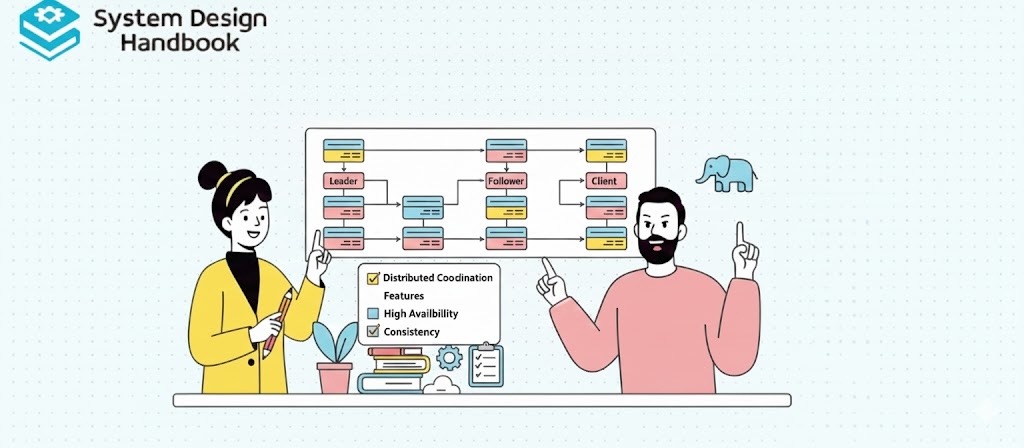
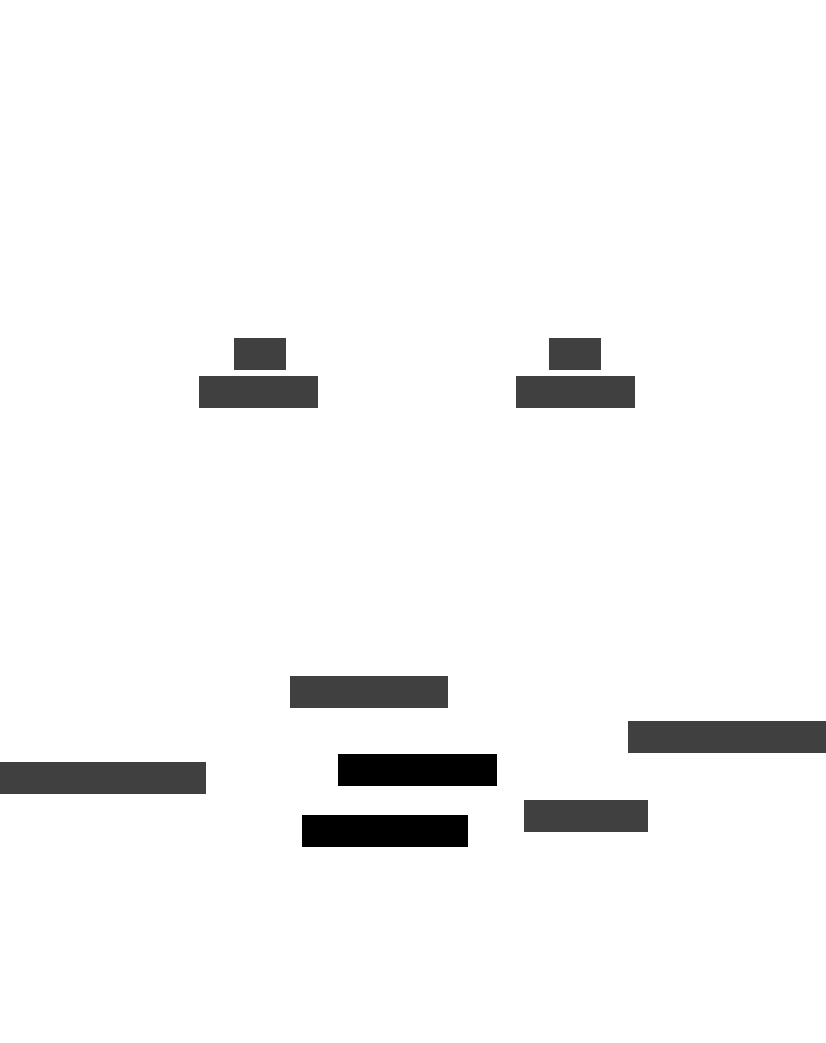
This guide walks through everything you need to articulate ZooKeeper’s design with confidence. You will learn its core guarantees, architectural decisions, consensus protocol, failure handling, and operational constraints. More importantly, you will understand why each design choice exists and how to explain trade-offs that demonstrate senior-level reasoning. The following diagram illustrates ZooKeeper’s position as a coordination layer that multiple distributed systems depend on.
Why coordination systems like ZooKeeper exist
As distributed systems grow, individual services must coordinate with one another. They need to agree on leaders, manage configuration consistently, detect failures, and ensure that only one node performs certain critical tasks at a time. Without a coordination mechanism, each system ends up re-implementing its own version of leader election, locking, and membership tracking. These implementations are often subtly incorrect, leading to race conditions and split-brain scenarios that only manifest under production load.
The core problem is that distributed systems operate in environments where messages can be delayed, reordered, or lost, and where nodes can fail independently. In such environments, coordination is not just about communication. It is about agreement under uncertainty.
Early distributed systems relied on shared databases or best-effort heartbeats for coordination, but these approaches break down at scale. Databases are not designed to provide the ordering and session semantics required for coordination. Ad hoc heartbeat systems struggle with false positives and race conditions.
Historical note: ZooKeeper emerged from Yahoo’s internal needs around 2007, when engineers realized they were repeatedly solving the same coordination problems across Hadoop, HBase, and other distributed systems. The name reflects its role in managing the “zoo” of distributed services that needed coordination.
ZooKeeper centralizes and standardizes coordination logic so that application developers do not need to solve these problems repeatedly. Instead of embedding coordination logic inside each application, ZooKeeper provides a small, well-defined set of primitives that can be composed to solve common coordination problems. Its value lies not in storing business data, but in its strong guarantees around ordering, consistency, and failure handling.
In interviews, articulating that ZooKeeper exists to simplify distributed system design by providing correctness guarantees that are otherwise difficult to implement correctly demonstrates foundational understanding. The next section examines the specific guarantees that drive every architectural decision.
Clarifying requirements and guarantees upfront
ZooKeeper’s design is driven almost entirely by its guarantees. Unlike application systems where features can be added incrementally, coordination systems must define their guarantees upfront because every architectural decision flows from these promises. In interviews, failing to clearly state ZooKeeper’s guarantees often leads to confusion later when discussing architecture, consensus, or failure handling. Strong candidates explicitly anchor their explanation around what ZooKeeper promises and what it does not.
Consistency guarantees that ZooKeeper provides
ZooKeeper provides strong consistency for writes through linearizability. All write operations appear to occur in a single global order that is consistent across the cluster. This property is critical for coordination because it ensures that all clients observe state changes in the same order. If two clients attempt to create the same lock, linearizability guarantees that one will succeed and one will fail. They will never both succeed simultaneously.
ZooKeeper also provides FIFO ordering per client session, where requests from a single client are processed in the order they are sent. This session ordering guarantee allows developers to build higher-level coordination patterns without complex synchronization logic.
However, ZooKeeper does not guarantee that all reads see the latest write unless explicitly synchronized. A client reading from a follower may observe stale data if a write was recently committed but not yet propagated. This is an intentional trade-off that enables read scalability while preserving write correctness. Clients requiring strong read consistency must use the sync operation before reading, which forces the follower to catch up with the leader’s committed state.
Watch out: A common interview mistake is claiming that ZooKeeper provides linearizable reads by default. It does not. Only writes are linearizable. Reads are sequentially consistent within a session but may lag behind the latest committed state.
Availability and fault tolerance assumptions
ZooKeeper is designed to tolerate failures, but it prioritizes correctness over availability. It requires a quorum of nodes to be operational in order to process writes. If a quorum is not available, ZooKeeper becomes unavailable for writes rather than risking inconsistency. This design choice aligns with the CAP theorem trade-off ZooKeeper makes. It chooses consistency and partition tolerance over availability.
In interviews, explicitly stating this trade-off signals a strong understanding of distributed systems fundamentals.
ZooKeeper assumes a crash-stop failure model rather than Byzantine failures. Nodes may fail or restart, but they do not act maliciously or send corrupted data. This assumption simplifies the design significantly and is standard for coordination systems operating within trusted data center environments. The following table summarizes ZooKeeper’s guarantee categories and their implications.
| Guarantee category | What ZooKeeper provides | What ZooKeeper does not provide |
|---|---|---|
| Write consistency | Linearizable writes in global order | High write throughput or horizontal write scaling |
| Read consistency | Sequential consistency within sessions | Linearizable reads without explicit sync |
| Availability | Available when quorum is reachable | Available during network partitions affecting majority |
| Fault tolerance | Crash-stop failures with majority survival | Byzantine fault tolerance |
| Data model | Small metadata and coordination state | Large payloads or complex queries |
Clarifying what ZooKeeper does not do is just as important as explaining what it does. Interviewers often test whether candidates mistakenly treat ZooKeeper as a general database or misuse it for high-volume workloads. Once guarantees are clear, the rest of ZooKeeper’s design becomes easier to explain because leader election, consensus protocols, read and write paths, and failure handling all exist to uphold these guarantees. The next section explores the data model that supports these coordination patterns.
Core abstractions and data model
ZooKeeper’s data model is deliberately minimal because its primary role is coordination, not data storage. A simpler model reduces ambiguity and makes correctness easier to reason about under failures. The data model supports just enough structure to enable common coordination patterns while avoiding features that could compromise ordering guarantees or performance predictability.
Hierarchical namespace and znodes
ZooKeeper exposes a hierarchical namespace that resembles a filesystem, where each node is called a znode. This structure allows applications to organize coordination state logically and discover related information through parent-child relationships. Unlike filesystem files, znodes are not designed to store large amounts of data. They typically contain small metadata or configuration values, with a default maximum size of 1MB per znode.
In interviews, explicitly stating that znodes are meant for metadata rather than bulk data helps avoid a common misunderstanding.
Each znode maintains a stat structure containing metadata fields that are essential for coordination logic. The czxid field records the transaction ID when the znode was created, while mzxid tracks the most recent modification. Version numbers (version, cversion, aversion) enable optimistic concurrency control, allowing clients to perform conditional updates that fail if the version has changed. The ephemeralOwner field identifies the session that created an ephemeral znode, and numChildren counts immediate children.
Understanding these stat fields demonstrates depth of knowledge that interviewers appreciate.
Pro tip: When explaining znodes in interviews, mention the stat structure fields by name (czxid, mzxid, version). This signals familiarity with ZooKeeper’s internal mechanics and shows you have worked with the system beyond surface-level understanding.
Znode types and their coordination roles
Persistent znodes remain in the system until explicitly deleted and are often used to store configuration or long-lived coordination state. Ephemeral znodes are tied to a client session and are automatically removed when the session ends, making them fundamental to failure detection and membership tracking. When a service holding an ephemeral znode crashes, ZooKeeper automatically cleans up the znode, allowing other services to detect the failure without explicit notification.
Sequential znodes include a monotonically increasing sequence number in their name, generated by ZooKeeper rather than clients to ensure global uniqueness. These sequence numbers are crucial for implementing ordering-based coordination patterns such as leader election and distributed queues.
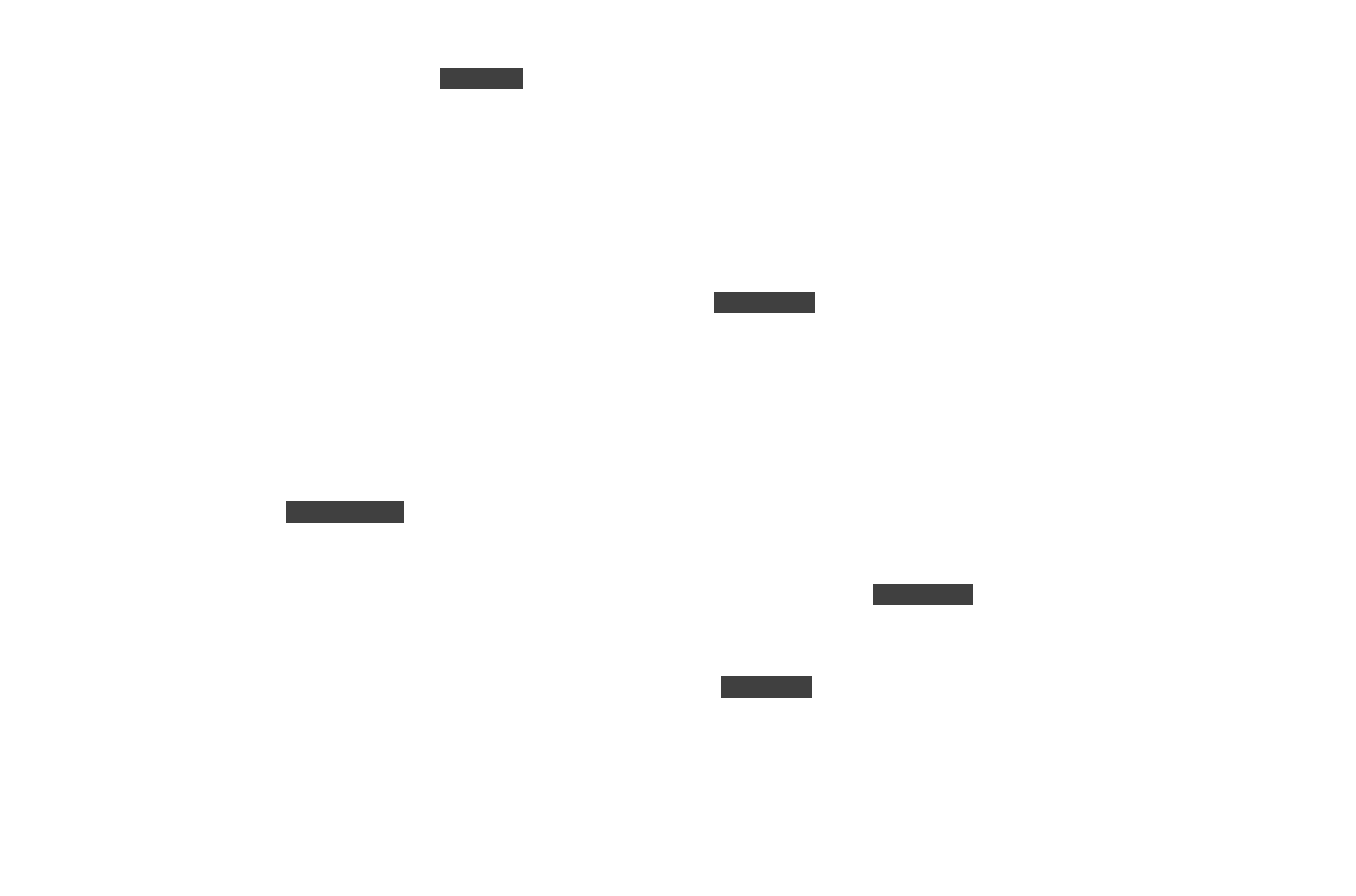
The combination of ephemeral and sequential properties enables powerful coordination primitives. A leader election pattern uses ephemeral sequential znodes where each candidate creates a znode, then watches the znode with the immediately lower sequence number. When that znode disappears (because the session ended or the process crashed), the watching client knows it might now be the leader. This elegant pattern emerges from combining simple primitives rather than requiring a complex leader election API. The diagram below illustrates the znode hierarchy and type relationships.
Watches as a coordination mechanism
ZooKeeper allows clients to set watches on znodes, which notify clients when data or children change. Watches are one-time triggers rather than persistent subscriptions. This design choice avoids unbounded notification state and keeps the system scalable. When a watched event occurs, ZooKeeper sends a notification to the client and clears the watch. The client must then re-read the state and set a new watch if needed. This pattern ensures that clients always revalidate the state rather than relying on potentially stale notifications.
Watches are a hint mechanism rather than a reliable event stream. Network delays or client processing time mean that by the time a client receives a watch notification and re-reads the state, additional changes may have occurred. Clients must be prepared to handle this by always reading current state after receiving a notification rather than assuming the notification contains complete information.
This design trade-off keeps ZooKeeper’s server-side complexity manageable while still enabling reactive coordination patterns. Understanding these abstractions prepares us to examine how ZooKeeper’s architecture upholds its guarantees.
High-level architecture overview
ZooKeeper is implemented as a replicated state machine where all servers maintain the same in-memory state, and state transitions occur through an ordered sequence of transactions. This model ensures strong consistency as long as all servers apply transactions in the same order. In interviews, describing ZooKeeper in terms of a replicated state machine immediately signals a strong distributed systems understanding.
Cluster roles and server types
A ZooKeeper cluster consists of multiple servers, typically an odd number to support quorum-based decisions. At any time, one server acts as the leader while the others act as followers. The leader is responsible for ordering all write requests, assigning transaction identifiers, broadcasting proposals, and committing transactions. Followers process read requests from clients and participate in consensus for writes by acknowledging proposals from the leader. This separation ensures that writes are serialized through a single point while reads can scale across multiple servers.
Some deployments also include observer nodes, which receive state updates but do not participate in quorum decisions. Observers improve read scalability without affecting write quorum size, making them valuable for geographically distributed deployments where you want local read replicas without increasing write latency.
However, observers introduce a trade-off. They may serve slightly staler data than followers because they do not participate in the acknowledgment path, and their failure does not affect cluster availability. Production deployments typically use three to five voting members for the quorum with additional observers as needed for read capacity.
Real-world context: LinkedIn’s ZooKeeper deployment uses observers extensively to serve read traffic from multiple data centers while keeping the voting ensemble small and fast. This pattern is common in organizations with global infrastructure requirements.
Request flow and client interaction
Clients connect to a ZooKeeper ensemble rather than a specific server, maintaining a session that can transparently failover between servers. Read requests can be served by any server, allowing ZooKeeper to scale reads efficiently. However, write requests are always forwarded to the leader regardless of which server receives them initially.
When a write request arrives, the receiving server forwards it to the leader, which assigns a transaction ID (zxid), proposes the transaction to followers, and commits once a quorum acknowledges. This asymmetry between reads and writes is a defining architectural characteristic of ZooKeeper.
The zxid is a 64-bit number composed of two parts. The epoch (high 32 bits) and the counter (low 32 bits). The epoch increments each time a new leader is elected, ensuring that transaction IDs from different leadership eras never conflict. The counter increments for each transaction within an epoch. This structure allows servers to quickly determine which transactions are more recent and whether they occurred under the current or a previous leader.
Understanding zxid composition helps explain recovery behavior after leader failures. The following diagram shows the request flow through a ZooKeeper cluster.
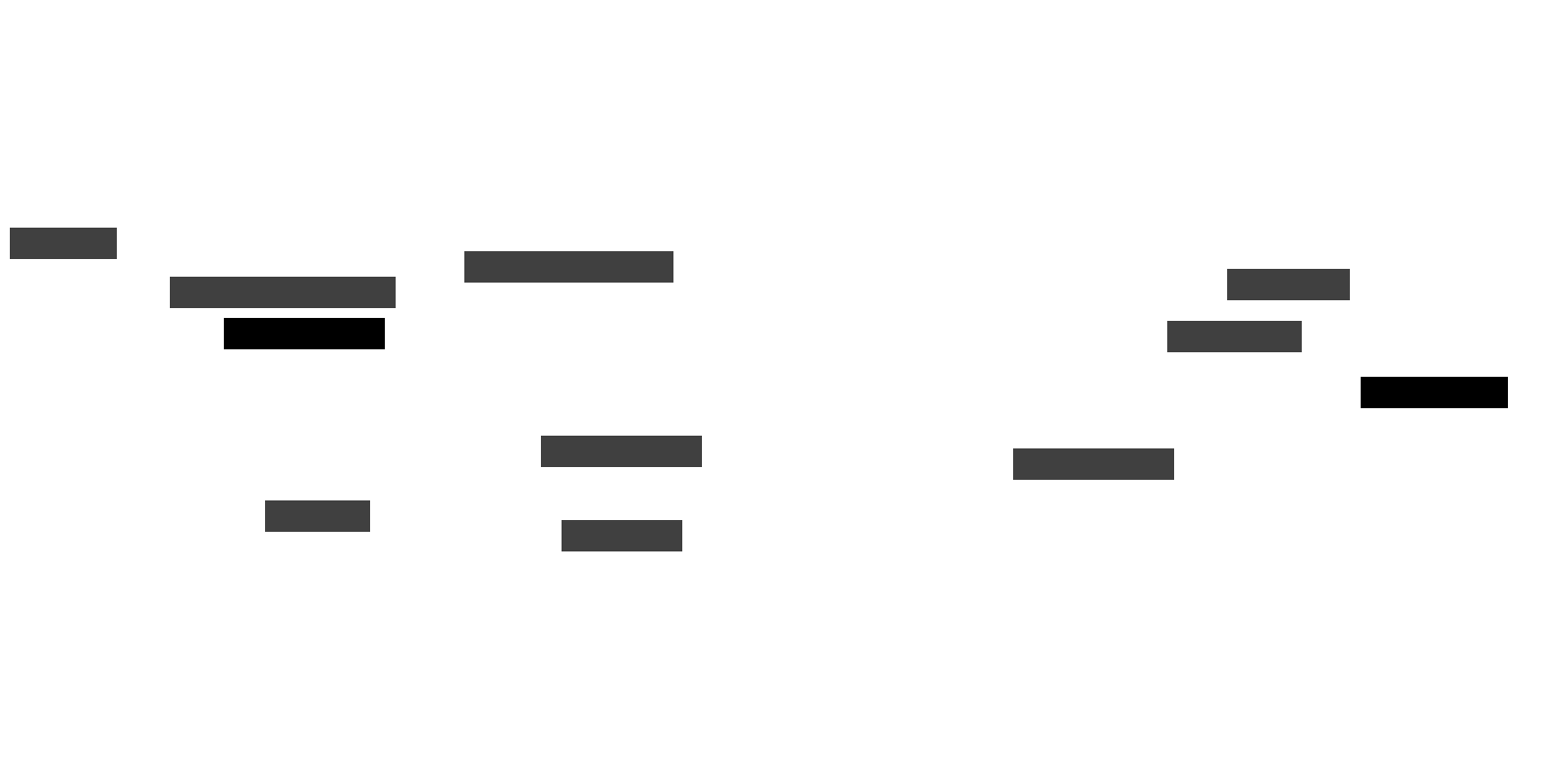
Interviewers often probe whether candidates understand why allowing writes on followers would break ZooKeeper’s guarantees. If followers could accept writes independently, they would need to coordinate among themselves to establish ordering, which reintroduces the complexity ZooKeeper is designed to hide. The single leader approach trades write throughput for simplicity and correctness. With the architecture established, we can now examine how ZooKeeper maintains leadership and cluster membership.
Leader election and cluster membership
ZooKeeper relies on a single leader to serialize write operations, avoiding the complexity of multi-leader consensus and simplifying ordering guarantees. The leader acts as the source of truth for transaction order, and its correct operation is essential to cluster correctness. In interviews, it is important to explain that the leader is not a performance optimization but a correctness requirement.
Leader election process
When a ZooKeeper cluster starts or loses its leader, it enters a leader election phase during which no writes can be processed. Each server proposes itself using a unique server identifier and its latest transaction history, specifically the highest zxid it has seen. The server with the most up-to-date state (highest zxid) wins the election, with server ID as a tiebreaker. This ensures that the new leader has all committed transactions before accepting new writes, preventing any possibility of losing committed state.
The election algorithm proceeds in rounds where servers exchange votes and update their vote if they discover another server with a higher zxid. A server becomes leader when it receives votes from a quorum of servers. This typically completes within a few hundred milliseconds in a healthy network but can take longer if network partitions cause repeated election attempts. During election, the cluster is unavailable for writes. This is an intentional trade-off to prevent split-brain scenarios.
Watch out: Interviewers sometimes ask what happens if two servers have the same highest zxid. The answer is that server ID serves as a deterministic tiebreaker, ensuring exactly one leader is elected. This detail shows you understand the edge cases in distributed protocols.
Membership changes and leader responsibilities
ZooKeeper supports dynamic cluster membership changes through a reconfiguration mechanism, but these operations are rare and carefully controlled. Adding or removing servers requires coordination to avoid inconsistent views of quorum membership. The reconfiguration process ensures that at no point does the old configuration and new configuration disagree about what constitutes a quorum.
Explaining that membership changes are intentionally conservative shows awareness of the risks involved in reconfiguration.
Once elected, the leader maintains heartbeat communication with followers to detect failures. If a follower stops responding, the leader eventually removes it from active membership. If the leader itself fails or becomes partitioned from the majority, followers detect the lack of heartbeats and trigger a new election. The leader also manages epoch transitions, incrementing the epoch number with each new election to ensure transaction ordering remains unambiguous across leadership changes.
These mechanisms work together to maintain cluster health while preserving correctness guarantees. The next section explores the consensus protocol that makes this possible.
Consensus and the ZooKeeper atomic broadcast protocol
ZooKeeper uses the ZooKeeper Atomic Broadcast (ZAB) protocol rather than a generic Paxos implementation. ZAB is tailored specifically for leader-based systems with a single active leader at a time, which simplifies the protocol compared to general-purpose consensus algorithms. In interviews, it is sufficient to explain that ZAB ensures all servers agree on the same sequence of state transitions without requiring deep protocol internals.
Proposal, acknowledgment, and commit phases
When the leader receives a write request, it assigns a transaction ID (zxid) and enters the proposal phase by broadcasting the transaction to all followers. Each follower that receives the proposal persists it to its transaction log before sending an acknowledgment back to the leader. The leader waits until it receives acknowledgments from a quorum (majority) of servers, including itself. Once quorum is achieved, the leader enters the commit phase by broadcasting a commit message, and all servers apply the transaction to their in-memory state.
This two-phase process ensures durability and ordering even if failures occur during execution. If the leader crashes after proposing but before committing, the transaction is not lost because a quorum of servers has persisted it. The new leader’s recovery process will discover this uncommitted transaction and either commit it (if a quorum has it) or abort it (if insufficient servers received it). The quorum requirement means that any two quorums must overlap by at least one server, ensuring committed transactions survive leader failures.
Recovery and synchronization
ZAB includes a recovery mode that runs during leader election. Before the new leader can accept writes, it must synchronize state with followers to ensure no committed transactions are lost and no uncommitted transactions are incorrectly applied. The leader first determines the highest zxid that was committed in the previous epoch by communicating with followers. It then sends any missing committed transactions to followers that lag behind and ensures all servers agree on which transactions are committed.
This synchronization phase is critical for correctness. Interviewers often test whether candidates understand that ZooKeeper must not accept new writes until synchronization completes. Accepting writes prematurely could result in transaction ordering violations if some followers still have incomplete state from the previous epoch. The recovery phase typically completes quickly (sub-second) but adds to overall leader election latency.
Historical note: ZAB was designed specifically for ZooKeeper’s requirements rather than being adapted from Paxos. While Paxos handles general consensus, ZAB optimizes for the specific case of a stable leader broadcasting an ordered sequence of updates, which better matches ZooKeeper’s usage patterns.
ZAB guarantees that all committed transactions are delivered in the same order to all servers and that once a transaction is committed, it will not be rolled back. These guarantees form the backbone of ZooKeeper’s consistency model and enable clients to reason about coordination state without worrying about divergent views. Understanding ZAB at this conceptual level is sufficient for most interviews, though some interviewers may probe deeper into specific failure scenarios. The next section examines how these guarantees manifest in actual read and write operations.
Read and write request handling
All write requests are funneled through the leader, including creating znodes, updating data, and deleting nodes. Serializing writes ensures a single global order and prevents conflicting updates. In interviews, explaining why this limits write throughput but simplifies correctness is critical. The leader becomes a bottleneck for write operations, but this is intentional because coordination workloads typically have modest write rates compared to the need for strong ordering guarantees.
Write path and durability
When a client sends a write request to any ZooKeeper server, that server forwards it to the leader. The leader assigns the next zxid, creates a proposal, and broadcasts it to followers. Each server persists the proposal to its write-ahead log before acknowledging, ensuring durability even if the server crashes immediately after acknowledging. The leader commits after receiving quorum acknowledgment, and all servers apply the transaction to their in-memory data tree. Finally, the originating server responds to the client with the result.
This path introduces latency because every write requires at least one round trip to the leader plus waiting for quorum acknowledgment. Write latency typically ranges from 2-10 milliseconds in a well-configured cluster, with P99 latencies potentially reaching 50-100 milliseconds during load spikes or garbage collection pauses. Disk performance is critical because synchronous log writes are on the critical path. Production deployments often use dedicated SSDs for the transaction log and separate disks for snapshots.
Read path and consistency trade-offs
Read requests can be served by any server, including followers and observers. This allows ZooKeeper to scale reads efficiently by adding more servers. However, because reads may be served from a follower that has not yet received the latest committed write, they may return stale data. ZooKeeper provides the sync operation to address this. A client can issue sync before a read, which forces the server to catch up with the leader’s committed state before responding to subsequent reads.
This read model is a deliberate trade-off. Allowing local reads improves performance dramatically since reads do not require any inter-server communication, but clients must explicitly request stronger consistency when needed. Most coordination patterns can tolerate slightly stale reads because they re-read state after receiving watch notifications anyway. However, patterns that require reading the absolute latest state must use sync or read from the leader directly. The following table compares read and write characteristics.
| Characteristic | Write operations | Read operations |
|---|---|---|
| Consistency | Linearizable (global order) | Sequential (may be stale) |
| Server handling | Leader only | Any server (follower, observer) |
| Latency (typical) | 2-10ms (quorum required) | Sub-millisecond (local) |
| Scalability | Limited by single leader | Scales with cluster size |
| Durability requirement | Persisted before ACK | None (in-memory) |
Pro tip: In interviews, explicitly mention that ZooKeeper’s read/write asymmetry is why it works well for read-heavy coordination workloads but poorly for write-heavy workloads. This shows you understand when to use ZooKeeper and when to consider alternatives.
Client session semantics
ZooKeeper maintains client sessions that track connection state and ordering guarantees. A session is established when a client first connects and remains active as long as the client sends heartbeats. Session semantics ensure that ephemeral znodes are cleaned up correctly when a session ends and that client requests are processed in FIFO order within the session. The session timeout determines how long the server waits before declaring a session dead if heartbeats stop.
Session expiration is a critical failure detection mechanism. When a client crashes or becomes network-partitioned, its session eventually expires, and ZooKeeper automatically deletes all ephemeral znodes created by that session. Other clients watching those znodes receive notifications, enabling them to detect failures and react appropriately. This mechanism is foundational to patterns like leader election and service discovery.
Understanding how sessions connect protocol behavior to application-level correctness strengthens interview answers. The next section explores common coordination patterns built on these primitives.
Coordination patterns and their implementation
ZooKeeper’s power comes not from complex built-in features but from simple primitives that compose into sophisticated coordination patterns. Understanding how to build leader election, distributed locks, and barriers using znodes and watches demonstrates the kind of systems thinking interviewers value. These patterns emerge from combining ephemeral znodes, sequential znodes, and watches in specific ways.
Leader election pattern
The leader election pattern uses ephemeral sequential znodes to establish ordering among candidates. Each candidate creates an ephemeral sequential znode under a designated election path, receiving a unique sequence number. The candidate with the lowest sequence number becomes the leader. All other candidates set a watch on the znode with the immediately preceding sequence number. When that znode disappears (because the leader crashed or voluntarily released leadership), the watching candidate checks if it now has the lowest sequence number and assumes leadership if so.
This design is elegant because it avoids the thundering herd problem. Rather than all candidates watching the leader and simultaneously trying to claim leadership when the leader fails, each candidate only watches its immediate predecessor. At most one candidate needs to react to any given failure, minimizing contention. The ephemeral property ensures automatic cleanup when processes crash, and the sequential property guarantees a deterministic ordering without client coordination.
Distributed lock pattern
The distributed lock pattern is similar to leader election but with different semantics around lock acquisition and release. A client wanting to acquire a lock creates an ephemeral sequential znode under the lock path. If its znode has the lowest sequence number, it holds the lock. Otherwise, it watches the immediately preceding znode and waits. When that znode disappears, the client checks again whether it now holds the lock. To release the lock, the client simply deletes its znode, which automatically notifies the next waiter.
Read-write locks extend this pattern by using different prefixes for readers and writers. Writers follow the standard lock pattern, while readers only wait for earlier write requests, allowing multiple concurrent readers. This pattern demonstrates how ZooKeeper’s primitives support sophisticated locking semantics without requiring ZooKeeper to implement locks directly.
Real-world context: Apache Curator, the most widely used ZooKeeper client library, implements these patterns as reusable recipes. Production systems rarely implement coordination patterns from scratch. Instead, they use Curator’s InterProcessMutex, LeaderSelector, and similar classes that handle edge cases and retry logic.
Configuration management and barriers
Configuration management uses persistent znodes to store configuration data and watches to notify services of changes. Services read their configuration from a znode and set a watch. When an administrator updates the configuration, all watching services receive notifications and re-read the updated value. This pattern enables dynamic configuration changes without restarting services, though services must handle configuration updates gracefully.
Barrier patterns coordinate multiple processes to wait until a condition is met before proceeding. A double barrier ensures that all processes arrive at a barrier point before any proceed and that all processes leave before the barrier is cleared. Implementation uses a barrier znode whose children represent waiting processes. Processes enter by creating an ephemeral child and wait until the expected number of children exists. They exit by deleting their child and wait until all children are gone.
These patterns illustrate how ZooKeeper’s simple primitives enable complex distributed coordination. The following diagram shows the leader election pattern in action.
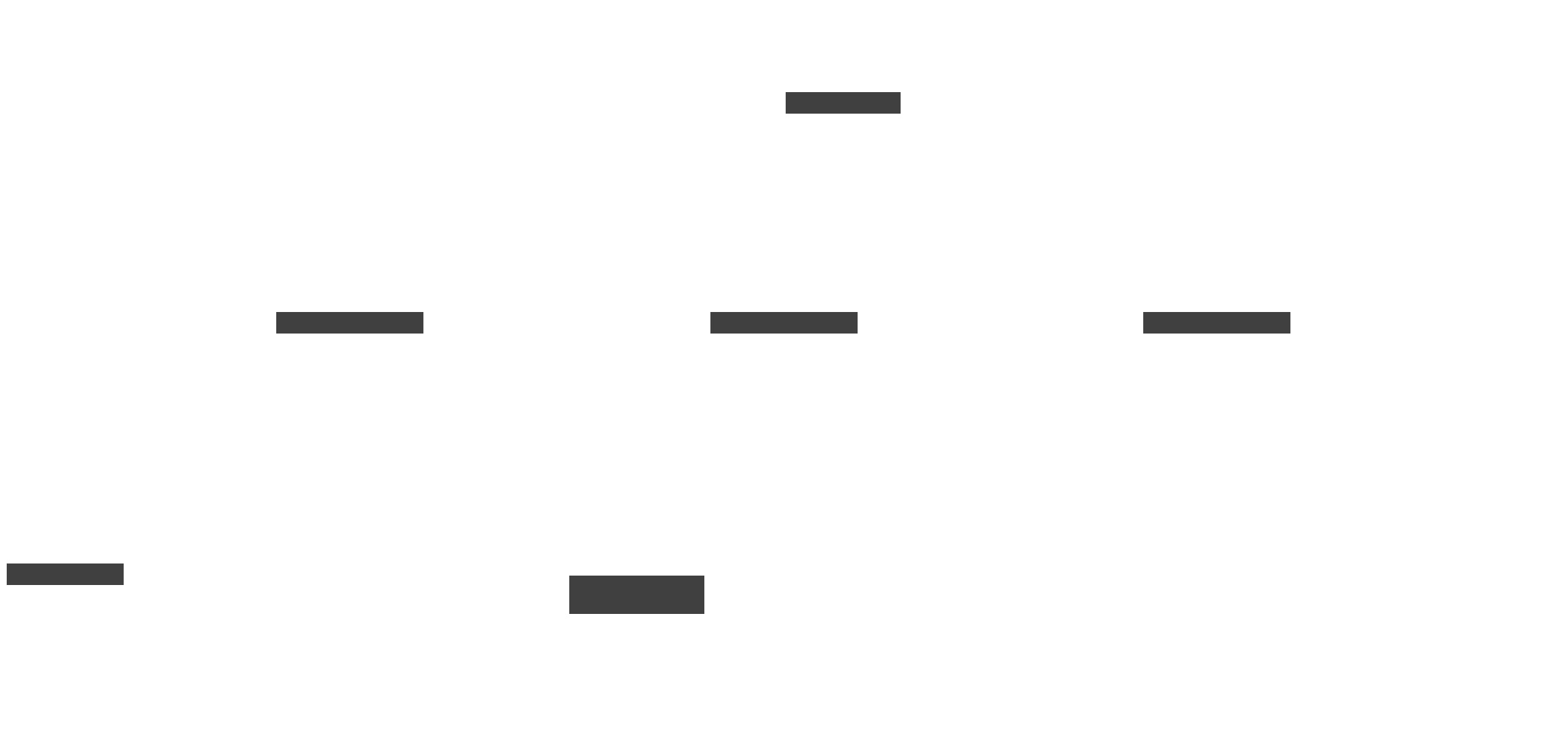
These patterns work reliably because ZooKeeper guarantees ordering and handles failure cleanup automatically. However, implementing them correctly requires careful attention to edge cases like session expiration during critical sections or network partitions that cause watch notifications to be delayed. The next section examines how ZooKeeper maintains durability and recovers from failures.
State management, durability, and recovery
ZooKeeper stores coordination state that other systems depend on for correctness. Losing committed state can cause split-brain behavior, duplicate leaders, or inconsistent configuration. As a result, ZooKeeper treats durability as a core requirement rather than an optimization. Every design decision around state management prioritizes correctness over performance.
Transaction logs and write-ahead logging
Every ZooKeeper server maintains a write-ahead transaction log. Before acknowledging a proposal, a server persists it to disk using fsync to guarantee durability. This ensures that once a transaction is acknowledged, it will survive crashes and restarts. The transaction log contains a sequential record of all state changes, allowing complete reconstruction of the data tree by replaying transactions from the beginning.
Disk performance directly impacts ZooKeeper latency because synchronous log writes are on the critical path for every write operation. Slow disks or disks shared with other workloads can cause latency spikes and even trigger session timeouts for connected clients. Production deployments typically dedicate fast SSDs exclusively to the transaction log, separate from the operating system and snapshot storage. Monitoring disk write latency (particularly P99) is essential for maintaining reliable ZooKeeper operation.
Snapshots and efficient recovery
Over time, transaction logs grow large, which would make recovery increasingly slow if servers needed to replay every transaction from the beginning. ZooKeeper periodically creates snapshots of its in-memory state, capturing the complete data tree and session information at a point in time. These snapshots allow servers to recover quickly by loading a snapshot and replaying only transactions that occurred after the snapshot was taken.
Snapshots are taken asynchronously and do not block normal operations. ZooKeeper uses a fuzzy snapshot approach where the snapshot may not represent a consistent point-in-time view of the data tree because transactions continue during the snapshot process. However, this is acceptable because recovery applies transactions on top of the snapshot, correcting any inconsistencies. This approach provides efficient recovery without introducing write pauses for snapshotting.
Watch out: A common operational issue is running out of disk space because old transaction logs are not cleaned up. ZooKeeper’s autopurge feature automatically removes old snapshots and logs, but it must be configured explicitly. Failing to enable it eventually fills the disk and causes the cluster to fail.
Crash recovery behavior
When a server crashes and restarts, it loads the latest snapshot and replays committed transactions from the log to reconstruct its in-memory state. It then joins the cluster as a follower (or triggers an election if it was the leader) and synchronizes with the current leader to receive any transactions it missed while down. This recovery process ensures that no committed transactions are lost even if all servers restart simultaneously, as long as a quorum’s worth of data survives.
The recovery flow reinforces ZooKeeper’s guarantee that committed state is never rolled back. Even in scenarios where the leader crashes immediately after committing, the quorum acknowledgment requirement ensures enough servers have the transaction persisted that the next leader will include it. Understanding this recovery behavior demonstrates appreciation for the careful engineering that makes distributed coordination reliable. The next section examines how ZooKeeper handles various failure scenarios.
Failure handling and fault tolerance
ZooKeeper assumes a crash-stop failure model where servers may fail or become unreachable, but they do not behave maliciously. This assumption simplifies protocol design and is standard for coordination systems operating within trusted data center environments. Interviewers often test whether candidates mistakenly assume Byzantine fault tolerance, which ZooKeeper does not provide.
Handling server failures
ZooKeeper tolerates failures as long as a quorum of servers remains available. If a follower fails, the system continues operating normally because the remaining followers can still form a quorum for write acknowledgments. Clients connected to the failed follower automatically reconnect to another server and resume operations transparently. If the leader fails, the cluster pauses writes and triggers a leader election. This pause is typically brief (hundreds of milliseconds to a few seconds) but can extend if network issues complicate the election.
The quorum requirement means a cluster of 2f+1 servers tolerates up to f failures. A three-server cluster tolerates one failure. A five-server cluster tolerates two. Increasing cluster size beyond five provides diminishing returns because each additional server increases write latency (more acknowledgments needed) without significantly improving fault tolerance. Most production deployments use three or five servers, adding observers for read scalability rather than additional voting members.
Network partitions and quorum behavior
During network partitions, ZooKeeper ensures that only the partition containing a quorum can make progress. Minority partitions become unavailable for writes because they cannot gather enough acknowledgments. This prevents split-brain scenarios where multiple leaders could emerge and accept conflicting writes. Clients in minority partitions experience connection failures and must reconnect once the partition heals.
The quorum requirement means ZooKeeper chooses consistency over availability during partitions, aligning with its CP positioning in the CAP theorem. A cluster split into equal halves (in even-sized configurations, though these are discouraged) would have neither half able to make progress. This behavior is intentional. Accepting writes in multiple partitions would violate linearizability and could corrupt coordination state that other systems depend on.
Pro tip: When discussing partition behavior in interviews, explicitly connect it to CAP theorem trade-offs. Say something like: “ZooKeeper is a CP system. It sacrifices availability during partitions to preserve consistency, which is the right trade-off for coordination workloads where incorrect state is more dangerous than temporary unavailability.”
Slow nodes and performance isolation
Slow or overloaded nodes can degrade cluster performance because every write requires quorum acknowledgment. A slow follower that consistently delays acknowledgments can increase write latency for all clients. ZooKeeper mitigates this by requiring acknowledgments from any quorum rather than all nodes, meaning slow followers can be tolerated as long as a majority responds quickly. Severely slow followers can be removed from the cluster through reconfiguration.
Garbage collection pauses are a common source of slowness in JVM-based systems like ZooKeeper. A long GC pause can cause a server to miss heartbeats, triggering unnecessary leader elections or session expirations. Production deployments tune JVM settings carefully, often using G1 or ZGC garbage collectors with appropriate heap sizes to minimize pause times. Monitoring GC behavior is essential for stable operation. The next section examines ZooKeeper’s approach to security and access control.
Security, access control, and isolation
ZooKeeper often sits at the core of distributed systems, controlling leadership, configuration, and cluster membership. A security breach in ZooKeeper can cascade across multiple dependent systems, making security a first-class concern rather than an afterthought. In interviews, acknowledging the sensitivity of coordination data signals understanding of ZooKeeper’s role as critical infrastructure.
Authentication mechanisms
ZooKeeper supports multiple authentication mechanisms to verify client identity. The digest scheme uses username and password authentication, suitable for simple deployments. The ip scheme authenticates based on client IP address, useful for restricting access to specific network segments. For enterprise environments, ZooKeeper supports Kerberos (SASL) authentication, integrating with existing identity management infrastructure. TLS/SSL can secure connections between clients and servers, protecting credentials and data in transit.
Authentication establishes who the client is but does not define what the client can do. This separation between authentication and authorization allows flexible security configurations where the same identity management system handles authentication while ZooKeeper-specific access controls govern authorization. Production deployments typically use Kerberos or certificate-based authentication combined with network segmentation to protect the ZooKeeper ensemble.
Authorization and access control lists
ZooKeeper enforces authorization using access control lists (ACLs) attached to znodes. Each ACL entry specifies an authentication scheme, an identity within that scheme, and a set of permissions. Permissions include READ (get data and list children), WRITE (set data), CREATE (create children), DELETE (delete children), and ADMIN (set ACLs). ACLs are inherited during creation by default but can be modified independently on each znode.
Fine-grained ACLs allow multiple applications to share a single ZooKeeper ensemble safely. Each application can have its own namespace with ACLs preventing other applications from reading or modifying its coordination state. This multi-tenant isolation is essential in environments where a single ZooKeeper cluster serves multiple teams or services. However, ACLs add operational complexity and must be managed carefully to avoid accidentally locking out legitimate users.
Real-world context: Large organizations like Netflix run shared ZooKeeper clusters serving dozens of applications. Strict ACL policies ensure that a bug or misconfiguration in one application cannot corrupt coordination state used by others, while shared infrastructure reduces operational burden.
Multi-tenant isolation considerations
Even with ACLs preventing unauthorized access, shared ZooKeeper clusters can experience noisy-neighbor problems. One application creating excessive watches or performing high-volume operations can degrade performance for all other applications. ZooKeeper does not provide resource quotas or rate limiting at the application level, so operational discipline and monitoring are essential. Some organizations run separate ZooKeeper clusters for critical applications that cannot tolerate interference from other workloads.
Namespace conventions help organize multi-tenant deployments. A common pattern assigns each application a top-level znode (e.g., /app1, /app2) with ACLs restricting each application to its own subtree. Administrators can then monitor and manage each application’s usage independently. Recognizing these operational considerations demonstrates practical experience beyond protocol-level understanding. The next section examines ZooKeeper’s scaling characteristics and operational constraints.
Scaling ZooKeeper and operational considerations
ZooKeeper scales reads well because they can be served by any server in the cluster. Adding more followers or observers increases read capacity without affecting write quorum size. However, write scalability is inherently limited because all writes go through a single leader and require quorum acknowledgment. This asymmetry means ZooKeeper is well-suited for read-heavy coordination workloads but poorly suited for write-intensive use cases.
Read scalability with observers
Observer nodes receive the full transaction stream from the leader but do not participate in quorum voting. This means adding observers increases read capacity without affecting write latency. Observers are particularly valuable in geographically distributed deployments where you want local read replicas close to clients without increasing cross-datacenter write latency. A typical pattern places the voting ensemble in one datacenter with observers in other datacenters.
Observers trade off consistency for availability and performance. Because they do not participate in acknowledgments, they may lag further behind the leader than followers. Clients reading from observers might see staler data than clients reading from followers. For many coordination patterns this is acceptable, but applications requiring the freshest possible data should read from followers or use the sync operation.
Write scalability limits
All writes go through the leader and require quorum acknowledgment, making write throughput fundamentally limited. A well-tuned ZooKeeper cluster can handle thousands to tens of thousands of writes per second, depending on payload size and disk performance. However, this throughput ceiling exists regardless of cluster size because adding servers increases coordination overhead without adding write parallelism.
In interviews, acknowledging this limitation shows realistic system understanding. ZooKeeper is not designed for workloads with millions of writes per second or large data payloads. If an application requires higher write throughput, the answer is usually to reduce reliance on ZooKeeper rather than trying to scale it. Techniques include caching configuration locally, batching updates, or using alternative systems for high-volume coordination needs.
Cluster size constraints and operational complexity
ZooKeeper clusters are intentionally kept small. Increasing cluster size increases coordination overhead and latency for writes because more acknowledgments are needed for quorum. Most production deployments use three to five voting servers, which provides adequate fault tolerance while maintaining reasonable write latency. Larger clusters make sense only when observer nodes handle the additional read load.
As usage grows, operational complexity becomes a significant challenge. Monitoring disk performance, network latency, and session behavior is essential for maintaining reliability. ZooKeeper exposes metrics through JMX and four-letter commands (srvr, stat, mntr) that should be integrated into monitoring infrastructure. Key metrics include outstanding request count, average latency, max latency, and approximate data size. Alerting on these metrics helps catch problems before they cause outages.
Watch out: A common operational mistake is treating ZooKeeper as a fire-and-forget system. Unlike stateless services that can simply be restarted, ZooKeeper requires careful attention to disk health, network stability, and JVM tuning. Undisciplined operations lead to mysterious session timeouts and leader instability.
Production teams often underestimate the operational burden of running ZooKeeper reliably. Careful attention to disk I/O latency, network configuration, and JVM garbage collection is essential. Some organizations choose managed coordination services (like AWS managed Kafka’s built-in coordination or etcd in Kubernetes) to reduce this burden, accepting reduced flexibility in exchange for operational simplicity. The next section examines common trade-offs and misuse patterns.
Trade-offs, limitations, and alternatives
ZooKeeper makes explicit trade-offs that are appropriate for coordination workloads but problematic for other use cases. Understanding these trade-offs helps determine when ZooKeeper is the right choice and when alternatives better fit the requirements. In interviews, discussing limitations demonstrates mature judgment about technology selection.
Consistency versus availability trade-offs
ZooKeeper explicitly prioritizes consistency over availability. During network partitions or leader failures, the system may become unavailable for writes rather than risking divergent state. This decision aligns with ZooKeeper’s role as a coordination system where incorrect state is more dangerous than temporary unavailability. A coordination system that accepts conflicting writes during partitions could cause split-brain scenarios in dependent systems, leading to data corruption or duplicate processing.
This trade-off means ZooKeeper is unsuitable for use cases requiring always-on write availability. Systems that can tolerate eventual consistency or have application-level conflict resolution should use different coordination mechanisms. ZooKeeper’s unavailability during partitions is a feature, not a bug. It prevents the worse outcome of inconsistent coordination state.
Performance and throughput limitations
ZooKeeper’s leader-based write path limits write throughput and increases latency under heavy load. Typical write latencies range from 2-10 milliseconds in a well-configured cluster, with P99 latencies reaching 50-100 milliseconds during load spikes. This performance profile is acceptable for coordination workloads with modest write rates but problematic for high-volume use cases.
ZooKeeper is also limited in the amount of data it can store. The default maximum znode size is 1MB, and the entire data tree must fit in memory. Production clusters typically hold tens of thousands to hundreds of thousands of znodes totaling gigabytes of data. Attempting to use ZooKeeper for larger datasets or high-volume data storage leads to memory pressure and degraded performance.
Common misuse patterns
ZooKeeper is sometimes misused as a message queue, with processes writing messages to znodes and others reading them. This pattern fails because ZooKeeper is not designed for high-volume transient data. Message queues like Kafka or RabbitMQ are far better suited. Another misuse is storing large configuration files or binary data in znodes, which exceeds the intended data size and impacts cluster performance. Some teams also attempt to use ZooKeeper for service discovery with frequent updates, overwhelming the write path that is designed for infrequent coordination events.
In interviews, calling out these misuse scenarios reinforces credibility and shows practical experience. The correct response to each misuse is to identify the actual requirement and choose an appropriate tool. Use message queues for messaging, databases for large data, and purpose-built service discovery systems for frequent registration updates.
Alternative coordination systems
Several systems provide similar coordination capabilities with different trade-offs. etcd, developed for Kubernetes, uses Raft consensus and provides a simpler API with similar consistency guarantees. Consul combines coordination with service discovery and health checking, offering a more integrated solution for microservices environments. Kafka’s internal coordination moved from ZooKeeper to an integrated Raft-based controller in recent versions, eliminating the external dependency.
| System | Consensus protocol | Primary use case | Key differentiator |
|---|---|---|---|
| ZooKeeper | ZAB | General coordination | Mature, widely adopted, proven at scale |
| etcd | Raft | Kubernetes coordination | Simpler API, gRPC interface, built for cloud-native |
| Consul | Raft | Service discovery + coordination | Integrated health checking, service mesh support |
| Kafka Raft (KRaft) | Raft | Kafka metadata management | Eliminates external dependency for Kafka |
The choice between these systems depends on the specific environment and requirements. ZooKeeper remains the standard for Hadoop ecosystem components and legacy systems. etcd is the clear choice for Kubernetes-native applications. Consul excels in environments prioritizing service discovery integration. Understanding when to use each system demonstrates the practical judgment interviewers seek. The final section covers how to present ZooKeeper design effectively in interviews.
Presenting ZooKeeper System Design in interviews
ZooKeeper System Design questions can easily consume an entire interview if not structured carefully. Strong candidates begin by clearly stating ZooKeeper’s purpose and guarantees, then progressively dive into architecture, consensus, and failure handling. Interviewers value clarity and structure over exhaustive detail, and they assess not just knowledge but how well you communicate complex concepts.
Structuring your explanation
Start with a brief statement of what problem ZooKeeper solves. It provides centralized coordination for distributed systems with strong consistency guarantees. Then establish the key guarantees. These include linearizable writes, sequential read consistency, session semantics, and quorum-based fault tolerance. Only after establishing guarantees should you dive into architecture (leader/follower model, ZAB consensus) and implementation details (znodes, watches, write-ahead logging).
This structure works because architecture decisions only make sense in light of the guarantees they support. Explaining ZAB before explaining why linearizable writes matter puts the cart before the horse. Interviewers notice when candidates anchor their explanation in requirements rather than jumping to implementation details.
Prioritizing correctness over mechanics
In most interviews, guarantees matter more than protocol mechanics. Explaining that ZooKeeper provides linearizable writes through leader-serialized consensus with quorum acknowledgment is more valuable than describing exact message formats or state transitions. Focus on why the design choices exist rather than exhaustively documenting how they are implemented.
Demonstrating that you know where to stop is a sign of seniority. Junior candidates often try to prove their knowledge by explaining every detail, while senior candidates explain enough to demonstrate understanding and then pause for interviewer questions. If the interviewer wants more depth on consensus, they will ask. If they probe operational concerns, shift toward scaling and monitoring. This flexibility shows strong communication skills.
Common pitfalls to avoid
Candidates often fail by treating ZooKeeper as a database rather than a coordination system, ignoring failure scenarios, or overemphasizing performance optimizations. Another common mistake is describing only the happy path without addressing what happens during leader failure, network partition, or session expiration. Interviewers specifically test for understanding of failure behavior because that is where distributed systems are most difficult.
Avoid getting lost in protocol details unless explicitly asked. Spending five minutes explaining ZAB message sequencing when the interviewer wanted to discuss failure detection wastes precious interview time. Similarly, avoid claiming ZooKeeper provides guarantees it does not, like linearizable reads or high write throughput. Demonstrating accurate understanding of limitations builds credibility.
Pro tip: Practice explaining ZooKeeper in three levels of depth. First, a 30-second elevator pitch covering what it is and why it matters. Second, a 5-minute overview covering guarantees, architecture, and key trade-offs. Third, a 15-minute deep dive covering consensus, failure handling, and operational concerns. Being able to adjust depth on demand demonstrates interview maturity.
For additional preparation, Grokking the System Design Interview on Educative provides curated patterns and practice problems that build repeatable System Design intuition. Other valuable resources include best System Design certifications, courses, and platforms that offer structured learning paths for different experience levels.
Conclusion
ZooKeeper represents one of the purest examples of distributed systems design in practice. It exists not to store data efficiently but to enforce correctness across unreliable systems, providing the coordination guarantees that other distributed systems depend on for their own correctness.
The key takeaways center on three themes. Guarantees drive architecture, meaning every design choice in ZooKeeper flows from its commitment to linearizable writes, session ordering, and quorum-based fault tolerance. Simplicity enables composition, because the minimal data model of znodes, watches, and session semantics allows sophisticated coordination patterns to emerge from combining simple primitives. Correctness trumps performance, since ZooKeeper intentionally sacrifices write throughput and partition availability to maintain the strong consistency that coordination workloads require.
The coordination landscape continues to evolve. Newer systems like etcd and Consul offer similar guarantees with different APIs and operational models. Kafka’s move to eliminate ZooKeeper dependency signals a trend toward integrated coordination rather than external services. However, the fundamental principles remain constant. Distributed coordination requires consensus, consensus requires trade-offs, and understanding those trade-offs is what separates engineers who can build reliable systems from those who cannot.
Confidence, structure, and correctness matter more than memorizing protocols. If you anchor your explanation in guarantees, show awareness of failure scenarios, and articulate trade-offs clearly, ZooKeeper System Design becomes an opportunity to showcase deep systems thinking rather than an intimidating topic.