
AI Guardrails System Design: Building Safe, Reliable, and Scalable AI Systems
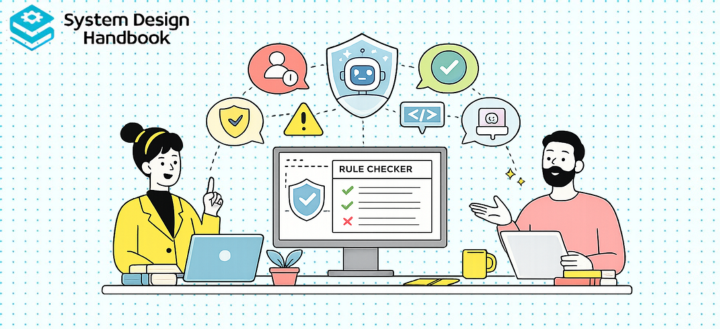
If you have been following recent System Design trends, you have likely noticed that AI safety is no longer treated as an afterthought. As AI systems become more integrated into real-world applications, the consequences of unsafe outputs have become impossible to ignore. This is why AI guardrails System Design is now a recurring topic in interviews, especially for roles involving LLMs and generative AI.
When you design an AI system today, you are not just responsible for functionality and scalability. You are also responsible for ensuring that the system behaves safely under unpredictable conditions. Interviewers are increasingly evaluating whether you can design systems that handle both expected and adversarial inputs gracefully.
Why Unguarded AI Systems Fail In Production
It is easy to assume that a powerful model will produce reliable outputs, but real-world systems tell a different story. Without guardrails, AI systems can generate hallucinated information, unsafe content, or responses that violate business policies. These failures are not edge cases, they are common scenarios that arise in production environments.
For example, a chatbot without proper safeguards might confidently provide incorrect medical advice or leak sensitive information. These types of failures highlight why guardrails are essential and why interviewers expect you to address them explicitly in your designs.
What Interviewers Are Actually Evaluating
When an interviewer asks you to design an AI-powered system, they are not just testing your ability to integrate an LLM. They are evaluating whether you can anticipate risks and build systems that mitigate them effectively.
They want to see how you think about input validation, output filtering, policy enforcement, and monitoring. A strong answer demonstrates that you understand the full lifecycle of AI interactions, including how systems behave under failure conditions.
Why Guardrails Are A Signal Of Senior-Level Thinking
Understanding the AI guardrails System Design signals that you are thinking beyond basic functionality. It shows that you are aware of real-world challenges such as misuse, adversarial inputs, and compliance requirements.
This level of awareness is often what separates strong candidates from average ones. When you incorporate guardrails into your design naturally, you demonstrate that you are ready to build production-grade AI systems.
What Are AI Guardrails? A System Design Perspective
AI guardrails are mechanisms that control, monitor, and constrain the behavior of AI systems to ensure safe and reliable outputs. Instead of relying solely on the model’s internal behavior, guardrails act as external layers that enforce rules and policies.
From a System Design perspective, you should think of guardrails as part of the architecture rather than an add-on feature. They are integrated at multiple points in the system to ensure that both inputs and outputs are aligned with desired behavior.
Understanding Guardrails As A Layered System
One of the most important concepts in AI guardrails System Design is that safety is achieved through multiple layers. No single mechanism is sufficient to handle all possible risks, which is why guardrails are distributed across different stages of the pipeline.
These layers work together to filter inputs, guide model behavior, validate outputs, and enforce policies. This layered approach ensures that even if one mechanism fails, others can compensate.
Distinguishing Between Moderation, Validation, And Control
To design effective guardrails, you need to understand the different roles they play. Moderation focuses on detecting harmful or inappropriate content, while validation ensures that inputs and outputs meet predefined criteria. Control mechanisms, on the other hand, guide the behavior of the model through prompts and constraints.
These functions are often implemented together but serve distinct purposes. Recognizing these differences allows you to design systems that are both flexible and robust.
Where Guardrails Fit In The AI Architecture
Guardrails are not confined to a single component of the system. They are embedded throughout the architecture, from the moment a user submits a query to the final response generated by the model.
This means that guardrails operate at multiple stages, including input processing, prompt construction, model interaction, and output validation. Understanding this placement is critical for designing systems that are safe end-to-end.
A High-Level View Of Guardrails In The Pipeline
| Stage | Guardrails Role |
| Input Processing | Filters and sanitizes user inputs |
| Prompt Construction | Enforces constraints and instructions |
| Model Interaction | Applies behavioral limits |
| Output Processing | Validates and filters responses |
| Monitoring | Tracks and improves system behavior |
How To Explain Guardrails In Interviews
When explaining guardrails in an interview, you should avoid vague definitions and focus on their role within the system. Describe how they interact with different components and how they contribute to overall safety.
This approach shows that you understand guardrails as part of a larger system rather than an isolated feature.
Core Components Of An AI Guardrails System
To design AI guardrails effectively, you need a clear mental model of the system’s components. These components work together to ensure that the system behaves safely and reliably across different scenarios.
Instead of thinking about guardrails as a single feature, you should view them as a collection of interconnected layers. Each layer addresses a specific type of risk, contributing to the overall robustness of the system.
The Flow Of A Guarded AI Request
When a user interacts with an AI system, their request passes through multiple stages before a response is generated. Each stage introduces an opportunity to apply guardrails, ensuring that risks are mitigated early and often.
This flow begins with input validation, continues through prompt construction and model interaction, and ends with output validation and monitoring. Understanding this flow helps you design systems that are both safe and efficient.
Breaking Down The Core Components
To make this more concrete, consider the following components and their roles in the system.
| Component | Role In Guardrails System |
| Input Validator | Filters unsafe or malformed inputs |
| Prompt Controller | Enforces instructions and constraints |
| Output Validator | Checks responses for safety and accuracy |
| Policy Engine | Applies rules and compliance logic |
| Monitoring System | Tracks interactions and detects issues |
Why Each Component Matters
Each component addresses a different type of risk, and removing any one of them can expose the system to failure. For example, without input validation, the system may process malicious prompts, while without output validation, it may generate unsafe responses.
Interviewers expect you to recognize these dependencies and design systems that include all critical components. This demonstrates a comprehensive understanding of AI guardrails System Design.
Connecting Components Into A Cohesive System
The real challenge is not identifying components but integrating them into a cohesive architecture. You need to explain how data flows between components and how decisions are made at each stage.
A strong answer shows how these components work together to create a layered defense system. This reflects how guardrails are implemented in real-world AI systems.
Input Guardrails: Controlling What Goes Into The System
The quality and safety of inputs directly influence the behavior of an AI system. If unsafe or malicious inputs are allowed to pass through, even the most advanced models can produce undesirable outputs.
This is why input guardrails are considered the first and most critical layer of defense. By controlling what enters the system, you reduce the likelihood of downstream failures.
Understanding Prompt Injection Attacks
Prompt injection is one of the most common threats in AI systems. It occurs when a user manipulates the input to override system instructions or extract unintended behavior from the model.
For example, a user might attempt to bypass restrictions by embedding hidden instructions within a query. Without proper input guardrails, the system may follow these instructions and produce unsafe responses.
Handling Malicious And Adversarial Inputs
Not all unsafe inputs are obvious. Some inputs are designed to exploit weaknesses in the system, making them difficult to detect using simple rules.
This requires more advanced techniques such as pattern detection, anomaly detection, and contextual analysis. Designing input guardrails involves anticipating these scenarios and building mechanisms to handle them effectively.
Input Sanitization And Filtering Techniques
Input guardrails often include sanitization processes that clean and normalize user inputs. This may involve removing harmful patterns, enforcing input formats, or limiting certain types of queries.
These techniques help ensure that the system processes only valid and safe inputs. They also reduce the risk of unexpected behavior during model interaction.
Types Of Input Risks And Mitigation Strategies
| Risk Type | Example | Mitigation Approach |
| Prompt Injection | Hidden instructions in input | Input filtering and rewriting |
| Malicious Queries | Requests for harmful content | Policy-based blocking |
| Data Leakage Attempts | Requests for sensitive data | Access control and validation |
| Ambiguous Inputs | Unclear or misleading queries | Input clarification |
Why Input Guardrails Are Critical In Interviews
When you emphasize input guardrails in your design, you demonstrate that you understand where many failures originate. This shows that you are thinking proactively rather than reactively.
Interviewers value this perspective because it reflects real-world experience. Designing strong input guardrails is often the difference between a safe system and one that fails under pressure.
Prompt Engineering And Context Guardrails
When you think about prompts, it is tempting to treat them as a way to improve output quality. In reality, prompts are one of the most powerful guardrail mechanisms you have in an AI system. They define how the model behaves, what it prioritizes, and what it avoids.
In System Design interviews, this is where you can show a deeper understanding. Instead of saying “we use a prompt,” you should explain how prompts enforce constraints, guide behavior, and reduce risk before the model even generates a response.
Using System Prompts To Enforce Boundaries
System prompts act as the foundation of control in LLM-based systems. They define rules such as what the model is allowed to answer, how it should respond, and what it should refuse.
For example, a well-designed system prompt can instruct the model to avoid sensitive topics, provide disclaimers, or respond in structured formats. This reduces the burden on downstream guardrails and improves overall system safety.
Context Filtering And Retrieval Safety
In many systems, especially those using RAG, context is dynamically retrieved and injected into prompts. While this improves accuracy, it also introduces new risks because retrieved content may contain unsafe or irrelevant information.
Context guardrails ensure that only safe and relevant data is passed to the model. This involves filtering retrieved documents, validating sources, and removing potentially harmful content before it becomes part of the prompt.
Limiting Model Scope And Behavior
Another important aspect of prompt guardrails is limiting the scope of the model’s responses. Instead of allowing the model to generate open-ended answers, you can constrain it to specific formats or domains.
For example, you might restrict the model to answering only based on the provided context or enforce structured outputs such as JSON. These constraints reduce ambiguity and make the system more predictable.
Prompt Guardrails Architecture Overview
| Component | Role In Prompt Guardrails |
| System Prompt | Defines behavior and constraints |
| Context Filter | Ensures safe and relevant inputs |
| Prompt Builder | Combines query and context |
| Output Format Enforcer | Limits response structure |
Why Prompt Guardrails Matter In Interviews
When you explain prompt-level controls clearly, you demonstrate that you understand how to guide model behavior proactively. This shows that you are not relying solely on post-processing to fix issues.
Interviewers value this approach because it reflects how production systems reduce risk early in the pipeline.
Output Guardrails: Validating Model Responses
Even with strong input and prompt guardrails, you cannot fully trust model outputs. LLMs can still generate unsafe, incorrect, or misleading responses, especially when dealing with ambiguous queries.
This is why output guardrails are essential. They act as a final checkpoint to ensure that responses meet safety, accuracy, and policy requirements before reaching the user.
Detecting Toxic And Unsafe Content
One of the primary functions of output guardrails is detecting harmful or inappropriate content. This includes toxicity, hate speech, and policy violations.
This is typically handled using moderation models or rule-based filters. These systems analyze the generated response and block or modify it if it violates predefined guidelines.
Handling Hallucinations And Incorrect Outputs
Hallucinations are one of the most challenging issues in AI systems. A model may generate confident but incorrect answers, which can be dangerous in domains like healthcare or finance.
Output guardrails can mitigate this by validating responses against trusted sources or requiring the model to provide citations. This helps ensure that outputs are grounded in reliable information.
Enforcing Structured And Safe Outputs
Another important role of output guardrails is enforcing structure. By requiring outputs to follow predefined formats, you reduce ambiguity and make it easier to validate responses.
For example, enforcing JSON output allows you to programmatically check whether the response meets certain criteria. This adds an additional layer of control and reliability.
Output Guardrails Components Overview
| Component | Role In Output Validation |
| Moderation Engine | Detects unsafe content |
| Fact Checker | Validates accuracy |
| Format Validator | Ensures structured outputs |
| Response Filter | Blocks or modifies responses |
Why Output Guardrails Are Critical In Interviews
When you emphasize output validation, you show that you understand the limitations of AI models. This demonstrates a realistic and practical approach to System Design.
It also signals that you are designing systems with user safety in mind, which is a key expectation in modern AI roles.
Policy Engine And Rule-Based Enforcement
As AI systems grow in complexity, managing safety rules becomes increasingly challenging. Without a centralized mechanism, policies can become inconsistent and difficult to maintain.
A policy engine solves this problem by acting as the central authority for defining and enforcing rules. It ensures that all parts of the system adhere to the same standards and guidelines.
Rule-Based Vs ML-Based Enforcement
Policy enforcement can be implemented using rule-based systems, machine learning models, or a combination of both. Rule-based systems are deterministic and easy to interpret, while ML-based approaches can handle more complex scenarios.
In practice, most systems use a hybrid approach to balance precision and flexibility. Understanding this trade-off is important for designing effective guardrails.
Defining And Managing Policies
Policies define what the system is allowed to do and what it must avoid. These can include content restrictions, compliance requirements, and business rules.
Managing these policies requires a structured approach, including versioning, updates, and testing. This ensures that policies remain consistent and can evolve as requirements change.
Dynamic Policy Updates And Adaptability
One of the key advantages of a policy engine is the ability to update rules dynamically. This allows the system to adapt to new risks or requirements without requiring major architectural changes.
For example, if a new type of misuse is identified, you can update the policy engine to handle it immediately. This flexibility is essential for maintaining safe AI systems.
Policy Engine Architecture Overview
| Component | Role In Policy Enforcement |
| Policy Repository | Stores rules and guidelines |
| Rule Engine | Evaluates inputs and outputs |
| Enforcement Layer | Applies decisions |
| Audit System | Tracks policy compliance |
Why Policy Engines Matter In Interviews
When you include a policy engine in your design, you demonstrate that you understand governance and compliance. This is particularly important for enterprise systems where safety requirements are strict.
It also shows that you are thinking about scalability and maintainability, not just immediate functionality.
Guardrails Architecture Patterns
AI guardrails are most effective when implemented as a multi-layer defense system. Each layer addresses a specific type of risk, creating redundancy and improving overall reliability.
This approach ensures that even if one layer fails, others can catch the issue. It reflects how real-world systems are designed to handle complex and unpredictable scenarios.
The Pre-Processing To Post-Processing Pipeline
A common architecture pattern involves applying guardrails before and after the model interaction. Pre-processing focuses on input validation and prompt control, while post-processing handles output validation and filtering.
This pipeline creates a structured flow where risks are addressed at multiple stages. It also makes the system easier to reason about and debug.
Inline Vs Asynchronous Guardrails
Guardrails can be applied either in-line or asynchronously, depending on the use case. Inline guardrails operate in real time and are essential for preventing unsafe outputs before they reach the user.
Asynchronous guardrails, on the other hand, analyze interactions after the fact. They are useful for monitoring, auditing, and improving the system over time.
Combining Multiple Guardrails Layers
In practice, systems combine different types of guardrails to achieve comprehensive coverage. Input validation, prompt control, output filtering, and policy enforcement all work together to create a robust system.
This layered approach allows you to address different types of risks without relying on a single mechanism. It also makes the system more resilient to failures.
Guardrails Architecture Comparison
| Pattern | Description | Use Case |
| Pre/Post Pipeline | Input and output validation | General-purpose systems |
| Inline Guardrails | Real-time enforcement | Chatbots, assistants |
| Asynchronous Guardrails | Post-analysis and monitoring | Logging and auditing |
| Multi-Layer Defense | Combination of all layers | High-risk applications |
Why Architecture Patterns Matter In Interviews
When you can explain these patterns clearly, you show that you understand how to structure complex systems. This demonstrates both technical depth and practical experience.
It also helps you communicate your design more effectively, which is a key skill in System Design interviews.
Designing Guardrails For Different Use Cases
If you approach AI guardrails System Design with a single generic solution, you will quickly run into limitations. Different applications have different risk profiles, which means the guardrails must be tailored accordingly.
A chatbot used for casual conversations does not require the same level of control as a financial assistant or a healthcare system. In interviews, showing that you adapt guardrails based on context demonstrates strong product and system thinking.
Guardrails For Chatbots And Assistants
In conversational systems, the primary focus is on preventing harmful or inappropriate outputs while maintaining a natural user experience. This requires balancing strict moderation with flexibility so that the system does not feel overly restrictive.
You need to design guardrails that filter unsafe inputs, guide responses through prompts, and validate outputs without introducing noticeable latency. This balance is critical for maintaining user engagement while ensuring safety.
Guardrails For Enterprise AI Systems
Enterprise systems often operate under strict compliance and governance requirements. In these environments, guardrails must enforce policies related to data privacy, access control, and regulatory standards.
This means incorporating strong policy engines, audit logs, and validation layers. Interviewers expect you to recognize that enterprise systems prioritize reliability and compliance over flexibility.
Guardrails For Developer Tools And Copilots
AI-powered developer tools introduce unique challenges because they generate code and interact with sensitive environments. Guardrails in these systems must prevent insecure code generation and ensure adherence to best practices.
This involves validating outputs against security standards and restricting certain types of operations. Designing these guardrails requires a deep understanding of both AI behavior and software engineering principles.
Guardrails For Content Generation Systems
Content generation systems, such as marketing tools or writing assistants, need guardrails that ensure brand safety and content quality. This includes filtering inappropriate language and maintaining consistency with guidelines.
Unlike other systems, these guardrails must also consider tone, style, and context. This adds another layer of complexity to the design.
Use Case Comparison Overview
| Use Case | Guardrails Focus | Key Requirement |
| Chatbots | Safety + UX balance | Low latency |
| Enterprise AI | Compliance + governance | High reliability |
| Developer Tools | Code safety | Security validation |
| Content Systems | Brand safety | Quality control |
How To Talk About Use Cases In Interviews
When discussing use cases, your goal should be to show adaptability. You should explain how guardrails change based on the application rather than presenting a fixed design.
This demonstrates that you understand the real-world implications of your System Design decisions.
Monitoring, Feedback, And Continuous Improvement
AI systems operate in dynamic environments where new risks and edge cases emerge over time. This means that guardrails cannot remain static; they must evolve continuously.
Monitoring plays a crucial role in identifying gaps and improving the system. Without it, even well-designed guardrails can become ineffective.
Logging And Observing AI Interactions
To improve guardrails, you need visibility into how the system is being used. This involves logging inputs, outputs, and decisions made by guardrail components.
These logs allow you to analyze patterns, identify failures, and understand how users interact with the system. This insight is essential for refining guardrails.
Incorporating User Feedback
User feedback is one of the most valuable sources of information for improving AI systems. It provides direct insight into how the system performs in real-world scenarios.
By incorporating feedback into your pipeline, you can identify issues that may not be captured by automated systems. This creates a feedback loop that continuously enhances system performance.
Continuous Policy Tuning
Policies need to be updated regularly to address new risks and requirements. This involves analyzing logs, identifying gaps, and updating rules accordingly.
A well-designed system allows for dynamic policy updates without requiring significant architectural changes. This flexibility is essential for maintaining effective guardrails.
Monitoring And Feedback Architecture Overview
| Component | Role In Continuous Improvement |
| Logging System | Captures interactions |
| Analytics Engine | Identifies patterns and issues |
| Feedback Loop | Incorporates user input |
| Policy Updater | Adjusts guardrails dynamically |
Why This Matters In Interviews
When you emphasize monitoring and feedback, you demonstrate that you understand how systems evolve over time. This shows a level of maturity that goes beyond initial design.
Interviewers value candidates who think about long-term system behavior and continuous improvement.
AI Guardrails System Design Interview Walkthrough
When you are asked to design a safe AI system, your first step should be to clarify the requirements. You should ask about the type of application, risk level, and expected user interactions.
This helps you define the scope of guardrails and ensures that your design aligns with the problem. It also shows that you approach System Design in a structured way.
Designing The Guardrails Layers
Once requirements are clear, you can outline the guardrails architecture. This includes input validation, prompt control, output validation, and policy enforcement.
You should explain how these layers interact and how they collectively ensure system safety. This demonstrates your ability to design multi-layer systems.
Handling Edge Cases And Failures
A strong design must account for edge cases and failure scenarios. This includes handling malicious inputs, unexpected outputs, and system errors.
You should explain how your system detects and mitigates these issues. This shows that you are thinking proactively about potential risks.
Scaling The Guardrails System
As the system grows, guardrails must scale alongside it. This involves handling increased traffic, managing larger datasets, and maintaining low latency.
You should discuss strategies such as distributed processing, caching, and efficient rule evaluation. This demonstrates your ability to design scalable systems.
Discussing Trade-Offs Clearly
No system is perfect, and guardrails are no exception. You should explain the trade-offs between safety, performance, and user experience.
For example, stricter guardrails may reduce risk but increase latency or limit functionality. A balanced discussion of these trade-offs shows strong System Design thinking.
What A Strong Answer Looks Like
A strong answer is structured, clear, and grounded in real-world considerations. It demonstrates an understanding of both technical and practical aspects of guardrails.
When you can present your design confidently, you show that you are ready to handle complex AI system challenges.
Using structured prep resources effectively
Use Grokking the System Design Interview on Educative to learn curated patterns and practice full System Design problems step by step. It’s one of the most effective resources for building repeatable System Design intuition.
You can also choose the best System Design study material based on your experience:
Common Interview Pitfalls And Final Takeaways
Treating Guardrails As Optional
One of the biggest mistakes candidates make is treating guardrails as an optional feature. In reality, guardrails are a core part of any AI System Design.
Ignoring them can make your answer feel incomplete and unrealistic. Interviewers expect you to address safety as a fundamental requirement.
Over-Relying On The Model
Another common pitfall is assuming that the model itself will handle safety concerns. While modern models are powerful, they are not foolproof.
Relying solely on the model can lead to unsafe outputs and unpredictable behavior. Guardrails are necessary to provide external control and validation.
Ignoring Edge Cases And Adversarial Inputs
Failing to consider edge cases can weaken your design significantly. Adversarial inputs and unexpected scenarios are common in real-world systems.
Addressing these explicitly shows that you understand the challenges of deploying AI systems in production environments.
Not Discussing Trade-Offs
A design without trade-offs is incomplete. You should always explain the benefits and limitations of your approach.
This demonstrates critical thinking and helps interviewers understand your decision-making process.
Building A Reusable Guardrails Framework
The key takeaway is to develop a reusable framework for designing AI guardrails. This framework should include input validation, prompt control, output validation, policy enforcement, and monitoring.
When you internalize this approach, you can adapt it to different problems and scenarios effectively.
Final Thoughts
If you look at AI guardrails System Design from a broader perspective, it becomes clear that it is about building trust in AI systems. Without guardrails, even the most advanced models can produce unreliable or unsafe outputs.
As you prepare for interviews, focus on designing systems that are not only functional but also safe and reliable. Think about how guardrails fit into the overall architecture and how they evolve over time.
The candidates who stand out are the ones who can connect safety, scalability, and usability into a cohesive design. When you can explain not just how your system works but how it protects users, you demonstrate the level of thinking that modern AI systems demand.