
A system design bootcamp is not a collection of videos or a list of topics. It is a guided learning journey that takes candidates from fragmented understanding to structured, interview-ready thinking. Unlike self-study, a bootcamp provides sequencing, context, and progression, which are essential for mastering system design.
System design is difficult, not because the concepts are obscure, but because they are interconnected. A bootcamp exists to teach those connections deliberately rather than leaving learners to discover them through trial and error.
Who benefits most from a system design bootcamp
A system design bootcamp is especially valuable for engineers who already know how to write code but struggle to explain system-level decisions. Backend engineers, full-stack developers, and engineers targeting mid-to-senior roles often fall into this category.
These candidates typically understand individual components well but lack confidence when asked to design an entire system from scratch. A bootcamp helps bridge that gap by training holistic reasoning rather than isolated knowledge.
What outcomes a bootcamp is designed to deliver
The goal of a system design bootcamp is not mastery of every possible system. Instead, it aims to produce candidates who can approach any system design question calmly, structure their thinking clearly, and justify trade-offs confidently.
Interview readiness, not theoretical completeness, is the primary outcome.
How system design interviews are evaluated (bootcamp mindset)
System design interviews are fundamentally different from coding interviews. Interviewers are not testing correctness or speed. They are evaluating reasoning, communication, and judgment under ambiguity.
A well-designed bootcamp mirrors this evaluation style. Instead of teaching isolated concepts, it trains candidates to think the way interviewers think and to surface the signals interviewers look for naturally.
What interviewers are actually listening for
Interviewers focus on how candidates reason through uncertainty. They notice whether candidates ask clarifying questions, whether they start with a high-level view, and whether they can explain trade-offs without being defensive.
They are also paying attention to how candidates react when assumptions are challenged. Adjusting gracefully is often a stronger signal than defending an initial design.
| Interview signal | What it reveals |
| Clear structure | Organized thinking |
| Trade-off discussion | Engineering judgment |
| Early failure awareness | Real-world experience |
| Simple explanations | Deep understanding |
The bootcamp is built to train these exact behaviors.
The bootcamp mindset shift
One of the most important mindset shifts the bootcamp introduces is moving away from “getting the right answer.” In system design interviews, there is rarely a single correct design. What matters is whether your design is reasonable, explainable, and adaptable.
The bootcamp reinforces that confidence comes from process, not perfection.
Bootcamp foundation: system design fundamentals
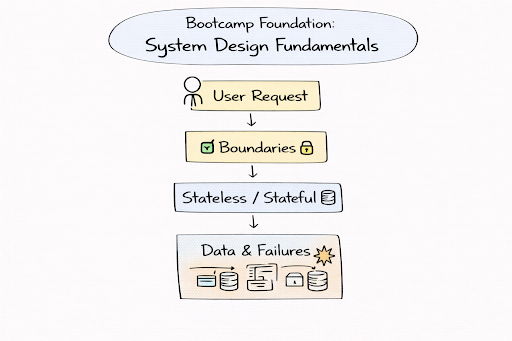
Many candidates want to jump straight into complex distributed systems. A strong bootcamp resists this urge. Fundamentals are taught first because every advanced concept depends on them.
Without a solid grasp of request flow, boundaries, and state, advanced topics feel abstract and overwhelming. The bootcamp intentionally slows down at this stage to build clarity.
Core mental models introduced in the foundation phase
The foundation phase focuses on understanding how systems actually work end-to-end. Candidates learn to reason about a single request moving through a system, where responsibilities lie, and how failures propagate.
Rather than memorizing components, the emphasis is on mental models that can be reused across problems.
Why interviewers care so much about fundamentals
Interviewers use fundamentals as an early filter. Candidates who struggle to explain basic request flow or boundaries are unlikely to succeed in deeper discussions, regardless of how advanced their knowledge appears.
The bootcamp treats fundamentals as non-negotiable because interviewers do the same.
Learning to think in systems (not components)
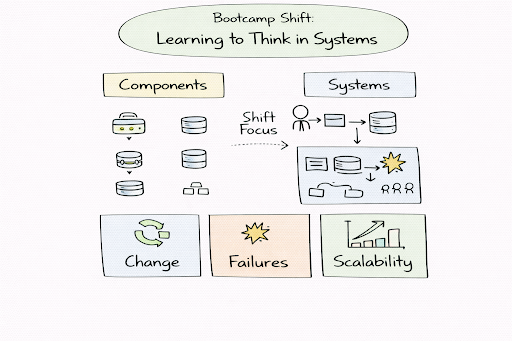
Many candidates approach system design by listing components. They talk about load balancers, caches, databases, and queues without explaining how those pieces work together.
Systems thinking shifts the focus from components to behavior. Instead of asking “what should I use,” candidates learn to ask “what happens when this changes, fails, or scales.”
How the bootcamp trains system-level reasoning
The bootcamp consistently emphasizes end-to-end reasoning. Candidates practice explaining how a request enters the system, how data flows, where state lives, and how failures affect users.
This approach forces candidates to connect decisions across layers rather than treating each part in isolation.
Avoiding premature optimization
Another key lesson in systems thinking is restraint. Over-optimizing early is a common mistake that signals inexperience. The bootcamp trains candidates to start simple and evolve designs only when justified by requirements.
Interviewers strongly prefer designs that can grow over designs that assume scale prematurely.
Systems thinking as an interview differentiator
Candidates who think in systems sound calm and deliberate. They can explain why a decision was made and what its consequences are. Interviewers recognize this immediately.
| Thinking style | Interview impression |
| Component listing | Shallow understanding |
| End-to-end reasoning | Strong system intuition |
| Early optimization | Weak judgment |
| Progressive refinement | Senior-level thinking |
Data modeling and data ownership module
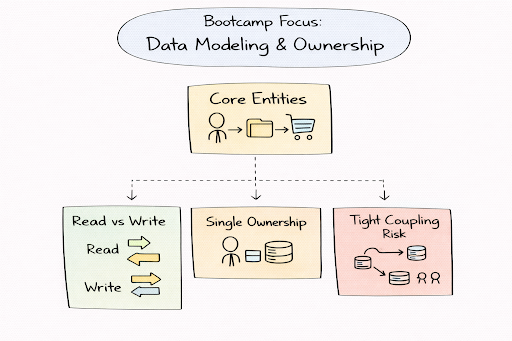
A system design bootcamp treats data modeling as a first-class skill because most real-world system failures originate from poor data decisions, not from missing infrastructure. Candidates often underestimate how deeply data shapes scalability, consistency, and coupling.
Interviewers know this, which is why they probe data early in system design interviews. The bootcamp mirrors that reality by introducing data modeling before advanced scalability or distributed systems topics.
Learning to identify what data actually matters
In this module, candidates learn to identify the core entities a system manages and how those entities relate to each other over time. The emphasis is not on schemas or table design, but on understanding which data drives system behavior and user experience.
Strong candidates can explain which data changes frequently, which data is read most often, and which data requires strict correctness guarantees. This understanding directly informs later design decisions.
Read and write patterns as design drivers
The bootcamp trains candidates to reason from access patterns rather than storage technologies. Whether a system is read-heavy, write-heavy, or mixed fundamentally changes how it should be designed.
Candidates learn how read-heavy systems benefit from denormalization and caching, while write-heavy systems often require careful normalization and batching. Interviewers listen closely for this reasoning because it demonstrates performance intuition.
Ownership boundaries and coupling control
A central lesson in this module is that every piece of data must have a single owner responsible for correctness. Allowing multiple services to modify the same data directly leads to tight coupling and inconsistent state.
The bootcamp reinforces the idea that ownership should be enforced through APIs and clear boundaries, not shared databases. Candidates who internalize this principle consistently perform better in interviews.
| Data modeling decision | Interview signal |
| Clear entity ownership | Strong system boundaries |
| Access-pattern-driven design | Performance intuition |
| Minimal shared state | Scalability awareness |
APIs, communication, and interaction patterns
In system design interviews, APIs represent contracts between components rather than implementation details. The bootcamp teaches candidates to think of APIs as long-lived agreements that shape scalability, reliability, and team autonomy.
Interviewers expect candidates to reason about how components communicate, not just what methods exist.
Synchronous and asynchronous communication trade-offs
This module focuses on helping candidates understand when synchronous communication is appropriate and when asynchronous interaction is a better fit. Synchronous calls are simple and intuitive, but tightly couple latency and availability. Asynchronous patterns improve resilience and scalability but introduce complexity.
Candidates learn to justify these choices based on requirements rather than defaulting to one approach.
Designing for retries and idempotency
Failures are inevitable, which makes retries unavoidable. The bootcamp emphasizes designing APIs that tolerate retries safely through idempotent operations.
Interviewers often probe this area because it reveals whether candidates design with failure in mind or assume ideal conditions.
Evolution, versioning, and long-term thinking
APIs evolve over time. The bootcamp introduces concepts like pagination, backward compatibility, and versioning as signals of production experience.
Strong candidates mention these considerations naturally, without getting lost in protocol details.
| API decision | What interviewers infer |
| Clear contracts | System stability |
| Idempotent writes | Failure awareness |
| Async where appropriate | Scalability judgment |
Scalability and performance bootcamp module
The bootcamp reframes scalability as maintaining acceptable performance as load increases, not simply handling more users. Interviewers are less impressed by large numbers than by clear reasoning about bottlenecks.
Candidates are trained to identify which component becomes the limiting factor first and why.
Horizontal scaling as a design goal
This module explains why horizontal scaling is favored in large systems despite its complexity. Candidates learn what makes a service horizontally scalable and what prevents scaling, such as shared state or coordination points.
Interviewers expect candidates to articulate these constraints clearly.
Performance intuition over calculation
Rather than focusing on formulas or exact metrics, the bootcamp builds performance intuition. Candidates practice explaining why latency increases, where contention arises, and how changes affect the critical path.
This style of reasoning aligns closely with how interviewers evaluate performance discussions.
Progressive scaling strategies
The bootcamp emphasizes that systems do not need to be built for peak scale immediately. Candidates learn to explain how a system evolves as load grows, adding complexity only when justified.
This progressive mindset signals strong engineering judgment.
| Scalability focus | Interview signal |
| Bottleneck-first thinking | Senior-level intuition |
| Simple initial design | Good judgment |
| Justified complexity | Experience |
Distributed systems and consistency module
Distributed systems concepts are where many candidates struggle. This module exists to demystify distribution by focusing on behavior rather than theory.
Interviewers use distributed systems discussions to differentiate mid-level candidates from senior engineers.
Understanding partial failure as the norm
The bootcamp trains candidates to treat partial failure as a normal condition. Networks delay messages, nodes fail independently, and components become temporarily unavailable.
Candidates practice explaining how systems behave when things go wrong, not just when everything works.
Consistency as a user-facing decision
Rather than framing consistency in abstract terms, this module ties consistency choices directly to user experience. Candidates learn to explain what users see during inconsistency windows and why that behavior is acceptable or not.
Interviewers respond strongly to this framing because it connects technical decisions to real-world impact.
Coordination costs and system limits
The module emphasizes minimizing coordination wherever possible. Candidates learn why distributed locks, leader election, and synchronous writes limit scalability and increase latency.
Strong candidates explain when coordination is necessary and when it can be avoided.
| Distributed concern | What it reveals |
| Consistency choice | Product reasoning |
| Coordination awareness | Scalability maturity |
| Failure handling | Resilience thinking |
Failure handling and resilience training
A defining difference between academic system design and real-world system design is the treatment of failure. In production systems, failures are not rare edge cases. They are expected conditions that must be handled deliberately.
Interviewers know this, which is why they consistently probe failure scenarios. The bootcamp reflects this reality by making failure handling a core module rather than an afterthought.
Learning to think beyond the happy path
Candidates are trained to describe what happens when dependencies slow down, crash, or return incorrect responses. The focus is not on preventing all failures, but on containing their impact.
Strong candidates can explain how the system behaves under stress in a predictable way. This ability signals operational maturity and real-world experience.
Core resilience principles emphasized in the bootcamp
Rather than memorizing mechanisms, candidates learn how resilience techniques work together. Timeouts bound waiting, retries recover from transient failures, idempotency makes retries safe, and circuit breakers protect the system from cascading collapse.
Interviewers reward candidates who explain these mechanisms as a coordinated strategy rather than a collection of buzzwords.
Graceful degradation and user trust
The bootcamp also emphasizes graceful degradation. Not all features need to be available during failures. Preserving core functionality while degrading non-critical paths maintains user trust.
Candidates who can articulate this trade-off consistently perform better in interviews.
System design exercises and guided practice
System design is not a passive skill. It must be practiced in conditions that resemble real interviews. The bootcamp, therefore, places heavy emphasis on guided exercises rather than purely theoretical instruction.
Exercises are structured to reinforce concepts learned in earlier modules while gradually increasing complexity.
Progression from simple to complex exercises
Candidates begin with foundational exercises that test clarity and structure before moving to more complex, distributed systems problems. This progression mirrors how interview difficulty increases across rounds.
Revisiting the same exercise multiple times is encouraged. Each iteration should feel simpler, clearer, and more confident than the last.
Guided feedback as a learning accelerator
Feedback is what transforms practice into improvement. The bootcamp emphasizes reflection after each exercise, focusing on clarity, trade-offs, and communication rather than correctness alone.
Candidates learn to identify their own weak spots and adjust accordingly.
| Practice focus | Skill developed |
| Repetition | Structural clarity |
| Verbal explanation | Communication |
| Failure walkthroughs | Resilience thinking |
| Feedback review | Rapid improvement |
Mock interviews and interview execution training
Many candidates understand system design concepts but struggle during real interviews due to nerves, poor pacing, or unclear explanations. This module focuses on execution under pressure.
Interviewers evaluate not just what you say, but how you say it. Calm, structured communication is a powerful signal.
Training for real interview dynamics
The bootcamp simulates real interview conditions, including time constraints, interruptions, and changing requirements. Candidates practice staying grounded while adapting their design.
Handling follow-up questions gracefully is treated as a core skill, not an afterthought.
Managing time and depth intentionally
Candidates learn how to allocate time across clarification, design, and deep dives. Spending too long in one area often leads to rushed or incomplete discussions later.
Interviewers appreciate candidates who manage time deliberately and adjust depth based on signals.
Building confidence through repetition
Confidence comes from familiarity. By the time candidates complete this module, the interview format feels predictable rather than intimidating.
This composure is often the deciding factor in borderline interviews.
Bootcamp to real interviews: readiness and next steps
Interview readiness is not about knowing every system design problem. It is about being able to approach any problem with a clear process and calm reasoning.
The bootcamp helps candidates assess readiness honestly by focusing on structure, clarity, and adaptability rather than content coverage.
Transitioning from practice to interviews
Candidates are encouraged to continue practicing selectively rather than endlessly. At this stage, quality matters more than quantity. Revisiting weak areas yields more benefit than attempting new exercises randomly.
The bootcamp also emphasizes maintaining confidence and avoiding burnout during interview preparation.
Long-term value beyond interviews
While the bootcamp is interview-focused, the skills developed extend into real engineering work. Clear thinking, trade-off analysis, and failure-aware design are valuable throughout an engineering career.
Candidates who internalize these skills often report improved confidence in design discussions at work.
Using structured prep resources effectively
Use Grokking the System Design Interview on Educative to learn curated patterns and practice full System Design problems step by step. It’s one of the most effective resources for building repeatable System Design intuition.
You can also choose the best System Design study material based on your experience:
Final thoughts
A system design bootcamp works because it replaces randomness with structure. Instead of guessing what to study next, candidates follow a deliberate progression that builds confidence layer by layer.
The bootcamp does not promise shortcuts. It promises clarity, repetition, and guided reasoning. Those qualities align perfectly with how system design interviews are evaluated.
Candidates who complete a well-structured system design bootcamp do not just perform better in interviews. They think more clearly about systems overall, which is the real mark of strong engineering growth.