

Designing Zoom is a popular System Design interview problem because it forces candidates to reason about real-time communication under strict performance constraints. Unlike text-based systems, video conferencing introduces challenges around latency, bandwidth, synchronization, and quality degradation, all of which must be handled gracefully at scale.
Interviewers often choose this problem because it reflects systems that must work reliably in imperfect network conditions. Candidates are expected to think about how millions of users join meetings from different regions, devices, and network qualities while still experiencing a usable product.
What Interviewers Are Evaluating
Interviewers are not testing whether candidates know specific media protocols or codecs in depth. Instead, they are evaluating architectural thinking, tradeoff analysis, and the ability to design systems that prioritize user experience under constraints.
Strong candidates demonstrate an understanding of separation of concerns, especially between signaling, media transport, and control logic. Interviewers also pay close attention to how candidates explain failure handling, scalability, and system evolution.
Expected Scope In Interviews
In a typical interview, the scope is intentionally constrained to core video conferencing functionality. Candidates are usually expected to design meeting creation, participant joining, audio and video streaming, and basic reliability mechanisms.
Advanced features such as background effects, transcription, or analytics are generally out of scope unless explicitly requested. Recognizing this scope early helps candidates focus on the architectural challenges that matter most.
Clarifying Requirements And Scope
A strong answer to design Zoom always begins with clarifying requirements. Video conferencing systems have many hidden assumptions, and making incorrect ones can derail the entire design.
Interviewers expect candidates to ask clarifying questions before proposing solutions. This demonstrates structured thinking and shows that the candidate understands System Design as a requirements-driven process rather than a technology-driven one.
Core Functional Requirements
At a functional level, Zoom exists to allow users to communicate using audio and video in real time. In interviews, candidates are expected to focus on these fundamental interactions rather than edge cases.
Core functionality typically includes creating meetings, allowing participants to join and leave, transmitting audio and video streams, and supporting basic screen sharing. The system should allow participants to see and hear each other with minimal delay.
Non-Functional Requirements And Constraints
Non-functional requirements are especially critical in video conferencing systems. Low latency is essential to maintain natural conversation, and availability is important because meetings are often time-sensitive.
Candidates should also acknowledge scalability, as meetings can range from two participants to thousands. Network variability must be handled gracefully so that users on poor connections still have a usable experience.
Defining What Is Out Of Scope
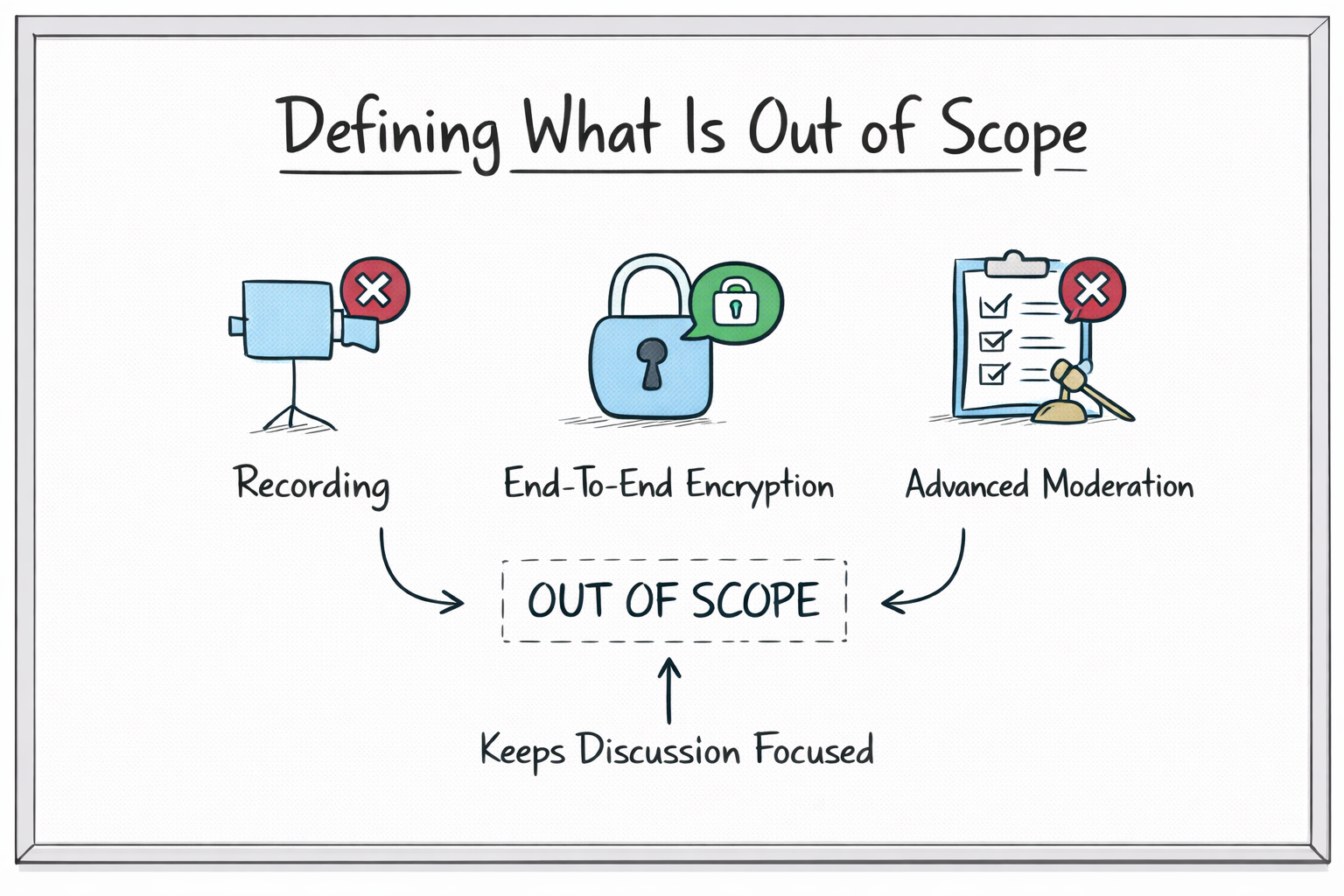
Clearly defining what is excluded helps keep the discussion focused. Features such as recording, end-to-end encryption details, or advanced moderation controls are often treated as extensions unless explicitly included.
Calling out exclusions demonstrates good judgment and allows interviewers to evaluate depth rather than breadth.
High-Level System Architecture
Once requirements are clear, candidates should move to a high-level architectural overview. This step establishes the foundation for the rest of the discussion and allows interviewers to assess whether the candidate can reason about systems holistically.
At a high level, Zoom consists of client applications, signaling services, and media processing systems. Each component has a distinct responsibility, and clean separation of concerns is critical for scalability and maintainability.
Client, Signaling, And Media Layers
Client applications include desktop, mobile, and web clients responsible for capturing audio and video, rendering streams, and interacting with users. These clients communicate with backend systems to coordinate meetings and exchange media.
The signaling layer handles meeting setup, participant discovery, and session management. It is responsible for coordinating who is connected and how media connections are established.
The media layer handles the actual transport and processing of audio and video streams. This layer is optimized for low latency and high throughput rather than complex business logic.
The table below summarizes the responsibilities of each layer.
| Layer | Responsibility |
| Client Layer | Capture And Render Audio And Video |
| Signaling Layer | Coordinate Meetings And Participants |
| Media Layer | Transport And Process Media Streams |
High-Level Call Flow
A typical call flow begins when a user creates or joins a meeting. The client contacts the signaling service to authenticate and retrieve meeting information. Once connected, the client establishes media connections according to the system’s media architecture.
Interviewers expect candidates to explain this flow clearly before diving into optimization or failure handling. A clear end-to-end explanation demonstrates strong system-level understanding.
API Design And Signaling
APIs and signaling mechanisms define how clients coordinate meetings and establish communication. In design Zoom, interviewers look for APIs that support real-time interactions while remaining simple and scalable.
Good API design reflects a clear understanding of meeting lifecycle, participant state, and connection management. It also allows the system to evolve without tightly coupling clients to backend internals.
Meeting And Participant APIs
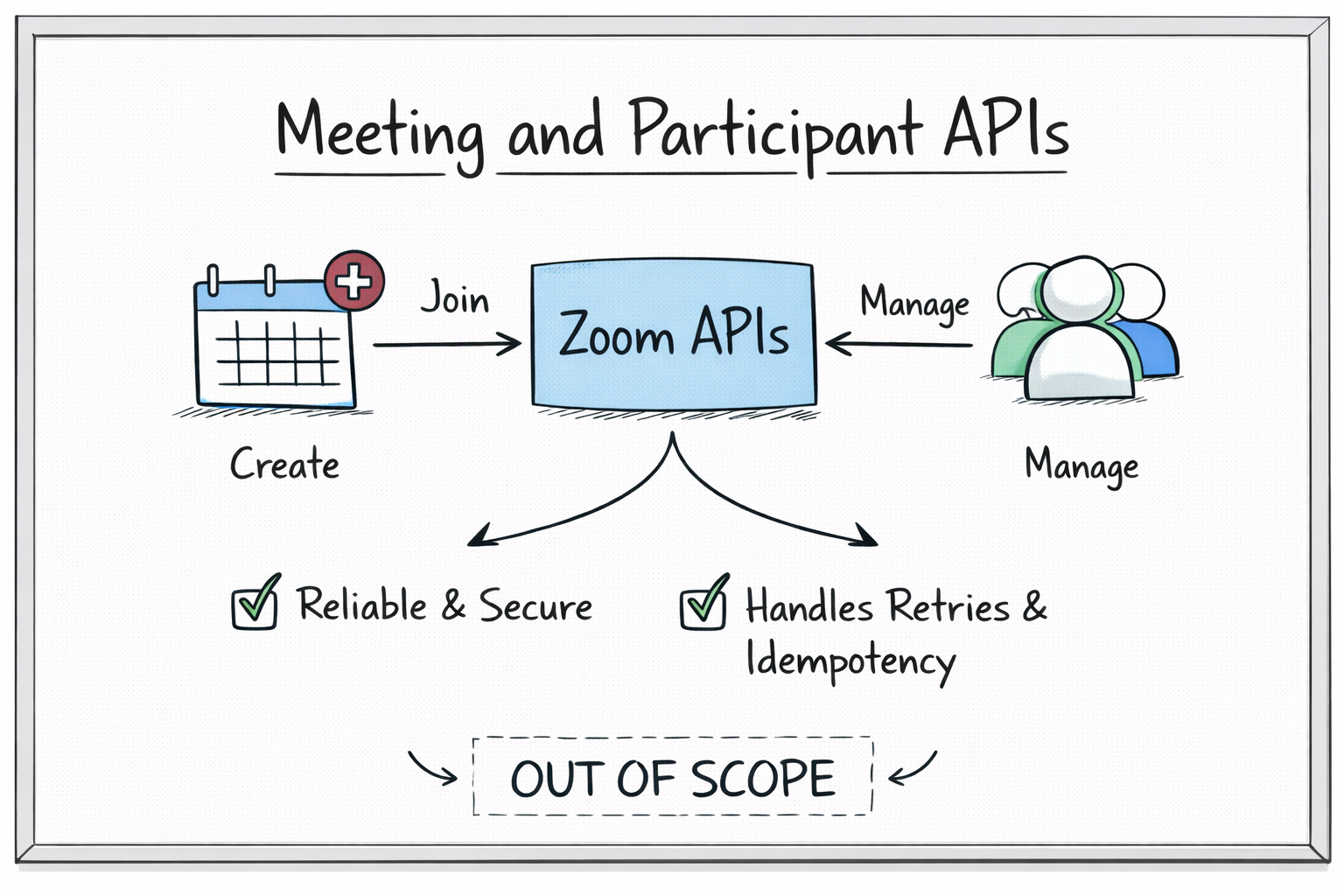
Meeting APIs handle actions such as creating meetings, joining sessions, and managing participants. These APIs are typically request-response based and must be reliable and secure.
Candidates should explain how these APIs scale across large numbers of concurrent meetings and how they handle retries and idempotency.
Signaling Flow For Call Setup
Signaling APIs coordinate how clients discover each other and establish media connections. This includes exchanging metadata such as network information and supported capabilities.
Interviewers expect candidates to explain signaling at a conceptual level rather than protocol specifics. The focus should be on coordination and state management rather than implementation details.
The table below summarizes core API categories in Zoom System Design interviews.
| API Category | Purpose |
| Meeting APIs | Create And Manage Meetings |
| Participant APIs | Join And Leave Sessions |
| Signaling APIs | Coordinate Media Setup |
Media Streaming And Real-Time Communication
In design Zoom, media streaming is the heart of the system. Unlike text-based communication, audio and video data is continuous, latency-sensitive, and highly sensitive to network conditions. Interviewers expect candidates to recognize that delivering media reliably in real time is fundamentally different from serving static or request-based data.
Strong candidates explain that the primary goal of media streaming is conversational smoothness. Small delays or jitter can significantly degrade user experience, even if the system is technically correct.
Audio And Video Streaming Requirements
Audio streams typically take priority over video because humans are more tolerant of video degradation than audio disruption. Candidates should explain how systems are often optimized to preserve audio quality even under poor network conditions.
Video streams consume significantly more bandwidth and must adapt dynamically. Interviewers look for awareness that video quality is not fixed and must adjust based on available bandwidth and device capability.
Handling Network Variability
Network conditions vary widely across users and can change during a call. Strong candidates explain how the system continuously monitors network performance and adapts media quality in response.
This adaptation may include lowering video resolution, reducing frame rate, or temporarily disabling video while preserving audio. Explaining this tradeoff shows an understanding of real-world constraints.
Media Transport At A High Level
Interviewers do not expect candidates to dive into protocol details, but they do expect a high-level understanding of how media is transported. Media streams are typically sent over connections optimized for low latency rather than guaranteed delivery.
Candidates should explain why occasional packet loss is acceptable and preferable to introducing additional latency through retries.
Media Architecture And Call Topology
One of the most important decisions in design Zoom is how media flows between participants. Interviewers expect candidates to discuss different call topologies and explain why one is chosen over another.
The choice of media architecture directly affects scalability, latency, and infrastructure cost.
Peer-To-Peer Communication
In small meetings, peer-to-peer communication can reduce latency and server load. Each participant sends media directly to others, resulting in minimal intermediary processing.
Candidates should explain why this approach does not scale well as participant count grows. Bandwidth usage increases rapidly, and devices may become overwhelmed.
Server-Based Media Distribution
For larger meetings, server-based architectures are required. Media servers receive streams from participants and forward them to others. This centralization allows better control and scalability at the cost of additional infrastructure.
Interviewers value candidates who explain how servers can selectively forward streams rather than mixing them, reducing compute cost while maintaining scalability.
Tradeoffs In Media Topologies
Explaining tradeoffs clearly is critical in System Design interviews. The table below summarizes common call topologies and their implications.
| Topology | Strength | Limitation |
| Peer-To-Peer | Low Latency | Poor Scalability |
| Selective Forwarding | Scales To Large Meetings | Higher Complexity |
| Central Mixing | Simple Clients | High Server Cost |
Scalability And Performance Optimization
Zoom usage patterns are bursty and time-bound. Meetings often start at scheduled times, leading to spikes in connection requests and media traffic. Interviewers expect candidates to recognize and design for these patterns.
Strong candidates explain how systems must scale quickly to handle sudden load and then scale down when meetings end.
Geographic Distribution And Latency
To minimize latency, media servers must be geographically distributed. Candidates should explain how users are routed to nearby servers to reduce round-trip time.
Interviewers often probe how the system handles participants joining from different regions. Explaining regional routing and cross-region coordination demonstrates global system thinking.
Load Balancing And Resource Allocation
Efficient load balancing is critical for both signaling and media services. Candidates should explain how new meetings and participants are assigned to servers based on current load and proximity.
Resource allocation is particularly important for media servers, which consume significant CPU and bandwidth. Explaining how capacity is monitored and adjusted shows operational awareness.
Performance Bottlenecks And Mitigation
Common bottlenecks include network bandwidth, server CPU, and connection limits. Strong candidates explain how monitoring and gradual optimization help identify and resolve these issues over time.
The table below summarizes scalability challenges and common optimizations.
| Challenge | Optimization Approach |
| Traffic Spikes | Elastic Scaling |
| Global Users | Regional Servers |
| Media Load | Selective Forwarding |
| Server Limits | Load-Aware Routing |
Reliability, Fault Tolerance, And Quality Control
Failures are inevitable in real-time systems. Interviewers want candidates to design systems that continue functioning even when parts fail.
Strong candidates explain how clients can reconnect to alternative servers if a media server becomes unavailable. Temporary disruptions are acceptable if calls recover quickly.
Quality Monitoring And Adaptive Control
Quality control is an ongoing process in video conferencing systems. Candidates should explain how the system continuously measures metrics such as latency, packet loss, and jitter.
These metrics drive adaptive decisions that balance quality and stability. Interviewers value candidates who explain this feedback loop clearly.
Graceful Degradation Under Stress
When conditions worsen, the system should degrade gracefully rather than failing abruptly. This may involve reducing video quality, disabling non-essential features, or prioritizing audio.
Explaining graceful degradation demonstrates a user-centric approach to System Design.
Ensuring High Availability
High availability requires redundancy at multiple levels. Candidates should explain how signaling and media services are replicated and how traffic is rerouted during outages.
The table below summarizes reliability strategies in Zoom-like systems.
| Concern | Design Strategy |
| Server Failure | Automatic Reconnect |
| Network Issues | Adaptive Bitrate |
| Overload | Graceful Degradation |
| Regional Outage | Traffic Rerouting |
Recording, Playback, And Data Storage
Recording introduces a fundamentally different set of requirements compared to real-time communication. In design Zoom interviews, candidates are expected to recognize that recording is not latency-sensitive in the same way as live media, but it is storage-intensive and reliability-critical.
Interviewers often look for candidates who separate recording concerns from live streaming. Recording should not slow down or destabilize live meetings, even when large numbers of users enable it simultaneously.
Recording Architecture At A High Level
Recordings can be captured either on the client side or server side. Strong candidates explain that server-side recording is generally preferred for reliability and consistency, as it avoids dependency on a single participant’s device or network.
In a server-side approach, media streams are duplicated or tapped from the live pipeline and written to storage asynchronously. This ensures that recording failures do not affect real-time communication.
Storage And Retrieval Of Recorded Media
Recorded meetings generate large media files that must be stored efficiently and retrieved later. Candidates should explain how recordings are stored in object storage systems optimized for large, immutable files.
Interviewers expect candidates to discuss access control, ensuring that only authorized users can view or download recordings.
The table below summarizes recording-related design considerations.
| Aspect | Design Approach |
| Capture | Server-Side Recording |
| Storage | Object Storage |
| Retrieval | Authenticated Access |
| Impact On Live Calls | Isolated And Asynchronous |
Security, Privacy, And Access Control
Security is a critical concern in video conferencing systems. Interviewers expect candidates to explain how users are authenticated before joining meetings and how permissions are enforced.
Meeting access controls determine who can join, who can share audio or video, and who can record sessions. Strong candidates explain these controls at a conceptual level without diving into implementation specifics.
Media Encryption And Privacy
Protecting audio and video streams is essential to prevent unauthorized access. Candidates should explain how media is encrypted during transit to protect against interception.
Interviewers are less concerned with cryptographic details and more interested in whether candidates understand the role encryption plays in maintaining user trust and compliance.
Privacy Considerations
Privacy concerns influence architectural decisions such as where media is processed and stored. Candidates should explain how data retention policies and user controls fit into the overall System Design.
Acknowledging privacy tradeoffs demonstrates awareness of real-world product and regulatory constraints.
The table below summarizes security-related concerns and responses.
| Concern | Design Response |
| Unauthorized Access | Authentication And Authorization |
| Data Interception | Encrypted Media Streams |
| Recording Access | Permission-Based Controls |
| Data Retention | Policy-Driven Storage |
Bottlenecks, Tradeoffs, And Alternative Designs
Interviewers often ask candidates to identify where the system might struggle under load. In design Zoom, common bottlenecks include bandwidth saturation, media server overload, and signaling service contention.
Strong candidates proactively identify these risks and explain how they are mitigated through architectural choices.
Tradeoff Analysis In Key Design Decisions
Every major decision in a video conferencing system involves tradeoffs. For example, routing all media through central servers improves control and scalability but increases infrastructure cost and latency.
Interviewers value candidates who clearly articulate these tradeoffs and justify their choices based on stated requirements.
Alternative Designs Under Different Constraints
Candidates may be asked how the system would change under different constraints, such as supporting extremely large webinars or operating in low-bandwidth environments.
Discussing alternative designs shows flexibility and depth of understanding rather than rigid adherence to a single solution.
The table below highlights tradeoffs in major design areas.
| Decision Area | Primary Approach | Alternative | Tradeoff |
| Media Routing | Distributed Servers | Centralized | Latency Vs Simplicity |
| Recording | Server-Side | Client-Side | Reliability Vs Cost |
| Quality Control | Adaptive | Fixed | Stability Vs Predictability |
How To Answer Design Zoom In Interviews
A strong answer to design Zoom follows a clear narrative. Candidates begin by clarifying requirements, then outline a high-level architecture, and finally dive into the most challenging components such as media streaming and scalability.
Interviewers appreciate candidates who guide the conversation and manage time effectively rather than jumping between unrelated details.
Common Interview Mistakes
One common mistake is diving too deeply into protocol or codec details. Interviewers are evaluating System Design thinking, not low-level media engineering expertise.
Another mistake is ignoring failure scenarios. Strong candidates proactively discuss how the system behaves when things go wrong.
What A Strong Answer Signals To Interviewers
A strong answer signals that you can design complex real-time systems, reason about tradeoffs, and communicate clearly. It demonstrates readiness for roles that involve building and operating large-scale user-facing systems.
Using structured prep resources effectively
Use Grokking the System Design Interview on Educative to learn curated patterns and practice full System Design problems step by step. It’s one of the most effective resources for building repeatable System Design intuition.
You can also choose the best System Design study material based on your experience:
Final Thoughts
Design Zoom is one of the most challenging System Design interview problems because it combines real-time communication, scalability, reliability, and user experience constraints. Success depends less on memorizing architectures and more on demonstrating structured thinking and sound judgment.
Candidates who perform well treat the interview as a collaborative design exercise. They clarify assumptions, prioritize core requirements, and explain decisions with confidence and humility. Mastering this approach prepares you not only for design Zoom but for a wide range of System Design interviews involving real-time, distributed systems.