

If you are preparing for an Amazon Software Development Manager interview, System Design is no longer just a technical exercise. Amazon SDM System Design questions are designed to evaluate how you think as a leader, how you balance architecture with execution, and how well you guide teams toward scalable, long-term solutions.
At the SDM level, Amazon is not testing whether you can write flawless code or draw perfect diagrams. They are testing whether you can lead complex System Design conversations, make sound trade-offs, and ensure that engineering decisions align with customer impact and business goals.
This guide breaks down what Amazon SDM System Design questions look like, how they differ from SDE interviews, what Amazon evaluates in your answers, and how you should prepare to meet the bar with confidence.
Understanding The Amazon SDM Role
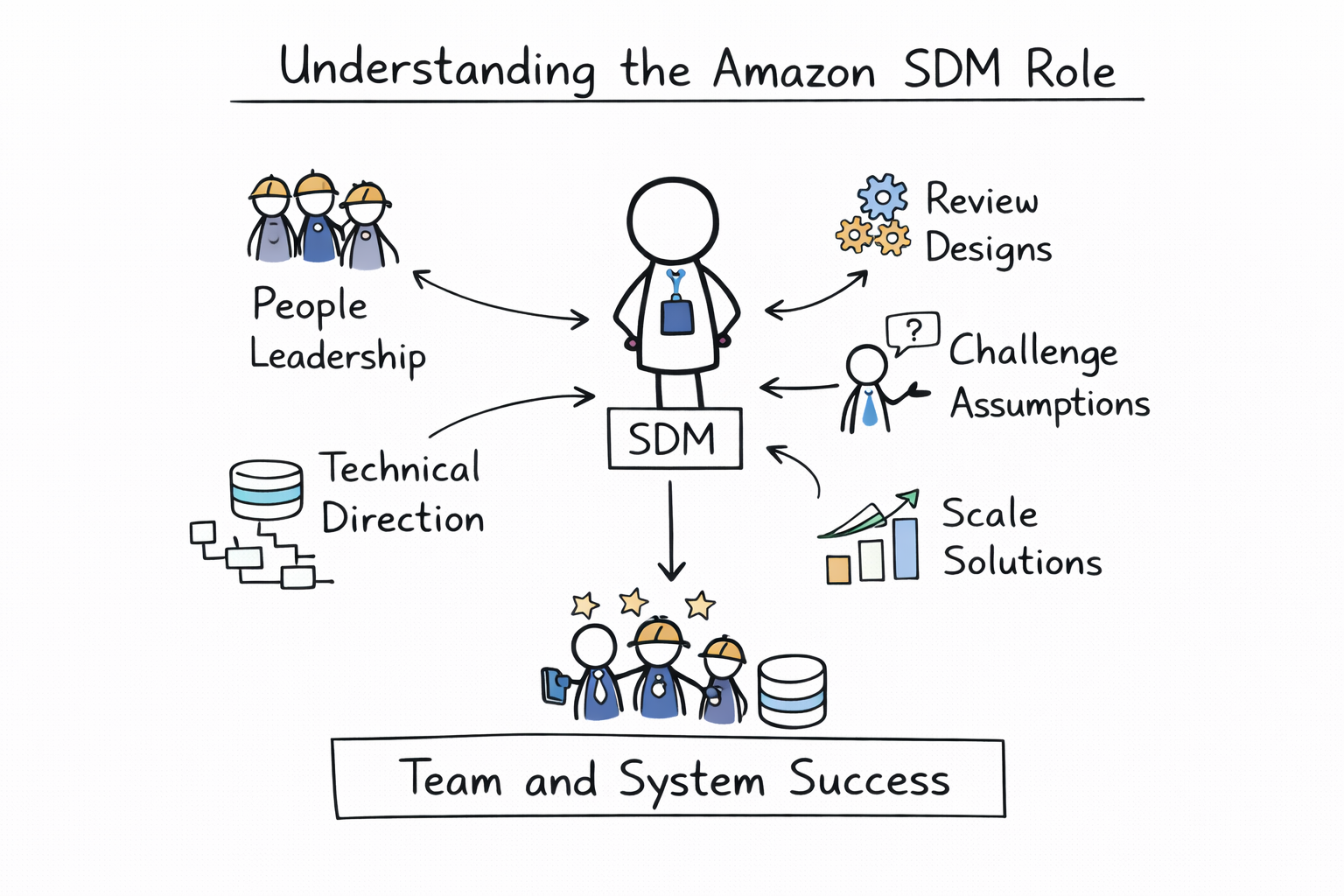
Before diving into System Design questions, it is important to understand what the SDM role represents at Amazon. As a Software Development Manager, you are responsible for both people leadership and technical direction. You are expected to build high-performing teams while also owning the technical health of the systems your team delivers.
Unlike senior individual contributors, SDMs are not expected to design every system themselves. Instead, you are expected to review designs, challenge assumptions, guide architectural decisions, and ensure that solutions scale over time. Your effectiveness is measured by the success of your team and the systems they build.
This dual responsibility is exactly why System Design is a critical part of the SDM interview process.
Why Amazon Emphasizes System Design For SDMs
Amazon operates at a massive scale, and many failures at scale are not caused by poor coding but by poor design decisions. At the SDM level, Amazon wants leaders who can prevent those failures before they happen.
System Design questions allow interviewers to assess whether you understand how systems evolve, where they break, and how architectural choices affect delivery speed, reliability, and cost. More importantly, they reveal how you think about guiding engineers through ambiguity.
Amazon is evaluating whether you can lead System Design discussions, not dominate them.
How Amazon SDM System Design Questions Differ From SDE Questions
One of the most common mistakes SDM candidates make is answering System Design questions like senior engineers. While technical depth is important, the evaluation criteria are fundamentally different.
The table below highlights the key differences.
| Dimension | SDE System Design | SDM System Design |
| Primary Focus | Architecture and correctness | Leadership and decision-making |
| Depth | Deep technical detail | Selective depth with context |
| Perspective | Individual contributor | Team and org-level |
| Ownership | Design execution | Design direction |
| Evaluation | Scalability and performance | Trade-offs and outcomes |
As an SDM, you should demonstrate that you understand the system deeply enough to guide engineers, review designs critically, and make informed decisions.
What Amazon Is Testing With SDM System Design Questions
Amazon SDM System Design questions test three core capabilities. First, they test technical judgment. You must demonstrate that you understand modern System Design concepts well enough to identify good and bad designs.
Second, they test leadership thinking. Interviewers want to see how you align teams, manage trade-offs, and make decisions under uncertainty.
Third, they test communication. You must be able to explain complex systems clearly to different stakeholders, from senior leadership to junior engineers.
Your answers should reflect all three dimensions.
Common Themes In Amazon SDM System Design Questions
Amazon SDM System Design questions are often framed around large, ambiguous problems that mirror real-world challenges. You may be asked to design a platform used by multiple teams, scale an existing system, or redesign a service that is failing under load.
In some cases, the question may explicitly ask you to focus on organizational challenges, such as managing dependencies between teams or balancing short-term delivery with long-term architecture.
These questions are intentionally open-ended to see how you prioritize, structure, and lead.
Example Amazon SDM System Design Questions
To make expectations more concrete, consider examples of realistic Amazon SDM System Design questions.
You may be asked how you would design a global order processing system used by multiple Amazon services. Another common prompt is how you would approach redesigning a legacy system that is slowing down feature development. You may also be asked how you would design an internal platform that supports hundreds of engineers across different teams.
In each case, the interviewer is evaluating how you approach the problem, not whether you arrive at a single correct answer.
How To Structure Your Answer As An SDM
Strong SDM candidates approach System Design questions with structure and intention. You should begin by clarifying the problem and defining success criteria. This shows that you do not jump into solutions without understanding the business and technical context.
Next, you should discuss high-level architecture options and explain the trade-offs involved. This is where your technical judgment becomes visible.
Finally, you should address execution and leadership considerations, such as how you would align teams, manage risk, and ensure long-term system health.
This balance between architecture and execution is critical at the SDM level.
How Deep Should You Go Into Technical Details?
Depth is a nuanced area in Amazon SDM System Design interviews. You are expected to go deeper than a TPM but not as deep as a principal engineer.
You should be comfortable discussing architectural patterns, data storage choices, scalability strategies, and failure handling at a conceptual level. You should also be able to dive deeper into areas that are critical to the system’s success.
If an interviewer pushes you into technical details, treat it as a collaborative exploration rather than a test. This often signals that they are assessing your technical ceiling and judgment.
The Importance Of Trade-offs In SDM System Design
Trade-offs are at the heart of Amazon SDM System Design questions. Amazon wants leaders who understand that every decision has consequences.
You should be explicit about the trade-offs you are making and why. Discussing trade-offs around performance, cost, reliability, and developer productivity demonstrates maturity and real-world experience.
Being transparent about what you would revisit as requirements change shows that you think long-term.
How Amazon Leadership Principles Influence SDM System Design
Amazon Leadership Principles are deeply embedded in SDM System Design interviews. Your answers should naturally reflect these principles without explicitly naming them.
For example, designing systems that prioritize customer impact aligns with Customer Obsession. Simplifying architecture aligns with Invent and Simplify. Designing cost-aware solutions reflects Frugality.
Interviewers listen closely for these signals as they evaluate your fit as a leader.
Evaluating Execution And Organizational Impact
At the SDM level, System Design discussions often extend beyond architecture into execution. You may be asked how you would roll out a system incrementally, handle migrations, or manage dependencies across teams.
This is where SDMs can differentiate themselves. Discussing phased rollouts, metrics, and operational readiness demonstrates that you understand how systems succeed in production.
Execution-focused thinking is a strong signal of leadership readiness.
Common Mistakes SDM Candidates Make In System Design Interviews
One common mistake is focusing too much on technical details and not enough on leadership. While technical depth matters, Amazon expects SDMs to think at a higher level.
Another mistake is failing to address organizational complexity. Ignoring cross-team dependencies or ownership boundaries can make your answer feel unrealistic.
Some candidates also struggle with clarity, overloading the interviewer with details without a clear narrative. Strong SDM answers are structured and easy to follow.
How To Prepare For Amazon SDM System Design Questions
Preparation for Amazon SDM System Design questions should focus on both technical breadth and leadership depth. You should review common System Design patterns and understand how large systems evolve over time.
Practicing design discussions with a leadership lens is critical. Focus on explaining why decisions are made, how teams are aligned, and how risks are mitigated.
Mock interviews can help you refine your structure and communication style.
How System Design Performance Affects Amazon SDM Hiring Decisions
System Design performance plays a major role in Amazon SDM hiring decisions. Strong performance signals that you are capable of leading complex technical initiatives and earning engineers’ trust.
Weak System Design signals, especially around judgment or leadership, can raise concerns about your readiness to manage teams and systems at scale.
Amazon evaluates the entire interview loop, but System Design is often one of the most influential components for SDM roles.
Final Thoughts On Amazon SDM System Design Questions
Amazon SDM System Design questions are not about proving that you are the smartest engineer in the room. They are about proving that you can lead teams to build scalable, reliable systems that deliver long-term value.
If you approach these questions with a balance of technical understanding, leadership thinking, and clear communication, you will align well with Amazon’s expectations. With the right preparation, System Design becomes an opportunity to showcase your impact as a technical leader.