
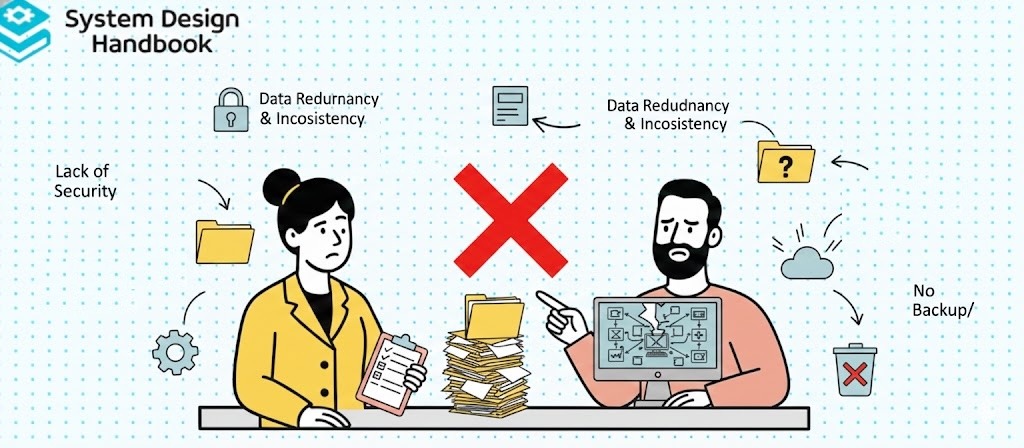
When preparing for System Design interviews, candidates often focus heavily on modern databases, distributed systems, and scalability techniques. However, interviewers frequently test foundational understanding by asking why database management systems replaced traditional file-based systems in the first place. This is where understanding the disadvantages of file system in DBMS becomes critical.
The file system approach was one of the earliest methods for storing and managing data. While it worked well for small-scale applications, it introduced serious limitations as systems grew larger and more complex. Modern DBMS architectures exist largely to solve these shortcomings.
In interviews, you are rarely asked to criticize file systems directly. Instead, you are expected to naturally explain why certain DBMS features such as transactions, indexing, concurrency control, and centralized schemas are necessary. A strong grasp of file system disadvantages allows you to explain these design choices with clarity and confidence.
What Is A File System In DBMS Context?
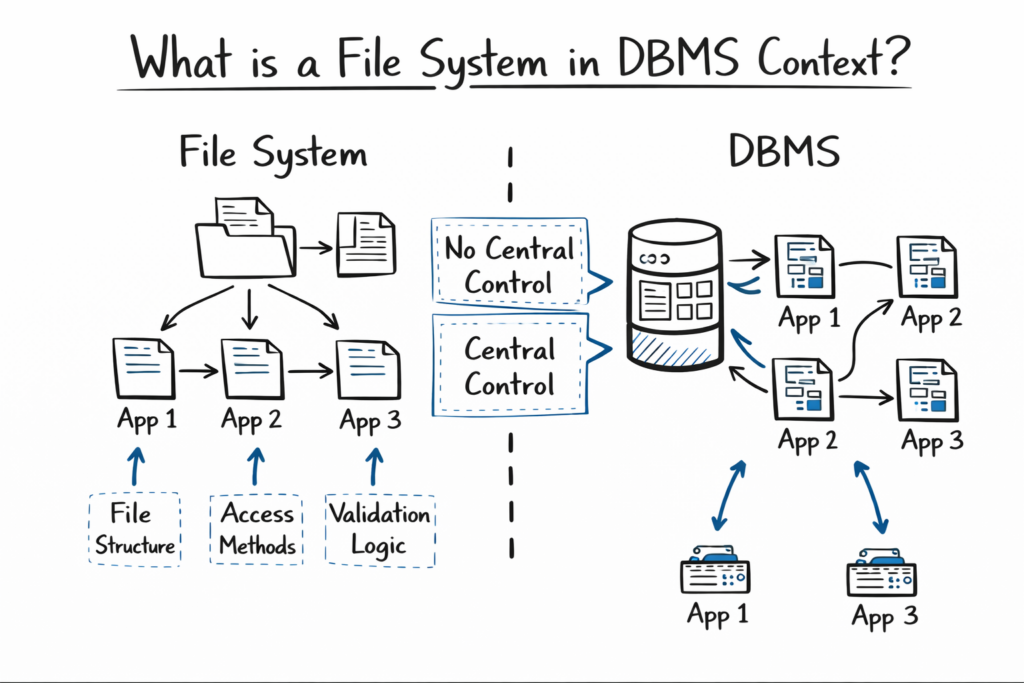
A file system is a basic data storage mechanism where data is stored in files on disk and managed by the operating system. Each application defines its own file structure, access methods, and data validation logic.
Unlike a DBMS, the distributed file system does not provide centralized control over data storage, querying, concurrency, or recovery. While simple and lightweight, this approach breaks down quickly as applications scale.
Understanding this contrast helps frame why the disadvantages of file system in DBMS are so frequently discussed in database and System Design interviews.
1. Data Redundancy And Inconsistency
One of the most significant disadvantages of file system in DBMS is data redundancy. In a file-based system, multiple applications often store the same data in separate files because there is no shared data repository.
This redundancy leads directly to data inconsistency. When the same data exists in multiple locations, updating one file does not automatically update the others. Over time, different versions of the same data emerge, causing correctness issues.
In interviews, this disadvantage is often used to justify centralized databases and normalized schemas. Interviewers want to see that you understand how redundancy increases storage cost and undermines data reliability.
| Aspect | File System Behavior |
|---|---|
| Data Storage | Multiple copies across files |
| Update Handling | Manual and error-prone |
| Consistency Guarantee | None |
| Maintenance Cost | High |
2. Difficulty In Data Access
Another major disadvantage of file system in DBMS is the lack of flexible data access. In file systems, data retrieval logic is embedded directly into application code. Any new query requirement often requires modifying the application itself.
This tight coupling between data storage and application logic makes systems rigid and difficult to evolve. In contrast, DBMS platforms provide declarative query languages that allow data retrieval without changing application code.
From an interview perspective, this limitation explains why SQL and query optimizers exist. It also highlights why modern systems favor abstraction layers between data and application logic.
3. Lack Of Data Isolation
In a file-based system, data for different functional areas is often scattered across multiple files. There is no concept of logical data isolation at the system level.
This creates serious challenges when partial data needs to be accessed. Applications must load entire files and manually filter relevant records, leading to inefficiency and increased complexity.
In System Design interviews, this disadvantage helps justify the use of schemas, tables, and views in DBMS systems. It also connects naturally to discussions about modularity and separation of concerns.
4. Integrity Constraint Enforcement Problems
Data integrity constraints such as primary keys, foreign keys, and value constraints are difficult to enforce in file systems. Each application must implement its own validation logic, which often leads to inconsistencies.
When multiple applications access the same data, enforcing constraints becomes even more difficult. There is no centralized authority to guarantee correctness.
This disadvantage is frequently referenced indirectly in interviews when discussing why relational databases enforce constraints at the database level rather than in application code.
| Integrity Aspect | File System Limitation |
|---|---|
| Key Constraints | Not enforced globally |
| Referential Integrity | Manual checks only |
| Validation Rules | Duplicated in code |
| Error Prevention | Weak |
5. Atomicity And Transaction Management Issues
File systems do not support transactions in the database sense. When multiple updates occur, there is no guarantee that all operations will complete successfully as a unit.
If a system crashes mid-operation, partial updates may persist, leaving data in an inconsistent state. Recovering from such failures often requires manual intervention or complex custom logic.
In System Design interviews, this disadvantage is central to explaining the importance of ACID properties. Interviewers expect you to articulate why atomicity and rollback mechanisms are essential for reliable systems.
6. Concurrency Control Limitations
As soon as multiple users or processes access the same files concurrently, file systems begin to struggle. Without built-in concurrency control, simultaneous reads and writes can lead to race conditions and corrupted data.
While operating systems provide basic file locking, these mechanisms are coarse-grained and inefficient for complex workloads.
In interviews, this disadvantage naturally leads into discussions about locks, isolation levels, and concurrency control mechanisms in DBMS platforms.
| Concurrency Aspect | File System Outcome |
|---|---|
| Concurrent Reads | Limited support |
| Concurrent Writes | High conflict risk |
| Fine-Grained Locking | Not available |
| Scalability | Poor |
7. Security Weaknesses
File systems rely heavily on operating system-level permissions for security. These permissions are often too coarse-grained to meet application-level security requirements.
There is no concept of role-based access control at the data level. Sensitive fields within a file cannot easily be protected differently from the rest of the file.
In System Design interviews, this disadvantage helps explain why databases provide user roles, privileges, and fine-grained access controls.
8. Backup And Recovery Challenges
Backup and recovery are complex and error-prone in file systems. Since data is spread across multiple files, ensuring a consistent backup requires coordinating file copies carefully.
If a failure occurs during backup, restoring data to a consistent state becomes difficult. There is no built-in mechanism to ensure snapshot consistency.
This disadvantage is often used in interviews to justify features such as write-ahead logging, checkpoints, and automated recovery in DBMS systems.
9. Lack Of Data Independence
Data independence refers to the ability to change the data schema without affecting application logic. File systems provide very little support for this concept.
Any change in file structure typically requires modifying every application that accesses that file. This tight coupling increases development effort and risk.
In interviews, this disadvantage helps demonstrate why schema evolution and abstraction layers are critical for long-lived systems.
10. Poor Scalability For Large Systems
File systems do not scale well as data volume and user count increase. Performance degrades due to inefficient access patterns, lack of indexing, and limited concurrency control.
As systems grow, managing file-based storage becomes increasingly complex and brittle. This limitation is one of the primary reasons DBMS platforms dominate modern System Design.
| Scaling Factor | File System Behavior |
|---|---|
| Data Volume | Performance degradation |
| User Count | High contention |
| Query Complexity | Inefficient |
| Maintenance Effort | Exponential growth |
How Interviewers Use File System Disadvantages To Test Design Thinking
Interviewers rarely ask candidates to list the disadvantages of file system in DBMS directly. Instead, they test this knowledge implicitly by asking why certain architectural choices exist.
If you can clearly explain why transactions, indexing, concurrency control, and centralized schemas matter, you are effectively demonstrating an understanding of file system limitations without explicitly naming them.
Strong candidates naturally contrast file systems with DBMS features when justifying design decisions.
Mapping File System Disadvantages To DBMS Advantages
Understanding the disadvantages of file system in DBMS makes it easier to explain why modern databases are designed the way they are.
| File System Limitation | DBMS Solution |
|---|---|
| Data redundancy | Normalization |
| No transactions | ACID properties |
| Weak concurrency | Locking and isolation |
| Poor recovery | Logging and checkpoints |
This mapping is especially useful in interviews when transitioning from problem constraints to solution architecture.
Conclusion
The disadvantages of file system in DBMS are not just historical trivia. They form the foundation for understanding why modern data systems exist and how they evolved.
In System Design interviews, this knowledge allows you to explain architectural decisions with clarity, depth, and confidence. Instead of memorizing features, you demonstrate reasoning rooted in real-world limitations.
As you continue preparing, revisit these disadvantages whenever you study database features. Doing so will help you internalize System Design principles and articulate them naturally under interview pressure.