

If you are preparing for Google interviews and targeting the L4 level, this question probably keeps coming up in your head: does Google ask System Design for L4? The short answer is yes, but not in the same way it does for senior or staff roles. The longer, more useful answer requires context, nuance, and an understanding of how Google actually evaluates engineers at different levels.
This guide walks you through exactly what to expect. You will learn when System Design shows up in L4 interviews, how deep it goes, how it differs from L5 and above, and how you should prepare without overengineering your prep. By the end, you should feel confident about what Google expects from you and how to meet that bar without unnecessary stress.
Understanding Google L4 And Why This Question Matters
Before diving into System Design itself, it helps to understand what L4 means at Google. L4 is often described as an early-career to mid-level software engineer. Many candidates at this level have two to five years of industry experience, though strong new graduates can also land L4 offers.
At L4, Google is primarily assessing whether you can operate as a reliable individual contributor. You are expected to write clean code, reason through problems, communicate clearly, and demonstrate solid engineering fundamentals. You are not expected to architect massive distributed systems end-to-end, but you are expected to show that you understand how real-world systems work.
That expectation is exactly why System Design sometimes appears in L4 interviews.
Should You Prepare System Design For L4 Interviews?
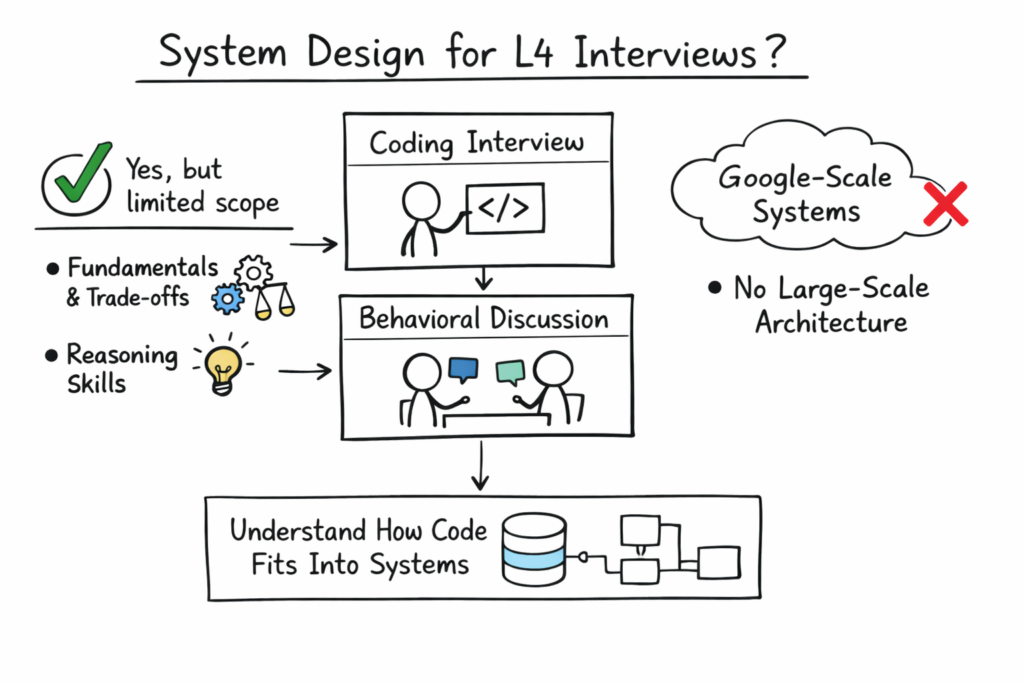
Yes, Google does ask System Design for L4, but the scope is intentionally limited. You should not expect the kind of open-ended, ambiguous, large-scale design questions that are common at L5 or L6. Instead, System Design at L4 focuses on fundamentals, trade-offs, and reasoning.
In many L4 loops, you may not see a dedicated “System Design interview round” at all. Instead, design thinking is often embedded in coding interviews or behavioral-style discussions. In some cases, especially for candidates with a few years of experience, Google may include a lightweight design-focused interview.
The key idea is that Google wants to see whether you understand how code fits into systems, not whether you can design Google-scale infrastructure from scratch.
When System Design Appears In The L4 Interview Loop
System Design does not appear uniformly for every L4 candidate. Whether you get System Design depends on factors like your background, your resume, and the role you are interviewing for.
The table below summarizes how System Design typically shows up at L4.
| Interview Scenario | Likelihood Of System Design | What It Looks Like |
|---|---|---|
| New Graduate Or Early Career | Low | Basic design concepts embedded in coding discussions |
| 2–5 Years Experience | Medium | Lightweight design interview or structured design questions |
| Backend Or Infrastructure Role | Higher | API design, data modeling, simple scalability discussions |
| Frontend Or Mobile Role | Medium | Component design, state management, performance considerations |
What matters most is not whether you get a design interview, but whether you are prepared to reason about systems if the interviewer steers the conversation there.
How Google’s L4 System Design Differs From L5 And Above
Understanding what L4 System Design is not can be just as helpful as knowing what it is.
At L5 and higher, Google expects you to handle ambiguity, define requirements, make architectural decisions independently, and justify trade-offs at scale. At L4, the bar is different. You are expected to reason clearly within a smaller, more guided problem.
The table below highlights the difference.
| Dimension | L4 System Design | L5+ System Design |
|---|---|---|
| Scope | Small to medium features | Large distributed systems |
| Ambiguity | Low to moderate | High |
| Focus | Fundamentals and clarity | Architecture and leadership |
| Trade-offs | Basic and guided | Complex and self-directed |
| Ownership | Component-level | System-level |
This distinction is critical. Overengineering your answers at L4 can actually hurt you, because it signals a mismatch between your approach and the role expectations.
Common System Design Topics For Google L4
While Google does not publish an official syllabus, certain themes show up consistently in L4 interviews. These topics reflect real-world engineering fundamentals rather than abstract theory.
You may be asked to design a simple service, discuss how data flows through an application, or explain how you would structure a feature end-to-end. Interviewers care less about buzzwords and more about whether your design makes sense.
Common areas include API design, basic database choices, handling scale at a high level, caching concepts, and failure handling in simple systems. You may also be asked to reason about latency, performance bottlenecks, or how a design evolves as usage grows.
Example L4-Style System Design Questions
To make this concrete, here are examples of System Design questions that align with the L4 bar. These are not trick questions, and they do not require advanced distributed systems knowledge.
You might be asked to design a URL shortening service, but with a clear scope and guidance. You could be asked how you would design a simple messaging feature between users. In some cases, the interviewer may ask you to design an API for a specific feature, such as user notifications or file uploads.
The emphasis is always on clarity, simplicity, and reasoning. Interviewers want to see that you can break a problem down logically and communicate your thought process.
What Google Evaluates In L4 System Design Answers
Google’s evaluation criteria for L4 System Design are subtle but consistent. They are not grading you on whether your design matches a “perfect” solution. Instead, they are evaluating how you think.
Interviewers pay close attention to how you clarify requirements, how you structure your approach, and how you explain trade-offs. They also look for signals that you understand basic system constraints, such as latency, storage, and reliability.
Importantly, Google values communication highly. If you explain your design clearly and respond thoughtfully to feedback or follow-up questions, that goes a long way toward a strong evaluation.
How Deep Should You Go In L4 System Design?
Depth is one of the most common areas where candidates misjudge expectations. Many candidates either stay too shallow or dive far too deep.
At L4, you should aim for depth that demonstrates understanding, not mastery. You should be able to explain why you chose a relational database instead of a key-value store, but you do not need to design sharding strategies or multi-region replication unless prompted.
If the interviewer pushes you deeper, that is usually a good sign. It means they are exploring the upper bound of your understanding, not that you were expected to start there.
How System Design Is Sometimes Hidden Inside Coding Interviews
One important nuance is that System Design questions at L4 often do not look like traditional System Design questions. Instead, they are woven into coding interviews.
For example, after you solve a coding problem, the interviewer may ask how your solution would behave at scale, how you would modify it for production, or how you would expose it as an API. These follow-up questions are effectively testing System Design fundamentals.
Being prepared for these transitions is crucial. You should always be ready to step back from the code and discuss design implications in plain language.
How To Prepare For Google L4 System Design Without Overdoing It
Preparation for L4 System Design should be targeted and efficient. You do not need months of deep distributed systems study, but you do need structured practice.
Start by mastering the basics of common system components. Understand how clients talk to servers, how APIs are structured, and how data is stored and retrieved. Focus on reasoning about simple scalability challenges rather than extreme edge cases.
Practice explaining your designs out loud. Since communication is heavily weighted, clarity matters as much as correctness. If you can explain a design to a non-expert in a clear, logical way, you are likely at the right level.
Recommended Preparation Focus Areas For L4 Candidates
The table below summarizes what you should prioritize in your preparation.
| Area | Preparation Depth |
|---|---|
| API Design | Strong |
| Data Modeling | Strong |
| Basic Scalability | Moderate |
| Caching Concepts | Moderate |
| Distributed Systems Theory | Light |
| Advanced Infrastructure | Minimal |
This balance helps you stay aligned with Google’s expectations while avoiding unnecessary complexity.
Mistakes That Hurt L4 Candidates In System Design
One of the most common mistakes L4 candidates make is trying to sound senior. Overusing jargon, introducing complex architectures without justification, or ignoring the problem’s scope can all work against you.
Another common issue is failing to clarify requirements. Jumping straight into design without confirming assumptions often leads to misalignment with the interviewer’s expectations.
Finally, some candidates under-explain their decisions. Even if your design is reasonable, the interviewer cannot give you credit if they do not understand your reasoning.
How Google Uses System Design Signals For Leveling
System Design performance can influence leveling decisions, even at L4. A strong showing in design discussions can reinforce that you are operating comfortably at the L4 bar. In some cases, it may even spark conversations about L5 potential, though this is less common.
On the other hand, weak design signals rarely disqualify strong L4 coding candidates on their own. Google tends to look at the full picture, weighing coding, problem-solving, communication, and behavioral signals together.
Final Verdict
So, does Google ask System Design for L4? Yes, but in a way that aligns with the responsibilities of the role. You are not expected to design Google-scale systems, but you are expected to think beyond code and understand how real systems are built.
If you prepare with the right mindset, focusing on fundamentals, clarity, and communication, System Design becomes an opportunity rather than a risk. It allows you to demonstrate that you are not just a coder, but an engineer who understands how software works in the real world.
Approach L4 System Design with confidence, keep your answers grounded, and remember that Google is evaluating how you think, not how many architecture diagrams you can draw.