

If you are a fresher preparing for technical interviews in 2026, it is natural to wonder whether System Design really matters for you. Most advice around System Design seems aimed at senior engineers. Many fresher roles focus heavily on coding, data structures, and algorithms.
This creates confusion. You might ask yourself whether System Design is something you can safely postpone until later in your career.
The short answer is yes, System Design is important for freshers. The long answer is more nuanced and far more useful for interviews.
System Design is not about drawing massive architectures on day one. It is about learning how to think beyond code. Interviewers are increasingly looking for this mindset even in entry-level candidates.

What System Design Means For Freshers
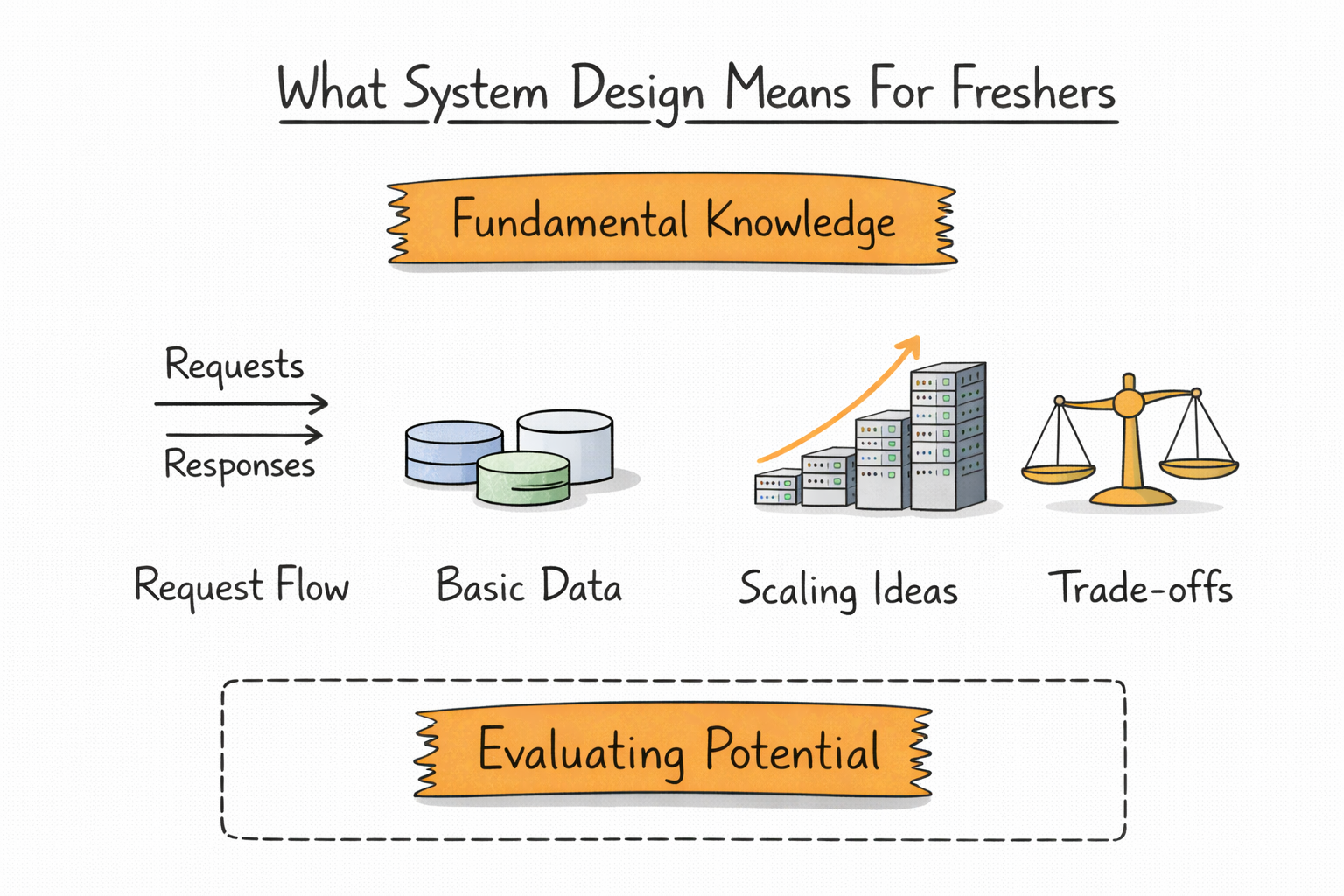
System Design for freshers does not mean designing global-scale systems. It means understanding how software fits together.
At a fresher level, System Design is about grasping request flow, basic data storage, simple scaling ideas, and trade-offs. It is about knowing why a system is structured the way it is, not memorizing complex architectures.
Interviewers are not expecting expertise. They are evaluating potential.
If you understand the fundamentals and can reason clearly, you already stand out.
Why System Design Is No Longer Just For Senior Roles
In the past, System Design interviews were reserved for senior positions. That boundary has blurred.
Modern software development demands engineers who can think holistically early in their careers. Even junior engineers are expected to understand how their code affects performance, reliability, and scalability.
As a fresher, showing awareness of System Design signals maturity. It tells interviewers that you think like an engineer who will grow quickly.
The table below shows how expectations have shifted.
| Earlier Expectations | Current Expectations |
| Focus on syntax | Focus on reasoning |
| Isolated coding tasks | Awareness of system impact |
| Follow instructions | Ask clarifying questions |
| Implement features | Understand architecture |
This shift explains why System Design has become important even for freshers.
How System Design Helps Freshers In Interviews
System Design gives you a framework for answering open-ended questions. Even when interviews are coding-heavy, follow-up questions often probe design thinking.
Interviewers may ask how your solution would scale or what happens under higher load. Freshers who cannot answer these questions feel stuck. Freshers with basic System Design knowledge respond confidently.
System Design also improves communication. You learn to explain your thinking, justify decisions, and adapt to feedback.
These are exactly the traits interviewers look for in entry-level candidates.
Is System Design Important For Fresher Coding Rounds?
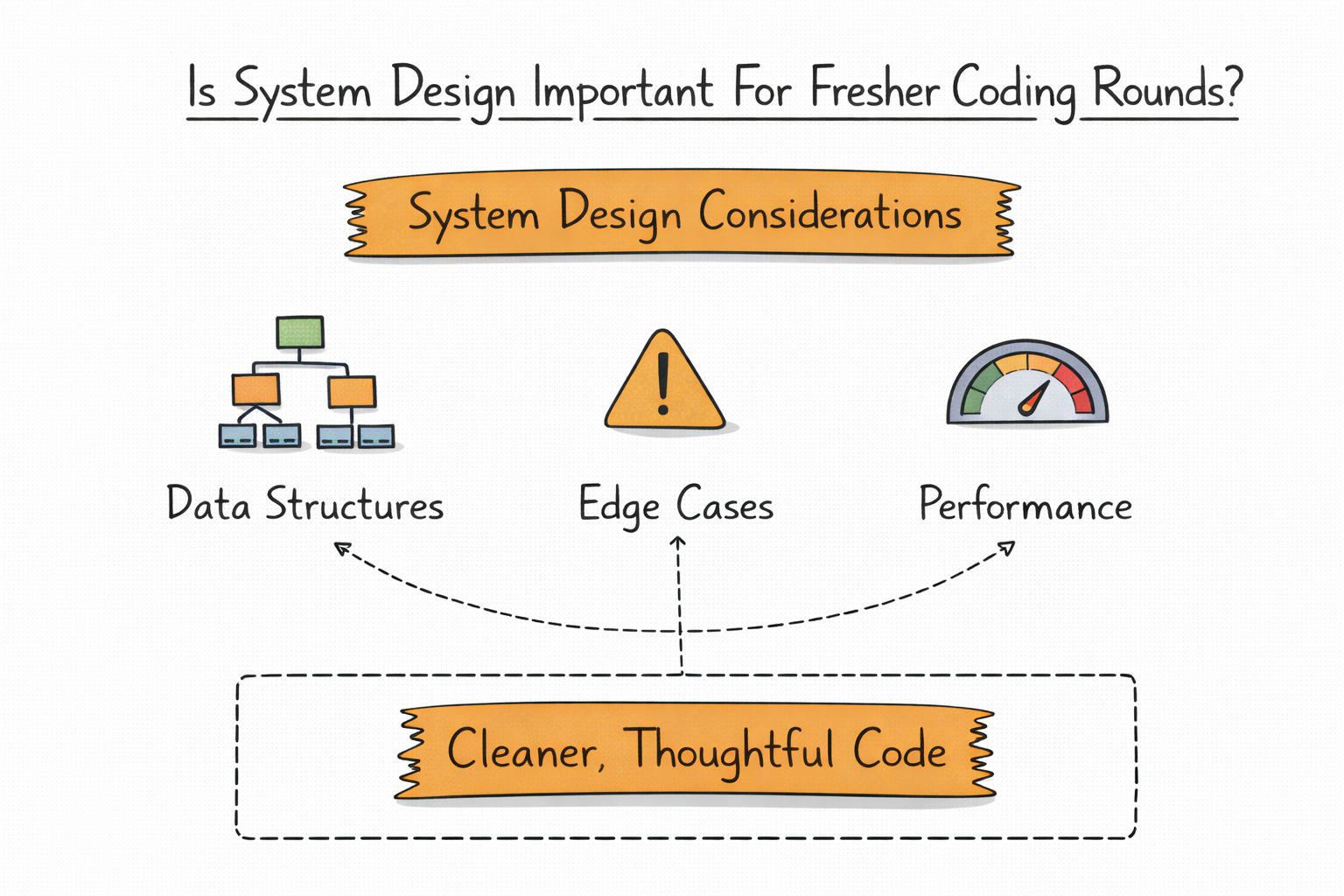
Even when System Design is not a separate interview round, it still matters.
Coding problems often hide System Design considerations. Choosing data structures, handling edge cases, and thinking about performance are all early forms of System Design.
A fresher who understands System Design tends to write cleaner, more thoughtful code. Interviewers notice this immediately.
System Design thinking strengthens coding rather than competing with it.
What Interviewers Expect From Freshers In System Design
Interviewers do not expect freshers to design complex distributed systems. They expect clarity and curiosity.
They want to see whether you can understand requirements, break problems into parts, and reason about trade-offs at a basic level.
The table below highlights the difference between unrealistic expectations and real expectations.
| What Freshers Fear | What Interviewers Expect |
| Designing large systems | Explaining simple flows |
| Knowing all the tools | Understanding why tools exist |
| Perfect answers | Logical reasoning |
| Experience stories | Clear thinking |
Once you understand this, System Design feels far less intimidating.
Why System Design Improves Learning For Freshers
System Design connects concepts that often feel isolated. Networking, databases, caching, and APIs start to make sense together.
Instead of memorizing topics, you see how they interact.
This integrated understanding accelerates learning. Freshers who study System Design early often find advanced topics easier later.
System Design acts as a mental map for software engineering.
Is System Design Important For Freshers With No Experience?
This is a common concern. Many freshers believe System Design requires real-world exposure.
While experience helps, it is not mandatory.
System Design interviews test conceptual understanding, not production war stories. You are expected to reason logically, not recall past outages.
Freshers who practice System Design problems gain simulated experience through thought experiments.
This practice builds confidence and interview readiness.
How System Design Helps Freshers Stand Out
Most freshers focus exclusively on coding. This creates a crowded field.
A fresher who understands basic System Design immediately differentiates themselves. You demonstrate that you think beyond the immediate problem.
Interviewers often remember candidates who ask thoughtful design questions, even if their coding is average.
System Design can become your unfair advantage.
System Design And Career Growth For Freshers
System Design is not just an interview topic. It shapes how you grow as an engineer.
Freshers who understand System Design communicate better with senior engineers. They ask better questions. They understand why decisions are made.
This accelerates career growth and trust.
The table below shows how early System Design exposure affects career trajectory.
| Without System Design | With System Design |
| Focus on tasks | Focus on impact |
| Limited context | Big-picture thinking |
| Slow growth | Faster responsibility |
| Reactive learning | Proactive learning |
This long-term benefit makes System Design important beyond interviews.
How Much System Design Should Freshers Learn?
Freshers do not need advanced depth. They need solid foundations.
Understanding request flow, basic data storage, simple scaling, and failure awareness is sufficient.
You should be able to explain a simple system clearly and reason about basic trade-offs.
Depth comes later. Foundations come first.
Interviewers value strong fundamentals more than shallow breadth.
Common Mistakes Freshers Make With System Design
One common mistake is ignoring System Design entirely. Another is over-preparing advanced topics too early.
Some freshers try to memorize architectures without understanding them. This leads to fragile knowledge that breaks under questioning.
System Design should be learned gradually, alongside coding practice.
Balance is key.
How Freshers Should Approach System Design Preparation
System Design preparation should be incremental.
You start with simple systems. You focus on clarity, not complexity. You practice explaining your thinking aloud.
This approach builds confidence and interview readiness.
The goal is not to impress. The goal is to reason clearly.
Is System Design Important For Freshers In FAANG Interviews?
FAANG interviews emphasize system thinking even for junior roles.
While expectations are adjusted for experience, freshers are still evaluated on how they approach design problems.
Showing structured thinking, asking good questions, and explaining trade-offs matters more than perfect designs.
System Design preparation significantly improves performance in these interviews.
When System Design Starts To Feel Natural For Freshers
System Design feels hard initially because it is unfamiliar. Over time, patterns emerge.
You start recognizing common components. You anticipate trade-offs. You become comfortable with ambiguity.
This transition happens faster than most freshers expect.
Consistency matters more than intensity.
Final Thoughts
System Design is important for freshers, but not in the way many people assume.
It is not about designing massive systems. It is about developing a way of thinking.
System Design teaches you how to reason, communicate, and grow as an engineer. These skills matter in interviews and throughout your career.
If you approach System Design with curiosity instead of fear, it becomes one of the most valuable skills you can build early.