

System design interviews are no longer reserved only for software engineers. Product managers are increasingly expected to demonstrate system-level thinking, especially when interviewing for technical or platform-focused roles. This shift reflects how modern product management sits at the intersection of business, user experience, and engineering execution.
System design for product managers is not about drawing detailed infrastructure diagrams or selecting specific technologies. Instead, it is about understanding how large systems are structured, how components interact, and how design decisions affect scalability, reliability, cost, and user experience. Interviewers want to see whether you can reason about trade-offs, ask the right clarifying questions, and align technical decisions with product goals.
This article breaks down system design for product managers in an interview-focused way. It explains what interviewers expect, how product managers should approach design problems, and how to communicate technical thinking without writing code.
What System Design Means For Product Managers
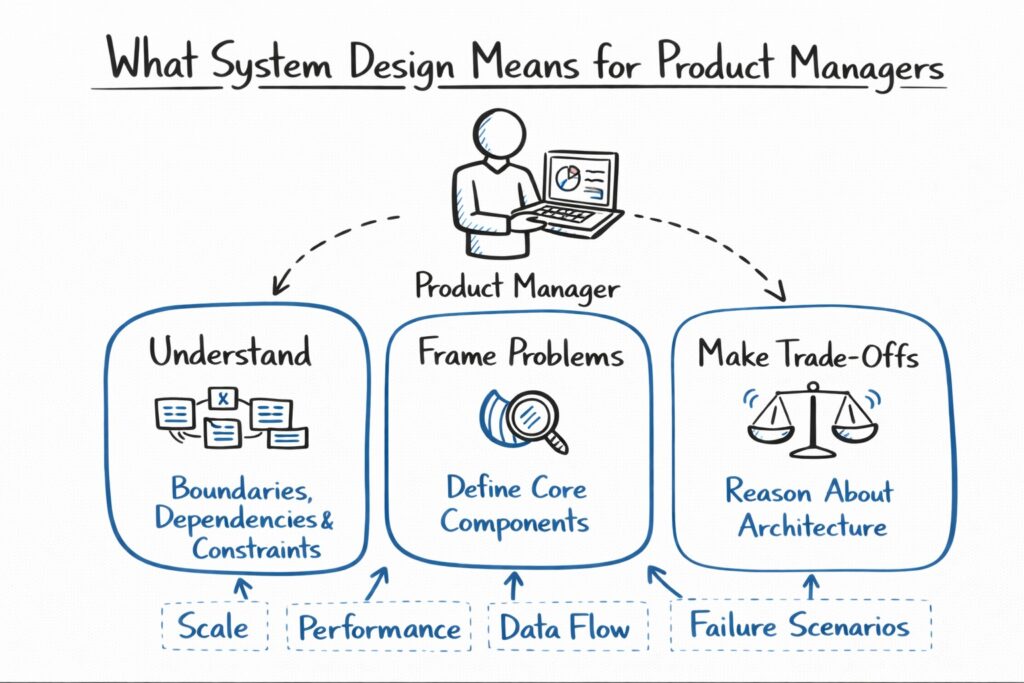
For product managers, system design is about understanding how a product is built at a high level and how architectural choices support business outcomes. Unlike engineers, product managers are not expected to design algorithms or implement services. Instead, they are expected to understand system boundaries, dependencies, and constraints.
In interviews, system design for product managers focuses on framing problems correctly, identifying core components, and making informed trade-offs. This includes reasoning about scale, performance, data flow, and failure scenarios from a product perspective.
How System Design Interviews Differ For Product Managers
System design interviews for product managers differ significantly from engineering-focused interviews. The emphasis is not on correctness of implementation but on clarity of thought and alignment with product strategy.
| Aspect | Engineer Focus | Product Manager Focus |
|---|---|---|
| Technical Depth | Low-level implementation | High-level architecture |
| Primary Concern | Performance and correctness | Trade-offs and impact |
| Evaluation Criteria | Technical accuracy | Decision-making clarity |
| Communication Style | Technical explanations | Cross-functional reasoning |
Understanding this distinction helps product managers avoid over-indexing on technical details while still demonstrating strong system intuition.
Framing The Problem Before Designing The System
One of the most important skills in system design for product managers is problem framing. Interviewers often evaluate how well you define the problem before proposing solutions.
Strong candidates start by clarifying the goal of the system, the target users, and the primary success metrics. They also ask questions about scale, usage patterns, and constraints. This shows that you understand how requirements drive architecture.
In interviews, spending time on framing signals maturity and prevents premature design decisions.
Identifying Core System Components
Product managers are expected to identify the major building blocks of a system without diving into implementation details. These components typically include clients, backend services, data storage, and integrations.
Rather than naming specific technologies, product managers should describe responsibilities. For example, instead of saying a specific database, you might say a persistent storage layer optimized for transactional data.
| Component Category | Product Manager Perspective |
|---|---|
| Clients | How users interact with the system |
| Backend Services | Business logic and workflows |
| Data Storage | Persistence and retrieval needs |
| Integrations | External dependencies |
| Infrastructure | Scalability and reliability support |
This abstraction-first approach aligns well with system design expectations for product managers.
Thinking In Terms Of User Journeys And Data Flow
System design for product managers is deeply tied to user journeys. Interviewers often expect you to explain how a request flows through the system from the user’s perspective.
Describing data flow helps demonstrate that you understand system interactions and dependencies. It also highlights potential bottlenecks and failure points.
For example, explaining how a user action triggers backend processing, data storage, and notifications shows system awareness without requiring technical depth.
Scalability From A Product Perspective
Scalability is a core theme in system design interviews, and product managers are expected to reason about it in terms of growth and user experience.
Rather than discussing specific scaling techniques, product managers should focus on questions like when the system needs to scale, which components scale independently, and how scaling impacts cost and performance.
| Scalability Concern | Product-Level Interpretation |
|---|---|
| Traffic Growth | User adoption increases |
| Data Growth | Feature usage expands |
| Geographic Expansion | New markets added |
| Cost Scaling | Infrastructure spend rises |
Discussing scalability in this way shows strategic thinking aligned with product planning.
Reliability And Failure Handling
Reliability is not just a technical concern. From a product perspective, reliability directly impacts user trust and brand reputation.
In system design interviews, product managers should be able to discuss how systems handle failures and what users experience during outages. This includes graceful degradation, retries, and fallback behaviors.
Interviewers are often impressed when product managers proactively consider failure scenarios and their impact on user experience.
Consistency And User Expectations
Data consistency is another area where system design intersects with product decisions. Product managers are not expected to explain consistency models in depth, but they should understand how inconsistency affects users.
For example, a slight delay in updating a social media feed may be acceptable, while inconsistent financial data is not. Framing consistency decisions around user expectations and business risk demonstrates strong judgment.
Trade-Offs As The Core Of System Design For Product Managers
At its core, system design for product managers is about trade-offs. Every architectural choice involves balancing speed, cost, reliability, and complexity.
Interviewers are less interested in the “right” answer and more interested in how you justify your choices. Explicitly calling out trade-offs shows transparency and strategic thinking.
| Trade-Off Dimension | Example Consideration |
|---|---|
| Speed vs Accuracy | Real-time updates vs correctness |
| Cost vs Scale | Overprovisioning vs efficiency |
| Complexity vs Flexibility | Simple design vs extensibility |
Discussing trade-offs clearly is one of the strongest signals a product manager can give in a system design interview.
Communication Style Matters More Than Diagrams
Unlike engineering interviews, system design for product managers is evaluated heavily on communication. Interviewers want to see whether you can explain complex systems in simple terms.
Clear structure, logical flow, and explicit assumptions matter more than visual diagrams. When diagrams are used, they should support the narrative rather than replace it.
This mirrors real-world product management, where clear communication with engineers and stakeholders is critical.
Common System Design Scenarios For Product Managers
Product managers are often asked to design systems that mirror real-world products such as marketplaces, messaging platforms, analytics dashboards, or recommendation systems.
In these scenarios, interviewers expect you to focus on user value, data flow, and system boundaries rather than implementation details.
| Scenario Type | Evaluation Focus |
|---|---|
| Marketplace | Transactions and trust |
| Messaging System | Reliability and latency |
| Analytics Platform | Data freshness and scale |
| Collaboration Tool | Concurrency and access |
Understanding these expectations helps tailor your answers effectively.
How To Structure Your System Design Answer
A strong system design answer from a product manager follows a clear structure. It begins with problem clarification, moves into high-level architecture, and then explores trade-offs and edge cases.
This structured approach demonstrates organized thinking and makes it easier for interviewers to follow your reasoning.
Avoid jumping straight into solutions. Instead, guide the interviewer through your thought process step by step.
Mistakes Product Managers Commonly Make In System Design Interviews
One common mistake is trying to sound overly technical. Product managers sometimes name-drop technologies without explaining why they matter, which can hurt credibility.
Another mistake is ignoring failure scenarios or scalability concerns. Even at a high level, acknowledging these aspects is essential.
Strong candidates stay within their role while demonstrating system awareness.
How Interviewers Evaluate System Design For Product Managers
Interviewers evaluate system design for product managers across several dimensions. They look for clarity of thinking, alignment with user needs, and awareness of trade-offs.
They also assess whether you can collaborate effectively with engineers by speaking a shared language without overstepping into implementation.
| Evaluation Area | What Interviewers Look For |
|---|---|
| Problem Framing | Clear understanding of goals |
| System Awareness | High-level architectural insight |
| Trade-Off Reasoning | Balanced decision-making |
| Communication | Clear and structured explanation |
Using System Design To Demonstrate Product Leadership
System design interviews are an opportunity for product managers to demonstrate leadership. By connecting technical decisions to business outcomes, you show that you can guide teams toward sustainable solutions.
Discussing how system constraints influence roadmap decisions or feature prioritization highlights real-world product thinking.
This leadership mindset often distinguishes strong candidates from average ones.
Preparing Effectively For System Design Interviews As A Product Manager
Preparation for system design interviews should focus on understanding common system patterns, practicing structured explanations, and learning to articulate trade-offs.
Studying real-world systems and reflecting on past product decisions helps build intuition. Practicing mock interviews improves confidence and clarity.
The goal is not to memorize designs, but to develop a repeatable thinking framework.
Conclusion
System design for product managers is ultimately about thinking holistically. It requires understanding how users, technology, and business constraints intersect.
In system design interviews, product managers who succeed are those who can reason clearly, communicate effectively, and align technical decisions with product goals. They do not try to out-engineer engineers, but they demonstrate deep system awareness and strong judgment.
By mastering system design concepts at the right level of abstraction, product managers can approach interviews with confidence and present themselves as effective partners in building scalable, reliable products.