

If you have ever searched “is System Design hard,” you are not alone. System Design is one of the most intimidating parts of technical interviews, even for experienced engineers. Unlike coding problems, System Design questions feel vague, open-ended, and subjective.
What makes this question interesting is that System Design is not hard in the way algorithms are hard. It is hard in a different, more psychological way. It forces you to think without guardrails, make decisions with incomplete information, and explain your reasoning clearly under pressure.
Understanding why System Design feels hard is the first step to realizing that it is also learnable.

What People Really Mean When They Say System Design Is Hard
When someone says System Design is hard, they are usually not talking about the System Design principles themselves. They are talking about the experience.
System Design problems do not give you clear inputs and outputs. There is no single correct answer. You are expected to ask questions, define assumptions, and make trade-offs in real time.
This ambiguity is uncomfortable, especially if your background is heavy on implementation and light on architectural decision-making.
The table below captures the difference between perceived difficulty and actual difficulty.
| Perceived Difficulty | Actual Challenge |
| No clear right answer | Many valid trade-offs |
| Too many concepts | Poor mental organization |
| Feels abstract | Lacks concrete practice |
| Hard to start | Unclear problem framing |
Once you identify the real challenge, System Design becomes far less intimidating.
Why System Design Feels Hard Compared To Coding Interviews
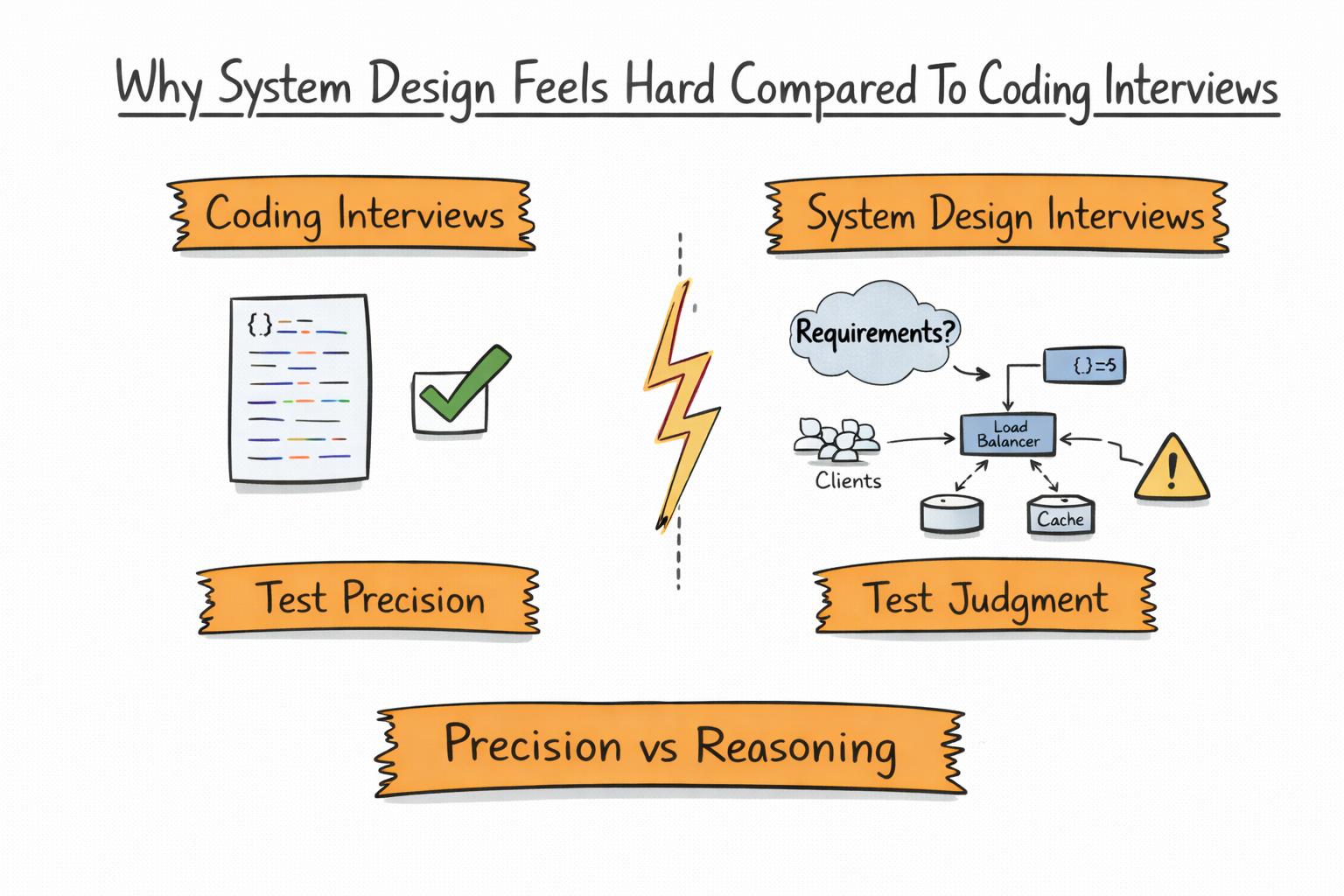
Coding interviews test precision. System Design interviews test judgment.
In coding interviews, you are rewarded for correctness. In System Design interviews, you are rewarded for reasoning. This shift catches many candidates off guard.
You are no longer solving a problem. You are designing a solution space.
System Design also requires verbal clarity. Even a good design can fail if you cannot explain it well. This combination of technical thinking and communication is why System Design feels harder than it actually is.
Is System Design Hard For Beginners?
System Design is hardest at the beginning. This is not because beginners lack intelligence, but because they lack reference points.
Without prior exposure, everything feels new. Load balancers, caching, replication, and queues appear disconnected. Over time, patterns emerge, and the complexity compresses.
The table below shows how perception changes with experience.
| Early Stage | Later Stage |
| Concepts feel disconnected | Patterns feel familiar |
| Unsure where to start | Has a clear starting point |
| Overwhelmed by options | Filters choices quickly |
| Afraid of wrong answers | Comfortable with trade-offs |
System Design is front-loaded with difficulty. Once you cross the initial barrier, progress accelerates.
The Real Reason System Design Feels Overwhelming
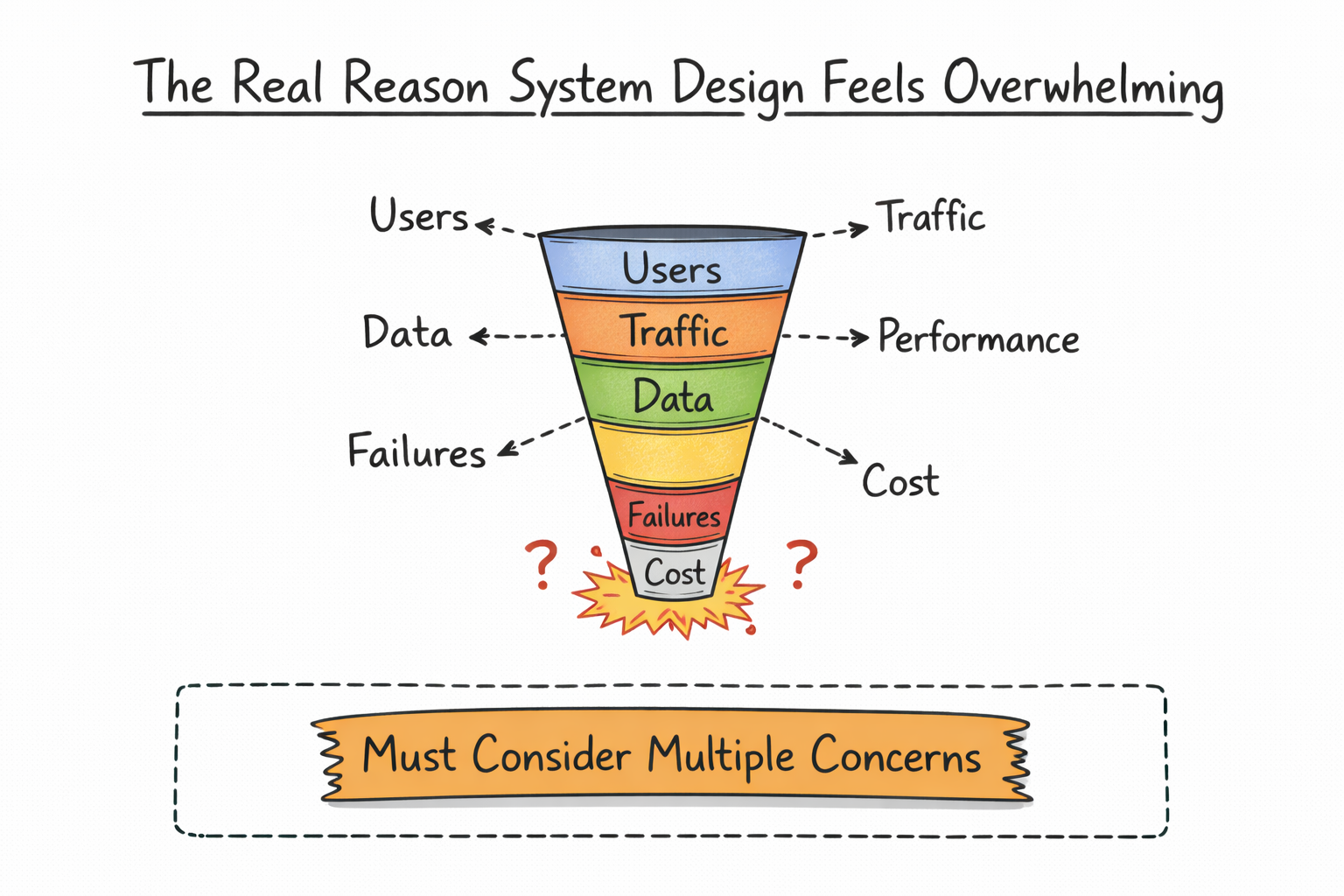
System Design forces you to think in layers. You must consider users, traffic, data, performance, failures, and cost simultaneously.
Most engineering tasks isolate one concern at a time. System Design does not.
This does not mean you must solve everything at once. Strong System Designers sequence their thinking. They start simple, then refine.
Interviewers are evaluating this sequencing skill more than the final architecture.
Is System Design Hard Without Real-World Experience?
This is one of the most common fears. Many candidates believe System Design is impossible without years of production experience.
Real experience helps, but it is not a requirement.
System Design interviews test conceptual understanding and reasoning, not war stories. You are not expected to know every failure mode you have never seen. You are expected to reason about them logically.
What matters is how you think, not what you have personally built.
What Interviewers Are Actually Testing In System Design
System Design interviews are designed to test how you think under uncertainty.
Interviewers observe how you clarify requirements, how you break down complexity, and how you justify decisions. They want to see if you can communicate like an engineer who owns systems, not just code.
The table below summarizes what interviewers listen for.
| Weak Signal | Strong Signal |
| Jumps to tools | Frames the problem first |
| Avoids trade-offs | Acknowledges trade-offs |
| Sounds scripted | Sounds adaptable |
| Defends choices blindly | Explains reasoning calmly |
Understanding this changes how you prepare.
Is System Design Hard Or Just Poorly Taught?
System Design often feels hard because it is taught backwards.
Many resources start with large, complex systems without teaching foundational thinking. This creates the illusion that System Design requires memorizing architectures.
In reality, System Design is about understanding request flow, data flow, and failure modes. Once those foundations are clear, large systems become combinations of smaller ideas.
When taught progressively, System Design becomes approachable.
The Role Of Ambiguity In System Design Difficulty
Ambiguity is not a flaw in System Design interviews. It is the point.
Real engineering problems rarely come with perfect specifications. System Design interviews simulate this reality.
If ambiguity makes you uncomfortable, System Design will feel hard. If you learn to work with ambiguity, System Design becomes engaging.
Interviewers reward candidates who ask clarifying questions and make reasonable assumptions.
How System Design Difficulty Changes Over Time
System Design difficulty decreases non-linearly. The first few weeks feel slow and confusing. Then patterns start to click.
You begin recognizing recurring components. You anticipate bottlenecks. You understand why certain trade-offs appear repeatedly.
The table below illustrates this learning curve.
| Time Invested | Experience |
| First 2 weeks | Confusion and overload |
| 1–2 months | Growing confidence |
| 3+ months | Pattern recognition |
| Ongoing | Refinement and clarity |
This curve explains why many candidates quit too early.
Is System Design Hard In FAANG Interviews?
FAANG interviews raise the bar, but they do not change the fundamentals.
You are still being tested on clarity, trade-offs, and communication. The difference is scale and expectations.
FAANG interviewers expect you to justify decisions under large-scale assumptions. They do not expect perfection.
Candidates who understand fundamentals perform well regardless of the company.
Common Mistakes That Make System Design Feel Harder Than It Is
Many candidates make System Design harder by overthinking early decisions. Others freeze because they fear making the wrong choice.
System Design interviews are forgiving if you explain your thinking. Silence and rigidity are bigger problems than imperfect decisions.
Learning to speak while thinking reduces difficulty dramatically.
How To Make System Design Feel Easier
System Design becomes easier when you adopt a structured approach.
You start by clarifying requirements. You define scale. You design a simple version first. You refine as needed.
This structure turns open-ended questions into manageable steps.
Confidence comes from having a process, not from knowing every answer.
Is System Design Hard To Learn Or Just Hard To Master?
System Design is easy to start and hard to master.
You can learn basic patterns quickly. Mastery takes time and repetition. This is true of any high-level engineering skill.
Interviewers do not expect mastery. They expect competence and clarity.
Recognizing this removes unnecessary pressure.
Final Thoughts: Is System Design Hard?
System Design is not hard because it is complex. It is hard because it demands a different way of thinking.
Once you shift from seeking correctness to explaining reasoning, System Design becomes manageable. Once you accept trade-offs instead of fearing them, confidence grows.
System Design is a skill. Skills feel hard until they feel natural.
And when System Design clicks, it stops being intimidating and starts becoming interesting.