

When candidates struggle in System Design interviews, the issue is rarely a lack of coding ability. More often, it is an incomplete understanding of System Design components and how they fit together to form scalable, reliable systems. Interviewers are not just evaluating whether you can name databases or load balancers. They want to see whether you understand why each component exists, what problems it solves, and how it interacts with the rest of the system.
System Design components form the building blocks of every large-scale application. Whether you are designing a URL shortener, a messaging platform, or a global payment system, the same foundational components appear again and again. What changes is how they are combined, configured, and prioritized based on requirements.
This article breaks down System Design components in a structured, interview-focused way. The goal is not to overwhelm you with tools, but to help you build a mental framework that allows you to reason clearly during System Design interviews.
What Are System Design Components?
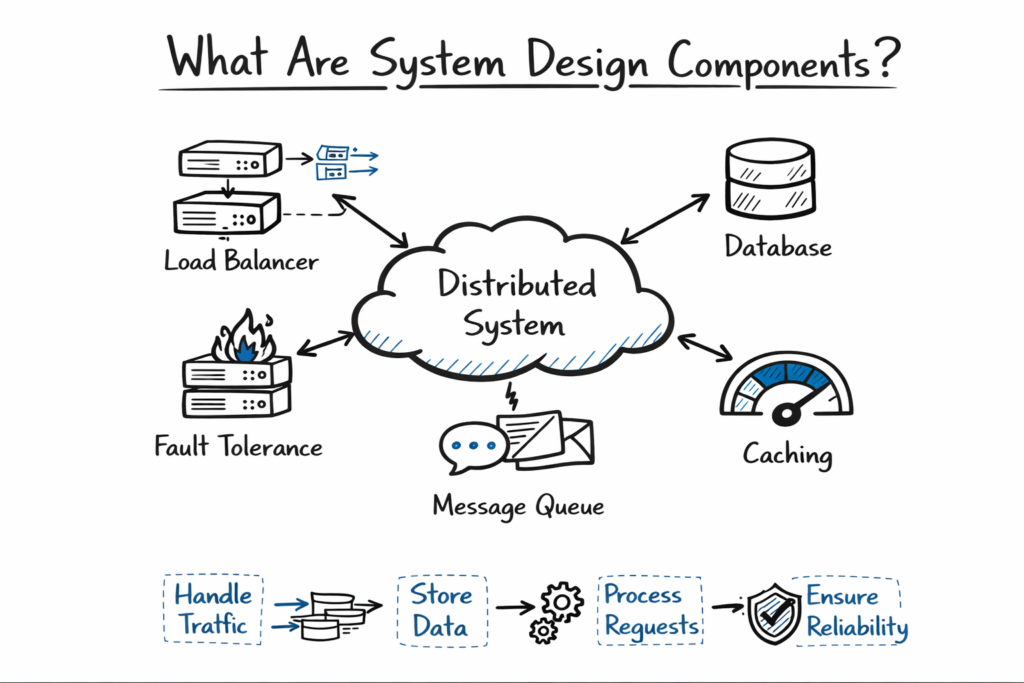
System Design components are the fundamental architectural elements used to build distributed systems. Each component serves a specific purpose, such as handling traffic, storing data, processing requests, or ensuring reliability.
In System Design interview questions, you are rarely asked to list components directly. Instead, you are expected to introduce them naturally as part of your design. Strong candidates demonstrate an understanding of System Design components by explaining why a component is needed, what alternatives exist, and what trade-offs come with each choice.
Clients And Entry Points
Every system begins with a client. Clients are the entry points through which users or other systems interact with your application.
Types Of Clients In Distributed Systems
Clients can take many forms depending on the use case.
| Client Type | Common Examples |
|---|---|
| Web Clients | Browsers, web applications |
| Mobile Clients | iOS and Android apps |
| API Clients | Third-party services, internal microservices |
| Batch Clients | Scheduled jobs, data pipelines |
In interviews, you typically assume multiple types of clients exist. This assumption influences decisions around scalability, authentication, and API design.
Load Balancers As Traffic Distributors
Load balancers are one of the most important System Design components because they sit at the boundary between clients and backend services.
Role Of Load Balancers
A load balancer distributes incoming requests across multiple backend servers to prevent any single server from becoming overwhelmed. It also plays a role in fault tolerance by routing traffic away from unhealthy instances.
In interviews, mentioning load balancers early signals that you are thinking about scalability and availability from the start.
Types Of Load Balancing Strategies
Different strategies impact system behavior in subtle ways.
| Strategy | Behavior |
|---|---|
| Round Robin | Requests distributed evenly |
| Least Connections | Traffic sent to the least busy server |
| Hash-Based | Requests routed based on key |
| Geo-Based | Traffic routed by location |
Explaining why you chose a specific strategy shows depth of understanding.
Application Servers And Business Logic
Application servers are where the core business logic lives. They process requests, apply rules, and coordinate interactions between other components.
Stateless Vs Stateful Application Servers
Modern System Design interviews strongly favor stateless application servers because they scale more easily.
| Server Type | Characteristics |
|---|---|
| Stateless Servers | No session data stored locally |
| Stateful Servers | Session data stored on the server |
Stateless designs allow any server to handle any request, which simplifies scaling and failure recovery.
Databases As Persistent Storage
Databases are among the most heavily discussed System Design components in interviews because data storage choices affect scalability, consistency, and performance.
Relational And Non-Relational Databases
Choosing the right database depends on access patterns and consistency requirements.
| Database Type | Typical Use Cases |
|---|---|
| Relational Databases | Transactions, structured data |
| Key-Value Stores | Caching, fast lookups |
| Document Databases | Semi-structured data |
| Columnar Databases | Analytics workloads |
Interviewers are less interested in brand names and more interested in whether you understand why a certain database type fits the problem.
Caching Layers For Performance
Caching is a critical System Design component for improving latency and reducing load on databases.
Where Caches Fit In The Architecture
Caches typically sit between application servers and databases, though they can also exist at the client or CDN level.
Caching decisions directly affect system performance and cost. In interviews, you should explain what data is cached, how cache invalidation works, and what happens during cache misses.
Message Queues And Asynchronous Processing
Message queues enable asynchronous communication between system components. They are essential for building scalable and resilient systems.
Why Asynchronous Processing Matters
Asynchronous processing allows systems to handle spikes in traffic without overwhelming downstream services. It also improves fault isolation.
In interviews, message queues often appear when discussing background jobs, event processing, or decoupled microservices.
| Component | Responsibility |
|---|---|
| Producer | Sends messages |
| Queue | Buffers messages |
| Consumer | Processes messages |
Explaining this flow clearly demonstrates an understanding of System Design components working together.
Distributed Communication And APIs
APIs define how components communicate in a distributed system.
Synchronous Vs Asynchronous Communication
Different communication models have different trade-offs.
| Communication Type | Trade-Off |
|---|---|
| Synchronous APIs | Simple but blocking |
| Asynchronous APIs | Scalable but complex |
In interviews, strong candidates explain why a particular interaction is synchronous or asynchronous rather than defaulting to one approach.
Data Replication And Sharding
Replication and sharding are essential System Design components for scaling databases and improving reliability.
Replication For Fault Tolerance
Replication involves maintaining multiple copies of data across nodes. This improves availability and fault tolerance.
Sharding For Scalability
Sharding distributes data across multiple databases based on a key.
| Technique | Primary Goal |
|---|---|
| Replication | Reliability |
| Sharding | Scalability |
Discussing how replication and sharding interact shows an advanced understanding of data management in distributed systems.
Consistency Mechanisms And Trade-Offs
Consistency mechanisms ensure that data remains correct across distributed components.
Strong And Eventual Consistency
Consistency choices influence user experience and system complexity.
In interviews, you are expected to justify consistency choices based on business requirements rather than technical preference.
Fault Tolerance And Redundancy Components
Fault tolerance is achieved through redundancy, retries, and failover mechanisms.
Designing For Failure
Distributed systems assume components will fail. System Design components such as health checks, circuit breakers, and redundant instances help systems recover gracefully.
Interviewers often test this by asking what happens when a component fails.
Monitoring, Logging, And Observability
Observability components help engineers understand system behavior in production.
Why Observability Is Essential
Without observability, diagnosing issues in distributed systems becomes nearly impossible. Logs, metrics, and traces provide visibility into performance and failures.
Mentioning observability in interviews shows that you think beyond initial deployment.
Security As A Cross-Cutting Component
Security is not a standalone System Design component but a concern that spans the entire architecture.
Authentication And Authorization
Security components ensure that only authorized users and services can access system resources.
In interviews, even a brief acknowledgment of security considerations can set your answer apart.
How Interviewers Evaluate Your Understanding Of System Design Components
Interviewers do not expect you to include every possible component. Instead, they evaluate whether the components you choose make sense for the problem and whether you can explain the reasoning behind them.
They look for clear articulation of trade-offs, awareness of failure scenarios, and an ability to adapt the design as requirements change.
Mapping System Design Components To Interview Questions
Understanding how components map to common interview problems improves clarity.
| Interview Problem | Key Components |
|---|---|
| URL Shortener | Load balancer, database, cache |
| Messaging System | Message queue, consumers, storage |
| File Storage System | Object storage, metadata database |
| Analytics Platform | Data pipeline, batch processing |
This mapping helps you structure answers quickly under time pressure.
Conclusion
Mastering System Design components is about learning how to think in abstractions rather than memorizing technologies. During System Design interviews, interviewers care far more about your reasoning than the specific tools you name.
When you understand why each component exists and how it interacts with others, you can design almost any system with confidence. Over time, these components become mental building blocks that you assemble instinctively.
As you continue your preparation, focus on explaining System Design components clearly, justifying your decisions, and reasoning through trade-offs. That approach will consistently lead to stronger, more interview-ready System Design answers.