

Expert systems may sound like a legacy topic in the age of machine learning and large language models, but they continue to play an important role in System Design interviews. Interviewers use expert systems to test a candidate’s understanding of rule-based decision-making, knowledge representation, and reasoning under constraints.
The components of an expert system form a classic example of how complex decision logic can be modeled, structured, and scaled. Understanding these components helps you reason about explainability, deterministic behavior, and domain-driven System Design, all of which remain relevant in modern systems.
In System Design interviews, you are not expected to build an expert system from scratch. Instead, interviewers want to see whether you understand how expert systems are structured, what problems they solve well, and how their components interact to produce reliable decisions.
This article breaks down the components of an expert system in a clear, interview-ready way, focusing on architecture, responsibilities, and trade-offs rather than historical theory.
What Is An Expert System?
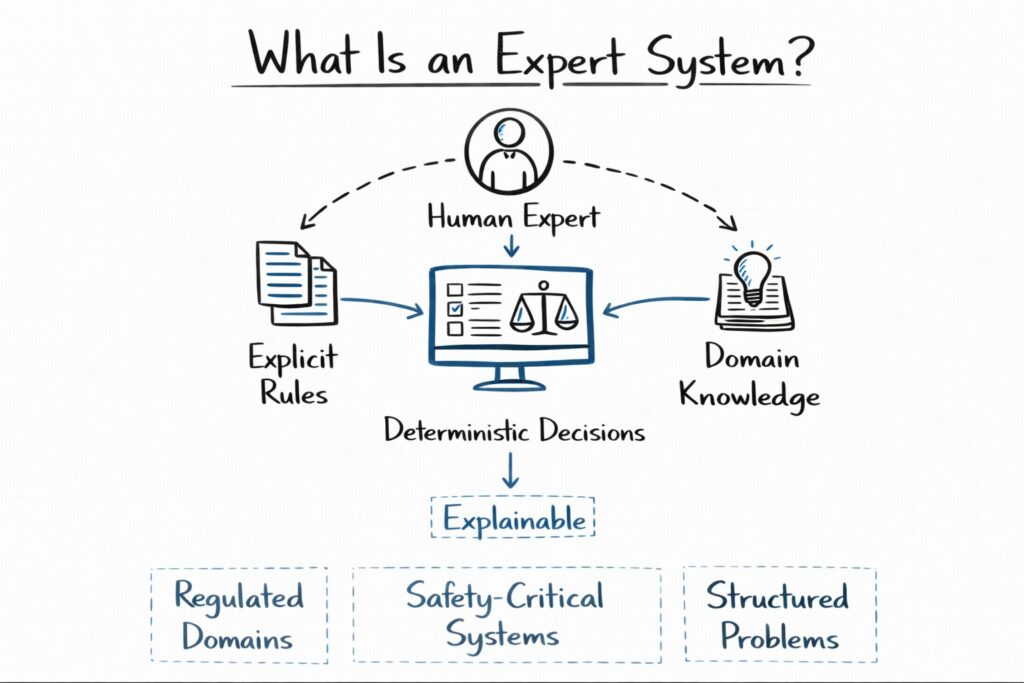
An expert system is a computer-based System Designed to emulate the decision-making ability of a human expert in a specific domain. It uses a predefined set of rules and domain knowledge to reason about problems and provide conclusions or recommendations.
Unlike machine learning systems that rely on probabilistic models, expert systems are typically deterministic. Their decisions are explainable because they follow explicit rules. This makes expert systems especially useful in regulated, safety-critical, or highly structured domains.
Understanding this distinction is important in System Design interviews, as it helps frame why expert systems still exist alongside modern AI approaches.
High-Level Architecture Of An Expert System
At a high level, an expert system consists of several core components that work together to simulate expert reasoning.
| Component Category | Primary Responsibility |
|---|---|
| Knowledge Storage | Domain expertise representation |
| Reasoning Engine | Decision-making logic |
| Interaction Layer | Communication with users |
| Control Components | Explanation and learning support |
Interviewers often expect you to describe this architecture verbally before diving into individual components.
Knowledge Base: The Foundation Of An Expert System
The knowledge base is the most critical component of an expert system. It stores domain-specific knowledge that the system uses to make decisions.
Nature Of Knowledge Stored
The knowledge base typically contains facts, rules, and relationships relevant to a specific problem domain. These rules are usually derived from human experts and encoded explicitly.
In interviews, it is important to emphasize that the quality of an expert system depends heavily on the accuracy and completeness of its knowledge base. A flawed knowledge base leads to flawed decisions, regardless of how strong the reasoning engine is.
Static And Dynamic Knowledge
Some expert systems rely on static knowledge that changes infrequently, while others incorporate dynamic data that evolves over time.
| Knowledge Type | Characteristics |
|---|---|
| Static Knowledge | Stable rules and facts |
| Dynamic Knowledge | Contextual or runtime data |
Explaining this distinction shows awareness of how expert systems adapt to real-world inputs.
Inference Engine: The Reasoning Core
The inference engine is the component that applies logic to the knowledge base in order to derive conclusions. It is often described as the brain of the expert system.
How The Inference Engine Works
The inference engine evaluates rules, matches conditions, and executes actions based on the available data. It determines which rules apply and in what order they should be executed.
In System Design interviews, you are not expected to implement inference algorithms, but you should understand their role in orchestrating reasoning.
Forward And Backward Reasoning
Expert systems commonly use two reasoning strategies.
| Reasoning Strategy | Description |
|---|---|
| Forward Chaining | Starts from known facts and derives conclusions |
| Backward Chaining | Starts from a goal and works backward |
Mentioning these strategies demonstrates a strong conceptual grasp without requiring excessive detail.
Working Memory: Managing Current State
Working memory stores temporary data and intermediate results generated during reasoning. It represents the current state of the problem being solved.
This component allows the expert system to separate long-term knowledge from short-term context. As new facts are introduced or rules are applied, working memory is updated accordingly.
In interviews, working memory is often overlooked, but mentioning it shows a deeper understanding of how expert systems manage state.
User Interface: Interaction With The System
The user interface enables communication between the expert system and its users. It collects input data and presents conclusions, recommendations, or explanations.
Importance Of Explainability
One of the key advantages of expert systems is explainability. Users often want to know why a particular decision was made.
In System Design interviews, highlighting explainability as a feature of expert systems demonstrates awareness of user trust and regulatory requirements.
Explanation Facility: Building Trust In Decisions
The explanation facility is a specialized component that allows the expert system to justify its conclusions. It can explain which rules were applied and how the final decision was reached.
This component is especially important in domains like healthcare, finance, or law, where decisions must be auditable and defensible.
Interviewers often use this component to contrast expert systems with black-box machine learning models.
| Feature | Expert System Capability |
|---|---|
| Decision Transparency | High |
| Rule Traceability | Explicit |
| Debugging Support | Strong |
Knowledge Acquisition Component: Updating The System
The knowledge acquisition component supports the process of adding, updating, or refining knowledge in the system. This often involves tools that help domain experts encode rules without deep technical expertise.
In System Design interviews, this component highlights one of the biggest challenges of expert systems: maintaining and scaling knowledge over time.
Discussing this challenge shows that you understand not only how expert systems work, but also their operational limitations.
Learning Component: Optional But Valuable
Some expert systems include a learning component that allows them to improve over time. This learning is typically limited compared to modern machine learning systems, but it can help refine rules or suggest updates.
While not mandatory, mentioning learning capabilities demonstrates awareness of hybrid systems that combine rule-based and data-driven approaches.
Control Mechanism: Orchestrating The System
The control mechanism coordinates interactions between components. It manages the flow of data, triggers inference cycles, and ensures that conclusions are produced in a controlled manner.
In System Design interviews, this component is useful for explaining how complex systems maintain order and predictability.
How Components Of An Expert System Work Together
Understanding individual components is important, but interviewers care more about how these components interact.
| Interaction Flow | Description |
|---|---|
| User Input | Data enters through interface |
| Knowledge Access | Rules retrieved from knowledge base |
| Reasoning | Inference engine applies logic |
| State Update | Working memory updated |
| Output | Decision and explanation returned |
Describing this flow clearly is often enough to satisfy interview expectations.
Strengths Of Expert System Architecture
Expert systems excel in environments where decisions must be explainable, consistent, and based on well-defined rules. Their components are designed to support transparency and control.
In interviews, you can position expert systems as ideal for deterministic domains with stable knowledge and clear decision criteria.
Limitations And Trade-Offs Of Expert System Components
Expert systems struggle when knowledge becomes too complex or changes frequently. Maintaining a large knowledge base is time-consuming and error-prone.
Discussing these trade-offs shows balanced thinking, which interviewers value highly.
Expert Systems Vs Modern AI In System Design Interviews
Interviewers sometimes ask candidates to compare expert systems with machine learning systems. The components of an expert system help frame this comparison.
| Dimension | Expert System | Machine Learning |
|---|---|---|
| Explainability | High | Often limited |
| Adaptability | Manual updates | Automatic learning |
| Determinism | Strong | Probabilistic |
| Maintenance | Knowledge-heavy | Data-heavy |
Understanding this contrast strengthens your System Design answers.
Common Interview Questions Related To Expert Systems
Interviewers may ask how you would design a decision engine, rule-based workflow, or compliance system. Recognizing when an expert system fits these problems is key.
Rather than proposing machine learning by default, explaining how expert system components address the problem shows thoughtful design.
How Interviewers Evaluate Expert System Knowledge
Interviewers evaluate whether you understand why each component exists, how they interact, and what trade-offs they introduce.
They are less concerned with terminology and more interested in clarity of reasoning.
Preparing For Expert System Questions In System Design Interviews
Preparation involves understanding classic architectures and practicing clear explanations. Focus on explaining components in simple terms and connecting them to real-world use cases.
You do not need deep AI knowledge, but you should demonstrate architectural awareness.
Conclusion
The components of an expert system represent one of the clearest examples of structured, rule-based System Design. They highlight the importance of knowledge representation, explainability, and controlled reasoning.
In System Design interviews, understanding expert systems helps you articulate deterministic decision-making approaches and compare them thoughtfully with modern AI systems.
By mastering these components, you add another powerful tool to your System Design toolkit and demonstrate breadth, depth, and architectural maturity.