

If you are interviewing for a Technical Program Manager role at Google, one topic almost always creates uncertainty: Google TPM System Design questions. Unlike software engineering interviews, TPM interviews do not test your ability to write production code. At the same time, they are far more technical than traditional program management interviews.
This creates a unique challenge. You are expected to demonstrate strong System Design understanding without acting like a software architect or a coder. Google wants to see how you think, how you structure complex technical conversations, and how well you can guide cross-functional teams through system-level decisions.
This guide walks you through what Google TPM System Design questions actually look like, how they differ from SWE System Design interviews, what Google evaluates in your answers, and how you should prepare with the right depth and mindset.
Why System Design Matters In Google TPM Interviews
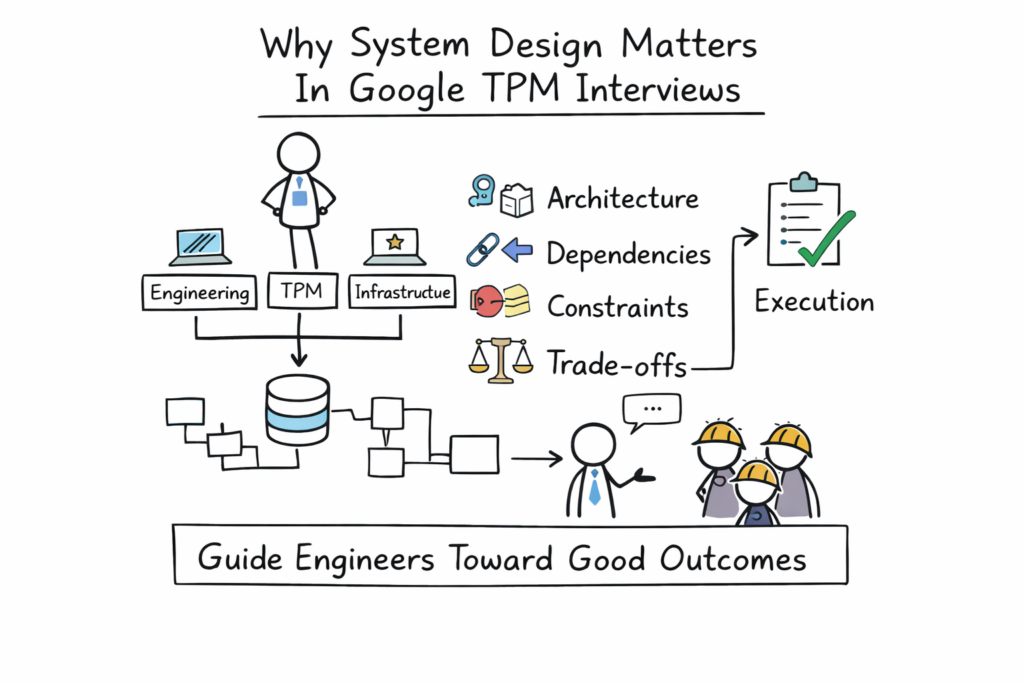
At Google, TPMs operate at the intersection of engineering, product, infrastructure, and execution. You are responsible for driving large, technically complex initiatives forward, often across multiple teams. That responsibility makes System Design knowledge non-negotiable.
Google uses System Design questions to evaluate whether you understand how large systems are built, scaled, and evolved over time. They want to see whether you can reason about architecture, dependencies, constraints, and trade-offs well enough to guide engineers toward good outcomes.
You are not being evaluated on whether you can design the system yourself. You are being evaluated on whether you can lead the design conversation.
What Google TPM System Design Questions Are Really Testing
Google TPM System Design questions are not about low-level implementation details. Instead, they focus on how you think at a system level and how you communicate technical complexity.
Google interviewers are typically looking for three core signals. They want to see technical fluency, structured thinking, and leadership-oriented decision-making. Your answers should reflect that you understand the system well enough to ask the right questions, identify risks, and align stakeholders.
The emphasis is on clarity, prioritization, and trade-offs rather than on drawing perfect architecture diagrams.
How Google TPM System Design Differs From SWE System Design
One of the most common mistakes TPM candidates make is preparing for System Design the same way software engineers do. While there is overlap, the evaluation criteria are fundamentally different.
The table below highlights the key differences.
| Dimension | TPM System Design | SWE System Design |
|---|---|---|
| Focus | Decision-making and coordination | Architecture and implementation |
| Depth | High-level with selective deep dives | Deep technical detail |
| Coding | None | Often expected |
| Ownership | Cross-team execution | Technical correctness |
| Evaluation | Trade-offs and communication | Scalability and correctness |
As a TPM, you should demonstrate that you understand the system well enough to guide engineers, not replace them.
Common Google TPM System Design Question Themes
Google TPM System Design questions often revolve around real-world, ambiguous problems. These questions are intentionally open-ended to simulate the kinds of challenges you would face on the job.
You may be asked to design a large-scale internal tool, a user-facing feature, or a platform used by multiple teams. In many cases, the interviewer will ask how you would approach designing or launching a system rather than asking you to design it end-to-end.
These questions are designed to reveal how you reason under uncertainty, how you define success, and how you balance technical constraints with execution realities.
Example Google TPM System Design Questions
To ground this discussion, here are examples of realistic Google TPM System Design questions.
You might be asked how you would design a system to support real-time collaboration across Google Docs. Another common prompt is how you would design a notification system used by multiple products. You may also be asked how you would approach migrating a large legacy system to a new architecture.
In each case, the interviewer is less interested in the final design and more interested in how you structure the conversation and guide decision-making.
How To Structure Your Answer To Google TPM System Design Questions
Strong TPM candidates approach System Design questions methodically. You should begin by clarifying the problem and defining the goals of the system. This shows that you do not jump to solutions without understanding the context.
Next, you should identify key constraints and stakeholders. This includes technical limitations, user needs, reliability requirements, and organizational dependencies. By doing this early, you demonstrate program-level thinking.
Once the foundation is clear, you can walk through a high-level System Design and explain the major components, data flows, and integration points. At this stage, it is important to explain why certain decisions are made rather than just what those decisions are.
How Deep Should You Go In Technical Details?
Depth is one of the hardest aspects of Google TPM System Design questions. Going too shallow can make you seem non-technical. Going too deep can make you seem misaligned with the role.
The right balance is to demonstrate technical fluency without diving into implementation details unless prompted. You should be comfortable discussing APIs, data storage choices, scalability concerns, and reliability strategies at a conceptual level.
If the interviewer pushes you into a deeper technical area, treat it as a collaborative discussion rather than a test. This often signals that they are exploring your technical ceiling rather than expecting a specific answer.
Key Evaluation Areas In Google TPM System Design
Google evaluates TPM System Design answers across multiple dimensions. Technical understanding is only one part of the picture.
The table below summarizes what interviewers typically assess.
| Evaluation Area | What Google Looks For |
|---|---|
| Technical Fluency | Ability to reason about systems |
| Structure | Clear, logical approach |
| Trade-offs | Awareness of constraints and risks |
| Communication | Clear and concise explanations |
| Leadership | Ownership and decision-making |
A strong answer does not need to be perfect in every area, but it should be solid across most of them.
How Execution And Program Thinking Show Up In Design Questions
Unlike SWE interviews, Google TPM System Design questions often blend architecture with execution. You may be asked how you would roll out a system incrementally, manage dependencies, or mitigate risks during launch.
This is where TPMs can truly stand out. Talking about phased rollouts, stakeholder alignment, metrics, and rollback strategies shows that you think beyond design and into delivery.
Execution-oriented thinking signals that you understand how systems succeed or fail in real organizations, not just on whiteboards.
Common Mistakes TPM Candidates Make In System Design Interviews
One common mistake is treating System Design as a purely technical exercise. This often leads to answers that ignore execution risks, organizational constraints, or user impact.
Another frequent issue is failing to clarify assumptions. Jumping straight into architecture without aligning on goals can derail the conversation.
Some candidates also struggle with communication, either by overloading the interviewer with details or by being too vague. Finding the middle ground is key.
How To Prepare Effectively For Google TPM System Design Questions
Preparation for Google TPM System Design questions should focus on real-world systems rather than academic theory. Studying how large platforms evolve, scale, and fail can be incredibly valuable.
Practice explaining systems verbally, focusing on clarity and structure. Mock interviews can help you get comfortable navigating open-ended discussions.
Most importantly, practice thinking like a TPM. When reviewing a System Design, ask yourself how you would align teams, manage risk, and measure success.
How Google TPM System Design Influences Hiring Decisions
System Design performance plays a significant role in Google TPM hiring decisions. Strong System Design answers can elevate an otherwise average interview loop by demonstrating technical leadership and maturity.
On the other hand, weak System Design signals can raise concerns about your ability to operate effectively in a highly technical environment. Google wants TPMs who can earn engineers’ trust, and System Design discussions are one way they assess that trust.
Final Thoughts
Google TPM System Design questions are not about proving that you are the smartest engineer in the room. They are about proving that you can guide complex technical initiatives with clarity, confidence, and sound judgment.
If you approach these questions with a structured mindset, focus on trade-offs and execution, and communicate clearly, you will align well with Google’s expectations. With the right preparation, System Design becomes an opportunity to showcase your strengths rather than a source of anxiety.