
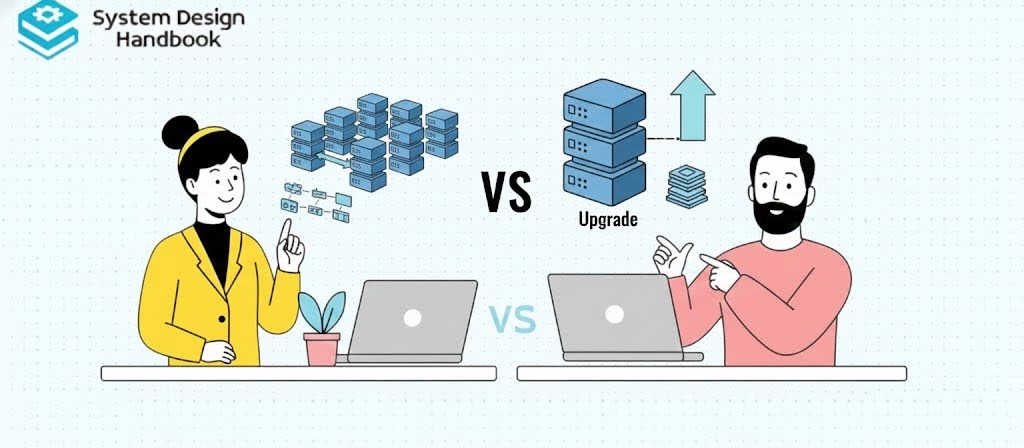
Scaling questions appear in almost every System Design interview, and yet they are often underestimated. You might think scaling is just about “adding more servers” or “upgrading machines,” but interviewers are looking for something deeper.
When you discuss horizontal scaling vs vertical scaling in System Design, you are really being tested on how you think about growth, limits, failure, and trade-offs. Interviewers want to see whether you understand how systems evolve over time, not just how they work on day one.
Scaling is an essential System Design concept and exposes whether you design defensively. Systems that work perfectly at a small scale often fail dramatically under real-world load. Knowing how and when to scale is what separates theoretical designs from practical ones.
What Scaling Means In System Design
Before comparing horizontal scaling vs vertical scaling, it is important to align on what scaling actually means in System Design.
Scaling is the ability of a system to handle increased load without degrading performance beyond acceptable limits. Load can mean more users, more requests per second, more data, or stricter latency requirements.
Scaling is not a single decision. It is a strategy that evolves as the system grows. Interviewers expect you to understand both early-stage scaling decisions and long-term scaling constraints.
Vertical Scaling Explained In System Design
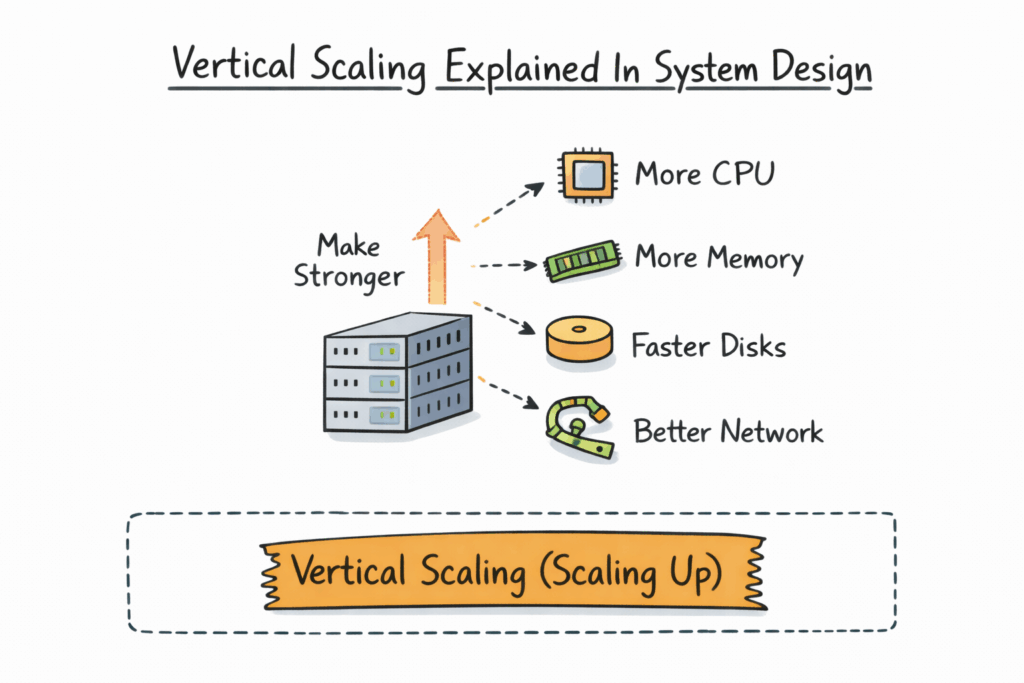
Vertical scaling means increasing the capacity of a single machine. You add more CPU, more memory, faster disks, or better network bandwidth to the same server.
In System Design interviews, vertical scaling is a key System Design principle and often described as “scaling up.” It is the most intuitive form of scaling because it mirrors how humans think about performance. If something is slow, make it stronger.
This approach works well in the early stages of a system’s life.
Why Vertical Scaling Feels Simple At First
Vertical scaling requires minimal architectural changes. You do not need to redesign request routing, data partitioning, or coordination mechanisms. The application logic often stays the same.
For small teams or early prototypes, this simplicity is a major advantage. You can delay complex distributed systems problems and focus on shipping features.
This is why many systems start with vertical scaling, even if they eventually move away from it.
The Practical Limits Of Vertical Scaling
Vertical scaling has a hard ceiling. Hardware improvements are finite, expensive, and eventually unavailable. There is always a maximum machine size.
Vertical scaling also introduces a single point of failure. When that machine goes down, the entire system goes down with it.
Interviewers expect you to recognize that vertical scaling is a short-term solution, not a long-term growth strategy.
Horizontal Scaling Explained In System Design
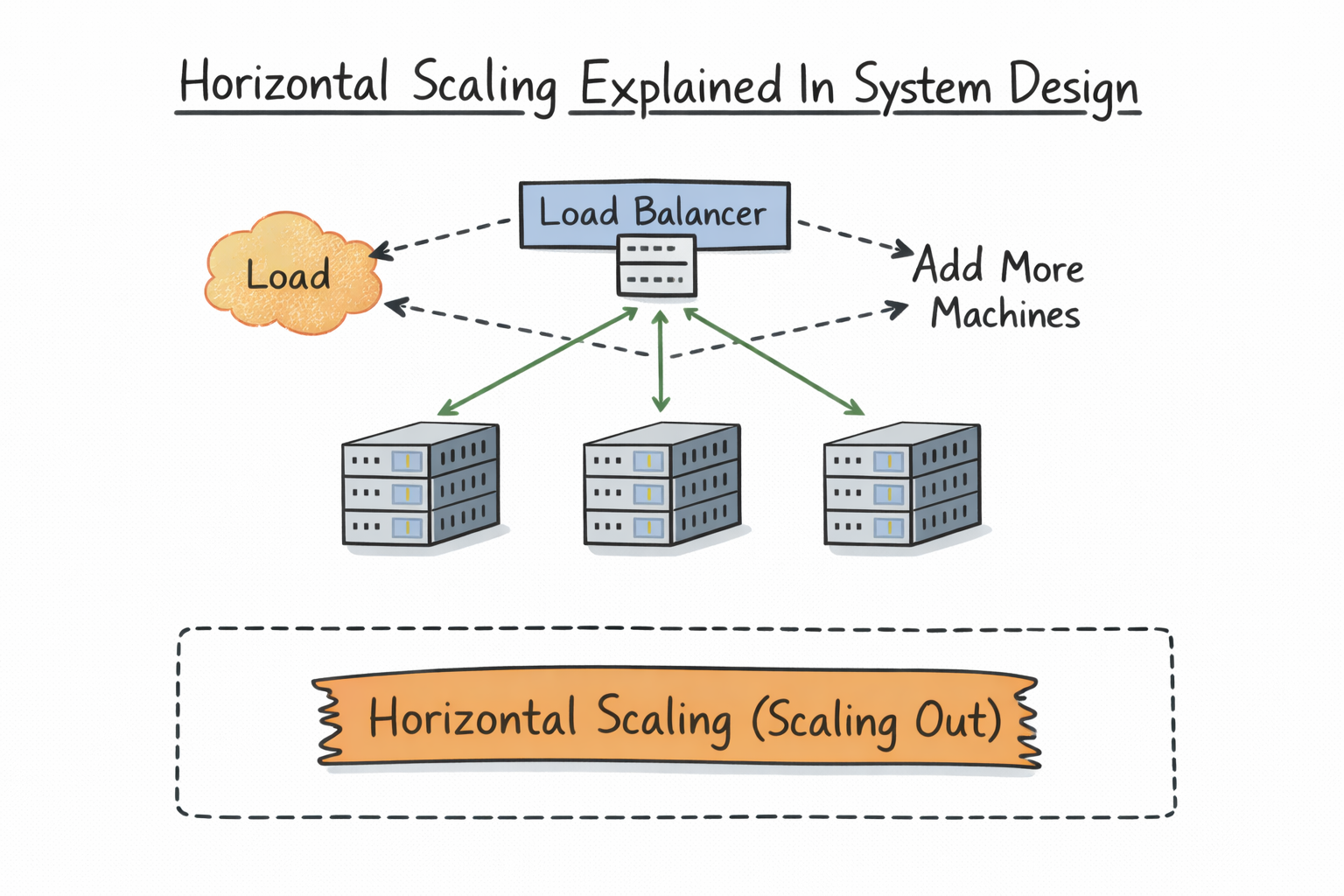
Horizontal scaling means adding more machines to distribute the load. Instead of making one server bigger, you make many servers work together.
In System Design interviews, horizontal scaling is often called “scaling out.” This approach aligns better with distributed system principles and cloud-native architectures.
Horizontal scaling is the foundation of most large-scale systems.
Why Horizontal Scaling Is Architecturally Powerful
Horizontal scaling allows systems to grow incrementally. You can add capacity gradually instead of making large, expensive upgrades.
It also improves fault tolerance. If one node fails, others can continue serving traffic. This property is essential for high-availability systems.
However, horizontal scaling introduces complexity. You now need to think about load balancing, data consistency, coordination, and failure handling.
The Mental Shift Horizontal Scaling Requires
With horizontal scaling, you stop thinking in terms of a single machine. You start thinking in terms of fleets, replicas, and partitions.
Interviewers pay close attention to whether you understand this shift. Using horizontal scaling correctly requires you to reason about distributed systems, not just performance.
Horizontal Scaling Vs Vertical Scaling At A High Level
The table below summarizes the core differences between horizontal scaling vs vertical scaling in System Design.
| Aspect | Vertical Scaling | Horizontal Scaling |
| Core Idea | Make one machine stronger | Add more machines |
| Architectural Change | Minimal | Significant |
| Fault Tolerance | Low | High |
| Scaling Limit | Hard hardware limit | Practically unbounded |
| Complexity | Low | High |
This comparison sets the foundation for deeper trade-off discussions in interviews.
How Interviewers Expect You To Compare Horizontal Scaling Vs Vertical Scaling
Interviewers are not looking for a “better” option. They are looking for judgment.
They want to see whether you can explain when vertical scaling is sufficient and when horizontal scaling becomes necessary. They also want to see whether you understand the cost of each approach.
The strongest answers explain both options, then justify a choice based on system requirements.
Performance Characteristics And Bottlenecks
Vertical Scaling And Performance
Vertical scaling improves performance by increasing available resources. Latency often improves because everything runs locally without network hops.
However, contention grows as the load increases. CPU scheduling, memory contention, and IO bottlenecks eventually dominate.
Performance improvements flatten quickly as the system approaches hardware limits.
Horizontal Scaling And Performance
Horizontal scaling improves throughput more than latency. You can handle more requests by spreading them across machines.
Latency may increase slightly due to network communication, but overall system capacity grows far beyond what vertical scaling allows.
This trade-off is critical in interviews. Interviewers expect you to differentiate between throughput scaling and latency optimization.
Reliability And Fault Tolerance Considerations
The table below highlights how horizontal scaling vs vertical scaling differ in reliability.
| Scenario | Vertical Scaling Behavior | Horizontal Scaling Behavior |
| Single Node Failure | Entire system goes down | Traffic rerouted to healthy nodes |
| Maintenance | Requires downtime | Rolling updates possible |
| Disaster Recovery | Complex and risky | Easier replication across zones |
In interviews, tying scaling choices to reliability signals maturity as a System Designer.
Cost And Operational Trade-Offs
Cost Profile Of Vertical Scaling
Vertical scaling often starts cheaply and becomes expensive quickly. High-end machines have steep pricing curves.
There is also a risk of over-provisioning. You might pay for capacity you rarely use.
Cost Profile Of Horizontal Scaling
Horizontal scaling allows finer-grained cost control. You add capacity incrementally as demand grows.
However, operational costs increase. Monitoring, orchestration, and debugging distributed systems require more effort.
Interviewers often probe whether you understand that horizontal scaling trades hardware cost for operational complexity.
Data Management Implications
Vertical Scaling And Data
With vertical scaling, data often lives on a single node. This simplifies transactions, indexing, and consistency.
However, data size eventually exceeds what one machine can handle.
Horizontal Scaling And Data
Horizontal scaling forces you to confront data distribution. Sharding, replication, and consistency models become unavoidable.
This is where many candidates struggle. Interviewers expect you to acknowledge that horizontal scaling is not just about adding servers. It fundamentally changes how data is managed.
Common Interview Scenarios And Expected Choices
The table below maps typical interview systems to scaling strategies.
| System | Typical Scaling Choice | Why |
| Early Startup MVP | Vertical Scaling | Simplicity and speed |
| Internal Tool | Vertical Scaling | Limited load |
| Social Media Feed | Horizontal Scaling | High traffic and availability |
| E-Commerce Platform | Horizontal Scaling | Burst traffic and fault tolerance |
| Financial Ledger | Hybrid Approach | Consistency with controlled scaling |
This table helps you justify decisions without sounding dogmatic.
Hybrid Scaling In Real Systems
Most real systems use a combination of horizontal scaling vs vertical scaling.
You might vertically scale database instances until they reach practical limits, then introduce sharding. You might horizontally scale stateless services while vertically scaling stateful ones.
Interviewers love candidates who acknowledge this nuance. It shows real-world thinking instead of textbook answers.
How To Explain Your Scaling Choice In Interviews
A strong explanation follows a simple structure. You describe current load, projected growth, and failure tolerance. You explain why vertical scaling works initially or why horizontal scaling is required.
You acknowledge trade-offs and limitations. You explain how the system can evolve.
This approach makes your answer sound grounded and adaptable.
Common Mistakes When Discussing Scaling
Many candidates assume horizontal scaling is always better. Others dismiss vertical scaling as naive.
Both extremes are red flags.
Interviewers want balanced reasoning. Vertical scaling is a valid strategy at the right time. Horizontal scaling is powerful but costly.
Understanding when to use each is the real skill being tested.
Final Thoughts On Horizontal Scaling Vs Vertical Scaling
Horizontal scaling vs vertical scaling in System Design is not a binary choice. It is a progression.
Most systems start small, scale vertically, then transition to horizontal scaling as growth demands it. The best designs anticipate this evolution without over-engineering early.
If you can explain not just how a system scales, but why it scales that way over time, you demonstrate exactly what System Design interviews are meant to assess.
Scaling is not about size. It is about foresight.