

Distributed systems are fundamentally about coordination between independent nodes that do not share memory and cannot rely on perfect communication. One of the earliest and most conceptually clean approaches to coordination is the ring algorithm in distributed systems design.
While modern systems often use more sophisticated coordination mechanisms, the ring algorithm remains highly relevant in System Design interviews. Interviewers use it to evaluate how well candidates understand leader election, fault tolerance, message passing, and the trade-offs of simple distributed coordination models.
This blog explains the ring algorithm from an interview-preparation perspective. The goal is not only to understand how the algorithm works, but also why it exists, where it fits, and how to reason about its strengths and limitations under real-world conditions.
What Is The Ring Algorithm In Distributed Systems
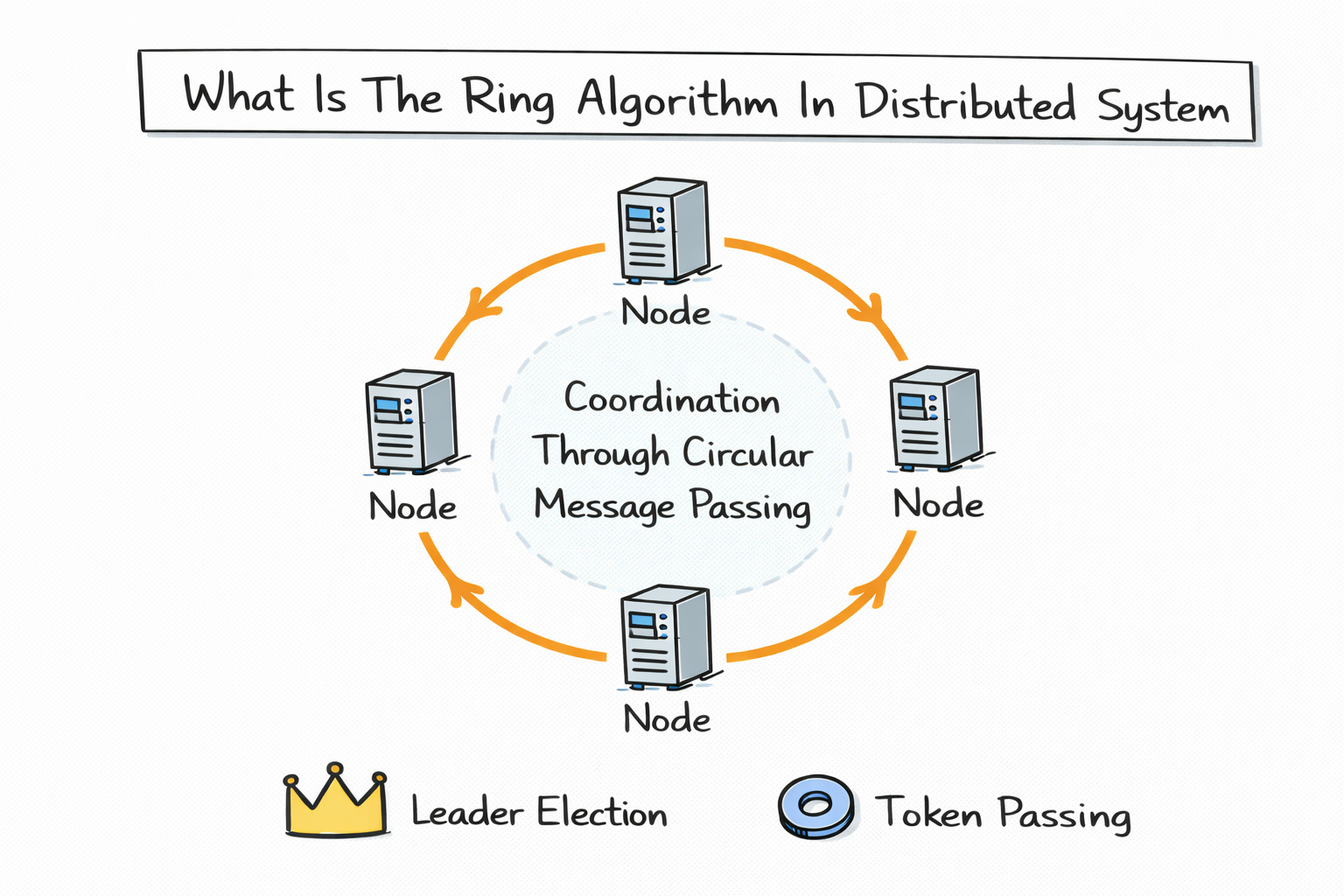
The ring algorithm in distributed systems design is a coordination technique in which nodes are logically arranged in a ring. Each node knows only its immediate neighbor or neighbors and communicates by passing messages around the ring.
There is no centralized controller. All coordination happens through message passing in a circular order. This structure makes the algorithm simple to reason about and easy to implement in environments where nodes can be ordered logically.
From an interview standpoint, the ring algorithm is most commonly discussed in the context of leader election, although the same structural idea appears in token passing and mutual exclusion mechanisms.
Why The Ring Algorithm Exists
The ring algorithm exists to solve a fundamental problem in distributed System Design: how to coordinate without shared state or centralized control.
In early distributed environments, simplicity and predictability were more important than raw performance. The ring structure provides deterministic behavior. Messages follow a known path, and responsibilities such as leadership can be agreed upon without complex consensus protocols.
Interviewers like the ring algorithm because it highlights core distributed systems principles such as no shared global state, decentralized coordination, and deterministic message flow.
Logical Ring Versus Physical Topology
One important clarification in interviews is that the ring in the ring algorithm is logical, not necessarily physical. Nodes do not need to be physically connected in a circle.
The logical ring defines the order in which messages are passed. The physical network may be fully connected, partially connected, or cloud-based. This distinction matters because candidates sometimes incorrectly assume physical adjacency.
Understanding this separation helps you explain how the ring algorithm can be implemented over arbitrary network topologies.
Ring Algorithm For Leader Election
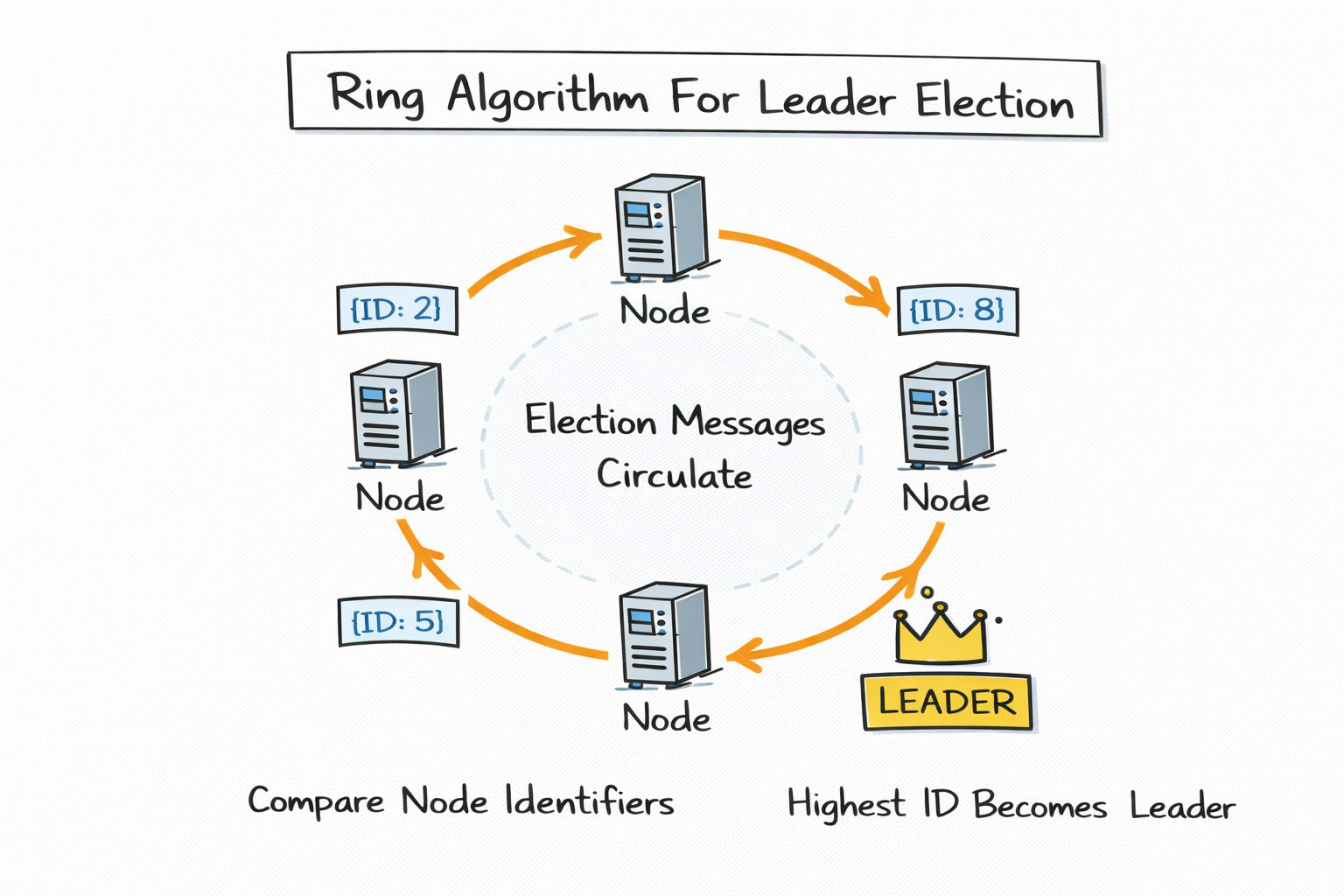
The most common use of the ring algorithm in distributed systems discussions is leader election.
The Core Idea Of Leader Election
Leader election is the process by which nodes agree on a single node to act as the coordinator or leader. The leader may handle tasks such as coordinating writes, managing configuration changes, or acting as a point of serialization.
In the ring algorithm, leader election is achieved by passing election messages around the ring and comparing node identifiers.
Identifier-Based Election
Each node has a unique identifier. When an election starts, a node sends its identifier to its neighbor. As messages circulate, nodes compare identifiers and forward the highest one they have seen.
Eventually, the highest identifier completes a full round of the ring and is declared the leader.
From an interview perspective, this process demonstrates decentralized decision-making and deterministic resolution.
Message Flow And Determinism
One of the defining characteristics of the ring algorithm is deterministic message flow.
Messages move in one direction around the ring, and each node performs a simple, local operation before forwarding the message. There is no need for global knowledge or complex coordination.
Interviewers often appreciate candidates who emphasize determinism, because it contrasts with more probabilistic or failure-prone approaches.
Handling Failures In The Ring Algorithm
Failures introduce complexity into any distributed algorithm, and the ring algorithm is no exception.
Node Failure Scenarios
If a node in the ring fails, message passing may be disrupted. The system must detect the failure and reconfigure the ring to bypass the failed node.
In interviews, candidates are often asked how the ring algorithm handles failures and whether it is resilient under partial failure conditions.
Failure Detection And Recovery
The ring algorithm typically relies on timeouts or heartbeat mechanisms to detect failures. Once a failure is detected, neighboring nodes adjust their pointers to restore the ring.
This recovery process adds overhead and complexity, which is one of the algorithm’s key trade-offs.
Performance Characteristics Of The Ring Algorithm
Understanding performance is essential in System Design interviews.
The ring algorithm has predictable but sometimes inefficient performance characteristics. Leader election requires messages to traverse the entire ring, which can be slow in large systems.
The table below summarizes the performance properties of the ring algorithm.
| Aspect | Behavior In Ring Algorithm | Interview Implication |
| Message Complexity | Linear with the number of nodes | Poor scalability |
| Latency | Increases with ring size | Slow leader election |
| Determinism | Fully deterministic | Easy to reason about |
Ring Algorithm Versus Centralized Coordination
Interviewers often compare the ring algorithm with centralized approaches to coordination.
Centralized systems are simpler initially but introduce single points of failure. The ring algorithm avoids centralization but pays the price in communication overhead and failure handling complexity.
Being able to articulate this comparison demonstrates strong trade-off reasoning.
The table below highlights this contrast.
| Property | Ring Algorithm | Centralized Coordinator |
| Single Point Of Failure | No | Yes |
| Message Overhead | High | Low |
| Failure Handling | Distributed | Centralized |
| Scalability | Limited | Moderate |
Token Passing And Mutual Exclusion
Beyond leader election, the ring algorithm concept appears in token passing systems.
In token-based systems, a token circulates around the ring, and only the node holding the token may perform a critical operation. This ensures mutual exclusion without shared memory.
Interviewers may ask about this variant to test understanding of coordination beyond leadership.
Strengths Of The Ring Algorithm
The ring algorithm has several strengths that make it attractive in certain contexts.
It is simple to understand and implement. Its behavior is predictable and deterministic. It avoids centralized control and aligns well with the principle of decentralization.
In interviews, these strengths are best framed as advantages in small or controlled environments rather than universal benefits.
Limitations Of The Ring Algorithm
The ring algorithm also has significant limitations.
It does not scale well to large numbers of nodes. It is sensitive to failures unless additional mechanisms are added. Recovery can be complex and slow.
Strong candidates acknowledge these limitations openly instead of trying to defend the algorithm as broadly applicable.
Modern Relevance Of The Ring Algorithm
Although modern distributed systems often use more advanced coordination mechanisms, the ideas behind the ring algorithm remain relevant.
Concepts such as logical ordering, decentralized coordination, and deterministic message passing appear in modern systems in more sophisticated forms.
Interviewers care less about whether the ring algorithm is used directly and more about whether candidates understand why it works and where it breaks down.
Comparing Ring Algorithm With Modern Consensus Protocols
A common interview follow-up is comparing the ring algorithm with consensus protocols such as Paxos or Raft.
The ring algorithm is simpler but provides weaker guarantees and poorer scalability. Consensus protocols handle failures and dynamic membership more robustly but at the cost of complexity.
The table below summarizes this comparison at a high level.
| Feature | Ring Algorithm | Consensus Protocols |
| Complexity | Low | High |
| Scalability | Limited | Better |
| Fault Tolerance | Basic | Strong |
| Use In Practice | Rare | Common |
How Interviewers Evaluate Ring Algorithm Knowledge
Interviewers use the ring algorithm to test foundational understanding rather than production readiness.
They look for clarity of explanation, awareness of trade-offs, and the ability to reason about failures and scalability.
Candidates who can explain the algorithm step by step and then critique it thoughtfully tend to perform well.
Common Mistakes Candidates Make
A common mistake is presenting the ring algorithm as a modern, scalable solution without acknowledging its limitations.
Another mistake is failing to explain how failures are handled or assuming perfect communication.
Avoiding these pitfalls shows maturity and practical understanding.
When To Mention The Ring Algorithm In Interviews
The ring algorithm is most appropriate to mention when discussing basic leader election, mutual exclusion, or early-stage coordination mechanisms.
It can also be useful as a contrast point when explaining why more advanced protocols are needed in large-scale systems.
Using it thoughtfully demonstrates depth rather than nostalgia.
Conclusion
The ring algorithm in distributed systems design is a foundational concept that teaches essential lessons about coordination, decentralization, and trade-offs.
While it is rarely used directly in modern large-scale systems, it remains highly valuable in System Design interviews because it exposes how distributed systems behave under simple assumptions.
Understanding the ring algorithm helps you reason clearly about leader election, message passing, failure handling, and scalability. More importantly, it sharpens your ability to explain why distributed coordination is inherently difficult and why real systems make the design choices they do.
Mastering this algorithm is not about memorization. It is about developing intuition, which is exactly what System Design interviews aim to assess.