

As distributed systems grow in size and complexity, the challenge is no longer just about building individual services. The real difficulty lies in making those services communicate reliably, scale independently, and behave predictably under failure. This is where middleware in distributed systems plays a foundational role.
Middleware is often invisible in architecture diagrams, yet it quietly handles some of the hardest problems in distributed systems. It sits between application logic and the underlying infrastructure, abstracting complexity and providing shared capabilities that would otherwise need to be reimplemented repeatedly.

In System Design interviews, middleware is rarely asked as a standalone topic. Instead, it appears implicitly whenever you discuss communication, coordination, reliability, scalability, or observability. Candidates who understand middleware deeply can explain not just what a system does, but how it stays operational under real-world constraints.
What Is Middleware In Distributed Systems
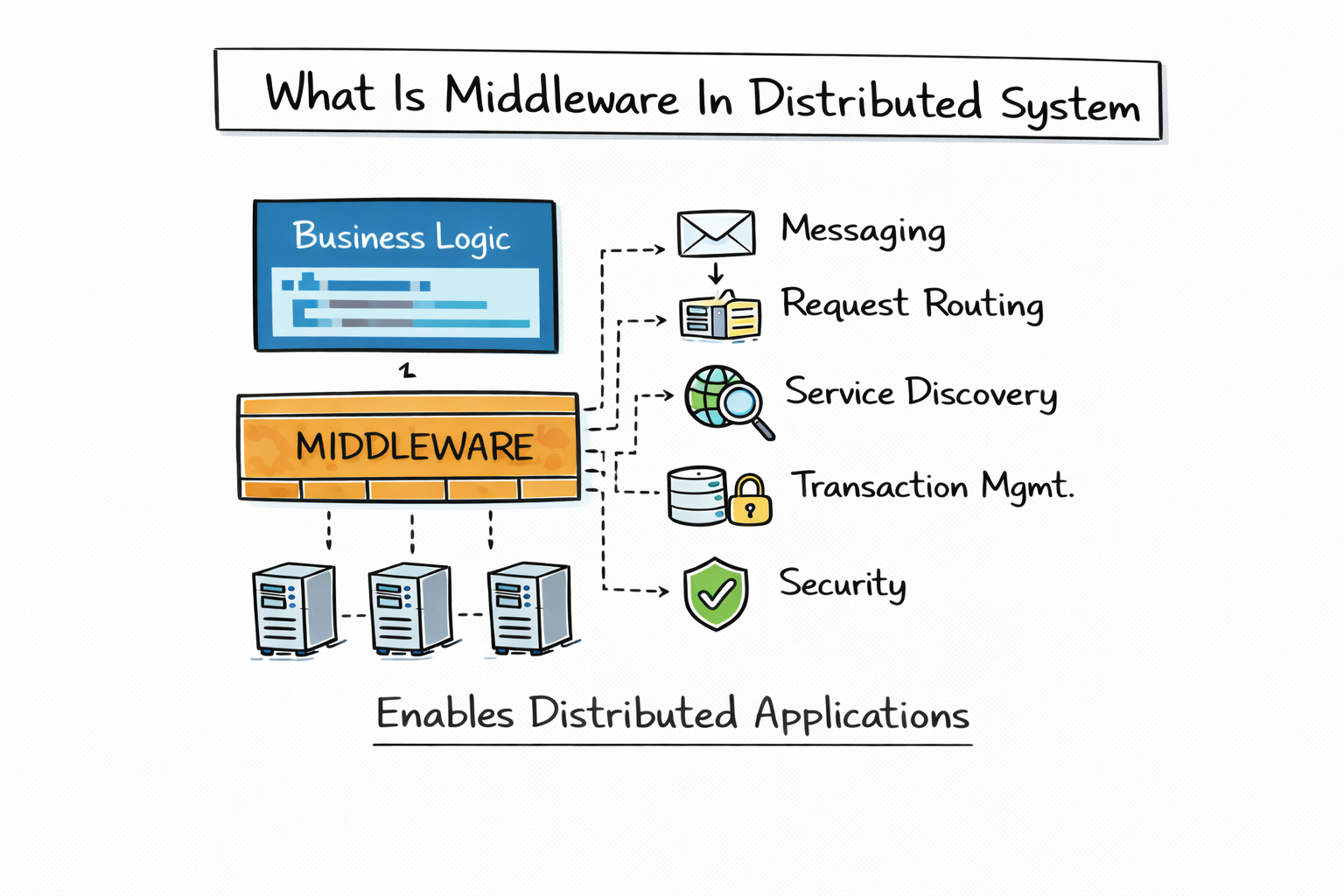
Middleware in distributed systems is a System Design concept that refers to the software layer that enables different components of a distributed application to communicate, coordinate, and operate cohesively. It provides common services such as messaging, request routing, service discovery, transaction management, and security.
From an interview perspective, middleware exists to solve cross-cutting concerns. Rather than embedding complex networking, retry logic, or serialization code into every service, middleware centralizes these responsibilities.
This separation allows application developers to focus on business logic while middleware ensures that services can interact reliably across machines, networks, and data centers.
Why Middleware Matters In System Design Interviews
Interviewers care about middleware because it reflects how distributed systems behave in production, not just how they look on a whiteboard. A design that ignores middleware implicitly assumes perfect networks, infinite scalability, and no operational complexity.
When candidates reference middleware naturally, it signals experience with real systems. It shows awareness of failure modes, performance bottlenecks, and coordination challenges that emerge at scale.
Middleware also provides interviewers with a way to probe deeper. Questions about retries, backpressure, message ordering, or service discovery often lead directly into middleware discussions.
The Role Of Middleware In Distributed Architectures
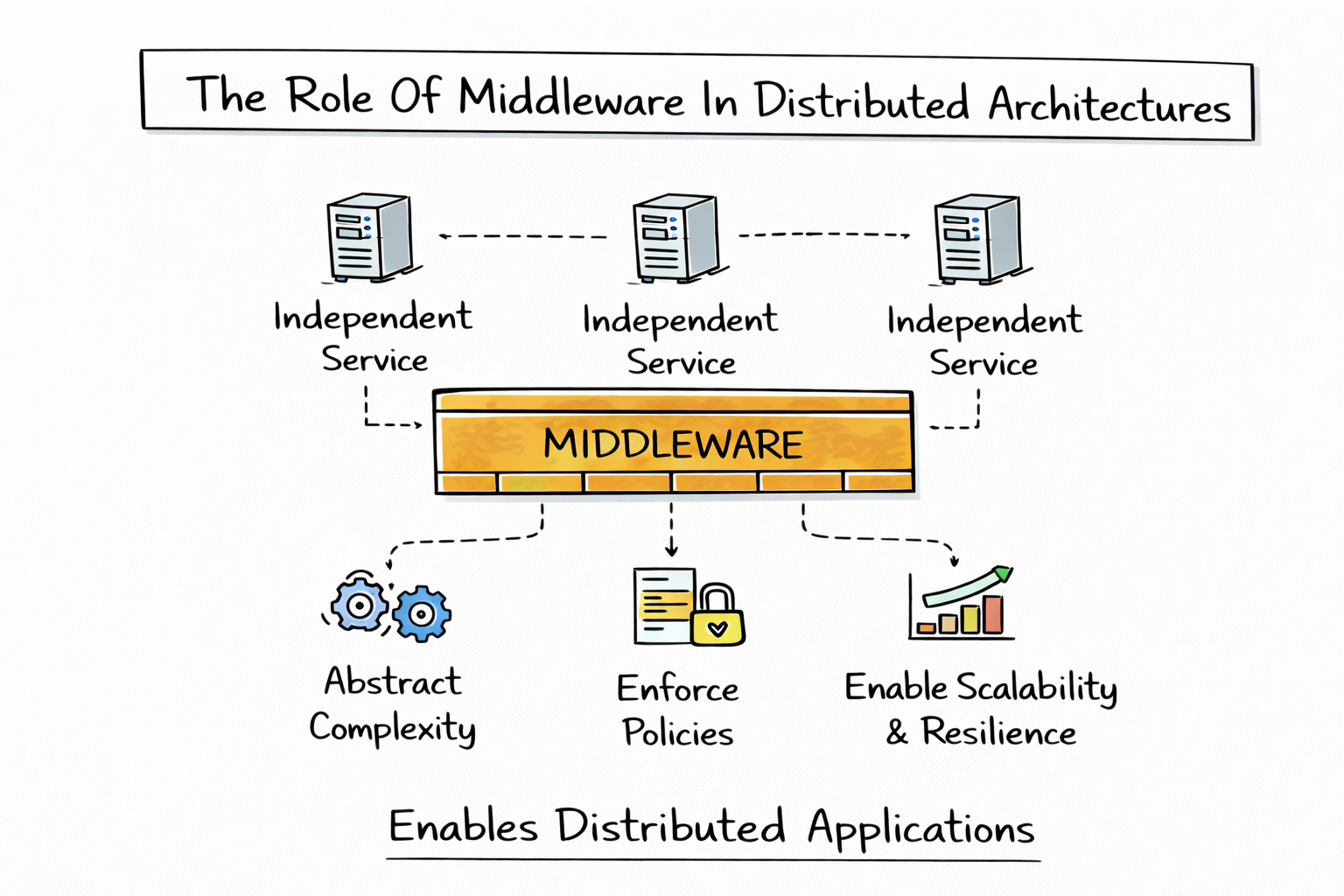
Middleware acts as connective tissue in distributed architectures. It links independent services into a functioning system while enforcing consistency in how communication and coordination occur.
At a high level, middleware performs three essential roles. It abstracts complexity, enforces system-wide policies, and enables scalability and resilience.
In interviews, understanding these roles helps you explain why middleware exists rather than treating it as an optional add-on.
Communication Middleware And Request Handling
One of the most common forms of middleware in distributed systems design is communication middleware. This category handles how services exchange requests and responses.
Remote Communication Abstraction
Distributed systems rely on remote communication, but direct network programming is error-prone and complex. Middleware abstracts this by providing standardized interfaces for remote calls.
Whether communication is synchronous or asynchronous, middleware ensures that messages are serialized, transmitted, and decoded consistently across services.
Interviewers often explore this area by asking how services communicate internally and how failures are handled during communication.
Reliability And Retries
Middleware often manages retries, timeouts, and circuit breaking. These mechanisms protect systems from cascading failures when dependencies become slow or unavailable.
Candidates who mention retries without considering duplication or idempotency usually face follow-up questions. Middleware exists precisely to handle these edge cases consistently.
The table below summarizes common communication concerns handled by middleware.
| Communication Concern | Middleware Responsibility | Interview Significance |
| Serialization | Encode and decode messages | Cross-language support |
| Timeouts | Prevent indefinite blocking | Fault isolation |
| Retries | Handle transient failures | Reliability |
| Circuit Breaking | Stop failure propagation | Resilience |
Messaging Middleware And Asynchronous Systems
As systems scale, synchronous communication becomes a bottleneck. Messaging middleware enables asynchronous interaction between services, improving scalability and fault tolerance.
Decoupling Producers And Consumers
Messaging middleware decouples producers from consumers by allowing them to communicate through queues or streams. This removes tight timing dependencies between services.
In interviews, introducing messaging middleware often signals maturity, especially for systems handling variable workloads or background processing.
Delivery Guarantees And Ordering
Messaging middleware defines how messages are delivered and processed. Guarantees such as at-least-once or exactly-once delivery shape how applications handle failures.
Interviewers may test whether candidates understand the implications of these guarantees on system complexity and correctness.
The table below compares common messaging guarantees from an interview perspective.
| Delivery Guarantee | Behavior Under Failure | Design Implication |
| At most once | Messages may be lost | Simpler logic |
| At least once | Messages may repeat | Idempotent processing |
| Exactly once | No loss or duplication | Higher complexity |
Middleware For Service Discovery And Configuration
As distributed systems grow, services cannot rely on static configuration. Middleware provides dynamic service discovery and configuration management.
Service Discovery
Service discovery middleware allows services to locate each other at runtime. This is critical in environments where instances are created and destroyed frequently.
In System Design interviews, service discovery often appears when discussing microservices or auto-scaling.
Configuration Management
Configuration middleware centralizes shared configuration such as feature flags, connection settings, and rate limits. It allows changes to propagate without redeploying services.
Candidates who mention configuration middleware demonstrate awareness of operational flexibility and safe rollout strategies.
Data Access Middleware And Abstraction
Middleware also plays a role in abstracting access to data stores. This includes connection pooling, caching layers, and transaction coordination.
Connection Management
Opening and closing database connections is expensive. Middleware manages connection pools to improve performance and stability.
In interviews, this topic often arises when discussing database scalability and resource exhaustion.
Transaction Coordination
In distributed systems, transactions that span multiple services are complex. Middleware may provide transaction coordination mechanisms or compensating workflows.
Interviewers expect candidates to recognize that traditional transactions do not scale cleanly in distributed environments.
Middleware And Fault Tolerance
Fault tolerance is a defining requirement of distributed systems, and middleware is deeply involved in achieving it.
Middleware detects failures, enforces timeouts, retries operations, and isolates faulty components. These behaviors prevent localized failures from escalating into system-wide outages.
In interviews, candidates who rely entirely on application logic for fault tolerance often struggle to justify scalability. Middleware-based fault handling provides consistency and reduces duplication.
Middleware And Observability
Observability is critical for operating distributed systems, and middleware plays a key role in making systems observable.
Middleware can automatically collect metrics, logs, and traces for communication between services. This reduces the burden on application developers and ensures consistency.
Interviewers often appreciate candidates who mention observability as a built-in concern rather than an afterthought.
The table below shows how middleware contributes to observability.
| Observability Signal | Middleware Contribution | Operational Benefit |
| Metrics | Request counts and latency | Capacity planning |
| Logs | Structured request logs | Debugging |
| Traces | End-to-end request flow | Root cause analysis |
Middleware And Security Concerns
Security is another area where middleware provides shared enforcement.
Middleware can handle authentication, authorization, encryption, and rate limiting uniformly across services. This avoids inconsistent security implementations and reduces risk.
In interviews, acknowledging middleware’s role in security demonstrates a holistic understanding of System Design beyond pure functionality.
Trade-Offs Introduced By Middleware
While middleware simplifies many aspects of distributed systems, it also introduces trade-offs. Additional layers add latency, complexity, and operational overhead.
Strong candidates acknowledge these trade-offs rather than presenting middleware as a universal solution. Interviewers value balanced reasoning that weighs benefits against costs.
Understanding when to introduce middleware and when to keep systems simpler is a key System Design skill.
Common Interview Scenarios Where Middleware Appears
Middleware in distributed systems design frequently appears indirectly during interviews. When designing APIs, background job processing, event-driven systems, or microservices, middleware decisions shape the architecture.
Candidates who can explain why middleware is necessary in these scenarios often outperform those who focus only on surface-level design.
Mistakes Candidates Make When Discussing Middleware
A common mistake is naming middleware technologies without explaining their purpose. Interviewers care more about reasoning than product familiarity.
Another mistake is ignoring failure modes and assuming middleware works magically. Good answers explain how middleware behaves under stress and failure.
How Interviewers Evaluate Middleware Knowledge
Interviewers assess middleware understanding by observing how naturally candidates incorporate it into designs. They look for awareness of cross-cutting concerns and realistic assumptions.
Candidates who view middleware as an essential part of system behavior rather than an implementation detail demonstrate senior-level thinking.
Conclusion
Middleware in distributed systems design is not optional at scale. It enables communication, coordination, fault tolerance, and observability across independent components.
In System Design interviews, understanding middleware helps you reason about real-world constraints and explain how systems remain reliable under load and failure. Rather than memorizing tools, focus on the principles middleware embodies and the problems it solves.
A strong grasp of middleware does not just improve interview performance. It reflects the mindset required to design and operate resilient distributed systems in production.