

If you are preparing for an entry-level role at Amazon, you may be wondering how much System Design you really need to know. The keyword Amazon SDE 1 System Design often creates confusion because System Design is traditionally associated with mid-level or senior engineering roles. At Amazon, however, even SDE 1 candidates are expected to demonstrate foundational system thinking.
This does not mean you will be asked to design massive distributed systems like DynamoDB or Amazon Prime Video. Instead, Amazon uses lightweight System Design discussions to evaluate how you think about real-world software, how your code fits into larger systems, and how well you understand basic architectural trade-offs.
This guide explains exactly what Amazon expects from SDE 1 candidates, how System Design appears in interviews, how deep you should go, and how to prepare without overwhelming yourself.

Understanding The Amazon SDE 1 Role
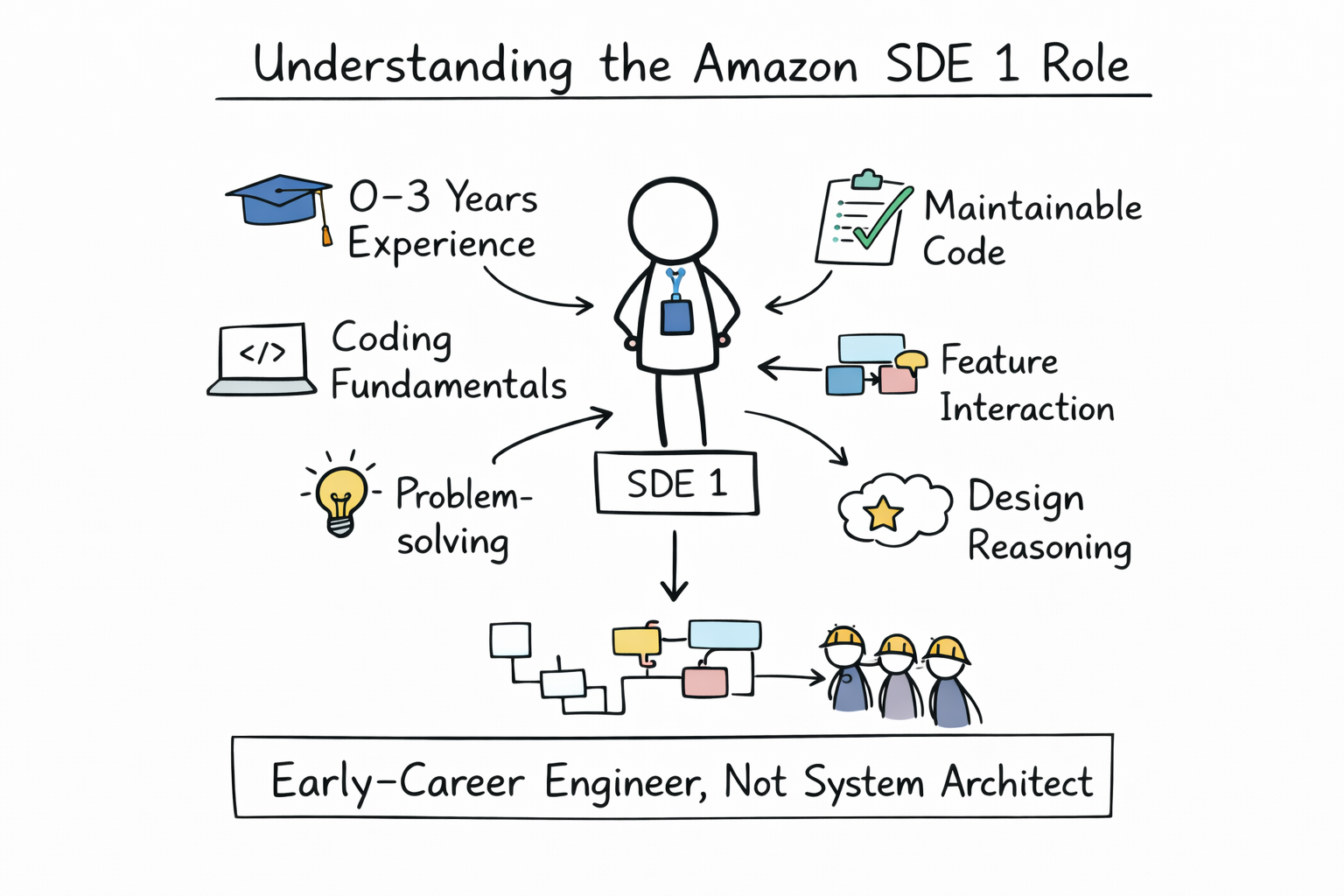
Before diving into System Design, it is important to understand what Amazon expects from an SDE 1. This role is designed for early-career engineers, typically with zero to three years of experience. At this level, Amazon expects strong coding fundamentals, problem-solving ability, and a clear understanding of basic software engineering concepts.
You are not expected to be a system architect. You are expected to be someone who can write maintainable code, understand how features interact with other components, and reason about design decisions in a structured way. System Design at this level is more about awareness than ownership.
Does Amazon Ask System Design For SDE 1?
Yes, Amazon does ask System Design questions for SDE 1, but the scope is intentionally limited. You are unlikely to see a standalone System Design round in an SDE 1 interview loop. Instead, System Design concepts are often embedded within coding interviews or discussed as part of behavioral and technical follow-ups.
Amazon interviewers use these discussions to evaluate whether you understand how your solutions behave in production. They want to know whether you can think beyond solving a problem on a whiteboard and consider how that solution would work in a real system.
Why Amazon Cares About System Design At The Entry Level
Amazon builds large-scale, customer-facing systems that must be reliable, scalable, and cost-efficient. Even junior engineers contribute to these systems, which means design decisions matter at every level.
System Design discussions help Amazon assess whether you understand concepts like data flow, scalability, fault tolerance, and performance at a basic level. They also reveal how you think about trade-offs and whether you can align technical decisions with business goals.
At SDE 1, Amazon is not testing mastery. They are testing readiness.
How Amazon SDE 1 System Design Differs From SDE 2 And Senior Levels
One of the biggest mistakes candidates make is preparing for Amazon SDE 1 System Design as if they were interviewing for SDE 2 or SDE 3. The expectations are very different.
The table below highlights how System Design expectations evolve at Amazon.
| Level | System Design Scope | Expected Ownership |
| SDE 1 | Basic components and reasoning | Feature-level thinking |
| SDE 2 | Medium-scale systems | End-to-end design |
| Senior SDE | Large distributed systems | Architecture leadership |
For SDE 1, the focus is on understanding and explaining simple systems clearly, not designing complex architectures.
How System Design Appears In Amazon SDE 1 Interviews
System Design often appears as follow-up questions during coding interviews. After you solve a problem, the interviewer may ask how your solution would scale, how it would be deployed, or how it would interact with other services.
In some cases, you may be asked to design a simple system or feature at a high level. These discussions are guided and scoped to keep them approachable for entry-level candidates.
The goal is to see how you reason, not to trick you with edge cases.
Common Amazon SDE 1 System Design Topics
Amazon SDE 1 System Design discussions usually revolve around everyday software engineering scenarios. You may be asked to think about basic client-server interactions, simple APIs, or data storage decisions.
Topics often include designing a simple service, structuring a feature like user authentication, or explaining how data flows through an application. You may also be asked to consider performance implications or basic failure scenarios.
These topics reflect what an SDE 1 might realistically encounter on the job.
Example Amazon SDE 1 System Design Questions
To make expectations concrete, consider examples of System Design questions appropriate for SDE 1.
You might be asked how you would design a basic URL shortening service, focusing on core components rather than scale. Another example is designing a simple order tracking system for an e-commerce application. You could also be asked how you would structure a notification feature that sends emails or messages to users.
In each case, the interviewer is evaluating clarity of thought, not architectural sophistication.
What Amazon Evaluates In SDE 1 System Design Answers
Amazon uses System Design questions to evaluate several key attributes. Technical understanding is important, but it is not the only factor.
Interviewers look at how well you clarify requirements, how logically you structure your answer, and how effectively you communicate your reasoning. They also evaluate whether you understand basic trade-offs and constraints.
Amazon’s Leadership Principles often influence how these answers are assessed. For example, thinking about scalability aligns with Think Big, while discussing simplicity aligns with Invent and Simplify.
How Deep Should You Go In SDE 1 System Design?
Depth is one of the most challenging aspects for SDE 1 candidates. Going too shallow can make you appear inexperienced, while going too deep can signal over-preparation or misunderstanding of role expectations.
At SDE 1, you should aim to explain what the system does, identify its main components, and describe how they interact. You should be able to explain why you made certain choices, but you do not need to dive into advanced infrastructure topics unless prompted.
If the interviewer asks follow-up questions, treat them as opportunities to demonstrate learning and adaptability.
The Role Of Communication In Amazon SDE 1 System Design
Communication plays a critical role in System Design discussions at Amazon. Even at the entry level, Amazon values engineers who can explain their ideas clearly and collaborate effectively.
You should focus on articulating your thought process step by step. If you are unsure about something, it is better to acknowledge uncertainty and reason through it logically rather than guessing.
Clear communication helps interviewers see how you would function on a real team.
How Amazon Leadership Principles Influence System Design Evaluation
Amazon’s Leadership Principles are deeply embedded in its interview process, including System Design discussions. While you are not expected to explicitly reference principles, your answers should naturally align with them.
For example, discussing cost considerations reflects Frugality. Talking about reliability and customer impact aligns with Customer Obsession. Explaining how you would iterate on a design shows Bias for Action.
Understanding this context helps you frame your answers more effectively.
Common Mistakes SDE 1 Candidates Make In System Design
One common mistake is overcomplicating the design. Introducing unnecessary components or advanced technologies can distract from the core problem and make your answer harder to follow.
Another mistake is skipping the requirement clarification. Jumping straight into design without understanding the use case often leads to misaligned solutions.
Some candidates also struggle with explaining trade-offs. Even simple systems involve choices, and Amazon values engineers who can articulate why one approach was chosen over another.
How To Prepare For Amazon SDE 1 System Design
Preparation for the Amazon SDE 1 System Design should focus on fundamentals. You should understand how basic web applications work, how data is stored and retrieved, and how systems scale at a high level.
Practicing explaining simple designs out loud is extremely helpful. Mock interviews or peer discussions can help you get comfortable with articulating your thought process.
You should also review Amazon’s Leadership Principles and think about how they apply to technical decision-making.
How System Design Signals Affect Amazon Hiring Decisions
System Design performance rarely makes or breaks an SDE 1 interview on its own. Amazon looks at the entire interview loop, including coding, behavioral, and communication signals.
However, strong System Design discussions can reinforce positive impressions and demonstrate that you are ready to grow within the organization. Weak System Design signals, especially when combined with unclear communication, can raise concerns about readiness for real-world engineering work.
Final Thoughts On Amazon SDE 1 System Design
Amazon SDE 1 System Design is not about designing massive distributed systems. It is about demonstrating that you understand how software works beyond isolated code snippets.
If you approach System Design with a focus on fundamentals, clarity, and thoughtful reasoning, you will align well with Amazon’s expectations. With the right preparation, System Design becomes an opportunity to show that you are ready to contribute meaningfully from day one.