

If you have ever worked on a software system that looked great on paper but collapsed during implementation, you have already experienced the gap between low-level design vs high-level design. Both are essential, both solve different problems, and confusing one for the other is one of the most common mistakes engineers make as systems grow.
In 2026, software systems will be more distributed, cloud-native, and AI-assisted than ever. Yet the distinction between high-level design and low-level design remains just as important as it was a decade ago. Strong high-level design helps teams align on architecture and scalability, while strong low-level design ensures that individual components are maintainable, performant, and correct.
This guide explains low-level design vs high-level design in depth, using modern system design contexts, real-world examples, and practical tables. The goal is not just conceptual clarity, but the ability to apply the right level of design thinking at the right time.

What Is High-Level Design?
High-level design focuses on the overall architecture of a system. It defines how major components interact, how data flows through the system, and how the system meets non-functional requirements such as scalability, availability, and reliability.
At this stage, you are not concerned with classes, functions, or database schemas. Instead, you are answering questions about system boundaries and responsibilities. You decide whether the system uses microservices or a monolith, whether communication is synchronous or asynchronous, and how traffic is distributed across regions.
In the context of low-level design vs high-level design, high-level design acts as the blueprint. It sets constraints and direction for all detailed work that follows. Without a solid high-level design, low-level optimizations often end up solving the wrong problems.
What Is Low-Level Design?
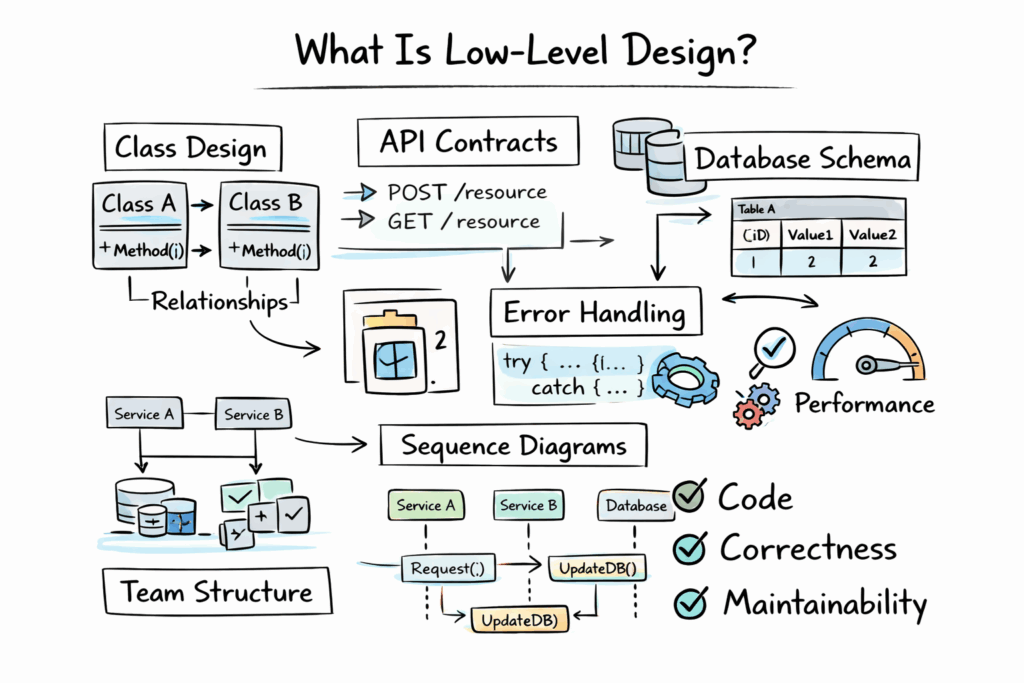
Low-level design focuses on the internal structure of individual components. It describes how classes, modules, APIs, and data structures are organized to implement the behavior defined by the high-level design.
This is where you define class relationships, method signatures, database schemas, and interaction sequences. In modern systems, low-level design also includes API contracts, error handling strategies, and performance considerations within a service.
When comparing low-level design vs high-level design, low-level design is closer to code but still abstract enough to reason about correctness and maintainability before implementation begins.
Core Differences Between Low-Level Design Vs High-Level Design
The difference between low-level design vs high-level design is not about importance but about scope and abstraction. The table below summarizes the key distinctions in a practical way.
| Aspect | High-Level Design | Low-Level Design |
| Focus | System architecture | Component internals |
| Scope | Entire system | Individual modules |
| Abstraction | High | Detailed |
| Audience | Architects, senior engineers | Developers, implementation teams |
| Output | Architecture diagrams | Class diagrams, API specs |
| Timing | Early design phase | Before or during implementation |
Understanding this distinction helps teams avoid misalignment. A team that jumps into low-level design without a stable high-level design often ends up rewriting code to accommodate architectural changes later.
High-Level Design In Modern Systems
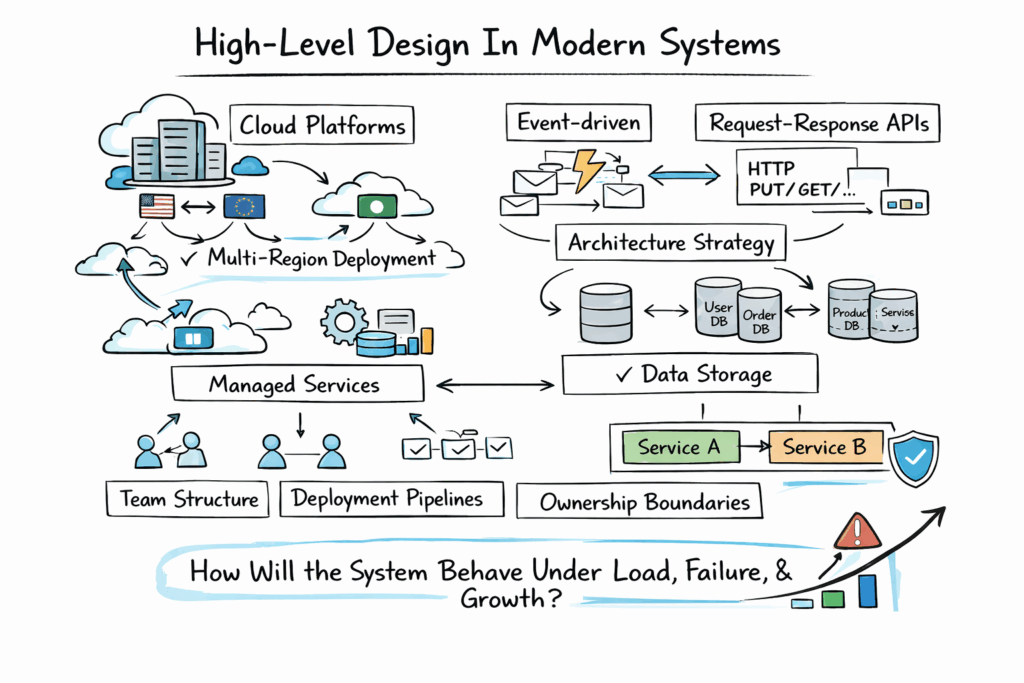
In 2026, high-level design is heavily influenced by cloud platforms, global traffic patterns, and operational complexity. High-level design decisions now routinely include multi-region deployments, managed services, and resilience strategies.
For example, deciding whether to use event-driven architecture or request-response APIs is a high-level design choice. So is choosing between centralized data storage and domain-specific databases.
High-level design also accounts for organizational realities. Team structure, deployment pipelines, and ownership boundaries influence architectural decisions. In this sense, high-level design is as much about people and processes as it is about technology.
In the debate of low-level design vs high-level design, high-level design answers the question of what the system is and how it behaves under load, failure, and growth.
Low-Level Design In Practice
Low-level design comes into play once architectural boundaries are established. It ensures that each component fulfills its responsibilities efficiently and cleanly.
In a microservices architecture, low-level design defines how a service validates input, interacts with its database, and exposes APIs. It includes class structures, object lifecycles, and concurrency handling.
In 2026, low-level design increasingly incorporates performance and security considerations from the start. Rate limiting logic, caching strategies, and input sanitization are often part of low-level design discussions rather than afterthoughts.
When comparing low-level design vs high-level design, low-level design is where design decisions directly translate into code quality and long-term maintainability.
Example: Designing A Ride-Sharing System
To understand low-level design vs high-level design more concretely, consider a ride-sharing platform.
At the high-level design stage, you decide that the system consists of user services, driver services, matching services, and payment services. You determine that the system uses asynchronous messaging for ride requests and synchronous APIs for pricing and payments. You also decide on geographic partitioning to reduce latency.
At the low-level design stage, you design the matching algorithm, define the data models for drivers and riders, and specify how the matching service handles concurrent updates. You decide how to represent driver availability in memory and how often data is persisted.
Both levels are essential. High-level design ensures scalability and reliability, while low-level design ensures correctness and performance within each service.
When To Use High-Level Design
High-level design is most valuable when defining a new system or making significant architectural changes. It helps stakeholders align on constraints and trade-offs before implementation begins.
High-level design is also critical during System Design interviews, where interviewers want to see your ability to reason about scalability, availability, and trade-offs. In these scenarios, diving too quickly into low-level design can signal a lack of architectural thinking.
In the context of low-level design vs high-level design, high-level design sets the stage. It prevents teams from optimizing details prematurely.
When To Use Low-Level Design
Low-level design is essential when implementing features, refactoring services, or optimizing performance-critical components. It helps developers reason about complexity, edge cases, and maintainability.
Low-level design is also crucial when multiple developers collaborate on the same component. Clear low-level design reduces ambiguity and prevents inconsistent implementations.
In modern agile environments, low-level design often happens incrementally. Even then, having a clear low-level design before writing complex logic saves time and reduces bugs.
How High-Level Design Influences Low-Level Design
High-level design decisions directly constrain low-level design choices. For example, choosing an event-driven architecture affects how services handle state, retries, and idempotency at the low level.
Similarly, decisions about data consistency at the high-level influence transaction handling and schema design at the low-level. This dependency is why treating low-level design vs high-level design as isolated activities leads to fragile systems.
A strong engineering culture ensures that low-level design aligns with high-level architectural intent.
Common Mistakes When Comparing Low-Level Design Vs High-Level Design
One common mistake is treating high-level design as a one-time activity. In reality, high-level design evolves as requirements change and systems scale.
Another mistake is over-engineering low-level design for hypothetical future needs. This often leads to unnecessary complexity without clear benefits.
Some teams also blur the distinction entirely, creating designs that are too detailed at the architectural stage or too vague at the implementation stage. Understanding low-level design vs high-level design helps avoid these pitfalls.
Low-Level Design Vs High-Level Design In Interviews
In interviews, candidates are often evaluated on their ability to move between abstraction levels. Interviewers expect you to start with high-level design, then selectively dive into low-level design for critical components.
For example, you might outline a distributed cache at the high level, then explain cache eviction logic at the low level. The ability to switch contexts smoothly demonstrates senior-level thinking.
Failing to distinguish low-level design vs high-level design in interviews often results in incomplete or unfocused answers.
Tooling And Documentation Differences
High-level design is typically documented using architecture diagrams, system context diagrams, and design decision records. These artifacts focus on relationships and trade-offs rather than implementation details.
Low-level design documentation includes class diagrams, sequence diagrams, API specifications, and database schemas. These documents are often closer to the code and evolve alongside it.
The table below highlights documentation differences clearly.
| Design Level | Common Artifacts | Update Frequency |
| High-Level Design | Architecture diagrams | Infrequent |
| Low-Level Design | Class and sequence diagrams | Frequent |
Recognizing these differences helps teams choose the right level of documentation for their needs.
The Role Of AI And Automation In 2026
In 2026, AI-assisted tools can generate code, suggest architectures, and analyze performance. However, they do not eliminate the need for human understanding of low-level design vs high-level design.
AI tools are particularly effective at assisting low-level design by generating boilerplate code or suggesting optimizations. High-level design still requires contextual judgment, trade-off analysis, and alignment with business goals.
Engineers who understand both levels deeply are best positioned to leverage automation effectively.
How To Improve Your Skills In Both Areas
Improving high-level design skills requires exposure to large systems and thoughtful analysis of trade-offs. Reading architecture case studies and participating in design reviews helps build this skill.
Improving low-level design skills requires hands-on experience, code reviews, and refactoring complex components. Writing clean, testable code is a direct outcome of strong low-level design thinking.
Balancing both is key. Focusing exclusively on one at the expense of the other limits long-term growth.
Conclusion
The debate of low-level design vs high-level design is not about choosing one over the other. It is about understanding how they complement each other to produce robust, scalable systems.
High-level design provides direction, scalability, and resilience. Low-level design ensures correctness, performance, and maintainability. In 2026, successful systems require mastery of both.
Engineers who can navigate seamlessly between these levels build systems that not only work today, but continue to evolve gracefully as requirements change.