

System Design interviews are often misunderstood as tests of architectural knowledge. In reality, they are designed to evaluate how you think through complex, ambiguous problems. Interviewers are not looking for a perfect system or a specific architecture. They are observing how you reason, how you communicate, and how you make decisions under uncertainty.
The open-ended nature of these interviews is intentional. Real engineering problems rarely come with complete requirements. Interviewers want to see whether you can operate comfortably without full information and still produce a coherent, defensible design.
Why ambiguity is a feature, not a flaw
Many candidates feel uncomfortable when requirements are vague. Strong candidates recognize that ambiguity is part of the signal. The interview is testing whether you can ask the right questions, make reasonable assumptions, and move forward deliberately.
Candidates who freeze or rush into design without clarification often struggle. Candidates who slow down, clarify intent, and frame the problem clearly tend to perform much better.
What interviewers infer from your behavior
Interviewers use your behavior to infer how you might perform in real engineering discussions. Calm reasoning, structured explanations, and openness to feedback signal maturity. Overconfidence, defensiveness, or rigid thinking are negative signals, even if the design itself is technically sound.
System Design interviews are as much about collaboration as they are about correctness.
How System Design interviews are structured across levels
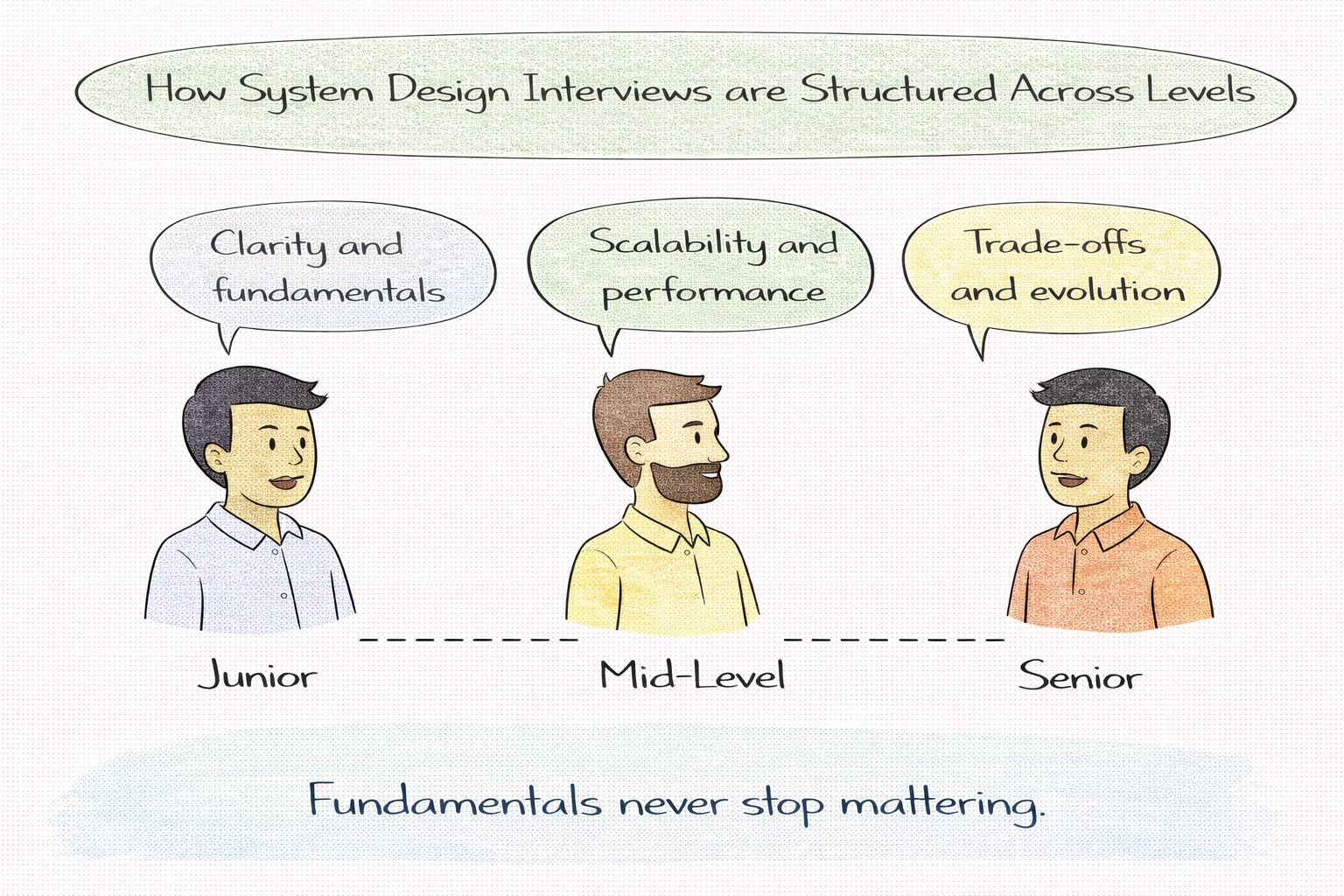
System Design interviews scale with seniority, but the core structure remains the same. Junior candidates are evaluated on clarity and fundamentals. Mid-level candidates are expected to reason about scalability and performance. Senior candidates are assessed on trade-offs, failure handling, and system evolution.
What changes is depth, not the nature of the conversation. Fundamentals never stop mattering.
What junior-level System Design interviews look like
At the junior level, System Design interviews focus on simple systems and basic reasoning. Interviewers want to see whether candidates can explain request flow, identify core components, and avoid unnecessary complexity.
Advanced topics are not expected. Clear explanations and structured thinking are far more important than scale.
What mid-level and senior interviews emphasize
As seniority increases, interviewers probe deeper into performance, data modeling, and failure scenarios. Candidates are expected to justify decisions, explain trade-offs, and adapt designs when constraints change.
Senior candidates are also expected to think about how systems evolve over time, not just how they work initially.
| Interview level | Primary evaluation focus |
| Junior | Fundamentals and clarity |
| Mid-level | Scalability and trade-offs |
| Senior | Failure handling and evolution |
Understanding this progression helps candidates calibrate their preparation appropriately.
How interviewers evaluate System Design answers
Interviewers evaluate how you arrive at a design, not just the design itself. They listen for logical progression, clear explanations, and thoughtful decision-making. A simple design explained well often outperforms a complex design explained poorly.
Interviewers also pay close attention to pacing. Spending too much time on one area often leads to rushed explanations later.
Signals interviewers actively listen for
During the interview, interviewers are constantly collecting signals. They notice whether you clarify requirements, whether you explain trade-offs rather than asserting choices, and whether you acknowledge uncertainty when appropriate.
They also evaluate communication style. Clear, simple language signals deep understanding. Overly technical jargon without explanation often signals shallow familiarity.
| Interview signal | What it indicates |
| Structured flow | Organized thinking |
| Trade-off discussion | Engineering judgment |
| Early failure awareness | Real-world experience |
| Adaptation to feedback | Maturity |
These signals often matter more than the specific technologies you mention.
Why follow-up questions are the real test
Follow-up questions are where interviewers probe in depth. They may change scale assumptions, introduce failures, or ask you to consider alternatives. Strong candidates treat these questions as extensions of the same problem rather than disruptions.
Your ability to adapt calmly and explain the impact of changes is often the strongest positive signal you can give.
A repeatable framework for System Design interview questions
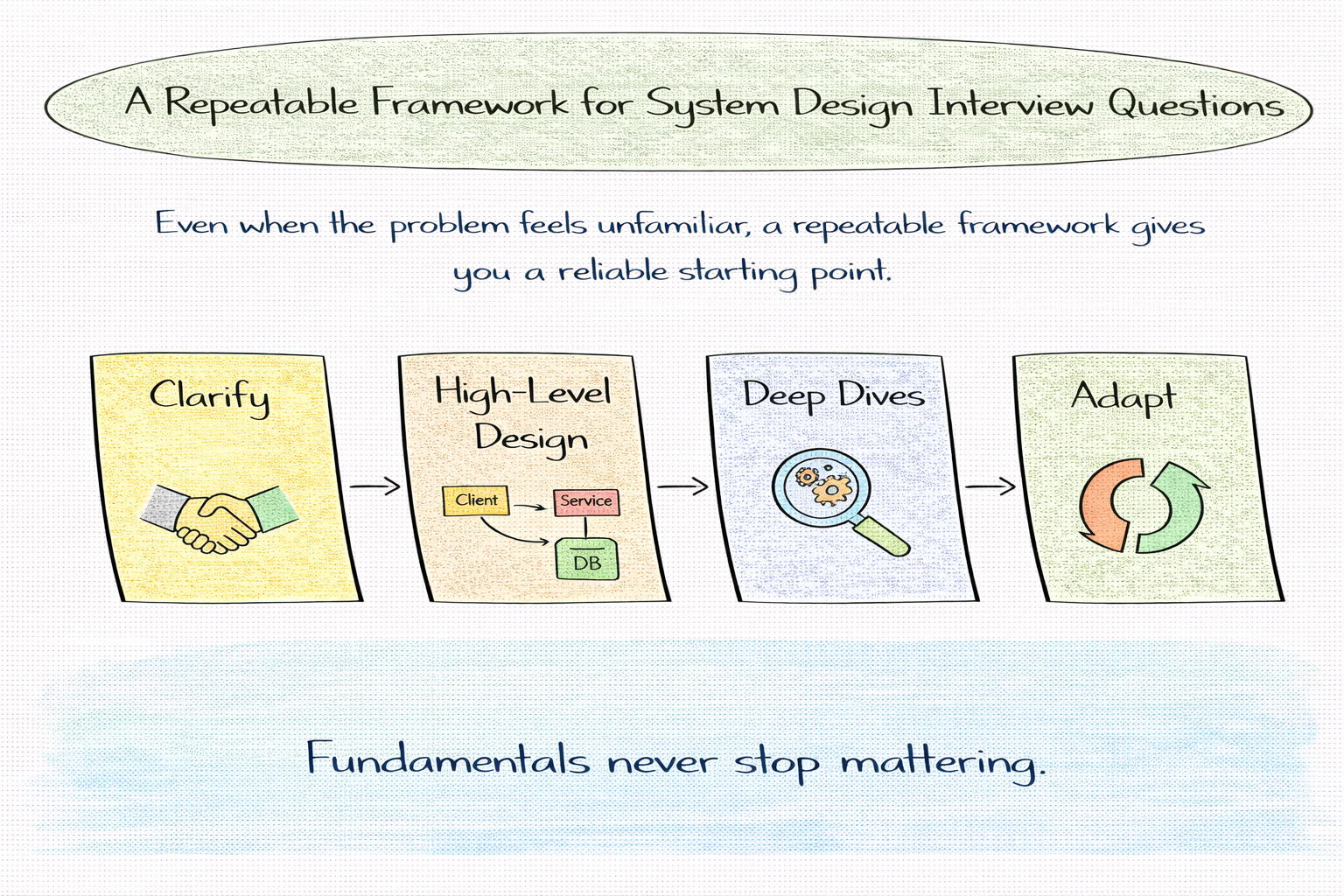
System Design interviews can feel overwhelming because the problem space is large. A repeatable framework reduces cognitive load and gives you a reliable starting point, even when the problem feels unfamiliar.
Interviewers expect experienced candidates to follow a recognizable flow, even if they never explicitly label it as a framework.
Starting with clarification and framing
Every System Design question should begin with clarification. Before proposing any architecture, strong candidates ensure they understand what the system must do and which constraints matter most. This includes scale expectations, correctness requirements, and operational assumptions.
Framing the problem in your own words ensures alignment with the interviewer and demonstrates deliberate thinking. It also creates a stable reference point for later discussion.
Moving from high-level design to focused depth
After clarification, strong candidates establish a high-level architecture. This creates a shared mental model before diving into details. From there, depth is added selectively in areas that matter most for the problem.
This progression mirrors how real systems are designed and helps interviewers follow your reasoning.
Adapting gracefully when constraints change
Interviewers often change constraints mid-discussion. A strong framework allows you to adapt without losing coherence. Instead of restarting, you reference earlier decisions and explain how the new constraint affects the design.
This ability to reason incrementally is one of the clearest signals of interview readiness.
| Framework stage | Why interviewers value it |
| Clarification | Prevents misalignment |
| High-level design | Establishes structure |
| Focused deep dives | Shows judgment |
| Adaptation | Demonstrates maturity |
Core System Design fundamentals to master first
System Design interviews consistently reward candidates who demonstrate strong fundamentals. Regardless of the system being designed, interviewers expect you to reason clearly about request flow, boundaries, and state. These basics form the backbone of every system, from simple services to complex distributed platforms.
Candidates who attempt to compensate for weak fundamentals with advanced terminology are quickly exposed. Interviewers use fundamentals as an early signal because they predict how well a candidate will handle deeper discussions later.
Request flow as the backbone of every answer
Understanding request flow means being able to explain what happens when a user interacts with the system, step by step. Interviewers frequently ask candidates to “walk through a request” because it reveals clarity of thought and end-to-end reasoning.
A strong answer describes where the request enters, how it is processed, where data is read or written, and how the response returns. Precision matters less than coherence.
System boundaries and separation of concerns
System boundaries define responsibility. Interviewers expect you to identify which components own which responsibilities and how they interact. Clear boundaries reduce coupling, simplify reasoning, and limit failure impact.
Candidates who blur boundaries often produce designs that are hard to scale or debug. Clear boundaries signal an engineering discipline.
Stateless versus stateful thinking
Interviewers expect candidates to prefer stateless designs unless there is a strong reason not to. Stateless services scale more easily and recover faster. State introduces complexity around consistency, recovery, and coordination.
Understanding where the state lives and why it belongs there is a fundamental skill that interviewers consistently probe.
| Fundamental concept | What interviewers are checking |
| Request flow | End-to-end clarity |
| Boundaries | Responsibility separation |
| Stateless services | Scalability intuition |
| State placement | Complexity awareness |
Data modeling and data ownership for interviews
Most System Design failures stem from poor data decisions rather than missing infrastructure. Interviewers know this and often probe data modeling early in the discussion. How you structure and own data influences scalability, consistency, and system evolution.
Candidates who treat data modeling as an afterthought struggle in interviews, even if the rest of the design seems reasonable.
Identifying core entities and relationships
Interviewers expect you to identify the key entities the system manages and explain how they relate to each other. This does not require detailed schemas. It requires understanding what data matters and how it changes over time.
Strong candidates explain which data is frequently accessed, which data changes often, and which data requires strict correctness.
Data ownership and service boundaries
Each piece of data should have a single owner responsible for correctness. Interviewers listen to whether you enforce ownership through APIs rather than shared databases. Shared ownership often leads to tight coupling and an inconsistent state.
Clear ownership boundaries simplify reasoning and make systems easier to evolve.
Access patterns drive design choices
Interviewers expect you to reason from access patterns rather than storage technologies. Read-heavy systems benefit from different strategies than write-heavy systems. Explaining this reasoning signals performance intuition and real-world experience.
| Data concern | Interview focus |
| Entity modeling | Structural clarity |
| Ownership | Coupling control |
| Access patterns | Performance reasoning |
| Consistency needs | Correctness judgment |
Scalability and performance concepts interviewers expect
Scalability in interviews is not about handling massive numbers. It is about maintaining acceptable performance as the load increases. Interviewers want to see whether you can identify bottlenecks before proposing solutions.
Candidates who jump straight to sharding or microservices without identifying constraints often struggle here.
Horizontal versus vertical scaling
Interviewers expect you to understand why horizontal scaling is preferred for most large systems. Vertical scaling is simple but limited. Horizontal scaling introduces complexity but allows systems to grow.
Understanding what prevents a component from scaling horizontally is often more important than knowing how to scale it.
Performance intuition over calculations
Interviewers rarely expect precise performance calculations. They care about intuition. Can you explain why latency increases? Can you identify the critical path? Can you reason about how caching changes system behavior?
Clear reasoning matters far more than numbers.
Bottleneck-first thinking
Strong candidates identify the bottleneck before optimizing. Adding resources elsewhere does not help if the bottleneck remains unchanged. Interviewers frequently ask, “What is the bottleneck here?” to test this intuition.
| Performance concept | What interviewers evaluate |
| Bottlenecks | Structural reasoning |
| Latency vs throughput | Performance intuition |
| Caching trade-offs | Judgment |
| Scaling strategy | Long-term thinking |
Distributed systems and failure handling in interviews
As systems grow, distribution becomes unavoidable. Interviewers use distributed systems discussions to differentiate mid-level candidates from senior ones. They want to see whether you understand how systems behave when components fail independently.
Candidates who assume perfect communication or no failures are quickly challenged.
Treating failure as a normal condition
Interviewers expect you to design for failure explicitly. Timeouts, retries, and graceful degradation should be discussed as part of the normal design, not as edge cases.
Strong candidates explain how the system behaves when things go wrong, not just when everything works.
Consistency, availability, and trade-offs
Interviewers expect candidates to explain consistency choices in terms of user experience. Eventual consistency may be acceptable in some systems but not in others. Explaining why a particular guarantee is chosen is more important than naming a consistency model.
Trade-offs between availability and consistency often surface naturally during these discussions.
Avoiding cascading failures
A key signal of maturity is awareness of cascading failures. Interviewers listen for whether failures are isolated or whether they propagate through the system. Clear boundaries and backpressure mechanisms help limit blast radius.
| Distributed concern | What it reveals |
| Failure handling | Operational maturity |
| Consistency reasoning | User-impact thinking |
| Coordination costs | Scalability awareness |
| Isolation | Reliability design |
Common System Design interview questions and examples
System Design interviews are grounded in examples because examples force candidates to apply concepts rather than recite them. Interviewers want to see how you reason through a concrete problem, make trade-offs, and adapt as constraints change.
Knowing theory without being able to apply it usually becomes obvious within minutes. Examples reveal whether your understanding is practical or superficial.
What makes an example interview-ready
Interview-ready examples are not necessarily complex. They are chosen because they expose core System Design decisions. Examples like designing a URL shortener, a news feed, a file storage system, or a messaging service allow interviewers to probe request flow, data modeling, scalability, and failure handling naturally.
Interviewers are less interested in whether you have seen the example before and more interested in how you structure your explanation.
| Example category | What interviewers evaluate |
| Simple systems | Fundamentals and clarity |
| Scalable systems | Bottleneck reasoning |
| Data-heavy systems | Ownership and consistency |
| Distributed systems | Failure handling |
How to use examples during preparation
When preparing, focus on explaining examples out loud from start to finish. Practice walking through the request lifecycle, explaining why each component exists, and describing how the system behaves under load or failure.
The goal is not to memorize architectures. It is to become comfortable reasoning through unfamiliar problems using familiar patterns.
Common mistakes candidates make in System Design interviews
Skipping clarification and assumptions
One of the most common mistakes is jumping into design before clarifying requirements. This often leads to misaligned solutions and wasted time. Interviewers interpret this as poor problem framing rather than enthusiasm.
Strong candidates pause early, ask clarifying questions, and state assumptions explicitly.
Over-designing too early
Many candidates assume extreme scale or advanced requirements without justification. This leads to unnecessary complexity and makes designs harder to explain. Interviewers prefer designs that start simple and evolve as constraints demand.
Complexity should be earned, not assumed.
Listing components without reasoning
Another frequent mistake is listing technologies or components without explaining why they are needed. Interviewers quickly probe these decisions, and vague answers signal shallow understanding.
Clear reasoning always beats long lists of components.
| Common mistake | Interview interpretation |
| Skipping clarification | Disorganized thinking |
| Over-engineering | Weak judgment |
| Buzzword usage | Shallow understanding |
| Ignoring failures | Lack of experience |
Treating interviews like exams
Candidates sometimes treat System Design interviews as tests to pass rather than conversations to navigate. This often leads to rigid thinking and defensiveness. Interviewers prefer candidates who think aloud, explore trade-offs, and adapt collaboratively.
System Design interviews reward reasoning, not perfection.
How to practice System Design interviews effectively
System Design practice is not about speed or correctness. It is about clarity, structure, and communication. Solving problems silently or focusing only on diagrams does not build interview readiness.
You must practice explaining your thinking clearly and confidently.
Repetition and refinement over variety
Solving many different problems once is less effective than solving a shorter set multiple times. Each repetition should feel clearer and more structured than the last. Interviewers notice this refinement quickly.
Practicing the same example multiple times helps you internalize patterns and reduces anxiety during interviews.
Practicing under realistic conditions
Effective practice includes time constraints, interruptions, and changing requirements. These conditions simulate real interviews and help you stay composed under pressure.
Mock interviews and peer feedback are especially valuable because they expose blind spots you may not notice on your own.
| Practice focus | What it builds |
| Explaining aloud | Communication clarity |
| Repetition | Confidence |
| Constraint changes | Adaptability |
| Feedback | Faster improvement |
Knowing when you are ready for System Design interviews
Readiness is not about knowing every possible System Design question. It is about being able to approach any question with a clear process and calm reasoning.
You are ready when you know what to do first, how to structure your answer, and how to recover if you get stuck.
Signs of interview readiness
Candidates who are ready can explain the request flow without hesitation, reason about trade-offs confidently, and adapt when interviewers change constraints. They are comfortable saying “it depends” and explaining why.
Confidence comes from familiarity with the process, not from memorization.
Avoiding the trap of endless preparation
Many candidates delay interviews because they feel “not ready yet.” In reality, readiness comes from practice and real interviews. At some point, continuing to study yields diminishing returns.
Trusting your preparation is part of interview readiness.
Using structured prep resources effectively
Use Grokking the System Design Interview on Educative to learn curated patterns and practice full System Design problems step by step. It’s one of the most effective resources for building repeatable System Design intuition.
You can also choose the best System Design study material based on your experience:
Final thoughts
System Design interview preparation is not about collecting architectures or memorizing answers. It is about developing a way of thinking that allows you to navigate ambiguity calmly and explain decisions clearly.
Strong candidates focus on fundamentals, structure their reasoning, and communicate trade-offs honestly. They treat interviews as collaborative discussions rather than tests to survive.
Once this mindset is in place, System Design interviews stop feeling overwhelming. They become opportunities to demonstrate how you think, how you reason, and how you approach real engineering problems. That confidence is the real outcome of effective System Design interview preparation.