

When System Design interviews move beyond simple architectures, they inevitably shift toward distributed systems. At that point, knowing high-level patterns is not enough. Interviewers want to see whether you understand the individual building blocks that make distributed systems work at scale. These building blocks are what we refer to as distributed system components.
Distributed system components are not isolated ideas. They interact constantly, influence each other’s behavior, and introduce trade-offs that define how a system performs under load, during failures, and as it grows. In interviews, candidates who can explain these components clearly and connect them to real-world behavior stand out immediately.
This guide walks through the most important distributed system components from a System Design interview perspective, focusing on what they do, why they exist, and how you should reason about them when designing systems under realistic constraints.
Why Distributed System Components Matter In Interviews
System Design interviews are not about memorizing architectures. They are about decision-making. Every design choice you make relies on understanding which components are involved and how they behave under stress.
When interviewers ask follow-up questions such as how a system handles failures, scales horizontally, or remains consistent across regions, they are implicitly testing your understanding of distributed system components. A strong grasp of these System Design fundamentals allows you to explain trade-offs instead of defaulting to vague answers or naming technologies without justification.
Nodes And Processes As Fundamental Components
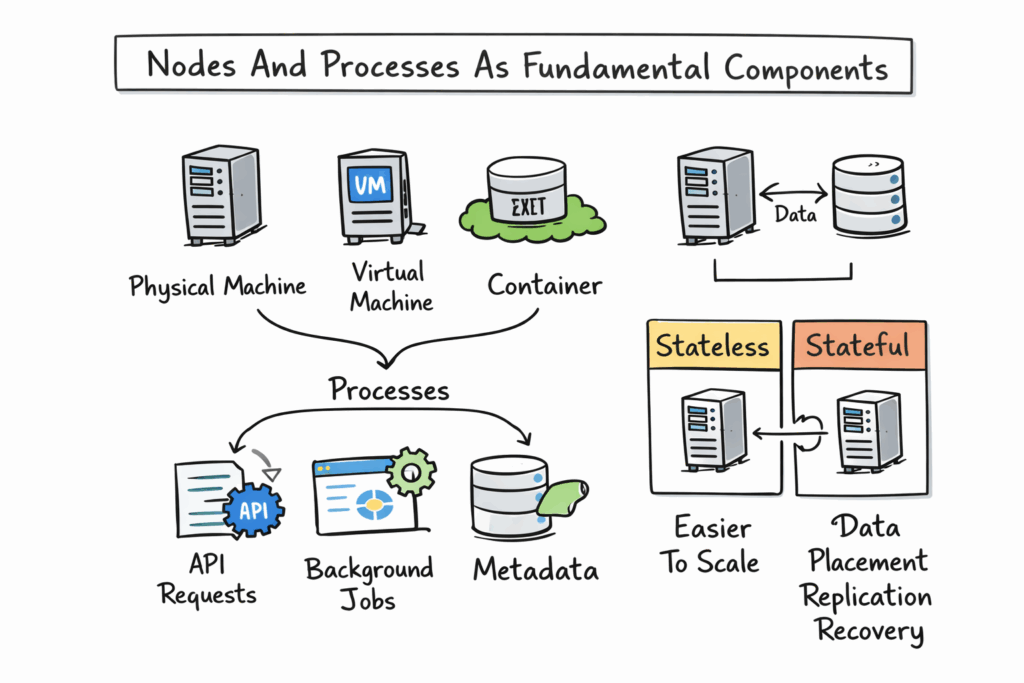
At the most basic level, a distributed system is made up of nodes. A node is any independent computing entity that participates in the system. Nodes can be physical machines, virtual machines, or containers running inside orchestration platforms.
Each node runs one or more processes. These processes perform specific roles, such as handling API requests, processing background jobs, or managing metadata. In interviews, it is important to clarify whether components are stateless or stateful because that distinction affects scalability and fault tolerance.
A System Design composed of stateless nodes can scale more easily, while stateful nodes require careful handling of data placement, replication, and recovery.
Communication Layers In Distributed Systems
Communication is one of the most critical distributed system components because everything depends on it working reliably under unpredictable conditions.
Network Communication
Nodes in distributed systems communicate over networks that introduce latency, packet loss, and partitions. These are not edge cases; they are expected realities. Distributed systems must be designed with the assumption that messages can be delayed, duplicated, or dropped.
In interviews, candidates are often evaluated on whether they explicitly account for network unreliability instead of assuming perfect communication.
Protocols And APIs
Communication typically happens using protocols such as HTTP, gRPC, or custom binary protocols. The choice of protocol affects performance, compatibility, and observability.
Interviewers may ask why one protocol is preferable over another, especially when discussing internal service-to-service communication versus public-facing APIs.
Load Balancers As Entry Points
Load balancers are often the first visible distributed system component in an architecture. They sit between clients and backend services and distribute incoming requests across multiple nodes.
From an interview standpoint, load balancers serve two purposes. They improve scalability by spreading traffic evenly, and they improve availability by routing traffic away from unhealthy nodes.
Load balancers can be implemented at different layers, and each choice introduces trade-offs. Understanding these trade-offs helps you justify architectural decisions during interviews.
The table below summarizes common load balancer types and their typical roles.
| Load Balancer Type | Operating Layer | Primary Benefit | Interview Relevance |
| Layer 4 | Transport | High throughput | Simple scaling scenarios |
| Layer 7 | Application | Intelligent routing | Advanced traffic control |
| Client-side | Application | Reduced bottlenecks | Microservices architectures |
Data Storage Components
Data storage is one of the most complex areas of distributed System Design because data must remain accessible, consistent, and durable despite failures.
Databases And Data Stores
Distributed systems often use multiple types of data stores rather than relying on a single database. Relational databases, NoSQL stores, key-value stores, and time-series databases may coexist in the same system.
In interviews, candidates should focus less on naming products and more on explaining why a particular data model fits the use case.
Replication And Sharding
Replication ensures that data exists in multiple locations, improving availability and fault tolerance. Sharding divides data across nodes to improve scalability.
These two mechanisms often work together but introduce complexity in consistency management. Interviewers frequently probe how replicas are synchronized and how shard rebalancing is handled during growth.
Caching As A Performance Component
Caching is a critical distributed system component for improving latency and reducing load on backend services.
Caches can exist at multiple levels, including client-side caches, edge caches, and server-side caches. Each level serves a different purpose and has different invalidation challenges.
In System Design interviews, caching often appears as a follow-up question after performance issues are identified. Candidates who proactively introduce caching demonstrate foresight and practical experience.
Service Discovery And Configuration Management
As systems grow, hardcoding service locations becomes impossible. Service discovery components allow services to find each other dynamically.
Configuration management systems store shared configuration data such as feature flags, database endpoints, and rate limits. These systems must themselves be highly available because many services depend on them.
Interviewers may ask how services discover each other during startup or how configuration changes are rolled out safely across a fleet of nodes.
Coordination And Consensus Components
Certain distributed system components exist specifically to manage coordination across nodes.
Leader Election
Leader election ensures that a single node performs a critical role at any given time, such as coordinating writes or managing metadata. This avoids conflicts but introduces dependencies on consensus algorithms.
In interviews, leader election often comes up when discussing databases, schedulers, or distributed locks.
Distributed Locks And Coordination Services
Coordination services help manage the shared state across nodes. They are used for tasks such as leader election, distributed locking, and membership tracking.
Interviewers typically care more about why coordination is needed than about the specific algorithms involved, although familiarity with consensus concepts strengthens your answer.
Messaging And Asynchronous Processing Components
Asynchronous messaging components decouple producers from consumers, improving system resilience and scalability.
Message queues and event streams allow systems to absorb traffic spikes and recover gracefully from partial failures. They also enable eventual consistency by allowing components to process events independently.
In interviews, asynchronous components often distinguish strong candidates from average ones because they demonstrate an understanding of real-world failure handling.
The table below compares common messaging models from a design perspective.
| Messaging Model | Delivery Guarantee | Typical Use Case | Interview Signal |
| Queue-based | At least once | Task processing | Reliability focus |
| Pub-sub | At most once | Event propagation | Scalability focus |
| Stream-based | Exactly once (configurable) | Data pipelines | Advanced design maturity |
Monitoring And Observability Components
A distributed system that cannot be observed cannot be reliably operated. Monitoring components collect metrics, logs, and traces that provide insight into system behavior.
From an interview perspective, observability is often overlooked by candidates, but mentioning it explicitly shows real-world experience. Interviewers may ask how you would detect failures, diagnose latency issues, or measure system health.
Fault Tolerance And Recovery Components
Fault tolerance is not a single component but a collection of mechanisms embedded throughout the system.
Retries, timeouts, circuit breakers, and health checks work together to prevent failures from cascading. Recovery mechanisms such as failover and data restoration ensure that the system can return to a healthy state after disruptions.
Interviewers frequently ask failure-based questions to see whether candidates think defensively rather than optimistically.
Security As A Distributed System Component
Security is often implicit but still an essential component of distributed systems.
Authentication, authorization, encryption, and rate limiting protect systems from misuse and abuse. In interviews, security typically appears as a follow-up concern rather than the primary focus, but acknowledging it strengthens your design.
How Distributed System Components Work Together
The most important interview skill is not listing components but explaining how they interact. Load balancers route traffic to stateless services, which communicate through APIs, retrieve data from distributed stores, and publish events to messaging systems. Coordination services manage shared state, while monitoring systems observe everything continuously.
Candidates who can narrate this flow clearly demonstrate systems thinking rather than fragmented knowledge.
Common Interview Mistakes When Discussing Components
One common mistake is treating distributed system components as interchangeable building blocks without acknowledging trade-offs. Another is ignoring operational concerns such as monitoring and failure recovery.
Interviewers are less interested in perfect architectures and more interested in thoughtful reasoning grounded in realistic constraints.
Conclusion
Distributed system components form the foundation of scalable, resilient architectures and are central to System Design interviews. Understanding what each component does, why it exists, and how it interacts with others allows you to reason clearly under interview pressure.
Rather than memorizing tools or diagrams, focus on building intuition. Practice explaining how components behave during failures, how they scale with traffic, and how trade-offs affect user experience. This mindset not only improves interview performance but also reflects how real-world systems are designed and operated.