

One of the hardest parts of a System Design interview is not the architecture itself. It’s learning how to think clearly while the problem keeps expanding in front of you.
You begin with a vague prompt like:
“Design a feed system.”
“Design a notification platform.”
“Design a scalable chat service.”
Then suddenly you’re juggling scalability, latency, databases, caching, and so much more, all while trying to communicate your thinking coherently under pressure. That’s why strong System Design interviews are rarely about memorizing architectures.
They’re about building a repeatable decision-making process.

The best candidates consistently turn messy prompts into structured engineering conversations. They clarify requirements, define constraints, identify bottlenecks, explain trade-offs, and evolve systems gradually instead of throwing random distributed systems buzzwords at the whiteboard.
This blog walks through a reusable System Design blueprint you can apply across many interview categories, including feeds, chat systems, notifications, live comments, and more.
The goal is not to memorize one perfect architecture. The goal is to develop a framework that helps you stay calm, structured, and requirements-driven, no matter what prompt appears in the interview.
Why a System Design blueprint matters
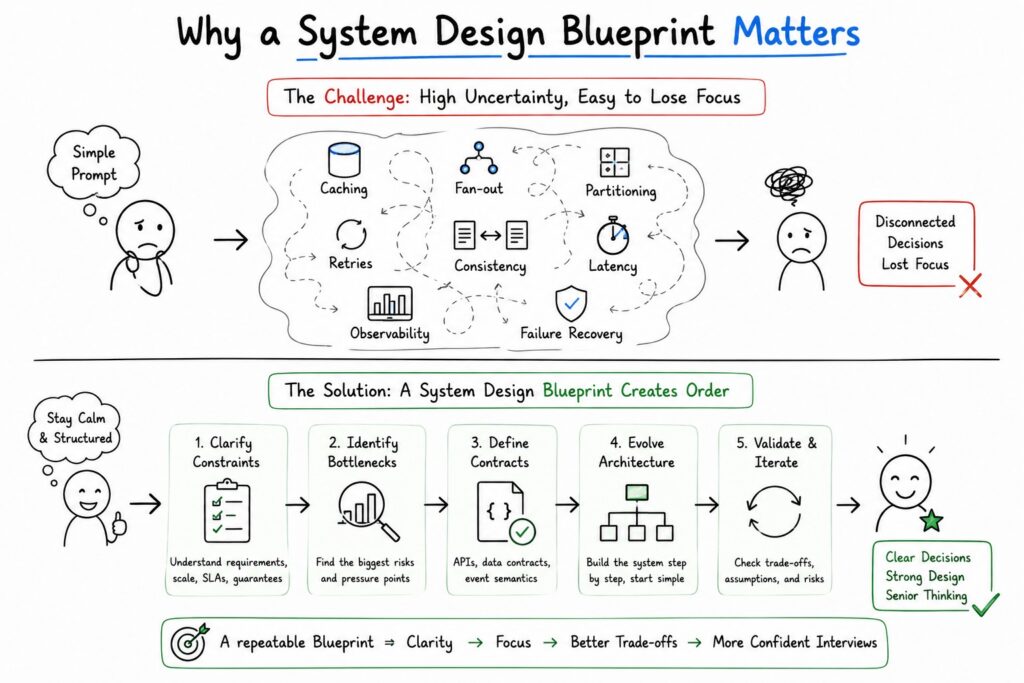
One of the biggest challenges in System Design interviews is handling uncertainty while remaining calm and structured. A prompt may sound simple initially, but within minutes, you are suddenly discussing caching, fan-out, partitioning, retries, consistency, latency, observability, and failure recovery all at once. Without a repeatable System Design blueprint, many candidates lose focus and begin making disconnected engineering decisions.
A good System Design blueprint creates order within that complexity. Instead of reacting emotionally to every new requirement, you move through the interview systematically by clarifying constraints, identifying bottlenecks, defining contracts, and evolving the architecture step by step. That structure immediately makes your interview feel more senior and deliberate.
System Design interviews reward decision-making
A common misconception is that System Design interviews reward the most complicated architecture. In practice, interviewers usually prefer candidates who build systems incrementally and justify every major decision clearly. A strong System Design blueprint helps you avoid unnecessary complexity by tying every architectural choice back to specific requirements.
For example, a read-heavy feed system requires different optimizations than a correctness-sensitive payment platform. The strongest candidates explain why they prioritize caching, replayability, sequencing, or durability depending on the operational needs of the system. That adaptability is far more valuable than memorizing infrastructure components.
The real skill behind System Design interviews
The highest-signal skill in a System Design interview is producing the right engineering artifacts in the correct order. Strong candidates first reduce ambiguity, then establish a minimal working architecture, and only afterward begin discussing scaling strategies, operational risks, and failure handling. This sequence is the foundation of an effective System Design blueprint.
Candidates who skip this sequence often struggle later in the interview. They start discussing databases, queues, and microservices before understanding traffic patterns or correctness requirements. That usually leads to architectures that feel disconnected from the actual problem being solved.
| Interview Phase | Primary Goal | Why It Matters |
|---|---|---|
| Clarification | Define requirements and constraints | Prevents overbuilding |
| Core Architecture | Establish system backbone | Creates structure |
| Interfaces | Define APIs and contracts | Makes interactions explicit |
| Scaling | Identify bottlenecks | Demonstrates maturity |
| Reliability | Handle failures and correctness | Shows operational thinking |
| Observability | Define metrics and SLOs | Proves operability |
A strong System Design blueprint helps you move through these phases naturally instead of treating the interview like a random brainstorming session.
The first 10 minutes shape the entire interview
The opening phase of the interview is where many candidates either establish control or accidentally create confusion that follows them for the next hour. A strong System Design blueprint always begins with scoping because architecture decisions are meaningless without clear constraints. The goal is to transform a vague prompt into a concrete engineering contract.
For example, if the interviewer says:
“Design a scalable notification system.”
You immediately need to clarify traffic scale, latency expectations, delivery guarantees, ordering requirements, and durability expectations. Those answers determine whether the architecture becomes heavily asynchronous, strongly consistent, globally distributed, or optimized for throughput.
Strong candidates also summarize the scoped requirements aloud before drawing anything. This creates alignment with the interviewer and prevents unnecessary architectural complexity later in the discussion.
Requirements should drive architecture
One of the clearest indicators of senior engineering thinking is the ability to connect requirement gathering directly to design decisions. A strong System Design blueprint never treats architecture patterns as universal solutions. Instead, every component exists for a clearly stated operational reason.
For example, learning that a system handles millions of reads per second immediately increases the importance of caching and materialized views. Discovering that ordering guarantees matter may shift the architecture toward append-only logs and partition-aware sequencing. Requirements shape the system, not the other way around.
| Requirement Type | Architectural Impact |
|---|---|
| Read-heavy traffic | Caching and precomputation |
| High fan-out | Pub/sub and batching |
| Strict ordering | Sequence-aware partitions |
| Strong durability | Replayable event logs |
| Low latency | Edge caching and async workflows |
| Correctness-sensitive operations | Idempotency and audit trails |
This requirement-driven approach is one of the most valuable aspects of a reusable System Design blueprint.
Most distributed systems reuse similar patterns
One of the biggest breakthroughs in learning System Design is realizing that many large-scale systems are variations of the same architectural ideas. Feeds, chat systems, notifications, live comments, and event pipelines often rely on surprisingly similar distributed systems concepts underneath. A strong System Design blueprint helps you recognize those reusable patterns quickly.
For example, many scalable systems revolve around append-only logs, asynchronous event processing, fan-out pipelines, materialized read models, or replayable streams. Once you understand these foundational shapes, new interview prompts become much easier to reason about because you are adapting patterns instead of inventing architectures from scratch.
The strongest candidates do not sound memorized while using these patterns. They explain why a particular architectural spine matches the requirements gathered earlier in the interview.
Choosing the right backbone for the system
Every strong System Design interview eventually establishes a dominant architectural “spine” for the system. This backbone becomes the organizing principle that ties the rest of the architecture together. A consistent System Design blueprint helps you identify that backbone early without overcomplicating the design.
For feed systems, the backbone is often a materialized read model optimized for fast retrieval. For chat systems, the backbone may become an append-only stream with ordering guarantees. For payment platforms, the backbone is usually a correctness-first transactional model with durable auditability.
| System Category | Common Backbone | Main Engineering Concern |
|---|---|---|
| Feed Systems | Materialized views | Read scalability |
| Chat Systems | Append-only streams | Ordering guarantees |
| Notifications | Event pipelines | Fan-out reliability |
| Live Comments | Pub/sub infrastructure | Broadcast scale |
| Payments | Transaction state machines | Correctness |
A good System Design blueprint allows you to explain these trade-offs calmly instead of jumping randomly between technologies.
Interfaces make architectures feel real
Many candidates draw architecture diagrams without ever explaining how the components actually communicate. This creates vague system discussions that feel theoretical instead of operational. A strong System Design blueprint solves this by defining explicit interfaces early in the interview.
For example, defining APIs, event contracts, replay semantics, or sequencing guarantees immediately makes the architecture more concrete. Interviewers can now evaluate how data moves through the system rather than simply looking at disconnected infrastructure boxes.
Strong candidates also explain what guarantees the interfaces provide. If the system uses at-least-once delivery, they explain how deduplication works. If ordering matters, they explain how sequencing is enforced consistently across distributed components.
Scaling discussions should focus on bottlenecks
One of the biggest mistakes candidates make is turning scaling discussions into technology shopping lists. They rapidly mention Redis, Kafka, Cassandra, Kubernetes, and microservices without identifying what operational pressure actually exists. A practical System Design blueprint always starts scaling discussions by asking:
“What breaks first?”
For a feed system, expensive ranking queries may become the bottleneck. For chat systems, WebSocket fan-out may dominate resource consumption. For notification platforms, burst traffic during event spikes may overwhelm downstream consumers.
Once the bottleneck becomes clear, the rest of the scaling discussion feels grounded and intentional instead of random.
| Scaling Problem | Common Mitigation |
|---|---|
| Queue lag | Consumer autoscaling |
| Hot partitions | Shard splitting |
| Tail latency spikes | Load shedding |
| Cache misses | Precomputation and warming |
| Gateway saturation | Backpressure management |
A strong System Design blueprint always ties mitigation strategies back to the operational problem being solved.
Graceful degradation demonstrates seniority
One of the clearest differences between junior and senior System Design answers is how candidates think about failures. Junior candidates often design systems as though every dependency behaves perfectly forever. Senior candidates assume outages, retries, duplication, and saturation are normal operating conditions.
A mature System Design blueprint defines which guarantees are sacred and which features can degrade under pressure. For example, a system may temporarily sacrifice recommendation freshness or real-time updates while preserving durability and correctness. That prioritization demonstrates real operational thinking.
Interviewers pay close attention to how candidates handle failure scenarios because that is where distributed systems become realistic instead of theoretical.
Correctness is where distributed systems become real
Correctness discussions often separate average System Design interviews from truly strong ones. Scaling a system is relatively straightforward compared to keeping it correct under retries, duplicate delivery, partial failures, and ordering issues. A reliable System Design blueprint always includes explicit correctness strategies.
Strong candidates discuss concepts like idempotency keys, replayable logs, sequence numbers, deduplication, audit trails, and reconciliation jobs naturally. These ideas demonstrate operational maturity because they acknowledge that distributed systems inherently produce duplicate events and inconsistent timing.
The best System Design interviews do not pretend failures are rare edge cases. They treat retries, crashes, and replay as normal parts of operating a distributed infrastructure at scale.
| Correctness Challenge | Common Solution |
|---|---|
| Duplicate writes | Idempotency keys |
| Duplicate delivery | Deduplication by sequence |
| Ordering problems | Partition-aware sequencing |
| Recovery after crashes | Durable replay logs |
| Auditing requirements | Append-only trails |
A practical System Design blueprint ensures you can discuss these trade-offs confidently across many interview categories.
Data modeling should follow access patterns
One of the most common interview mistakes is designing storage schemas before understanding how the data will actually be accessed. A strong System Design blueprint begins with query patterns first and storage choices second.
For example, feed systems optimize for ranked retrieval and pagination. Chat systems optimize for ordered message access. Notification systems optimize for user-specific filtering and status updates. The schema should always align with the dominant operational path.
This approach makes scaling decisions more natural because the storage model already matches the workload shape.
Observability is part of the architecture
Many candidates treat observability as an afterthought, but experienced engineers know observability is how systems remain operable in production. A mature System Design blueprint always includes metrics, SLOs, saturation indicators, and queue monitoring.
Strong candidates discuss latency per stage instead of relying solely on end-to-end metrics. They mention queue lag, cache hit rates, fan-out success rates, and resource saturation because these signals help identify operational problems before incidents escalate.
Interviewers often interpret strong observability discussions as evidence of real-world engineering experience.
| Observability Area | Example Metric |
|---|---|
| Latency | p95 request duration |
| Reliability | Error rate percentage |
| Saturation | Queue depth and CPU |
| Caching | Cache hit ratio |
| Streaming | Consumer lag |
| Fan-out | Delivery success rate |
A complete System Design blueprint does not stop at architecture diagrams. It explains how the system is monitored, debugged, and operated over time.
Closing perspective
A reusable System Design blueprint is not about removing creativity from System Design interviews. It is about ensuring you consistently focus on the highest-signal engineering discussions: requirements, bottlenecks, trade-offs, reliability, correctness, and observability.
The strongest candidates sound calm because they are not improvising randomly. They follow a repeatable process that keeps the interview organized even when the prompt becomes complex or the interviewer introduces curveballs.
With enough repetition, a strong System Design blueprint becomes second nature. You stop trying to memorize architectures and start thinking like an engineer designing systems that must scale, survive failures, and remain operable under real production pressure.