
Distributed systems are powerful because they allow applications to scale, remain available, and serve users across the globe. At the same time, they are notoriously difficult to design and reason about. The moment a system is distributed across multiple machines, a new class of problems emerges that simply does not exist in single-node systems.
In System Design interviews, interviewers are rarely interested in whether you can name these challenges. Instead, they want to see whether you instinctively account for them while designing a system. Strong candidates treat distributed system challenges as default assumptions rather than rare edge cases.
This blog walks through the most important challenges in distributed systems, explains why they occur, and shows how interviewers evaluate your understanding of them during System Design interviews.
Why Distributed Systems Are Hard By Nature
The core difficulty of distributed systems lies in the fact that they operate in an environment you do not fully control. Machines fail independently, networks behave unpredictably, clocks drift, and workloads change constantly. Unlike local programs, distributed systems must function correctly even when parts of the system are slow, unavailable, or behaving incorrectly.
In interviews, candidates who assume perfect conditions are often gently pushed into failure scenarios. Those who proactively acknowledge uncertainty and design defensively tend to perform significantly better.
Network Unreliability As A Fundamental Challenge
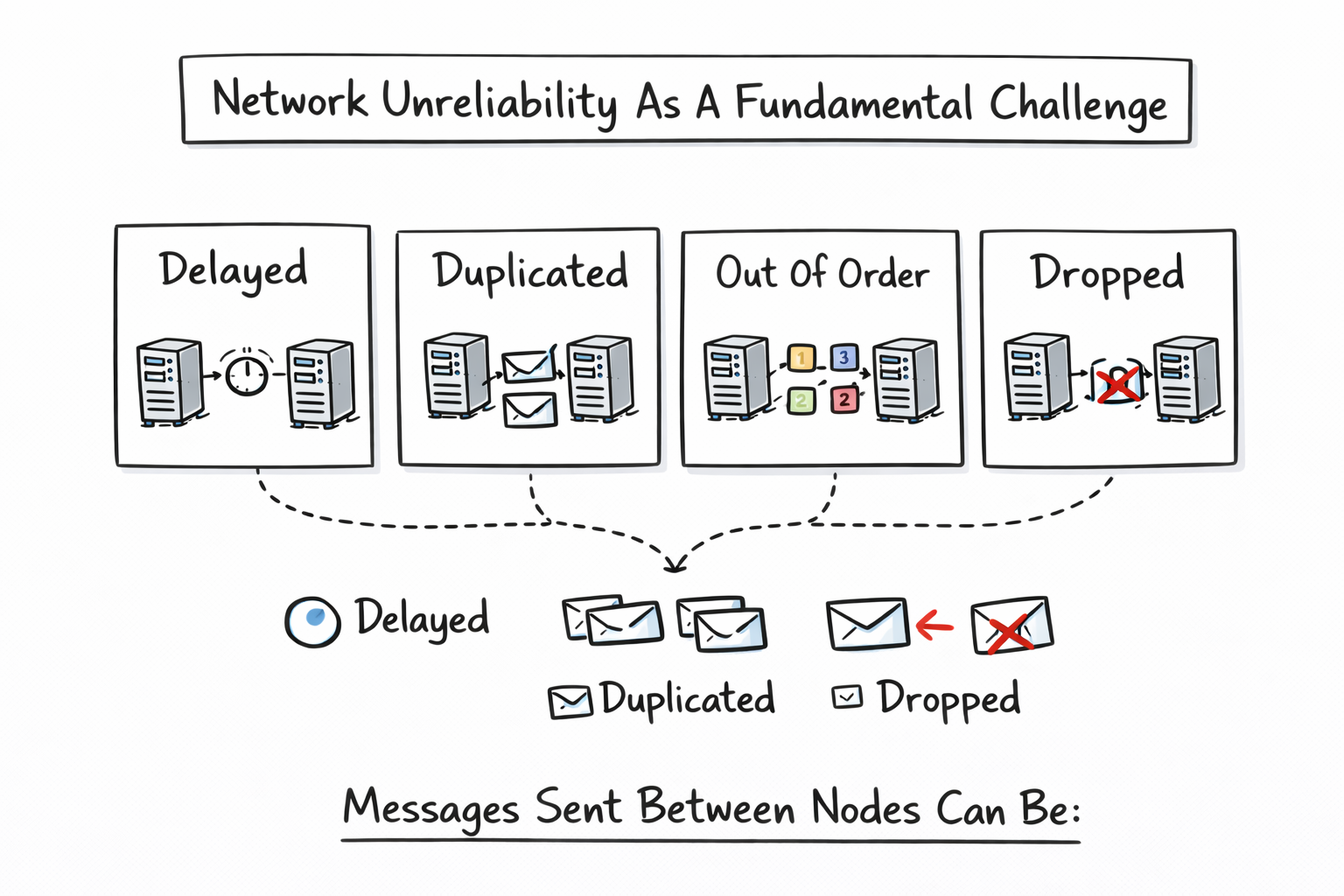
One of the most critical challenges in distributed System Design is unreliable network communication. Messages sent between nodes can be delayed, duplicated, delivered out of order, or dropped entirely.
Latency And Variability
Network latency is not just about speed; it is about unpredictability. A request that usually takes a few milliseconds may occasionally take seconds. This variability makes it difficult to reason about system behavior and requires careful timeout and retry strategies.
In interviews, candidates are often evaluated on whether they design systems that tolerate slow responses instead of blocking indefinitely.
Network Partitions
A network partition occurs when nodes are unable to communicate with each other, even though they are still running. From the perspective of each side, the other may appear to have failed.
Interviewers often use partitions to test whether candidates understand trade-offs between availability and consistency in distributed systems.
Partial Failures And Fault Tolerance
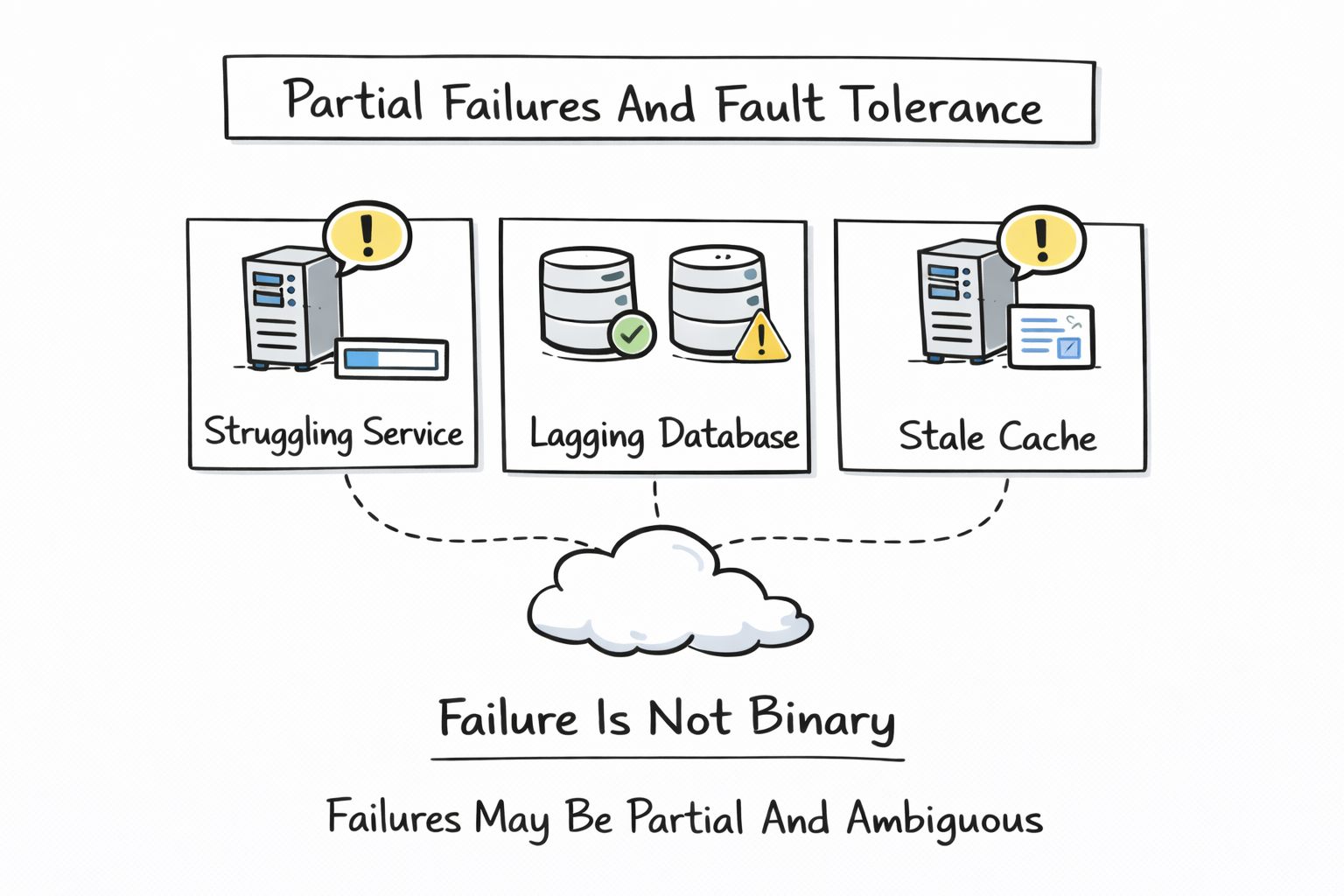
In distributed systems, failure is not binary. Some components may be functioning correctly while others are failing. This phenomenon is known as partial failure and is one of the most difficult challenges to handle.
A service may be reachable but responding slowly. A database replica may be alive but lagging behind. A cache node may return stale data instead of failing outright.
In interviews, candidates who assume that failures are clean and obvious tend to struggle. Interviewers prefer candidates who acknowledge ambiguous failure states and design systems that can tolerate them gracefully.
Data Consistency Challenges
Maintaining consistent data across multiple nodes is one of the defining challenges in distributed systems.
Conflicting Writes And Replication Lag
When data is replicated across nodes, updates may reach replicas at different times. This can result in users seeing different versions of the same data depending on which replica they read from.
Interviewers often explore this challenge by asking how systems resolve conflicts or how they ensure users do not see incorrect or confusing states.
Consistency Models And Trade-Offs
Different systems choose different consistency guarantees based on their requirements. Strong consistency simplifies reasoning but increases latency and reduces availability. Eventual consistency improves performance and availability but requires applications to tolerate temporary inconsistency.
In System Design interviews, explicitly stating and justifying your consistency model demonstrates maturity and real-world experience.
The CAP Theorem In Practice
The CAP theorem is often cited as a theoretical concept, but its real value lies in practical decision-making.
Because network partitions are unavoidable, distributed systems must choose between consistency and availability during failures. This choice is not permanent; it may vary depending on the operation or system state.
Interviewers are less interested in hearing the definition of CAP and more interested in how you apply it when designing systems under failure conditions.
Scalability And Load Distribution Challenges
Scaling a distributed system is not just about adding more machines. It introduces challenges related to coordination, data distribution, and uneven load.
Hotspots And Uneven Traffic
Certain data items or services may receive disproportionately high traffic. These hotspots can overwhelm individual nodes even when the system as a whole has ample capacity.
Interviewers often ask how systems detect and mitigate hotspots, especially in designs involving sharding or partitioning.
Dynamic Scaling
Workloads in real systems fluctuate over time. Scaling up too slowly results in degraded performance, while scaling too aggressively wastes resources.
In interviews, candidates who consider dynamic scaling strategies demonstrate an understanding of real-world operational challenges.
Coordination And Consensus Challenges
Many distributed systems require nodes to agree on shared state, such as which node is the leader or which configuration version is active.
Leader Election Complexity
Leader election simplifies certain operations by assigning responsibility to a single node. However, electing and maintaining a leader introduces new failure modes.
Interviewers may ask what happens if a leader fails or how the system prevents multiple leaders from existing simultaneously.
Distributed Locks And Shared State
Distributed locks help coordinate access to shared resources, but they are notoriously difficult to implement correctly. Incorrect locking can lead to deadlocks, performance bottlenecks, or an inconsistent state.
Strong candidates recognize that minimizing coordination is often preferable to relying heavily on distributed locks.
Time And Clock Synchronization Issues
Time behaves differently in distributed systems than in single-machine environments. Each node has its own clock, and those clocks are never perfectly synchronized.
Clock Drift And Ordering
Clock drift can cause events to appear out of order when comparing timestamps from different nodes. This complicates tasks such as logging, debugging, and conflict resolution.
Interviewers may test whether candidates rely too heavily on timestamps without acknowledging their limitations.
Logical Versus Physical Time
Many distributed systems use logical clocks or versioning mechanisms to reason about ordering instead of relying solely on physical time.
Understanding this distinction signals deeper familiarity with distributed System Design.
Observability And Debugging Challenges
Debugging distributed systems is significantly harder than debugging single-node applications.
Failures may only occur under specific timing conditions or at high load. Logs are scattered across multiple machines, and reproducing issues locally may be impossible.
In interviews, mentioning observability components such as metrics, logs, and traces demonstrates operational awareness that many candidates overlook.
Data Durability And Recovery Challenges
Ensuring that data is not lost during failures is a critical challenge in distributed systems.
Hardware failures, software bugs, and operator errors can all result in data loss if systems are not designed with durability in mind.
Interviewers often ask how systems recover from catastrophic failures, such as data center outages, to assess whether candidates think beyond normal operation.
Security And Trust Boundaries
Distributed systems often span multiple networks, services, and teams. This introduces challenges related to authentication, authorization, and secure communication.
Trust boundaries must be clearly defined, and assumptions about internal traffic being safe can lead to serious vulnerabilities.
In interviews, acknowledging security considerations strengthens your design even if it is not the primary focus of the question.
Performance Versus Reliability Trade-Offs
Many challenges in distributed systems arise from competing goals. Improving performance may reduce reliability, while improving reliability may increase latency.
Strong candidates articulate these trade-offs clearly instead of presenting designs as universally optimal.
The table below summarizes common trade-offs interviewers expect candidates to recognize.
| Design Goal | Improvement Impact | Trade-Off Introduced |
| Low latency | Faster responses | Reduced consistency |
| High availability | Fewer outages | Stale data risk |
| Strong consistency | Predictable reads | Higher latency |
| High throughput | More parallelism | Coordination complexity |
Human And Operational Challenges
Distributed systems are built and operated by people, and human factors introduce their own challenges.
Configuration mistakes, misunderstood dependencies, and incomplete runbooks can cause outages even in well-designed systems.
Interviewers sometimes probe this area by asking how changes are rolled out safely or how incidents are handled.
How Interviewers Evaluate Your Understanding Of These Challenges
Interviewers rarely expect perfect solutions. Instead, they look for awareness and reasoning.
Candidates who proactively mention failure scenarios, trade-offs, and uncertainty signal that they understand distributed systems as living, evolving systems rather than static diagrams.
A design that acknowledges limitations is often more impressive than one that claims to solve everything.
Common Mistakes Candidates Make
One common mistake is treating distributed systems as scaled-up monoliths. Another is ignoring failure modes until prompted by the interviewer.
Candidates also frequently focus too much on tools and technologies instead of underlying principles, which weakens their answers.
Conclusion
Challenges in distributed systems are not incidental; they define the field. Network unreliability, partial failures, consistency trade-offs, coordination complexity, and operational difficulty are all inherent aspects of distributed design.
In System Design interviews, your goal is not to eliminate these challenges but to show that you understand them and design systems that work despite them. By treating uncertainty as a given and reasoning through trade-offs clearly, you demonstrate the mindset interviewers are looking for in engineers who work on large-scale systems.