
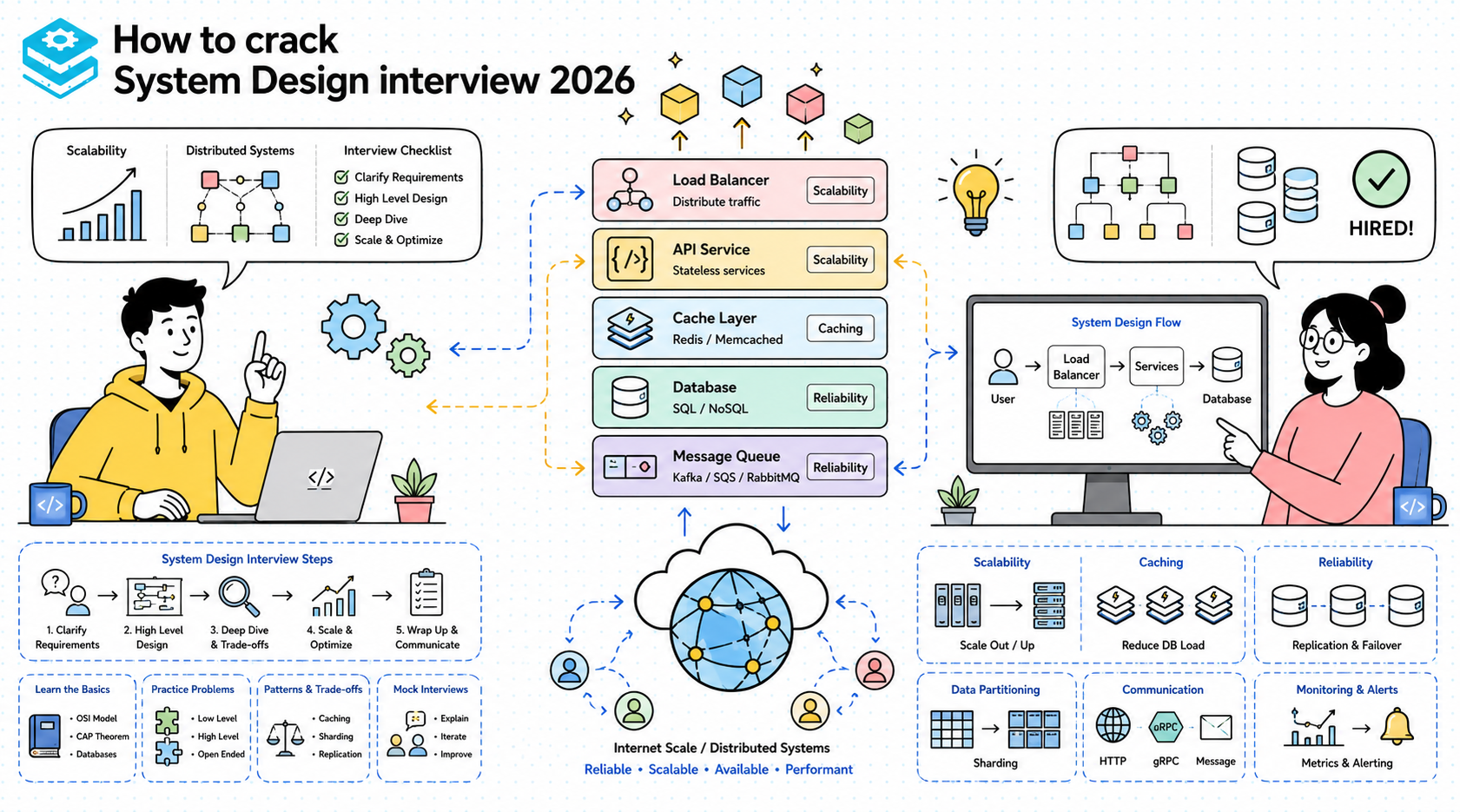
You’ve probably had this moment already: you open a system design prompt, stare at a blank page, and feel like you’re supposed to invent a distributed system on demand. That feeling is common, especially if most of your preparation so far has been coding interviews, not architecture conversations. System design interviews ask for a different kind of thinking. They expect you to reason through ambiguity, make trade-offs visible, and communicate clearly while building a solution in real time.
The bar has moved upward because interviews now feel closer to real engineering discussions than to whiteboard theory. Interviewers increasingly care about practical trade-offs, requirement clarification, and your ability to explain why one design choice is better than another in context. There is rarely a single perfect answer, and that is part of the challenge.
What has changed in System Design interviews by 2026
System design interviews have become more grounded in real systems and less tolerant of vague architecture talk. A few years ago, many candidates could get away with repeating familiar patterns like “add a load balancer, cache, and database replicas” without going much deeper. That is less effective now. Interviewers want to see whether you can connect those building blocks to actual product constraints such as cost, latency, availability, multi-region behavior, and operational simplicity. Trade-offs are no longer a bonus discussion at the end; they are central to the evaluation.
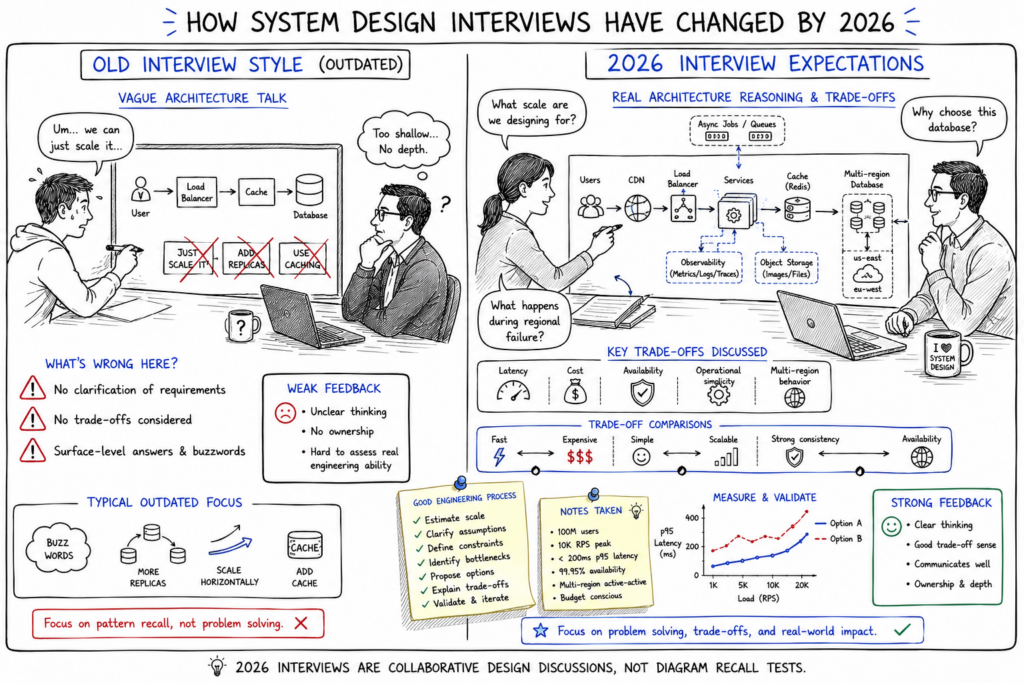
Communication expectations have also become sharper. Interviewers increasingly treat the session as a collaborative design review, not a monologue. That means strong candidates clarify requirements, state assumptions, estimate scale, and explain design choices as they go. In practice, the interview now tests whether you can structure a technical conversation under pressure, not just whether you know system design vocabulary. Sources that track recent interview patterns consistently emphasize structured thinking, requirement handling, and explicit trade-off discussion as key differentiators.
Reframing the goal: how to crack system design interview
A lot of candidates approach preparation as if they need to memorize five or ten famous architectures and then reproduce them on command. That strategy usually breaks down because interview prompts are designed to shift details, constraints, and priorities. A URL shortener with analytics is not the same problem as a URL shortener optimized for cost. A chat system with strict latency targets is not the same as one optimized for message durability. If you prepare only at the pattern-recognition level, you become fragile when the interviewer changes the shape of the problem.
A better goal is to think like a system designer rather than a memorizer of designs. That means learning how to move from requirements to architecture, from architecture to bottlenecks, and from bottlenecks to trade-offs. It also means accepting that there is no universally correct design, only a design that fits the constraints better than the alternatives. Once you internalize that, the interview becomes much less about performance theater and much more about structured reasoning.
Core skills you actually need
The first skill is a practical understanding of scalability and distributed systems. You do not need to become a distributed systems researcher, but you do need to know what happens when load increases, when a cache misses, when a region fails, or when writes and reads compete under different consistency models. Interviewers are listening for whether you understand concepts like partitioning, replication, load balancing, asynchronous processing, and failure handling as tools with costs, not as buzzwords. If your answer stops at naming components, it will sound thin. If it explains why those components exist and what problems they solve, it will sound much stronger.
The second skill is trade-off analysis. In real interviews, a technically valid design can still be weak if it ignores cost, complexity, or operational burden. The third skill is communication. You may know exactly what you mean, but unless the interviewer can follow your reasoning, that knowledge is hard to reward. Good system design performance usually comes from the combination of these three abilities: technical foundation, trade-off judgment, and clear articulation.
Understanding the interview structure
Most system design interviews follow a recognizable flow, even if the prompt changes. You usually begin by clarifying functional and non-functional requirements. Then you outline a high-level design with major components and data flow. After that, the interviewer often pulls you into deeper discussion around storage, scaling, bottlenecks, consistency, reliability, or specific product constraints. If you understand that flow, the interview becomes easier to manage because you stop treating it like an unpredictable performance.
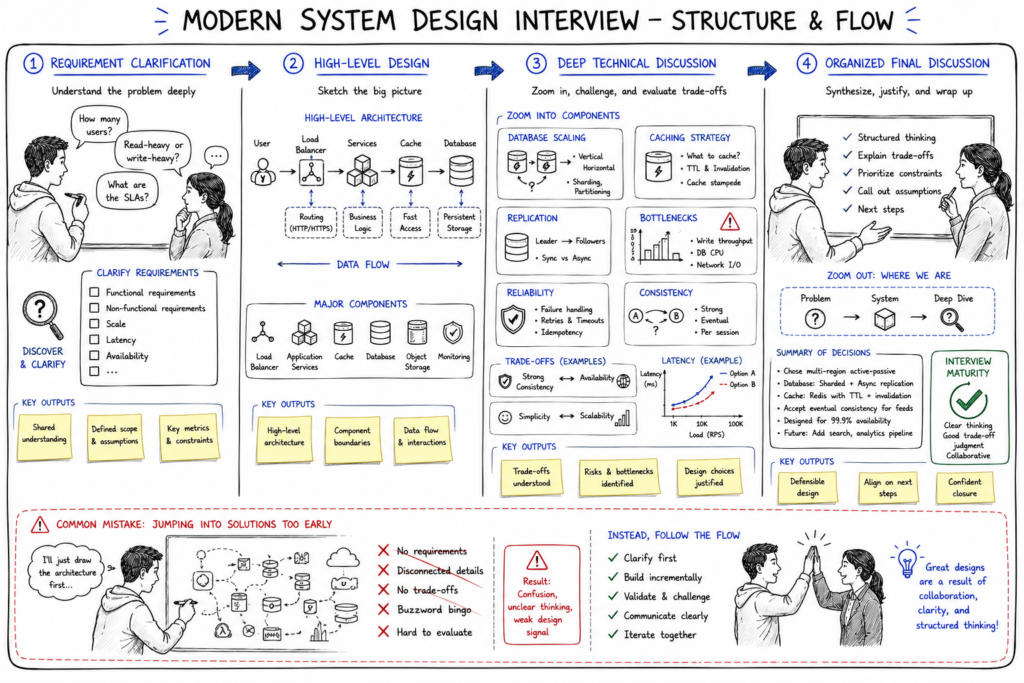
The mistake many candidates make is jumping directly into a solution before they have earned the right to do so. If you skip requirement clarification, you may optimize for the wrong goal. If you skip the high-level structure, your design can become a collection of disconnected details. The strongest answers feel organized because they match the natural progression of the conversation: define the problem, sketch the system, then zoom in where it matters. Interview guidance from recent system design prep sources keeps returning to this same point because it is one of the clearest signals of interview maturity.
Preparation approach comparison
| Preparation approach | Focus area | Depth of understanding | Interview performance | Confidence level |
|---|---|---|---|---|
| Poor preparation approach | Memorizing famous architectures and canned phrases | Shallow | Inconsistent, collapses under follow-up questions | Fragile |
| Average preparation approach | Learning core components and practicing a few common prompts | Moderate | Decent on familiar questions, weaker on trade-offs | Mixed |
| Strong preparation approach | Requirements, architecture reasoning, trade-offs, and realistic discussion practice | High | Adaptable, structured, and persuasive | Stable |
What separates strong candidates is not that they know more diagrams. It is that they understand why designs evolve the way they do. A weak candidate often sounds prepared only at the surface level. They can mention Kafka, Redis, sharding, and CDNs, but they cannot justify when those choices are necessary or what pain they introduce. An average candidate can handle common patterns but becomes less convincing when the interviewer changes the assumptions.
A strong candidate is different because they can adapt. They start with the simplest workable system, then expand it in response to scale, reliability, or cost constraints. That progression feels natural because it mirrors real engineering decisions. This is the standard you should aim for: not just familiarity with systems, but fluency in how systems are reasoned about.
Building strong system design fundamentals
You do not need hundreds of concepts to become effective at system design interviews, but you do need a solid grip on the major building blocks. That includes load balancers, caches, databases, queues, CDNs, replication, sharding, indexes, and asynchronous processing. The important thing is not just recognizing these parts individually. It is understanding how they connect. A cache is not useful because “caches are fast.” It is useful because it changes read latency, reduces database pressure, and introduces consistency questions.
This is where many candidates underprepare. They learn what a queue is, but not when a queue is preferable to synchronous calls. They learn what replication is, but not how replication changes read/write behavior or recovery strategy. Strong fundamentals come from relational understanding. You should be able to explain how traffic enters a system, how data is stored and retrieved, where bottlenecks are likely to appear, and which component absorbs which kind of pressure. That level of connection is much more valuable than broad but shallow exposure.
Practicing with real-world problems
The most effective practice problems are the ones that force you to make design choices, not the ones that can be answered with a memorized template. Designing a URL shortener, chat service, news feed, file storage service, rate limiter, or notification system is useful because each one emphasizes different constraints. A URL shortener makes you think about scale and storage patterns. A chat system pushes you toward low-latency communication and message delivery concerns. A news feed introduces ranking, fan-out, and write/read asymmetry. The point is not to cover every prompt ever asked. It is to expose yourself to recurring classes of design tension.
You should also revisit the same problem more than once. Your first version of a chat system might be acceptable, but your second version should be better because you now think more clearly about ordering, connection management, and offline users. Iteration matters because system design skill grows through revision, not just exposure. When people ask how to crack system design interview 2026, one of the most useful answers is that you need repeated contact with the same classes of trade-offs until they stop feeling new. That is how pattern recognition becomes practical design judgment rather than memorized language.
Common mistakes candidates make
The first major mistake is jumping into solutions before understanding the requirements. This is usually driven by anxiety. Candidates want to prove they know something, so they start drawing architecture immediately. The result is often a design that solves a different problem than the one the interviewer intended. That creates a poor impression not because the candidate lacks technical knowledge, but because they showed weak judgment at the start of the conversation.
The second mistake is overcomplicating designs. Many candidates assume that more distributed components automatically mean a better answer. In reality, unnecessary complexity can make your design harder to explain, harder to operate, and less aligned with the stated requirements. The third mistake is ignoring trade-offs. If you mention replication without discussing consistency, or caching without discussing invalidation, or asynchronous processing without discussing eventual consistency, your answer feels incomplete. Interviewers notice that gap immediately because trade-offs are where architectural maturity becomes visible.
A practical preparation roadmap
Learning core concepts means building real understanding of storage models, scaling patterns, caching, queues, consistency, and reliability. This is not about reading a glossary. It is about knowing how these ideas behave in actual systems and how they affect one another. You should be able to answer practical questions like when to use a queue, why a cache might fail you, and what a write-heavy workload does to storage design. These concepts are the vocabulary of system design, but also its grammar.
Practicing structured designs means taking a problem, clarifying requirements, proposing a high-level architecture, and then drilling into critical decisions. Simulating interviews adds the communication layer that many candidates ignore until too late. It is one thing to think through a system quietly. It is another to explain it clearly while someone interrupts, asks for trade-offs, or pushes you into a corner case. That pressure is part of the skill. If your preparation never includes that dynamic, your interview performance may lag behind your actual knowledge.
How to think and communicate during the interview
During the interview, your job is not to impress with technical density. Your job is to make your thinking visible. Start by breaking the problem down into requirements and assumptions. Then move into a high-level design that the interviewer can visualize. After that, choose a few important areas to explore in depth, such as storage, scaling, or consistency. This structure matters because it gives the conversation shape. Without that structure, even a technically capable answer can feel chaotic.
You also need to explain decisions, not just announce them. If you choose a cache, explain what pressure it relieves and what complexity it adds. If you choose a relational database, explain why the access pattern justifies it. If the interviewer challenges your design, treat that as collaboration rather than attack. Strong candidates stay flexible, revise assumptions when needed, and show that they can reason under changing conditions. That is often more impressive than defending an original idea too rigidly.
Final tips for 2026 candidates
System design expectations in 2026 are unlikely to reward polished but shallow answers. Interviewers are increasingly interested in designs that feel operationally credible and product-aware. That means you should be ready to talk not only about scaling, but about cost, resilience, observability, and the real behavior of systems under imperfect conditions. The stronger your answer feels in those dimensions, the more likely it is to come across as modern and grounded.
You should also remember that clarity beats complexity. If you present a simpler architecture and explain it well, you will usually outperform a candidate who presents a more advanced architecture badly. Interviewers are not scoring diagram complexity. They are evaluating whether you understand how systems are built, where they fail, and how trade-offs should be explained. People often want a secret shortcut but there isn’t one. But there is a reliable path: structured thinking, repeated realistic practice, and the discipline to explain systems in a way that feels like real engineering.
Conclusion
If you take one thing from this guide, let it be this: success in system design interviews does not come from memorizing architectures. It comes from learning how to move from requirements to design, from design to trade-offs, and from trade-offs to a clear technical conversation.
The candidates who improve fastest are usually the ones who stop chasing “perfect answers” and start building repeatable thinking patterns. Learn the building blocks, practice with realistic prompts, simulate the interview environment, and keep refining how you explain your choices. That is not flashy advice, but it is the advice that works.
Happy learning!