

LeetCode has long been one of the most popular platforms for coding interview preparation, helping millions of software engineers practice algorithms and data structures. As System Design interviews have become increasingly important for mid-level and senior engineering roles, it was only natural for LeetCode to expand into this area as well. That has left many engineers asking whether its System Design course is worth adding to their interview preparation.
The answer depends on what you’re looking for. If you’re already familiar with LeetCode’s approach to learning, you may appreciate having both coding and System Design preparation within the same platform. On the other hand, System Design requires a very different way of thinking than coding interviews, so it’s important to evaluate the course on its own merits rather than assuming the LeetCode name guarantees a similar experience.
This guide takes a detailed look at what LeetCode’s System Design course offers, who it is designed for, where it performs well, and where you may want to supplement your preparation. The goal is to help you decide whether it deserves a place in your interview study plan.
How This Guide Evaluates the Course
Rather than focusing on marketing claims or ratings, this guide evaluates the course from the perspective of an interview candidate. The discussion looks at the course structure, teaching style, architectural depth, interview relevance, and overall learning experience to determine where it provides the most value.
What Is LeetCode’s System Design Course?
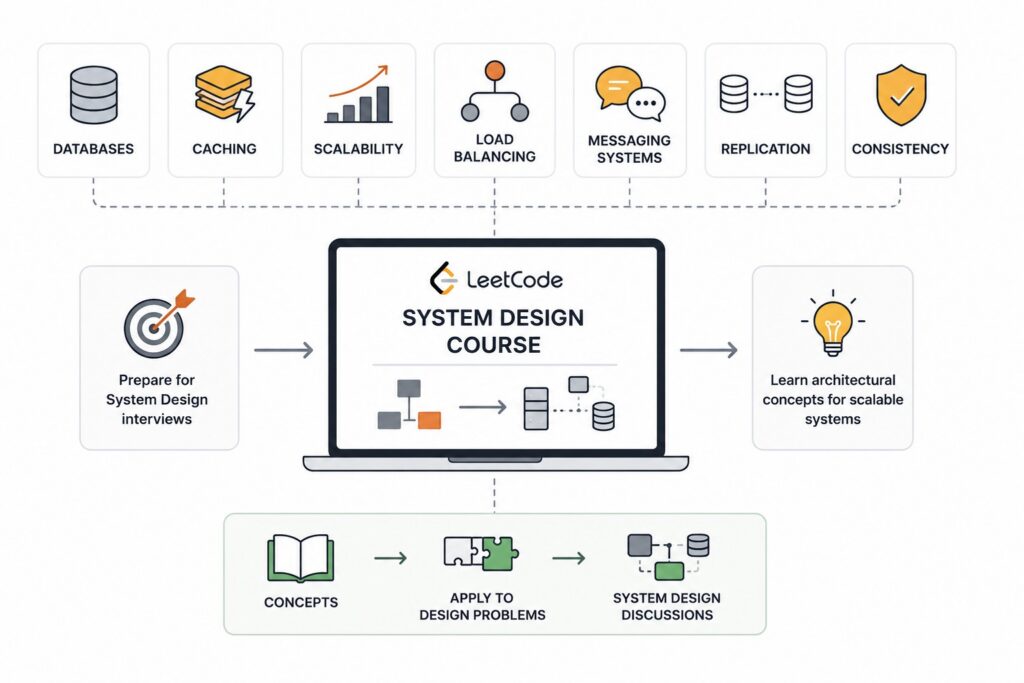
LeetCode’s System Design course is an interview preparation resource that teaches software engineers how to approach large-scale architecture problems commonly discussed during technical interviews. While LeetCode is best known for coding challenges, this course shifts the focus from writing algorithms to designing scalable, reliable, and distributed software systems.
Instead of concentrating on implementation details, the course explores the architectural concepts that appear repeatedly across modern distributed applications. Topics such as databases, caching, scalability, load balancing, messaging systems, replication, and consistency are introduced before being applied to complete System Design discussions.
Overview of the Course
The course is designed to complement LeetCode’s coding interview resources by addressing another major component of technical interviews. As engineers move toward senior software engineering roles, demonstrating architectural thinking becomes just as important as solving algorithmic problems.
Rather than treating every interview question as unique, the course emphasizes understanding common architectural patterns that can be adapted to different scenarios. This helps you develop a repeatable approach instead of relying on memorized solutions.
What the Course Covers
The curriculum focuses on the building blocks that appear in many large-scale systems. By understanding how these components interact, you gradually learn how complete architectures evolve from a collection of smaller design decisions.
The emphasis remains on reasoning through trade-offs rather than selecting technologies simply because they are commonly used. That approach reflects the kinds of discussions that typically take place during real interviews.
Who Created the Course?
The course is part of LeetCode’s growing educational platform, which has expanded beyond coding interview preparation into broader software engineering topics. It follows the same general philosophy of structured learning while adapting that approach to the unique challenges of System Design interviews.
Who Is It Designed For?
The primary audience consists of software engineers preparing for mid-level and senior technical interviews where System Design plays an important role. It is particularly relevant if you’ve already become comfortable solving coding problems and want to build confidence discussing scalable architectures.
| Feature | Overview |
|---|---|
| Primary Focus | System Design interview preparation |
| Learning Style | Structured online lessons |
| Best Audience | Mid-level and senior software engineers |
| Main Goal | Develop architectural thinking |
What’s Included in LeetCode’s System Design Course?
The course follows a structured progression that introduces core architectural concepts before combining them into complete interview scenarios. Rather than overwhelming learners with complex systems immediately, it gradually builds the foundation needed to understand larger distributed architectures.
This approach makes it easier to recognize recurring design patterns instead of viewing every interview question as an entirely new challenge. As you progress, individual concepts begin connecting together into reusable architectural frameworks.
Course Structure
The lessons generally begin with the fundamentals before moving toward complete design discussions. Early sections establish the vocabulary of distributed systems, while later sections demonstrate how those concepts work together to solve real scalability problems.
Each lesson builds upon previous material, allowing you to strengthen your understanding gradually instead of trying to absorb every concept simultaneously.
Topics Covered
Throughout the course, you’ll encounter discussions covering storage systems, scalability, databases, load balancing, replication, partitioning, caching, consistency, and messaging. These concepts appear repeatedly because they form the foundation of many modern distributed systems regardless of the application being designed.
Instead of focusing heavily on specific technologies, the course emphasizes architectural reasoning and understanding why particular design decisions are made.
Learning Experience
The overall learning experience is organized and approachable, making it suitable for engineers who already understand software development but have limited exposure to distributed systems. Visual diagrams help explain interactions between different components, while the structured progression keeps complex topics manageable.
The combination of explanations and architecture discussions encourages learners to think through design decisions instead of simply consuming technical information.
| Course Component | What You Can Expect |
|---|---|
| Core Topics | Scalability, databases, caching, messaging |
| Learning Flow | Fundamentals followed by design discussions |
| Teaching Style | Structured concept-first approach |
| Visual Content | Architecture diagrams and illustrations |
Who Is LeetCode’s System Design Course Best For?
The value of the course depends largely on your experience level and interview goals. Engineers at different stages of their careers often require different types of preparation, and understanding where you fit can help determine whether this course matches your needs.
LeetCode’s System Design course is aimed primarily at engineers transitioning from coding interviews toward architectural interviews. It helps bridge the gap between solving algorithmic problems and discussing large-scale software systems confidently.
Beginners
If you’re new to System Design, the structured lessons provide a clear introduction to many of the concepts that appear repeatedly in distributed systems. Learning the material in a logical order helps reduce the confusion that often comes from jumping between unrelated articles and videos.
Having some familiarity with backend development, databases, networking, and APIs will make the course considerably easier to follow because those topics serve as the foundation for larger architectural discussions.
Mid-Level Engineers
Mid-level software engineers preparing for senior interviews are likely to benefit the most from the course. At this stage of your career, interviewers increasingly evaluate architectural reasoning, scalability discussions, and your ability to justify design decisions rather than simply writing efficient code.
The course helps organize these concepts into a structured framework that can be applied consistently across many different interview questions.
Senior Engineers
Senior engineers may already recognize many of the distributed systems concepts covered throughout the lessons. For them, the primary value comes from refreshing interview skills, reviewing architectural patterns, and organizing existing knowledge into a more structured interview process.
Candidates preparing for highly advanced engineering roles should still expect to supplement their preparation with practical experience and broader architectural study.
| Experience Level | Suitability |
|---|---|
| Beginner | Good with backend fundamentals |
| Mid-Level Engineer | Excellent interview preparation |
| Senior Engineer | Strong refresher |
| Staff-Level Candidate | Helpful foundation with additional preparation |
Strengths of LeetCode’s System Design Course
One of the course’s biggest strengths is that it extends the familiar LeetCode learning experience into System Design. Engineers already using the platform for coding interview preparation can continue developing interview skills without switching to an entirely different learning environment.
The course also presents System Design concepts in a structured progression, making it easier to build confidence gradually rather than confronting large-scale architectures immediately.
Familiar Learning Platform
Many engineers already spend significant time using LeetCode for algorithm practice. Having System Design material available on the same platform creates a more consistent learning experience and allows candidates to prepare for multiple interview rounds in one place.
That familiarity also reduces the learning curve associated with navigating a completely new educational platform.
Structured Interview Preparation
The course focuses on the architectural thinking expected during interviews. Rather than emphasizing implementation details, it teaches you how to identify system requirements, discuss scalability, evaluate trade-offs, and communicate architectural decisions clearly.
This structured approach closely reflects the way many interviewers evaluate System Design candidates.
Clear Explanations and Practical Examples
Complex concepts are introduced gradually using diagrams and practical examples that demonstrate how different system components interact. By focusing on recurring architectural patterns, the course helps learners recognize similarities across different design problems instead of memorizing isolated solutions.
Over time, this pattern-based learning makes it easier to approach unfamiliar interview questions with confidence.
| Strength | Why It Matters |
|---|---|
| Familiar platform | Seamless interview preparation |
| Structured curriculum | Gradual learning progression |
| Interview-focused approach | Aligns with real interviews |
| Visual explanations | Simplifies distributed systems |
Weaknesses and Limitations
Although LeetCode’s System Design course provides a structured introduction to interview preparation, it is still only one part of a much broader learning journey. Like every educational resource, it makes decisions about which topics to prioritize and which ones learners will need to explore independently.
Understanding these limitations helps set realistic expectations and makes it easier to determine how the course fits into your overall preparation strategy.
Still Relatively New
Compared to some longer-established System Design resources, LeetCode’s course is still relatively new. As the platform continues expanding its educational offerings, the curriculum will likely continue evolving through additional examples, refinements, and updated content.
That ongoing development is encouraging, but it also means the course is still establishing its long-term reputation within the System Design community.
Practical Engineering Experience Cannot Be Replaced
Reading about distributed systems is fundamentally different from designing, operating, and maintaining production systems. Real engineering introduces monitoring, deployment, failure recovery, cost optimization, and operational trade-offs that no interview course can fully reproduce.
Courses provide valuable frameworks, but practical experience remains one of the most effective ways to strengthen architectural judgment.
One Course Is Never Enough
System Design covers an enormous range of topics, including networking, databases, operating systems, distributed computing, scalability, reliability, cloud infrastructure, and software architecture. Expecting any single course to provide complete mastery would be unrealistic.
The most successful candidates treat structured courses as a starting point while continuing to learn through practice, mock interviews, and exposure to real-world System Designs.
| Limitation | Impact |
|---|---|
| Newer curriculum | Continues to evolve |
| Interview-focused scope | Doesn’t replace production engineering |
| Limited practical experience | Hands-on learning remains important |
| Broad subject area | Continuous learning is essential |
LeetCode’s System Design Course vs Other Resources
LeetCode’s System Design course enters a space that already contains many well-established learning resources. Rather than asking whether it completely replaces those resources, it’s more useful to understand where it fits and what kind of learner benefits most from its approach.
One advantage of LeetCode is that many engineers are already using the platform for coding interview preparation. Having both coding and System Design content within the same ecosystem creates a more streamlined learning experience and reduces the need to switch between multiple platforms during interview preparation.
LeetCode vs Educative’s Original Grokking the System Design Interview
One of the most common comparisons is between LeetCode’s course and Educative’s original Grokking the System Design Interview. While both aim to prepare engineers for System Design interviews, they differ in maturity and teaching philosophy.
LeetCode provides a structured introduction to architectural concepts and interview thinking, but Educative’s original Grokking course remains the benchmark that many interview preparation resources are still compared against. Its structured methodology, pattern-based learning, and emphasis on interview frameworks continue to make it one of the strongest choices for engineers preparing specifically for System Design interview rounds.
LeetCode vs System Design Handbook
For engineers who want additional reading alongside a structured course, System Design Handbook works well as a free companion resource. Instead of replacing a course, it provides detailed guides that allow you to revisit individual concepts, explore additional architectures, and strengthen areas where you want more depth.
Using a structured course together with a reference library often creates a more balanced learning experience than relying entirely on either one by itself.
Which Resource Should You Choose?
The right choice ultimately depends on your goals. If you’re already using LeetCode extensively for coding interviews, keeping your preparation on the same platform may feel convenient. If your primary objective is maximizing System Design interview preparation, however, you should evaluate each resource based on its teaching approach, learning structure, and how well it matches the type of interviews you’re targeting.
| Resource | Best Use Case |
|---|---|
| LeetCode System Design | Interview preparation within the LeetCode ecosystem |
| Educative’s original Grokking the System Design Interview | Structured System Design interview preparation |
| System Design Handbook | Free reference and continued learning |
Is LeetCode’s System Design Course Enough to Pass Interviews?
This is one of the first questions most engineers ask before purchasing any interview course. While LeetCode’s System Design course provides a strong introduction to architectural thinking, completing it alone is unlikely to prepare you for every situation you’ll encounter during a real interview.
System Design interviews evaluate much more than technical knowledge. Interviewers want to see how you clarify requirements, estimate scale, discuss trade-offs, justify your decisions, and adapt your architecture when new constraints are introduced during the conversation.
What Interviewers Actually Evaluate
Strong interview performance comes from demonstrating clear reasoning rather than producing a perfect diagram. Interviewers are often more interested in how you think through problems than in the specific technologies you choose.
Candidates who ask thoughtful questions, communicate clearly, and explain the trade-offs behind their decisions generally perform better than candidates who simply reproduce familiar architectures.
Why Understanding Matters More Than Memorization
Many interview candidates spend too much time memorizing complete solutions for well-known System Design questions. That strategy often breaks down because interviewers deliberately change the problem or introduce new requirements halfway through the discussion.
A structured understanding of distributed systems allows you to adapt naturally as the conversation evolves instead of relying on previously memorized answers.
Building Confidence Through Practice
Reading about architecture is only the beginning. Explaining your designs aloud, receiving feedback, and practicing mock interviews are what gradually transform knowledge into interview confidence.
Every mock interview helps you improve your communication, identify weak areas, and become more comfortable thinking through complex architectural problems under pressure.
| Interview Skill | Best Way to Improve |
|---|---|
| Requirement gathering | Practice realistic interview scenarios |
| Communication | Explain architectures aloud |
| Trade-off analysis | Solve varied design problems |
| Confidence | Participate in mock interviews |
A Better Roadmap for Learning System Design
Preparing for System Design interviews is usually most effective when you approach it as a series of learning stages rather than trying to master everything at once. Each stage builds on the previous one, gradually improving both your technical understanding and your interview communication skills.
Instead of searching for a single resource that covers every topic, it’s often better to focus on developing a strong foundation before expanding into more advanced architectural discussions.
Build a Strong Foundation
Your first goal should be understanding the core concepts that appear repeatedly across distributed systems. Topics such as scalability, caching, storage, replication, messaging, partitioning, and consistency form the foundation of countless interview questions.
Once those ideas become familiar, solving larger architecture problems becomes significantly easier because you’re combining concepts you already understand instead of learning everything simultaneously.
Practice Complete Interview Questions
After building your foundation, it’s important to practice complete design discussions rather than studying concepts individually. Solving realistic interview questions helps you develop a repeatable process for gathering requirements, identifying bottlenecks, and communicating architectural decisions.
This stage is where technical knowledge gradually turns into interview skill.
Reinforce Your Knowledge
Revisiting previously learned concepts is just as important as learning new ones. Reading additional explanations, reviewing architectures, and studying different solutions helps deepen your understanding and prevents important concepts from fading over time.
Consistent revision also makes it easier to recognize recurring architectural patterns across different interview questions.
Continue Learning Beyond Interviews
No single resource covers every aspect of system design, which is why many experienced engineers combine a structured course with high-quality reference material and practical reading. The following resources complement one another and help build both interview skills and long-term architectural understanding.
Educative’s Original Grokking the System Design Interview
If your primary goal is interview preparation, Educative’s original Grokking the System Design Interview remains one of the strongest structured courses available. Its step-by-step approach to requirement gathering, scalability, trade-offs, and common design patterns has made it a long-standing benchmark for system design interview preparation.
System Design Handbook
System Design Handbook is an excellent free companion resource for reviewing concepts and exploring detailed guides on distributed systems, architecture patterns, databases, caching, messaging systems, and complete system design examples. It’s particularly useful when you want to reinforce concepts after completing a structured course.
Complete Guide to System Design (Dev.to)
The Complete Guide to System Design on Dev.to by Fahim ul Haq provides a practical roadmap for learning the subject from the ground up. It connects core concepts into a structured learning path, making it a valuable starting point for engineers who want an overview before diving into more specialized topics.
System Design Primer (Dev.to)
The System Design Primer on Dev.to by Educative offers concise explanations of essential distributed systems concepts and common interview topics. It’s well-suited for quick revision before interviews or for refreshing your understanding of fundamental architectural principles.
Frequently Asked Questions
Before purchasing LeetCode’s System Design course, most engineers have similar concerns about whether it matches their experience level and interview goals. While every learner’s situation is different, the following questions come up repeatedly among software engineers evaluating the course.
The answers below build on the topics covered throughout this guide and should help you decide whether the course fits your preparation strategy.
Is LeetCode’s System Design course worth the money?
For many engineers, yes. If you’re already using LeetCode for coding interview preparation, having System Design material available within the same platform creates a convenient and organized learning experience. The structured curriculum also removes much of the uncertainty involved in deciding what to study next.
Is it good for beginners?
Yes, particularly if you already have a basic understanding of backend development. Familiarity with APIs, databases, networking, and software architecture fundamentals makes it much easier to understand the larger distributed systems discussed throughout the course.
Is it enough by itself?
Probably not. Like every interview preparation course, it provides a strong foundation but cannot replace mock interviews, practical experience, and repeated exposure to different architectural problems. Interview confidence develops through practice rather than course completion alone.
How does it compare to other System Design courses?
LeetCode’s course offers a structured introduction to System Design within a platform that many engineers already know well. However, engineers whose primary goal is interview preparation should carefully compare the course structure, teaching style, and interview focus before making a decision.
Does it help with FAANG interviews?
Yes. The course teaches many of the architectural concepts and design patterns that frequently appear during interviews at large technology companies. While success ultimately depends on your preparation and communication skills, the material aligns well with common interview expectations.
Is the course regularly updated?
As a relatively new offering, the course continues to evolve as LeetCode expands its educational content. That ongoing development should help keep the material relevant as interview expectations and industry practices continue changing.
Final Verdict: Is LeetCode’s System Design Course Worth It?
LeetCode’s System Design course is a valuable addition to the platform’s interview preparation ecosystem. It provides a structured introduction to distributed systems, encourages architectural thinking, and helps engineers transition from coding interview preparation toward larger System Design discussions.
Its greatest advantage is convenience. Engineers who already rely on LeetCode for coding interviews can continue preparing for System Design without leaving the platform, making it easier to organize their overall interview study plan.
At the same time, it is important to remember that System Design is an enormous subject. No course can teach every architectural pattern or prepare you for every interview scenario. Long-term success still depends on practice, repeated design discussions, and continued exposure to real-world engineering problems.
Overall Evaluation
| Category | Rating |
|---|---|
| Beginner Friendliness | Excellent |
| Learning Structure | Very Good |
| Interview Preparation | Very Good |
| Architectural Reasoning | Very Good |
| Technical Depth | Good |
| Long-Term Value | Very Good |
| Overall Recommendation | A strong choice for LeetCode users preparing for interviews |
Let’s Discuss
LeetCode has successfully extended its interview preparation platform beyond coding challenges into System Design, giving software engineers another structured way to prepare for technical interviews. The course introduces many of the concepts that repeatedly appear during System Design rounds while encouraging learners to think about architectural trade-offs instead of memorizing predefined solutions.
Like any educational resource, however, the course works best when combined with consistent practice and continued learning. Interview success comes from developing the ability to communicate your ideas clearly, adapt to changing requirements, and justify your architectural decisions rather than simply completing lessons.
Join the Discussion
Have you taken LeetCode’s System Design course as part of your interview preparation? Did you find it useful, or were there areas where you expected more depth? Share your experience in the comments and let other readers know what helped you the most, what could be improved, and whether you would recommend the course to other engineers preparing for System Design interviews.