

Arpit Bhayani’s System Design course focuses on helping software engineers understand how distributed systems work and why different architectural decisions are made. The course is designed to develop engineering judgment alongside interview preparation, making it appeal to learners who want more than a collection of design templates.
Whether the course is worth it depends largely on your learning goals. If your objective is to gain a deeper understanding of distributed systems and spend time discussing architectural trade-offs, the teaching style may be a good fit. If you’re looking for the fastest possible route to preparing for System Design interviews, however, it’s important to understand how this course differs from more interview-focused alternatives.
This review examines the course on its own merits by looking at its teaching approach, learning experience, strengths, limitations, and the type of engineer who is most likely to benefit from it.

What Is Arpit Bhayani’s System Design Course?
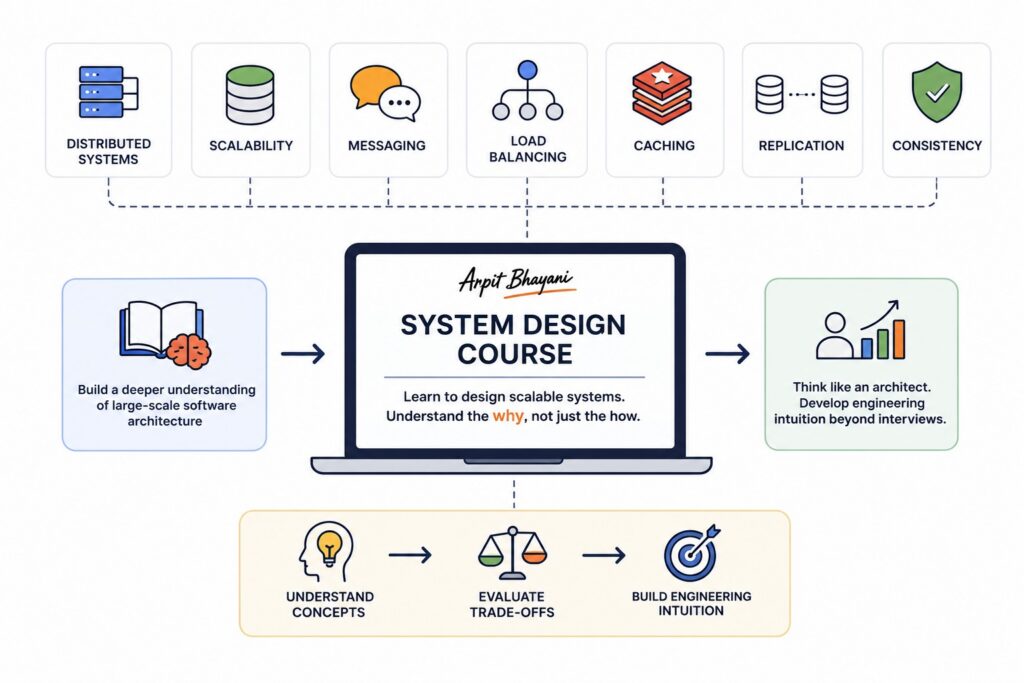
Arpit Bhayani’s System Design course is a structured learning program that teaches distributed systems through engineering discussions, architectural reasoning, and first-principles thinking. Instead of presenting System Design as a sequence of interview questions, the curriculum encourages learners to understand how scalable software systems evolve as requirements, traffic, and operational complexity increase.
The course explores many of the building blocks that appear in modern distributed systems, including databases, caching, partitioning, replication, messaging systems, consistency, scalability, and load balancing. These concepts are connected through larger architectural discussions that explain not only how systems are built but also why different design choices become appropriate under different constraints.
Another defining characteristic is the learning format. Depending on the program, learners may participate in interactive cohort sessions, architectural discussions, assignments, and collaborative problem-solving rather than progressing entirely through prerecorded lessons. This creates a learning experience that feels closer to technical design discussions inside an engineering team than a traditional online course.
| Feature | Overview |
|---|---|
| Primary Focus | Distributed systems and System Design |
| Learning Style | Cohort-based and self-paced options |
| Best Audience | Mid-level and senior software engineers |
| Goal | Build architectural reasoning and engineering intuition |
Where the Course Works Well
The biggest strength of Arpit Bhayani’s course is that it emphasizes understanding architectural decisions instead of simply introducing common interview topics. Throughout the curriculum, learners are encouraged to reason through design choices, evaluate different approaches, and understand the trade-offs involved in building scalable software systems.
Rather than treating distributed systems as a collection of technologies, the course repeatedly connects individual concepts together. This makes it easier to develop an intuition for how databases, caches, queues, storage systems, and services interact inside larger architectures.
Engineering-First Approach
Many lessons focus on understanding the reasoning behind an architecture instead of presenting a finished solution. This encourages learners to think about why certain technologies or patterns are selected rather than assuming there is only one correct design.
That mindset remains valuable beyond interviews because real engineering problems rarely have a single optimal solution. Different business requirements often lead to different architectural decisions, and understanding those trade-offs is one of the most valuable skills a software engineer can develop.
Strong Focus on First Principles
Another strength of the course is its emphasis on first-principles thinking. Instead of relying on reusable templates, learners are encouraged to break complex systems into smaller components and reason through each part independently before assembling a complete solution.
This approach helps build problem-solving skills that transfer naturally to unfamiliar architectural problems rather than only preparing learners for a fixed set of interview questions.
Interactive Learning Experience
For engineers who enjoy collaborative learning, the cohort format can be a meaningful advantage. Live discussions, architectural reviews, assignments, and conversations with instructors expose learners to multiple perspectives on solving the same design problem.
Because System Design rarely has a single correct answer, hearing different approaches often leads to a much deeper understanding than studying independently.
| Strength | Why It Helps |
|---|---|
| Engineering-first teaching | Builds long-term architectural thinking |
| First-principles reasoning | Develops transferable problem-solving skills |
| Interactive discussions | Encourages deeper understanding |
| Architectural trade-offs | Strengthens engineering judgment |
Where the Course Begins to Show Its Limitations
Although the course offers considerable engineering depth, it is not designed around rapid interview preparation. That distinction is important because many software engineers begin studying System Design with a very specific goal: performing well during technical interviews within a relatively short period of time.
The engineering-first philosophy means the curriculum often spends more time exploring why systems are designed a certain way than developing a structured interview methodology. For many learners this is a significant advantage, but others may prefer a course that focuses more directly on the interview process itself.
Less Interview-Centered
The course certainly improves your ability to discuss distributed systems, but interview preparation is not its only objective. Topics are often explored through broader engineering discussions rather than following a repeatable framework specifically designed for solving interview questions.
Candidates preparing for interviews under tight deadlines may therefore need additional practice to organize their architectural discussions into the structured format many interviewers expect.
Larger Time Commitment
Interactive learning naturally requires more time than watching prerecorded lessons. Live sessions, assignments, architectural discussions, and collaborative exercises create a richer educational experience, but they also require consistent participation.
Engineers balancing full-time work or preparing for interviews on a compressed schedule should consider whether they can dedicate enough time to benefit fully from the program.
Not Everyone Prefers Cohort Learning
The discussion-driven format will appeal to some learners more than others. Engineers who enjoy asking questions, debating architectural decisions, and learning alongside other developers may find the experience highly engaging.
Others simply prefer learning independently at their own pace. For those learners, a fully self-paced interview course may provide greater flexibility while requiring a smaller time commitment.
Modern Interviews Also Require Structured Methodology
Understanding distributed systems deeply is only one part of succeeding in System Design interviews. Candidates are also expected to gather requirements, estimate scale, identify bottlenecks, explain trade-offs, and communicate their thinking in a structured manner as the interview progresses.
While the course develops strong architectural intuition, engineers whose primary objective is interview performance may eventually look for additional resources that focus more explicitly on interview methodology.
| Limitation | Why It Matters |
|---|---|
| Broader engineering focus | Interview preparation is not the only objective |
| Cohort format | Requires consistent participation |
| Larger time commitment | Less suitable for accelerated preparation |
| Less emphasis on interview methodology | Additional interview practice may still be beneficial |
Who Should Consider Arpit Bhayani’s System Design Course?
This course is best suited to software engineers who want to understand distributed systems beyond the level required for typical interview preparation. Engineers who enjoy reasoning through architectural trade-offs, participating in technical discussions, and developing long-term engineering intuition are likely to benefit most from its teaching style.
For candidates whose immediate priority is preparing for upcoming System Design interviews, the course still provides valuable architectural knowledge, but it may not be the fastest route to developing a structured interview framework. In that situation, understanding both your learning style and your interview timeline becomes just as important as choosing the course itself.
| Experience Level | Recommendation |
|---|---|
| Beginner | Good with backend fundamentals |
| Mid-level engineer | Strong fit |
| Senior engineer | Excellent for architectural discussions |
| Staff/Principal candidate | Valuable alongside practical experience |
A Better Alternative for Interview Preparation: Educative’s Original Grokking the System Design Interview Course
Arpit Bhayani’s course and Educative’s original Grokking the System Design Interview course are designed with different objectives in mind. While Arpit’s course emphasizes engineering discussions and first-principles thinking, Educative’s original Grokking the System Design Interview course is built specifically to help software engineers succeed in System Design interviews through a structured and repeatable methodology.
That distinction matters because modern interviews evaluate more than technical knowledge. Interviewers want to understand how you approach ambiguous problems, organize your thinking, justify architectural decisions, and communicate trade-offs as the discussion evolves. A course built specifically around that interview process naturally prepares candidates differently from one that focuses primarily on engineering depth.
For engineers whose primary goal is interview preparation, a structured interview framework often provides a more direct path toward consistent interview performance while still building a solid understanding of distributed systems.
Why Educative’s Original Grokking the System Design Interview Course Still Stands Out
One of the reasons Educative’s original Grokking the System Design Interview course has remained relevant for so many years is that it teaches a repeatable process instead of encouraging candidates to memorize architecture diagrams. Rather than approaching every interview question as an entirely new problem, learners develop a systematic methodology that can be reused across many different design scenarios.
The course introduces a logical progression for solving System Design interviews, beginning with understanding the problem before gradually refining the architecture. This structured approach helps candidates stay organized throughout the interview instead of jumping directly into technical solutions before understanding the business requirements.
Because the methodology focuses on architectural reasoning rather than individual technologies, it remains useful even as interview questions continue evolving.
A More Structured Interview Framework
One area where Educative’s original Grokking the System Design Interview course particularly distinguishes itself is its interview methodology. Strong System Design interviews rarely begin with drawing architecture diagrams. Instead, experienced candidates spend time understanding requirements, estimating scale, identifying constraints, discussing trade-offs, and gradually building the system alongside the interviewer.
The course reinforces this process throughout the curriculum. Learners repeatedly practice gathering functional requirements, identifying non-functional requirements, estimating traffic, discussing bottlenecks, evaluating storage options, and selecting architectural components based on business constraints rather than personal preference.
This systematic workflow creates consistency across different interview questions. Whether you’re asked to design a URL shortener, messaging platform, ride-sharing application, or social network, the same structured thinking process continues to apply.
Better Coverage of Modern System Design Concepts
System Design interviews today extend far beyond databases and load balancers. Many companies now expect candidates to understand architectural patterns that reflect modern cloud-native software development and distributed systems engineering.
Educative’s original Grokking the System Design Interview course expands well beyond the traditional interview topics by incorporating concepts such as event-driven architectures, asynchronous processing, messaging systems, distributed storage, scalability patterns, service communication, fault tolerance, consistency models, and reliability engineering. Rather than presenting these subjects independently, the course demonstrates how they work together inside complete production-style architectures.
This broader coverage helps candidates understand not only which architectural components exist, but also why particular design decisions become appropriate under different technical and business constraints.
Better Long-Term Architectural Thinking
Although the primary objective of Educative’s original Grokking the System Design Interview course is interview preparation, the lessons also encourage the kind of architectural reasoning that remains valuable throughout a software engineering career. Instead of teaching reusable answers, the curriculum consistently reinforces reusable design principles that apply across many different software systems.
Learners are encouraged to compare multiple architectural approaches, evaluate trade-offs, identify bottlenecks, and understand how changing requirements influence System Design decisions. That way of thinking naturally transfers beyond interviews into production software development, architecture reviews, and technical leadership discussions.
As technologies evolve, the individual tools may change, but the underlying design principles remain remarkably consistent. Developing that intuition provides long-term value well beyond preparing for a single interview loop.
Who Should Choose Educative’s Original Grokking the System Design Interview Course?
Engineers preparing specifically for System Design interviews are likely to benefit the most from Educative’s original Grokking the System Design Interview course. Its combination of structured interview methodology, comprehensive coverage of distributed systems concepts, and emphasis on architectural reasoning creates a balanced learning experience that supports both interview success and long-term professional growth.
For candidates moving into senior software engineering roles, the course provides a repeatable framework that can be applied across a wide variety of interview questions while also strengthening the broader architectural thinking expected of experienced engineers. Engineers who want a resource focused specifically on maximizing interview performance will generally find this approach more closely aligned with the way modern System Design interviews are conducted.
Final Verdict
Is Arpit Bhayani’s System Design Course Worth It?
Arpit Bhayani’s System Design course offers a different learning experience from many interview-focused System Design resources. Instead of centering the curriculum around interview questions, it spends more time helping software engineers understand distributed systems through architectural reasoning, first-principles thinking, and engineering discussions. For learners who enjoy exploring why systems are designed a certain way, that teaching style can be particularly valuable.
The course is less focused on developing a repeatable interview methodology. Modern System Design interviews often require candidates to follow a structured process that includes gathering requirements, estimating scale, discussing constraints, evaluating trade-offs, and communicating decisions clearly throughout the conversation. While the engineering knowledge gained from the course certainly contributes to interview performance, candidates whose primary objective is preparing for interviews may benefit from a learning resource designed specifically around that interview process.
For engineers looking to maximize interview preparation while also building a strong understanding of modern distributed systems, Educative’s original Grokking the System Design Interview course offers a more comprehensive balance of structured interview methodology, architectural reasoning, and coverage of modern System Design concepts.
Keep Learning Beyond Any Single Course
System Design is one of the broadest subjects in software engineering. It combines distributed systems, databases, networking, cloud infrastructure, messaging systems, scalability, reliability, observability, and software architecture into a discipline that continues evolving as new technologies emerge. No individual course can realistically cover every aspect of that landscape.
The strongest software engineers rarely rely on a single learning resource. Instead, they combine structured courses with technical articles, architecture guides, engineering blogs, and consistent interview practice. That combination not only improves interview performance but also develops the long-term engineering intuition needed to design and evaluate production systems throughout an engineering career.
Whether you begin with Arpit Bhayani’s course, Educative’s original Grokking the System Design Interview course, or another structured resource, continued learning will always remain an important part of becoming a stronger System Designer.
Free Resources Worth Bookmarking
If you’re planning to continue learning after completing a structured course, the following free resources are excellent references for strengthening both your interview preparation and your understanding of modern distributed systems.
| Free Resource | Best For |
|---|---|
| System Design Primer | Reviewing interview fundamentals and core distributed systems concepts |
| Complete Guide to System Design | Following a structured learning roadmap from beginner to advanced topics |
| System Design Guide | Comprehensive guides covering distributed systems, architecture patterns, and modern System Design concepts |
| System Design Interview Guide | Preparing specifically for System Design interviews with interview-focused guides and examples |
| Advanced System Design for Principal Engineers | Exploring advanced architecture, large-scale distributed systems, and senior engineering design decisions |
Join the Discussion
Have you taken Arpit Bhayani’s System Design course during your interview preparation or as part of your professional development? Did the engineering-first approach match what you were looking for, or did you find yourself wanting a more interview-focused learning experience?
Share your experience in the comments. Different engineers learn System Design in different ways, and hearing real experiences from readers can help others choose the learning path that best fits their own career goals and interview preparation strategy.