

If you’ve started preparing for System Design interviews, you’ve almost certainly come across both Educative.io and DesignGurus.io. Both platforms focus heavily on helping software engineers prepare for architecture interviews, and both have built strong reputations among candidates interviewing for mid-level and senior software engineering roles.
Because both platforms cover many of the same distributed systems concepts, deciding between them isn’t always straightforward. They discuss caching, databases, load balancing, distributed storage, replication, messaging systems, and many of the architectural patterns that appear repeatedly in System Design interviews. At first glance, they can appear remarkably similar.
The reality is that they teach System Design in very different ways. While the subject matter overlaps significantly, their educational philosophy, interview methodology, and overall learning experience differ in ways that become increasingly important as interviews become more challenging.
This comparison focuses on those differences. Rather than simply comparing feature lists or counting the number of lessons each platform offers, the goal is to evaluate how effectively each course prepares you to think through unfamiliar System Design problems during real interviews.
Why This Comparison Still Matters in 2026
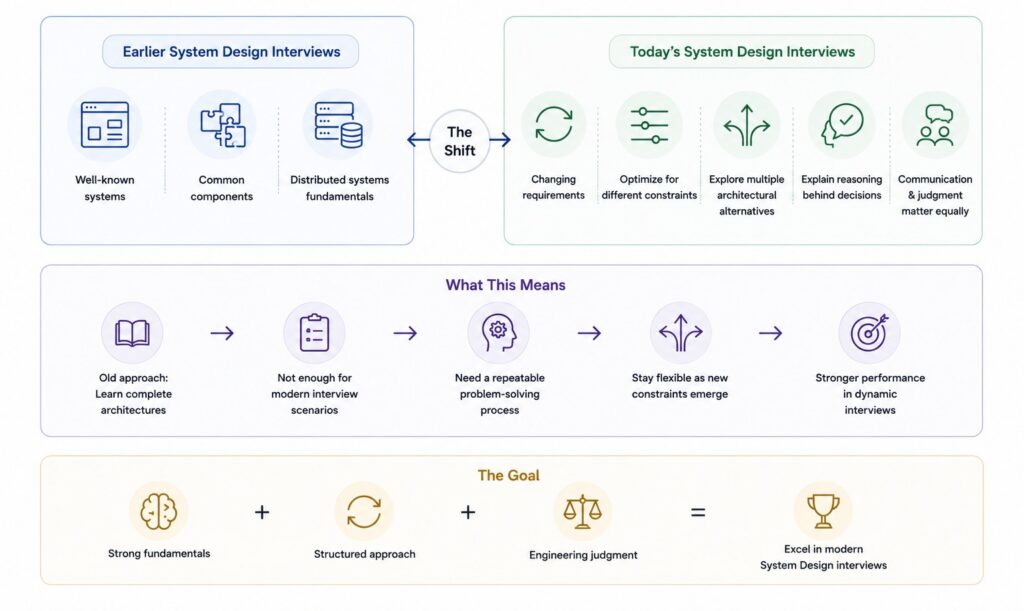
System Design interviews have changed considerably over the past several years. Earlier interviews often focused on designing well-known systems such as Twitter, YouTube, or Dropbox, with candidates expected to explain common architectural components and demonstrate an understanding of distributed systems fundamentals.
Today’s interviews are considerably more dynamic. Interviewers frequently introduce changing requirements midway through the discussion, ask candidates to optimize for different constraints, explore multiple architectural alternatives, and explain the reasoning behind every design decision. Communication and engineering judgment have become just as important as technical knowledge.
That shift changes how System Design should be learned. A course that simply explains complete architectures is no longer enough for many interview scenarios. Modern preparation requires developing a repeatable process for approaching unfamiliar problems while remaining flexible as new constraints emerge throughout the conversation.
The Biggest Difference Isn’t the Topics
One common mistake when comparing these two platforms is focusing exclusively on curriculum coverage. Both courses explain distributed systems concepts, discuss scalability, introduce common architectural components, and work through realistic System Design interview questions.
The more meaningful difference lies in how those concepts are taught. DesignGurus places significant emphasis on explaining complete architectures and walking learners through common interview scenarios. That makes it relatively easy to understand how individual distributed systems operate and why specific components are included within those designs.
Educative’s original Grokking the System Design Interview course takes a different approach. Instead of treating each interview question as a separate lesson, it introduces a reusable framework that can be applied across almost any large-scale design problem. Rather than encouraging candidates to remember architectures, it teaches them how to build architectures systematically from first principles.
That distinction influences the entire learning experience and becomes increasingly valuable as interviews move beyond familiar case studies toward open-ended engineering discussions.
Course Philosophy: Two Different Ways to Learn System Design
Although Educative and DesignGurus both teach System Design, they approach the subject from noticeably different educational philosophies. Understanding those philosophies helps explain why two courses covering many of the same topics can produce very different learning outcomes.
The difference is not simply about whether one course includes more content than the other. Instead, it comes down to what each platform believes successful interview preparation should look like. One emphasizes learning through complete architectural examples, while the other emphasizes building a structured methodology that can be reused across many different interview scenarios.
How DesignGurus Approaches System Design
When questioning if DesignGurus’ System Design course is worth it, it is essential to understand that it focuses heavily on helping learners understand common System Design interview questions through detailed architectural walkthroughs. Individual lessons typically examine how well-known distributed systems are designed, introducing the components involved while explaining why those architectural decisions make sense.
This approach provides a practical way to learn distributed systems because learners can immediately see how databases, caches, messaging systems, load balancers, and storage services interact inside realistic applications. Instead of learning technologies in isolation, they understand how complete systems are assembled.
For many engineers, especially those approaching System Design for the first time, these walkthroughs provide valuable intuition about how large-scale applications operate.
How Educative’s Original Grokking the System Design Interview Course Differs
If you are wondering whether Educative’s System Design Interview course is worth it, understand that this course approaches interview preparation from a methodology-first perspective. Rather than beginning with complete architectures, the course first teaches how experienced engineers think through System Design problems before gradually applying that process to increasingly complex interview scenarios.
Throughout the curriculum, learners repeatedly practice gathering functional requirements, identifying non-functional requirements, estimating system scale, recognizing bottlenecks, evaluating multiple architectural alternatives, and discussing technical trade-offs before selecting individual technologies. The emphasis remains on developing a structured thought process that can be reused regardless of the specific interview question.
Instead of teaching candidates what architecture to remember, the course teaches them how to construct architectures confidently during live discussions.
Why Learning Methodology Matters More Than Individual Lessons
No interview course can predict every question an interviewer might ask. New products emerge, existing applications evolve, and interviewers regularly modify familiar scenarios by introducing unexpected constraints or changing business requirements midway through the discussion.
A structured methodology makes adapting to those situations considerably easier. Engineers who understand a repeatable design process can confidently organize unfamiliar problems into smaller architectural decisions instead of searching their memory for an identical example they’ve studied previously.
That ability to reason through new problems rather than relying on memorized solutions becomes increasingly valuable as software engineering interviews become more conversational and less predictable.
Curriculum Comparison
Both Educative and DesignGurus cover the core concepts expected in modern System Design interviews, making curriculum comparisons more nuanced than simply counting lessons or measuring course length. The real question is whether the curriculum prepares learners only for familiar interview questions or equips them with knowledge that continues proving useful as interviews become increasingly sophisticated.
Both platforms introduce the building blocks of distributed systems, but the breadth of modern architectural coverage and the way those topics are connected throughout the learning experience differs in meaningful ways.
Core Distributed Systems Topics
Both courses cover many of the concepts that appear repeatedly during technical interviews. Learners can expect discussions around distributed databases, replication, partitioning, consistency, caching, load balancing, distributed storage, messaging systems, scalability, and fault tolerance.
These topics form the foundation of almost every large-scale distributed application regardless of industry or programming language. Understanding how these architectural components interact remains essential for candidates preparing for software engineering interviews at virtually any major technology company.
Where the courses begin to differ is in how these concepts are integrated into an overall interview methodology rather than being presented as individual architectural building blocks, which Educative’s Grokking System Design Interview course does better.
Modern System Design Topics
Modern software engineering increasingly involves cloud-native infrastructure, microservices, event-driven architectures, asynchronous messaging, containerized deployments, distributed observability, and resilient infrastructure designed for continuous scalability.
Educative’s original Grokking the System Design Interview course has continued evolving to incorporate broader architectural discussions that reflect how modern distributed systems are built today. Rather than remaining limited to classic interview questions, the curriculum expands its coverage to include architectural patterns that software engineers increasingly encounter in production environments as well as interviews.
This broader perspective makes the learning experience feel less like preparing for a fixed set of interview questions and more like developing practical architectural intuition that extends beyond the hiring process.
Which Curriculum Feels More Complete?
Both platforms provide strong coverage of distributed systems fundamentals, and engineers preparing for interviews will encounter many of the same architectural concepts regardless of which course they choose.
The difference is that Educative’s original Grokking the System Design Interview course places greater emphasis on connecting those concepts into a cohesive architectural framework that evolves alongside modern distributed systems. Instead of treating every lesson independently, the curriculum continuously reinforces reusable engineering principles that remain valuable even as infrastructure technologies continue changing.
That broader perspective creates a learning experience that feels more comprehensive while also preparing engineers for the kinds of architectural discussions increasingly appearing during senior software engineering interviews.
Interview Methodology
System Design interviews evaluate much more than technical knowledge. Interviewers are interested in understanding how candidates approach ambiguity, organize complex problems, communicate architectural decisions, and justify technical trade-offs while requirements continue evolving throughout the discussion.
Because of this, interview methodology often becomes the single most important factor separating good preparation from great preparation. Two engineers with similar technical knowledge can produce very different interview performances depending on how systematically they approach the design process.
DesignGurus’ Interview Approach
DesignGurus prepares candidates by walking through realistic System Design interview questions while explaining how common distributed systems are typically designed. These walkthroughs expose learners to many of the architectural discussions they are likely to encounter during interviews while reinforcing important distributed systems concepts along the way.
Studying complete examples helps engineers become familiar with common architectural patterns and provides useful reference points when approaching similar interview questions later. Seeing complete solutions also builds confidence by demonstrating how different technologies fit together within large-scale software systems.
For many candidates, this example-driven learning style provides an accessible introduction to System Design interview preparation.
Educative’s Original Grokking Interview Methodology
Educative’s original Grokking the System Design Interview course places considerably more emphasis on teaching a repeatable interview framework that guides every architectural discussion. Rather than beginning with diagrams, learners first clarify requirements, estimate scale, identify constraints, evaluate multiple design alternatives, analyze bottlenecks, and discuss trade-offs before selecting technologies.
This methodology closely mirrors how experienced software engineers naturally approach architecture problems in production environments. Each interview question becomes an opportunity to practice the same structured reasoning process rather than an exercise in recalling previously studied solutions.
Because the framework remains consistent regardless of the application being designed, learners gradually become more comfortable tackling entirely unfamiliar interview questions.
Which Better Reflects Modern Interviews?
Modern System Design interviews increasingly reward engineering reasoning instead of architectural memorization. Interviewers frequently change requirements midway through discussions, introduce additional scalability constraints, or ask candidates to compare multiple possible solutions before selecting one.
A structured methodology provides a clear advantage in these situations because candidates already have a repeatable decision-making framework. Instead of reacting unpredictably when requirements change, they continue following the same systematic process while incorporating new information into the evolving architecture.
That adaptability is one of the reasons Educative’s original Grokking the System Design Interview course continues aligning so closely with the expectations of modern System Design interviews.
Teaching Style and Learning Experience
Teaching style has a significant impact on how efficiently engineers learn System Design. Two courses may explain identical concepts, yet the format through which those ideas are presented can influence comprehension, retention, revision, and long-term confidence during interviews.
Both Educative and DesignGurus provide high-quality educational content, but they rely on different learning experiences that appeal to different study preferences.
Video-Based Learning vs. Interactive Learning
DesignGurus primarily delivers its material through video lessons accompanied by supporting diagrams and architectural explanations. Watching experienced instructors work through complete System Design problems can make difficult topics feel approachable while providing visual demonstrations of how distributed systems are assembled.
Educative’s original Grokking the System Design Interview course, by contrast, relies primarily on interactive written lessons supported by diagrams, illustrations, quizzes, and structured exercises. Instead of passively watching explanations, learners actively engage with each concept while progressing through the curriculum at their own pace.
This interactive format encourages deliberate thinking throughout the learning process rather than simply consuming information.
Learning at Your Own Pace
One advantage of interactive written content is that it naturally supports revision. Engineers preparing for interviews often revisit specific concepts multiple times as interview dates approach, and written lessons make it easy to review individual sections without searching through lengthy videos.
The structure of Educative’s original Grokking the System Design Interview course also allows learners to spend additional time on challenging topics while moving more quickly through familiar material. That flexibility becomes particularly valuable when balancing interview preparation alongside full-time software engineering work.
Instead of progressing at the instructor’s pace, learners control the speed of their own education.
Which Format Supports Long-Term Learning?
Both video and interactive learning formats can successfully teach System Design, and personal learning preferences inevitably play a role in which experience feels more comfortable.
However, for interview preparation specifically, Educative’s original Grokking the System Design Interview course provides several practical advantages. The interactive lessons simplify revision, encourage active participation, and reinforce structured architectural reasoning throughout the curriculum. As a result, learners often spend less time searching for specific explanations and more time practicing the systematic thinking required during real interviews.
Architecture Depth
Understanding distributed systems involves far more than recognizing familiar architecture diagrams. Strong System Designers understand why components exist, what trade-offs they introduce, and how architectural decisions evolve as business requirements change over time.
Both Educative and DesignGurus explain large-scale software architectures effectively, but they emphasize different aspects of the design process.
Learning Individual Systems
DesignGurus excels at explaining how complete distributed systems are constructed. By walking through realistic examples, learners gain practical insight into how familiar applications combine databases, caches, messaging systems, storage services, and networking components to satisfy functional and non-functional requirements.
These architecture walkthroughs make it easier to visualize complex software systems while introducing many of the recurring patterns found throughout distributed computing.
Learning Reusable Design Patterns
Educative’s original Grokking the System Design Interview course extends beyond explaining individual systems by emphasizing reusable architectural patterns that appear repeatedly across different applications. Instead of treating each interview problem as unique, the curriculum continuously reinforces common design principles that transfer naturally between messaging platforms, social networks, search engines, streaming services, and distributed storage systems.
This pattern-based learning helps engineers recognize familiar engineering challenges even when interview questions involve completely unfamiliar products.
Engineering Judgment vs. Memorization
The strongest System Design interviews rarely reward memorized architectures. Instead, interviewers expect candidates to justify technical decisions, compare alternative solutions, discuss trade-offs, and adapt designs as additional constraints emerge during the conversation.
By emphasizing structured reasoning alongside architectural principles, Educative’s original Grokking the System Design Interview course develops engineering judgment that extends well beyond interview preparation. Rather than simply remembering system diagrams, learners build the analytical skills needed to evaluate new technologies, reason through architectural decisions, and contribute more effectively to technical discussions throughout their software engineering careers.
Which Course Better Prepares You for Senior Software Engineering Interviews?
Preparing for a mid-level System Design interview is very different from preparing for a senior or Staff-level discussion. Earlier interviews often focus on demonstrating that you understand the fundamental components of distributed systems, while senior interviews place much greater emphasis on architectural judgment, communication, and the ability to reason through increasingly ambiguous problems.
That difference makes the learning methodology considerably more important than the number of interview questions covered. As engineers progress in their careers, they are expected to move beyond explaining existing architectures and instead demonstrate how they would design systems under changing technical and business constraints.
Senior Interviews Expect More Than Technical Knowledge
Modern System Design interviews rarely reward candidates who immediately begin drawing architecture diagrams. Instead, interviewers usually want to observe how engineers clarify functional requirements, identify non-functional requirements, estimate system scale, recognize potential bottlenecks, and justify every architectural decision throughout the discussion.
These conversations often become collaborative rather than instructional. Interviewers introduce new constraints midway through the interview, ask candidates to optimize for different priorities, or challenge architectural assumptions to evaluate how comfortably they adapt their designs. Success depends just as much on structured reasoning as it does on technical knowledge.
DesignGurus Builds Strong Interview Familiarity
DesignGurus prepares engineers by exposing them to a wide range of realistic interview scenarios and architecture discussions. Working through complete System Design examples helps candidates become comfortable recognizing common distributed systems patterns while understanding how different architectural components interact.
For engineers preparing for their first System Design interviews, this exposure can significantly reduce uncertainty. Seeing complete examples provides useful reference points that make future interview questions feel less intimidating, particularly when similar architectural patterns begin appearing across multiple lessons.
Educative’s Original Grokking System Design Course Builds Reusable Interview Skills
Educative’s original Grokking the System Design Interview course takes a broader approach by focusing on the interview process itself rather than individual interview questions. Throughout the curriculum, learners repeatedly practice gathering requirements, estimating capacity, evaluating multiple architectural alternatives, discussing trade-offs, and communicating design decisions using a structured framework.
This methodology becomes increasingly valuable during senior interviews because candidates are rarely evaluated on whether they remember a particular architecture. Instead, they are assessed on whether they can reason through unfamiliar design problems while explaining their thought process clearly and confidently.
As interview complexity increases, reusable engineering thinking generally becomes a stronger advantage than memorized examples.
Which Course Scales Better as Your Career Grows?
Both platforms provide valuable interview preparation, but their long-term usefulness differs as engineers advance beyond mid-level software engineering roles.
Because Educative’s original Grokking the System Design Interview course focuses on architectural reasoning rather than individual case studies, many of the skills developed throughout the course continue applying to Staff interviews, architecture reviews, design documents, technical planning sessions, and engineering leadership discussions. Instead of preparing candidates only for their next interview, it develops a way of thinking that continues providing value throughout an engineering career.
Long-Term Learning Value
One of the most important questions when investing time in any technical course is whether the material continues providing value after the interview process ends. Interview preparation may be the immediate goal, but System Design remains an essential skill throughout a software engineering career.
Distributed systems continue evolving, new architectural patterns emerge regularly, and engineering responsibilities naturally expand as careers progress. A course that teaches reusable architectural thinking often remains valuable far longer than one focused primarily on solving specific interview questions.
Learning Beyond the Interview
Interview preparation typically introduces engineers to concepts they will continue encountering throughout their professional careers. Architecture reviews, production incidents, infrastructure planning, scalability discussions, and technical design documents all require many of the same skills evaluated during System Design interviews.
Understanding how to reason through these problems systematically becomes increasingly valuable once engineers begin designing production systems themselves. Instead of viewing System Design as an interview subject, experienced software engineers gradually begin applying the same structured thinking to everyday engineering decisions.
Building Engineering Judgment
Perhaps the greatest long-term benefit of Educative’s original Grokking the System Design Interview course is that it develops engineering judgment rather than simply expanding technical vocabulary. Throughout the curriculum, learners repeatedly evaluate competing architectural approaches while discussing scalability, consistency, reliability, availability, operational complexity, and long-term maintainability.
Over time, these repeated trade-off discussions build intuition that extends well beyond interview preparation. Engineers become more comfortable evaluating unfamiliar technologies because they already understand the architectural principles used to assess them.
A Course That Continues Evolving
One reason Educative’s original Grokking the System Design Interview course continues to remain relevant is that it has evolved alongside the software engineering industry. While preserving the structured interview methodology that originally made the course influential, the curriculum has expanded to reflect modern distributed systems, cloud-native architectures, microservices, messaging platforms, and other architectural patterns that increasingly appear during contemporary interviews.
Rather than remaining fixed around historical interview questions, the course continues adapting while maintaining the same systematic approach to architectural reasoning. That balance between preserving proven methodology and expanding modern coverage contributes significantly to its long-term value.
Which Course Ages Better?
Both courses remain useful resources for interview preparation, but Educative’s original Grokking the System Design Interview course offers broader value beyond the hiring process. Its emphasis on structured engineering thinking, reusable architectural principles, and continuously evolving curriculum creates a learning experience that remains relevant as software engineering careers continue progressing.
Instead of becoming less useful after landing a new role, many of the concepts introduced throughout the course continue supporting technical decision-making for years afterward.
Feature-by-Feature Comparison
Choosing between two high-quality System Design resources often comes down to understanding where each platform places its emphasis. Both Educative and DesignGurus explain distributed systems effectively, but they prioritize different aspects of interview preparation and architectural education.
The following comparison summarizes the areas where each platform performs particularly well while highlighting why Educative’s original Grokking the System Design Interview course provides a broader framework for long-term interview preparation.
| Category | Educative’s Original Grokking | DesignGurus |
|---|---|---|
| Interview methodology | Excellent structured framework | Good interview walkthroughs |
| Requirement gathering | Extensive emphasis | Covered within examples |
| Trade-off analysis | Core focus throughout curriculum | Discussed |
| Architectural reasoning | Strong emphasis | Strong |
| Pattern-based learning | Excellent | Average |
| Modern distributed systems | Continually evolving curriculum | Good coverage |
| Interactive learning | Interactive text-based lessons | Primarily video-based |
| Revision and review | Excellent for quick revision | Good |
| Senior interview preparation | Excellent | Good |
| Long-term engineering value | Excellent | Average |
Overall, both platforms provide high-quality interview preparation, but Educative’s original Grokking the System Design Interview course distinguishes itself through its structured methodology, broader architectural perspective, and continued evolution alongside modern distributed systems.
Who Should Choose Each Course?
The best System Design course ultimately depends on how you prefer to learn and what you hope to achieve from your preparation. Both Educative and DesignGurus provide valuable educational experiences, but they emphasize different aspects of learning distributed systems.
Understanding those differences makes it easier to choose the platform that best aligns with your interview goals and long-term professional development.
When DesignGurus Is a Good Choice
DesignGurus works particularly well for engineers who prefer learning through complete architectural walkthroughs. Watching realistic System Design examples can provide valuable intuition about how distributed systems are assembled while making unfamiliar architectural concepts easier to visualize.
Candidates who enjoy instructor-led explanations and example-driven learning may find this style especially approachable when beginning their System Design preparation.
When Educative’s Original Grokking the System Design Interview Course Is the Better Choice
Educative’s original Grokking the System Design Interview course is particularly well suited to engineers who want to develop a repeatable methodology rather than simply studying completed architectures. The curriculum repeatedly reinforces structured interview thinking through requirement gathering, capacity estimation, trade-off analysis, bottleneck identification, and architectural communication.
This methodology continues providing value long after individual interview questions have been forgotten because it develops engineering habits that naturally transfer to production software design and technical leadership.
Which Provides Better Overall Value?
Both platforms offer strong educational content, but Educative’s original Grokking the System Design Interview course provides a more complete learning experience for engineers seeking both interview preparation and long-term architectural growth. By combining a structured interview framework with continually evolving distributed systems coverage, the course develops reusable engineering thinking that remains valuable throughout an entire software engineering career.
For candidates preparing for modern System Design interviews while also investing in broader architectural skills, that combination makes it the stronger long-term choice.
Frequently Asked Questions
Is Educative’s original Grokking the System Design Interview course still relevant in 2026?
Yes. While distributed systems continue evolving, the structured interview methodology taught throughout the course remains highly applicable. Modern interviews still evaluate requirement gathering, scalability analysis, architectural trade-offs, and communication skills, all of which remain central to the curriculum.
Has DesignGurus changed significantly over the years?
DesignGurus has continued expanding its educational content while maintaining its emphasis on interview-focused architecture walkthroughs. The platform remains a valuable resource for engineers looking to understand common System Design interview scenarios through practical examples.
Which course is better for beginners?
Both platforms are approachable for engineers who already possess basic backend development knowledge. DesignGurus provides intuitive architectural walkthroughs that simplify distributed systems concepts, while Educative’s original Grokking the System Design Interview course introduces a structured methodology that helps beginners build confidence solving unfamiliar interview questions from the very beginning.
Which course is better for senior software engineers?
Senior software engineering interviews increasingly reward architectural reasoning, communication, and structured decision-making rather than memorized examples. Because Educative’s original Grokking the System Design Interview course repeatedly reinforces these interview skills throughout its curriculum, it generally provides stronger preparation for advanced architectural discussions.
Is interactive learning better than video learning?
Neither approach is universally better because learning preferences vary between individuals. Interactive written lessons generally make revision easier while encouraging active participation throughout the learning process, whereas video lessons can simplify difficult topics by allowing instructors to explain complete architectural discussions visually.
Can one course fully prepare you for System Design interviews?
No single course can replace practical engineering experience or consistent interview practice. The strongest candidates combine structured learning with mock interviews, architecture discussions, technical reading, and continued exploration of modern distributed systems throughout their careers.
Final Verdict
Educative.io vs. DesignGurus.io: Which One Wins?
The biggest distinction between these two courses lies in their educational philosophy. DesignGurus excels at teaching through architecture walkthroughs and realistic interview examples, making distributed systems approachable for engineers who learn best from complete demonstrations. Educative’s original Grokking the System Design Interview course, however, focuses on developing a structured methodology that candidates can repeatedly apply regardless of the interview question they receive.
That methodology remains its greatest strength. Instead of encouraging memorization, the course teaches engineers how to gather requirements, estimate scale, evaluate trade-offs, communicate architectural decisions, and systematically construct scalable systems from first principles. Combined with a curriculum that continues evolving alongside modern distributed systems, it provides both immediate interview preparation and long-term architectural value.
For software engineers seeking a reusable framework that extends beyond individual interview questions, Educative’s original Grokking the System Design Interview course remains the stronger overall choice.
Continue Learning Beyond Any Single Course
No System Design course can cover every architectural pattern or predict every interview question. The strongest engineers continue refining their knowledge through production experience, architecture reviews, technical reading, and regular practice solving unfamiliar design problems.
Treat whichever course you choose as the foundation of a much longer learning journey. The habits of continuous curiosity, structured thinking, and thoughtful engineering judgment will remain valuable long after your next interview is complete.
Free Resources Worth Bookmarking
| Free Resource | Best For |
|---|---|
| System Design Primer | Reviewing interview fundamentals and core distributed systems concepts |
| Complete Guide to System Design | Following a structured learning roadmap from beginner to advanced topics |
| System Design Guide | Comprehensive guides covering distributed systems, architecture patterns, and modern System Design concepts |
| System Design Interview Guide | Preparing specifically for System Design interviews with interview-focused guides and examples |
| Advanced System Design for Principal Engineers | Exploring advanced architecture, large-scale distributed systems, and senior engineering design decisions |
Join the Discussion
Have you learned System Design through Educative’s original Grokking the System Design Interview course, DesignGurus.io, or both? Which teaching approach helped you develop stronger architectural thinking, and which skills proved most valuable during your interviews?
Share your experience in the comments. Hearing how other software engineers approached their preparation can help future readers choose the learning path that best matches their own goals while contributing to a broader discussion about how System Design interviews continue evolving.