

ByteByteGo’s System Design course is designed to help software engineers understand distributed systems through visual explanations, architecture case studies, and structured lessons. This course attempts to balance interview preparation with a broader understanding of how modern software systems are designed and scaled.
Whether the course is worth purchasing depends largely on what you’re trying to achieve. If your goal is to better understand the building blocks of distributed systems and learn through diagrams and real-world examples, the platform offers a compelling learning experience. If your primary objective is preparing for increasingly competitive System Design interviews, however, it’s worth understanding both the strengths of the course and the areas where additional learning may be beneficial.
This review focuses on the course itself rather than marketing claims or popularity. The discussion examines its teaching style, curriculum, interview preparation value, strengths, limitations, and the type of engineer who is most likely to benefit from it.
What Is ByteByteGo System Design?
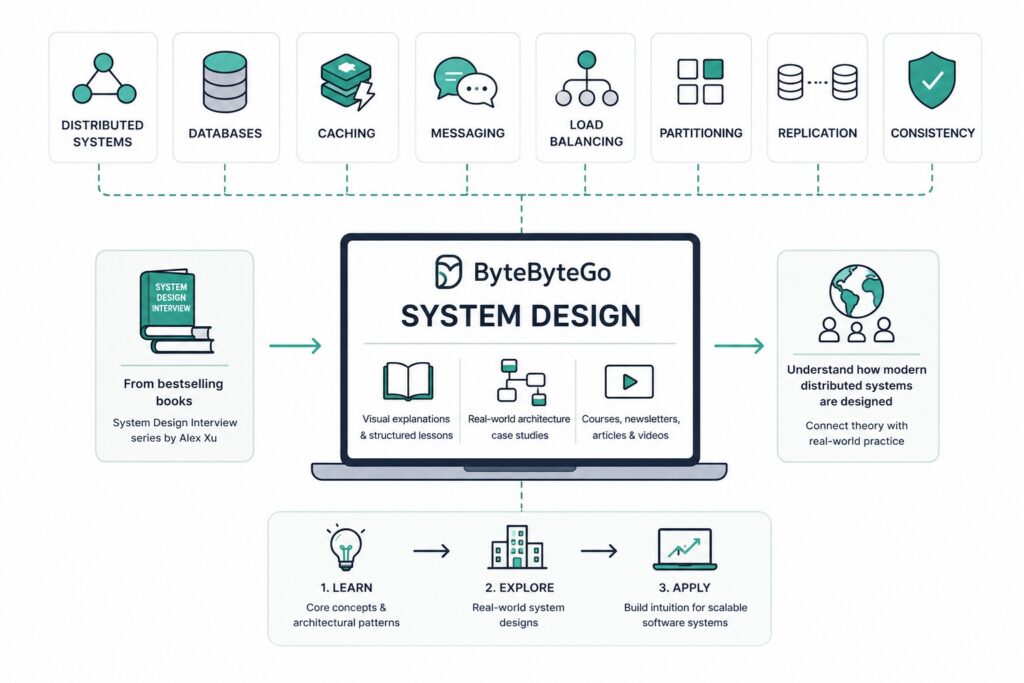
ByteByteGo System Design is an online learning platform focused on teaching distributed systems and software architecture through visual learning. The curriculum introduces many of the architectural concepts found in modern applications and explains how individual components combine to create scalable, reliable systems. Rather than concentrating on specific programming languages or cloud providers, the emphasis remains on understanding architectural principles that apply across different technologies.
The course covers topics such as scalability, databases, caching, replication, partitioning, consistency, messaging systems, load balancing, and distributed storage before applying those concepts to larger architecture discussions. Instead of treating each technology independently, the lessons demonstrate how these building blocks interact inside production-style systems.
One of the defining characteristics of ByteByteGo is its visual teaching style. Most lessons combine diagrams, written explanations, and architecture walkthroughs that simplify topics which are often difficult to understand through text alone. This approach makes distributed systems considerably more approachable for engineers who prefer learning visually.
| Feature | Overview |
|---|---|
| Primary Focus | System Design and distributed systems |
| Learning Style | Visual-first lessons with diagrams |
| Best Audience | Mid-level and senior software engineers |
| Goal | Build architectural understanding |
Where ByteByteGo Works Well
ByteByteGo’s greatest strength is its ability to explain complicated architectural concepts without making them feel overwhelming. Distributed systems involve many interconnected components, and understanding how those pieces fit together can be difficult when learning from documentation or isolated technical articles. ByteByteGo addresses this challenge by presenting ideas visually before connecting them into complete architectures.
The course also succeeds in helping learners recognize recurring architectural patterns. Rather than memorizing individual System Designs, engineers begin noticing how concepts such as caching, replication, partitioning, messaging systems, and load balancing appear repeatedly across many different applications.
Outstanding Visual Learning
The diagrams are one of the strongest parts of the learning experience. Instead of describing architectures entirely through text, ByteByteGo illustrates how requests move through systems, how services communicate, and how infrastructure components interact under different workloads.
For many learners, seeing a distributed system represented visually makes architectural relationships much easier to understand than reading lengthy technical explanations.
Practical Architecture Walkthroughs
Another strength is the way complete systems are explained step by step. Rather than immediately presenting a finished architecture, the lessons gradually introduce each component while explaining the reasoning behind its inclusion.
This progression helps learners understand how complex systems evolve as new scalability requirements and operational constraints are introduced.
Clear Distributed Systems Explanations
Many engineers encounter distributed systems concepts only occasionally in their day-to-day work. ByteByteGo introduces these ideas through straightforward explanations that prioritize conceptual understanding before discussing architectural complexity.
That teaching style makes topics such as replication, consistency, messaging, caching, and partitioning much less intimidating for engineers beginning their System Design journey.
Valuable Supporting Content
The learning experience extends beyond the course itself. ByteByteGo also includes supporting articles, newsletters, diagrams, and additional educational material that allow learners to revisit architectural concepts long after completing the primary curriculum.
This broader ecosystem gives the platform value beyond interview preparation because it can continue serving as a useful technical reference during everyday software engineering work.
| Strength | Why It Helps |
|---|---|
| High-quality diagrams | Simplifies distributed systems concepts |
| Architecture walkthroughs | Demonstrates how complete systems evolve |
| Clear explanations | Makes complex topics easier to understand |
| Supporting resources | Reinforces long-term learning |
Where ByteByteGo Begins to Show Its Limitations
Although ByteByteGo excels at explaining distributed systems visually, its teaching style differs from courses designed specifically around System Design interviews. Understanding architecture and performing well during an interview are closely related skills, but they are not exactly the same. Interviews require candidates to solve unfamiliar problems while communicating their reasoning in a structured and methodical way.
ByteByteGo focuses primarily on helping learners understand systems. As interview expectations continue evolving, many candidates also need a repeatable methodology for approaching open-ended design questions under time pressure.
Less Structured Around Interview Methodology
The course explains architectural concepts extremely well, but it spends comparatively less time teaching a consistent interview process. Strong System Design interviews typically involve gathering requirements, estimating scale, identifying bottlenecks, discussing trade-offs, and refining the design as new constraints emerge.
While ByteByteGo certainly improves architectural understanding, candidates may still need to develop a structured workflow for organizing those discussions during interviews.
Case Studies Don’t Replace a Framework
Architecture case studies are valuable because they demonstrate how real systems are designed. However, interviews rarely ask candidates to reproduce an existing architecture exactly. Instead, interviewers introduce new requirements and expect candidates to adapt their thinking accordingly.
Understanding the reasoning behind a design is ultimately more valuable than remembering the design itself, which is why a repeatable problem-solving methodology becomes increasingly important.
Modern Interviews Require Broader Reasoning
Today’s System Design interviews often explore architectural trade-offs rather than simply testing whether candidates recognize common technologies. Discussions increasingly include resilience, fault tolerance, asynchronous communication, service boundaries, scalability decisions, and changing business requirements.
Preparing for those conversations requires more than familiarity with distributed systems components alone.
Better as an Ongoing Reference
ByteByteGo functions exceptionally well as an ongoing reference for distributed systems concepts. The diagrams, architecture examples, and supporting educational material make it easy to revisit topics whenever needed.
For engineers preparing specifically for interviews, however, many eventually supplement these strengths with additional resources that focus more directly on interview methodology and structured architectural reasoning.
| Limitation | Why It Matters |
|---|---|
| Less interview-focused structure | Candidates still need a repeatable interview methodology |
| Case study emphasis | Interviews require adapting to unfamiliar problems |
| Limited focus on structured reasoning | Modern interviews reward architectural decision-making |
| Better as a long-term reference | Additional interview-focused preparation may still be useful |
Who Should Consider ByteByteGo System Design?
ByteByteGo System Design is best suited to software engineers who prefer visual learning and want to build a stronger understanding of distributed systems through diagrams and architecture discussions. Its approachable teaching style makes it particularly valuable for engineers who find traditional technical documentation difficult to follow and want to understand how scalable systems are assembled in practice.
Engineers preparing for System Design interviews will also benefit from the architectural knowledge provided throughout the course. However, candidates targeting highly competitive senior interview loops may eventually look for additional resources that place greater emphasis on structured interview methodology and systematic problem-solving. Viewed as a foundation for understanding modern distributed systems, ByteByteGo offers a strong learning experience that continues to provide value well beyond the interview process.
| Experience Level | Recommendation |
|---|---|
| Beginner | Good introduction |
| Mid-level engineer | Strong learning resource |
| Senior engineer | Valuable refresher |
| Staff/Principal candidate | Excellent reference alongside additional interview preparation |
A Better Alternative: Educative’s Original Grokking the System Design Interview Course
ByteByteGo is particularly strong at helping engineers understand distributed systems through diagrams and architecture case studies. However, learning how large-scale systems work and learning how to perform well in a System Design interview are not always the same objective. Modern interviews require candidates to think systematically, communicate clearly, and adapt their designs as interviewers introduce new requirements throughout the discussion.
This is where Educative’s original Grokking the System Design Interview course provides a different learning experience. Rather than centering the curriculum around architecture case studies alone, the course is built specifically around the interview process itself. It teaches a structured methodology that candidates can apply repeatedly across many different System Design questions instead of encouraging them to study individual architectures in isolation.
For engineers whose primary goal is interview preparation, this structured approach often translates more naturally into interview performance while still providing a strong understanding of modern distributed systems.
Why Educative’s Original Grokking the System Design Interview Course Still Stands Out
One of the reasons Educative’s original Grokking the System Design Interview course continues to remain relevant is that it focuses on teaching engineers how to think during a System Design interview rather than simply showing them completed architectures. While technologies continue evolving, the interview process itself has remained remarkably consistent. Candidates are expected to clarify requirements, understand constraints, estimate system scale, discuss architectural trade-offs, and communicate their reasoning clearly from beginning to end.
The course builds these habits throughout the curriculum by introducing a repeatable process that can be applied regardless of the specific interview question. Whether the discussion involves designing a messaging platform, a URL shortener, a recommendation system, or a large-scale social network, the same structured methodology continues to apply.
Because the emphasis is placed on reusable engineering principles instead of memorizing diagrams, the learning remains valuable long after individual interview questions change.
A More Structured Interview Framework
One of the biggest advantages of Educative’s original Grokking the System Design Interview course is its emphasis on interview methodology. Many engineers already understand databases, caching, messaging systems, and load balancing, yet still struggle during interviews because they don’t know how to organize their thinking under time pressure.
The course addresses this directly by teaching candidates to approach every interview systematically. Learners begin by gathering functional and non-functional requirements before estimating scale, identifying bottlenecks, selecting appropriate architectural components, discussing trade-offs, and refining the design as additional constraints are introduced.
This structured workflow creates consistency across completely different interview questions. Instead of relying on memory, candidates develop a process that allows them to reason through unfamiliar problems confidently and communicate their decisions clearly throughout the interview.
Better Coverage of Modern System Design
System Design interviews have evolved considerably over the past few years. Traditional discussions around databases, caching, replication, and load balancing remain important, but interviewers increasingly expect candidates to understand architectural patterns commonly used in modern distributed systems.
Educative’s original Grokking the System Design Interview course extends well beyond the traditional interview topics by incorporating concepts such as microservices, event-driven architectures, asynchronous processing, distributed messaging, cloud-native applications, fault tolerance, service communication, distributed storage, scalability strategies, and consistency models. Rather than presenting these ideas independently, the course demonstrates how they interact within complete production-style architectures.
This broader perspective better reflects the kinds of design decisions software engineers encounter in modern cloud environments while also preparing candidates for interviews that increasingly emphasize architectural reasoning over memorized examples.
Better Long-Term Architectural Thinking
Although Educative’s original Grokking the System Design Interview course is designed specifically for interview preparation, the skills developed throughout the curriculum remain valuable well beyond the hiring process. Instead of teaching candidates to recognize common architectures, the course consistently reinforces the reasoning process behind architectural decisions.
Learners repeatedly compare different solutions, evaluate trade-offs, identify bottlenecks, and understand how changing business requirements influence System Design. This develops engineering intuition that naturally transfers into production software development, architecture reviews, technical leadership discussions, and future interview preparation.
As technologies continue changing, the underlying principles of scalability, reliability, consistency, fault tolerance, and distributed systems remain remarkably stable. Understanding those principles provides lasting value throughout a software engineering career.
Who Should Choose Educative’s Original Grokking the System Design Interview Course?
Engineers preparing specifically for System Design interviews are likely to benefit the most from Educative’s original Grokking the System Design Interview course. Its combination of structured interview methodology, comprehensive coverage of distributed systems concepts, and emphasis on architectural reasoning creates a balanced learning experience that supports both interview success and long-term engineering growth.
Candidates targeting senior software engineering roles often need more than an understanding of architecture diagrams. They need a repeatable framework for solving unfamiliar design problems while explaining their reasoning clearly under interview conditions. By combining modern System Design concepts with a structured interview process, Educative’s original Grokking the System Design Interview course prepares candidates for both aspects of that challenge.
Final Verdict
Is ByteByteGo System Design Course Worth It?
ByteByteGo System Design is an excellent resource for engineers who prefer learning through diagrams, architecture illustrations, and real-world system examples. The course makes distributed systems significantly easier to understand by breaking complex architectures into smaller components before gradually connecting them into complete designs. For many software engineers, that visual approach removes much of the complexity that often makes System Design feel intimidating.
At the same time, understanding distributed systems and succeeding in a System Design interview are not identical goals. Modern interviews increasingly evaluate how candidates gather requirements, estimate scale, identify bottlenecks, discuss architectural trade-offs, and communicate their reasoning throughout an open-ended conversation. Those skills require a structured interview methodology in addition to technical knowledge.
For engineers whose primary objective is performing well in System Design interviews, Educative’s original Grokking the System Design Interview course provides a more complete preparation strategy. Alongside modern distributed systems concepts, it teaches a repeatable framework that helps candidates approach unfamiliar interview questions with confidence while developing the architectural reasoning expected in senior software engineering interviews.
Learning System Design Goes Beyond Any Single Course
No System Design course can teach everything. Distributed systems span databases, networking, caching, messaging systems, cloud infrastructure, observability, reliability, scalability, distributed storage, and software architecture, all of which continue evolving as new technologies emerge. Completing one course should therefore be viewed as the beginning of your learning journey rather than its conclusion.
The engineers who consistently perform well in interviews typically combine structured courses with regular design practice, technical articles, architecture case studies, engineering blogs, and mock interviews. That combination helps transform theoretical knowledge into practical engineering judgment while also improving the communication skills that interviewers evaluate throughout every System Design discussion.
Whether you begin with ByteByteGo or another learning platform, continuing to study modern architectures and practicing complete design problems will almost always have a greater impact than relying on a single educational resource.
Free Resources Worth Bookmarking
If you’re looking to continue learning after completing a structured course, the following free resources are excellent references for expanding your understanding of distributed systems and strengthening your System Design interview preparation.
| Free Resource | Best For |
|---|---|
| System Design Primer | Reviewing interview fundamentals and core distributed systems concepts |
| Complete Guide to System Design | Following a structured learning roadmap from beginner to advanced topics |
| System Design Guide | Comprehensive guides covering distributed systems, architecture patterns, and modern System Design concepts |
| System Design Interview Guide | Preparing specifically for System Design interviews with interview-focused guides and examples |
| Advanced System Design for Principal Engineers | Exploring advanced architecture, large-scale distributed systems, and senior engineering design decisions |
Join the Discussion
Have you used ByteByteGo System Design while preparing for software engineering interviews or learning distributed systems? Did the visual-first teaching style make architectural concepts easier to understand, or did you find yourself looking for a more structured interview-focused learning experience as your preparation progressed?
Share your experience in the comments. Every engineer approaches System Design differently, and hearing real experiences from other readers can help future learners decide which resources best match their interview goals, learning style, and long-term career objectives.