
System Design courses are unusually good at making architecture look obvious after somebody else has already made every difficult decision. A learner can read through a beautifully structured design for YouTube, nod approvingly at the CDN, admire the cache placement, and briefly feel ready for Staff-level responsibilities. Then somebody presents a blank board, changes one requirement, and that architectural confidence suddenly develops a dependency on the diagram that is no longer available.
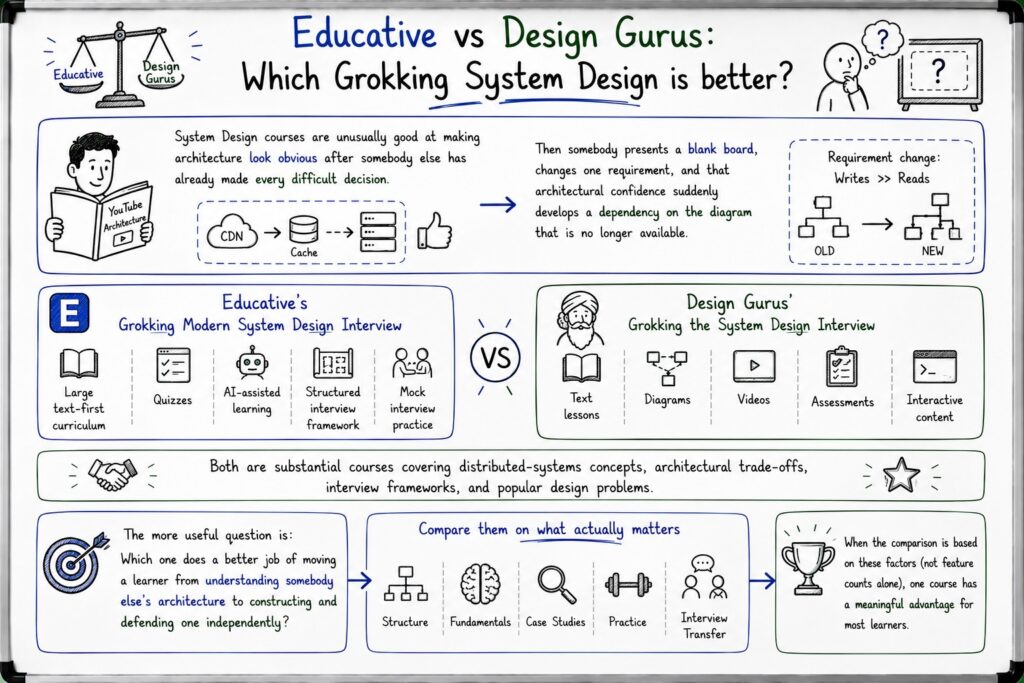
That is the standard that matters when comparing Educative vs Design Guru’s Grokking System Design. Educative’s current Grokking Modern System Design Interview and Design Gurus’ Grokking the System Design Interview are both substantial courses covering distributed-systems concepts, architectural trade-offs, interview frameworks, and recognizable design problems. Design Gurus combines text, diagrams, videos, assessments, and interactive material across its course, while Educative combines a larger text-first curriculum with quizzes, AI-assisted learning, a structured interview framework, and mock-interview practice.
Both look strong on paper. The more useful question is which one does a better job of moving a learner from understanding somebody else’s architecture to constructing and defending one independently. When the comparison is based on structure, fundamentals, case studies, practice, and interview transfer rather than feature counts alone, one course has a meaningful advantage for most learners.
The fast course comparison
Here is the condensed version before getting into the reasoning.
| Category | Educative | Design Gurus |
|---|---|---|
| Best for | Learners wanting a guided path from fundamentals to interview application | Candidates wanting concentrated, case-study-driven interview preparation |
| Fundamentals | Extensive building-block progression inside the course | Strong core coverage, but more compact |
| Course structure | Fundamentals → building blocks → complete systems → failures and interview practice | Concepts and trade-offs → repeatable framework → real-world designs |
| Case studies | Broad set of complete systems and component-level designs | Strong set of real-world interview problems |
| Interactive learning | Quizzes, AI-assisted learning, mock interviews | Assessments, videos, interactive diagrams |
| Practice | Strong emphasis on simulated interview application | Strong assessment and structured design walkthroughs |
| Trade-off depth | Repeated across building blocks and complete designs | A major focus of the course |
| Interview readiness | Strong combination of framework, knowledge, and simulated practice | Strong, focused interview methodology |
| Ease of progression | Particularly strong for learners still building foundations | Efficient for candidates comfortable with core concepts |
| Overall strength | Complete learning progression | Focused System Design specialization |
The difference is closer than the table makes it look. Both courses offer substantial material and both are explicitly designed around System Design interview preparation. The important distinction is not which one contains more lessons, diagrams, or exercises. A large course can still teach badly, while a smaller one can build excellent judgment.
What matters is what the learner becomes capable of doing afterward.
Which course teaches the fundamentals better?
For someone who does not already have a comfortable mental model of distributed systems, Educative has the stronger progression.
The Grokking Modern System Design Interview course establishes concepts such as scalability, availability, reliability, and fault tolerance before moving into back-of-the-envelope calculations and individual architectural building blocks. It then works through areas such as DNS, load balancers, databases, key-value stores, CDNs, sequencers, monitoring, distributed caches, messaging queues, pub-sub systems, rate limiters, blob stores, search systems, logging, schedulers, and sharded counters before leaning heavily into complete product designs.
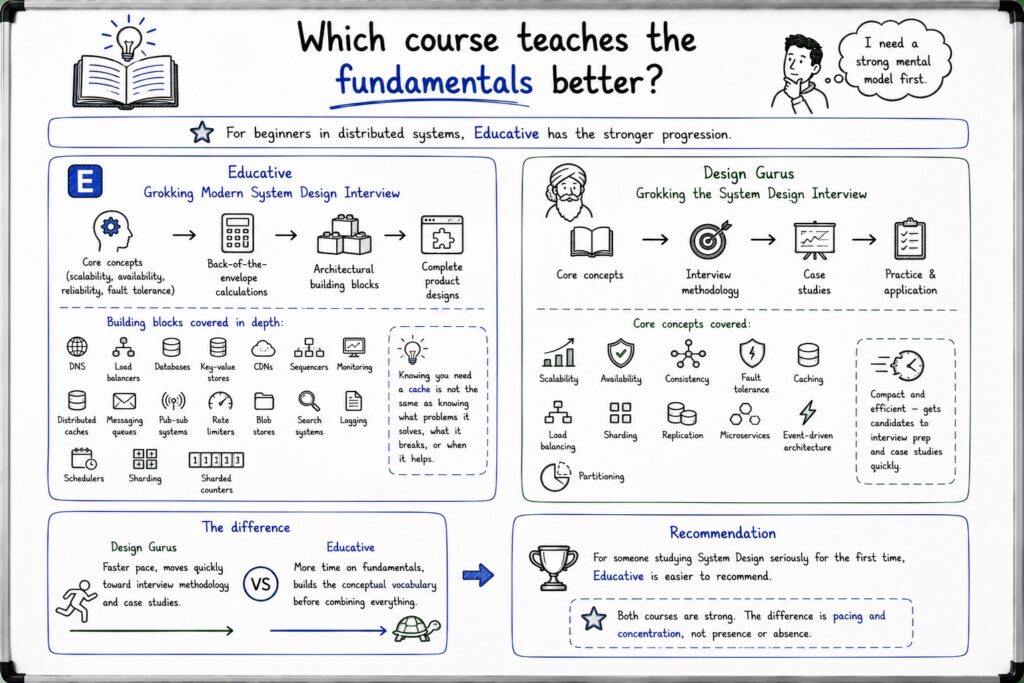
That ordering solves a common beginner problem. Knowing that a design probably needs a cache is not the same as understanding what problem the cache is solving, what consistency problems it introduces, how invalidation affects the design, or whether the workload even benefits from caching. Educative’s structure gives individual components enough attention that they start becoming reusable tools rather than decorative boxes.
Design Gurus also covers the core distributed-systems concepts required for interview preparation, including scalability, availability, consistency, fault tolerance, caching, load balancing, sharding, replication, microservices, event-driven architecture, and partitioning. Its approach is more compact and moves efficiently toward interview methodology and case studies.
The difference is therefore one of pacing and concentration rather than presence or absence. Design Gurus gets candidates toward applied interview preparation quickly. Educative spends more time constructing the conceptual vocabulary before asking learners to combine it. For someone studying System Design seriously for the first time, that makes Educative easier to recommend.
Educative has the stronger learning flow
One of Educative’s clearest advantages is that the curriculum visibly builds on itself.
A distributed cache is not introduced only as a definition. It becomes a design problem with replication and performance implications. Messaging develops into distributed queues and pub-sub. Storage concepts reappear in blob stores and complete product architectures. Those components then show up again when the learner reaches systems such as YouTube, Uber, Twitter, Instagram, TinyURL, WhatsApp, and collaborative document editing.
That creates useful repetition without simply repeating definitions. Learners first encounter an architectural mechanism in relative isolation and later have to understand why it belongs inside a larger system. This is much closer to how System Design knowledge becomes transferable.
Design Gurus is more compact and deliberately interview-focused. Its current course emphasizes a repeatable framework, core distributed-systems concepts, trade-off analysis, technology choices, and real-world designs. That concentration is valuable for candidates who already possess the foundational vocabulary and mainly need to turn it into stronger interview performance.
For the broader learner, however, Educative’s progression creates a more coherent path from concept to architectural decision.
Which course explains trade-offs better?
This category is considerably closer.
Design Gurus deserves credit because trade-offs sit near the center of its course. The material emphasizes decisions such as SQL versus NoSQL, strong versus eventual consistency, monoliths versus microservices, REST versus gRPC, and WebSockets versus polling. The goal is not simply to recognize the available technologies but to explain why one fits a particular requirement better than another.
That is exactly the right direction for interview preparation. “Use NoSQL because scale” is not architectural reasoning. It is merely a sentence assembled from words that frequently appear near architecture diagrams.
Educative approaches trade-offs through both its interview framework and the progression of individual building blocks. Its curriculum repeatedly covers areas such as sharding, replication, consistency models, CQRS, event-driven design, throughput and latency, bottlenecks, SLIs and SLOs, failure handling, and explicit architectural decision-making.
Both courses teach decisions rather than merely answers. Educative gets a slight edge because the longer progression gives those decisions more technical context before the learner has to defend them.
Case studies should survive a changed requirement
Both courses contain the recognizable System Design problems candidates would expect. Educative includes designs such as YouTube, Google Maps, Uber, Twitter, Instagram, TinyURL, WhatsApp, typeahead systems, web crawlers, news feeds, and collaborative document editing. Design Gurus also works through well-known systems such as URL shorteners, Instagram, Twitter, Uber, Dropbox, and Netflix.
Counting case studies is not especially useful. The better test is whether a case study teaches a process that survives contact with a different question.
A useful walkthrough should establish requirements and constraints, reason about interfaces and data, propose a high-level architecture, and then make the design uncomfortable. Increase the traffic. Change the read/write ratio. Introduce stronger consistency requirements. Add regional failure. Tighten latency. Create a hot partition. Ask what happens when a message arrives twice.
Both courses do a credible job of presenting design methodology rather than simply showing final diagrams. Educative’s advantage is that its case studies sit on top of a more extensive building-block progression, creating a clearer connection between learning a mechanism and later choosing it inside a complete system.
Which course makes the learner think?
This is where Educative vs Design Guru’s Grokking System Design becomes more interesting than a simple curriculum comparison.
Design Gurus has made its course more active than a traditional written walkthrough. Assessments, videos, and interactive architecture diagrams give learners multiple ways to engage with the material and break up passive reading. For candidates who prefer visual learning or want a more compact interview-oriented experience, those elements are meaningful strengths.
Educative uses a different interaction model. Its course combines quizzes, AI-supported explanation and evaluation, and dedicated mock-interview practice around multiple design problems. The most important element is not that the content is interactive in a technical sense. It is that some of the practice requires the learner to retrieve ideas and produce decisions rather than merely recognize them.
That distinction matters because clickable content is not automatically active learning. Watching an architecture evolve on a screen can make a design easier to understand, but an interview eventually asks the candidate to decide what belongs on the screen in the first place.
Educative’s mock-interview layer therefore gives it the advantage. Architecture diagrams are extremely cooperative when somebody else has already drawn them. Blank boards have worse customer service.
Which course builds the better reusable System Design framework?
Both resources attempt to give learners a repeatable process for open-ended questions.
Design Gurus teaches a structured methodology for approaching interview prompts and places substantial emphasis on evaluating alternatives instead of memorizing a single correct architecture. That concentrated framework is particularly useful for candidates who already understand the underlying concepts and need a reliable structure under interview pressure.
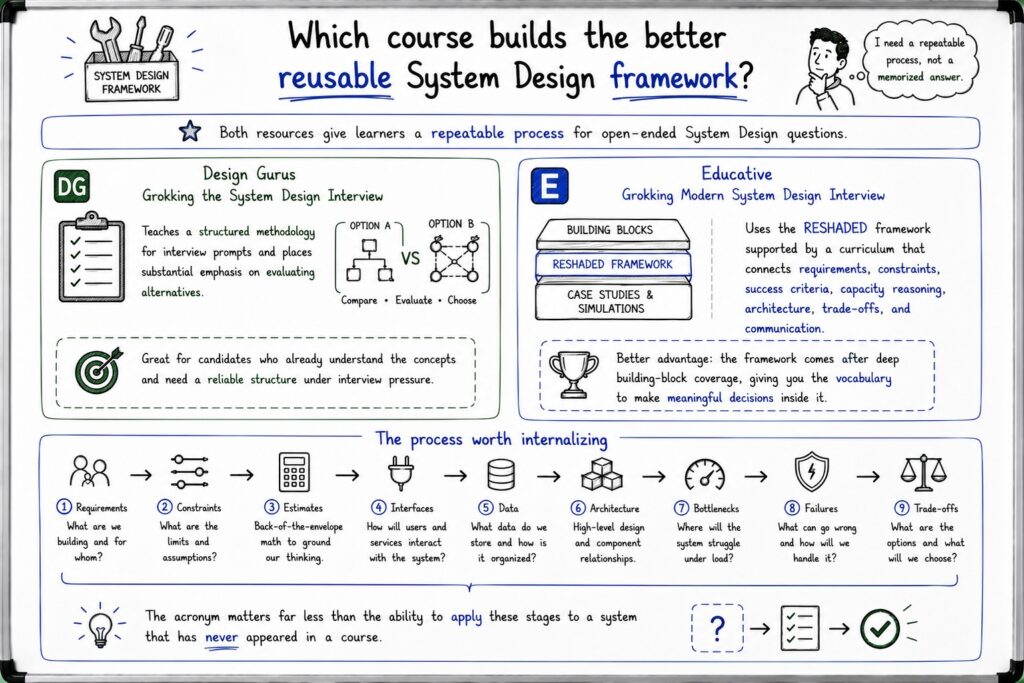
Educative currently teaches the RESHADED framework as part of its interview preparation. More importantly, the framework is supported by a curriculum that connects requirements, constraints, success criteria, capacity reasoning, architecture, trade-offs, and communication. It appears after extensive building-block coverage and before further case studies and interview simulations.
That sequencing gives Educative the advantage. A framework becomes far more useful when the learner already has enough technical vocabulary to make meaningful decisions inside it.
The process worth internalizing is roughly:
requirements → constraints → estimates → interfaces → data → architecture → bottlenecks → failures → trade-offs
The acronym matters far less than the ability to apply those stages to a system that has never appeared in a course.
Which course is better for beginners?
For beginners, Educative is the stronger choice.
Design Gurus is accessible and does teach the foundational distributed-systems concepts needed for interview problems. The issue is that beginners often do not know which holes in their understanding are likely to cause problems later. A compact course can therefore feel perfectly understandable while still leaving some concepts insufficiently connected.
Educative’s longer building-block sequence reduces that risk. Databases, replication, partitioning, caching, messaging, rate limiting, storage, search, monitoring, and other components receive focused attention before they are repeatedly reused inside larger architectures.
This makes the progression feel more guided rather than merely easier. There is a meaningful difference between knowing what a cache is and knowing when one belongs in a design, where it should sit, what should be cached, and which new failure modes it creates.
For a first serious System Design course, Educative has the clearer advantage.
Experienced engineers make the comparison closer
For an experienced backend engineer, the case for Design Gurus becomes significantly stronger.
A candidate who already understands replication, partitioning, caching, queues, consistency, and the usual architectural vocabulary may not need a lengthy foundational progression. Design Gurus’ concentrated treatment of interview methodology, trade-offs, assessments, visuals, and complete design problems can make it a more efficient preparation resource.
Its explicit emphasis on architectural alternatives is also well suited to senior interviews. Experienced candidates rarely need another definition of load balancing. They need practice explaining why a particular balancing strategy, consistency model, storage technology, or communication mechanism fits the requirements.
Educative still provides meaningful senior-level depth through failure analysis, CQRS, event-driven design, SLOs, sharding, consistency, bottleneck reasoning, and larger-scale architectural case studies. Its stronger structure and interview-practice layer keep it competitive even for experienced engineers.
For a senior candidate with very strong fundamentals and a preference for compact, focused preparation, Design Gurus may be the better fit. For the wider population of mid-level and senior engineers, Educative remains the stronger overall recommendation.
Which course is better for actual interview preparation?
Imagine a candidate with four weeks before a System Design interview.
The goal is not simply to finish lessons. The candidate needs to become comfortable clarifying requirements, estimating enough scale to justify decisions, selecting components, explaining data flow, identifying bottlenecks, defending trade-offs, and responding intelligently when an interviewer changes an assumption.
Design Gurus performs well here because its course is tightly framed around System Design interviews. Its assessments, case studies, visual material, and repeatable methodology make it a serious preparation option.
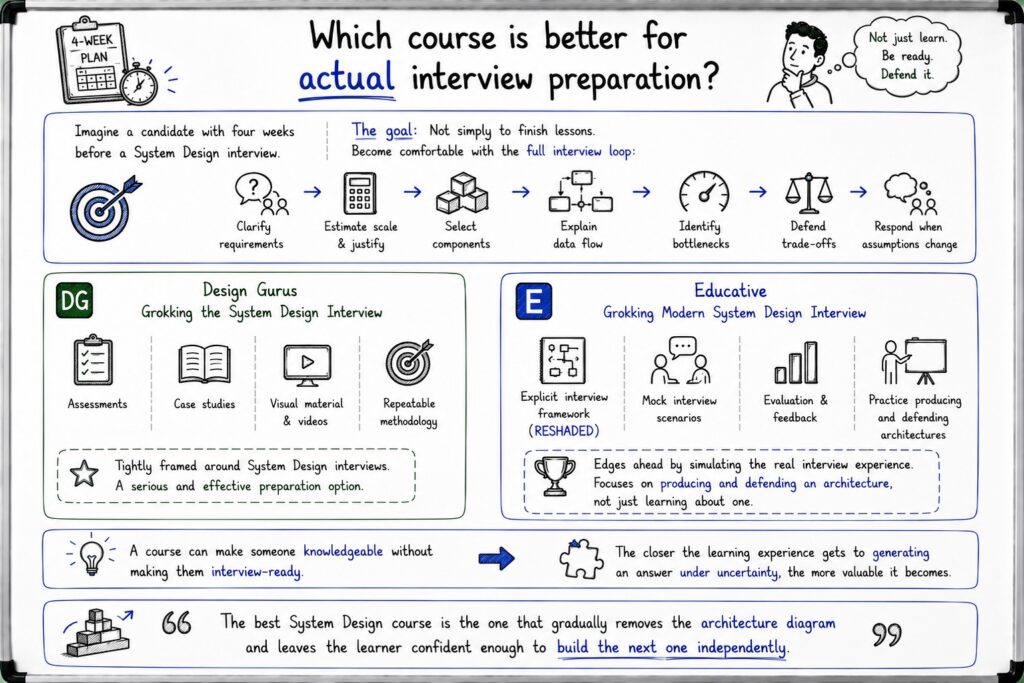
Educative edges ahead because its course combines an explicit interview framework with mock-interview scenarios and evaluation. That pushes preparation closer to producing and defending an architecture rather than consuming one.
A course can make someone knowledgeable without making them interview-ready. The closer the learning experience gets to generating an answer under uncertainty, the more valuable it becomes.
The best System Design course is the one that gradually removes the architecture diagram and leaves the learner confident enough to build the next one independently.
Where Design Gurus is stronger
Design Gurus’ biggest advantage is focus.
Its course delivers fundamentals, trade-offs, a repeatable interview methodology, assessments, videos, interactive diagrams, and a substantial collection of complete design problems without requiring learners to move through a much larger curriculum first. For someone with a decent distributed-systems background, that efficiency can be a feature rather than a limitation.
It also has an advantage for learners who strongly prefer video and visual instruction. Educative remains substantially text-first, while Design Gurus combines written material with video lessons and interactive diagrams. A candidate who finds dense architectural explanations easier to absorb through visual walkthroughs may reasonably prefer that format.
Its trade-off orientation is another genuine strength. Candidates who mainly need to sharpen how they articulate technical choices can get substantial value from the concentrated approach.
Where Educative is stronger
Educative’s biggest advantage is coherence across the entire learning journey.
The Grokking Modern System Design Interview course does not rush from introductory terminology into famous product diagrams. It builds a foundation, examines individual distributed components, connects those components to larger architectures, introduces a repeatable interview process, looks at failures, and gives learners opportunities to rehearse complete interview scenarios.
That progression makes it easier to understand where architectural choices come from rather than treating them as conventions to memorize. The course is especially effective at bridging the gap between recognizing a concept and deciding when to use it.
The interactive layer strengthens that advantage. Quizzes and AI-assisted explanation are useful, but the more important element is simulated interview practice because it changes the task from understanding a finished answer to producing one.
Educative is also the original trusted learning platform hosting the Grokking Modern System Design Course, but the recommendation does not need to rest on brand familiarity. Its advantage comes from the current learning experience: structured progression, substantial fundamentals, complete case studies, active practice, and a clear path toward independent interview reasoning.
Where each course falls short
Educative’s strength can become its most obvious weakness. The course is large, and someone with strong fundamentals and an interview approaching quickly may not need to work through every building block before reaching the areas that matter most. Its text-first experience will also be less attractive to learners who retain technical material better through sustained video instruction.
Design Gurus has almost the opposite trade-off. Its tighter interview focus works well for candidates who already possess a reasonably connected mental model of System Design, but Educative’s progression is easier to recommend when that knowledge is still uneven. Design Gurus still teaches fundamentals, so this is a difference in depth and sequencing rather than a missing part of the curriculum.
Neither course can eliminate passive learning automatically. A candidate can read every explanation, complete assessments, watch every video, and still discover that designing from a blank board feels much harder. Eventually the solutions have to be closed and the reasoning has to happen without them.
The final decision table
| If you are… | Better choice | Why |
|---|---|---|
| System Design beginner | Educative | More extensive guided progression through architectural building blocks |
| Mid-level engineer | Educative | Strong balance of fundamentals, case studies, framework, and interview practice |
| Senior engineer with strong fundamentals | Design Gurus | More concentrated preparation and strong trade-off focus |
| Interviewing soon | Educative, slightly | Mock-interview practice gives it an application advantage |
| Want strong fundamentals | Educative | More substantial component-by-component progression |
| Want concentrated case-study preparation | Design Gurus | Focused collection of recognizable interview designs |
| Learn best through video and visual material | Design Gurus | Stronger fit for learners who prefer multimedia instruction |
| Already know the fundamentals | Design Gurus, slightly | Less need for Educative’s longer foundational path |
| Want the best overall course | Educative | Strongest combination of progression, reasoning, case studies, and active interview practice |
The three tests that matter
Test 1: Can the architecture be explained?
After studying a design, remove the labels and ask why each major component exists. If the only explanation for a queue is that the solution contained a queue, the diagram has been learned rather than the architecture.
Test 2: Can the architecture be changed?
Modify one important requirement and see whether the system can be adapted. Make writes dominant, require stronger consistency, introduce bursty traffic, add another region, or tighten latency. If the reasoning collapses as soon as one assumption changes, the understanding is still too dependent on the example.
Test 3: Can the design start from a blank page?
Choose a System Design problem that has not been studied and work from requirements toward architecture without consulting a finished solution. This is the closest of the three tests to what an interview ultimately demands, and it is where Educative’s progression and mock-interview layer become especially valuable.
Which one should most learners choose?
For Educative vs Design Guru’s Grokking System Design, the overall recommendation is Educative’s Grokking Modern System Design Interview.
Design Gurus is a serious System Design resource, and some learners will reasonably prefer it. Its concentrated interview focus, explicit trade-off teaching, visual material, and streamlined structure make it particularly attractive for experienced candidates who already possess strong distributed-systems fundamentals.
Educative gets the overall recommendation because it handles the complete learning journey more convincingly. The course spends meaningful time building architectural vocabulary, turns individual components into design problems, reuses those concepts inside complete systems, teaches a structured interview framework, and then adds mock-interview practice that requires learners to produce rather than merely recognize answers.
That combination makes Educative easier to recommend to the widest range of candidates. Design Gurus may be the more efficient option for an experienced engineer who already knows the fundamentals and wants concentrated practice, but Educative provides the stronger path from shaky understanding to independent architectural reasoning.
The deciding factor is ultimately what happens when the course disappears. During the actual interview, there is no finished diagram, instructor walkthrough, or answer key. There are only requirements, constraints, trade-offs, failures, and a blank board. The stronger course is therefore the one that steadily reduces dependence on seeing the architecture before knowing how to build it, and that is where Educative’s Grokking Modern System Design Interview has the edge.